
Silver prices can change throughout the trading day, and knowing the current spot price is only the first step in understanding what your silver is worth. Whether you own sterling silver jewelry, inherited silverware, American silver coins, bullion bars, or scrap silver, the actual value depends on more than weight alone.
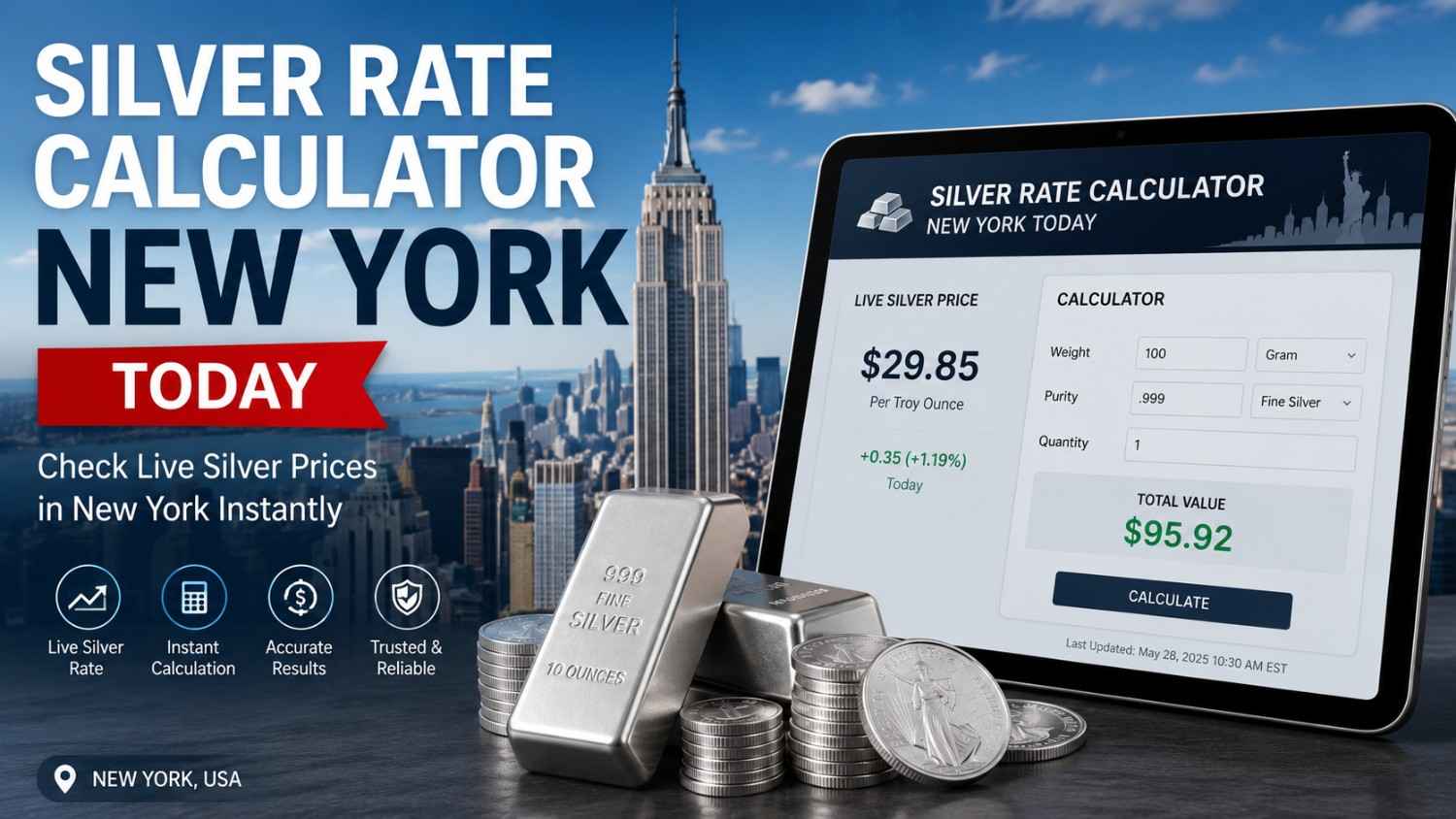
Our Silver Rate Calculator for New York helps you estimate the metal value of silver using its weight, purity, and the spot price per troy ounce. You can also explore potential selling prices, compare dealer offers, estimate buying premiums, and understand the difference between silver melt value and collectible value.
This guide is designed for New York residents who want practical answers before buying, selling, or evaluating silver. All calculations use US dollars (USD), and the calculator allows you to enter the silver spot price you want to use.
Use the calculator below to estimate the value of your silver based on its weight and purity. Select your preferred measurement unit, enter the current silver spot price per troy ounce, and calculate the estimated melt value.
Silver Rate Calculator
| Silver Type | Purity | Price / Gram | Price / Troy Oz |
|---|
The result represents the estimated value of the actual silver content, not a guaranteed dealer offer or retail selling price. Jewelry, collectible coins, and branded silver products may have additional value beyond their raw metal content.
Today’s Silver Rate in New York: Understanding the Spot Price
The silver spot price is the market reference price for silver available for immediate delivery under the relevant market conventions. It is commonly quoted in US dollars per troy ounce.
New York buyers and sellers may see different prices depending on the data provider, market session, bid-ask spread, and product being traded.
Before using a silver price in a calculation, check:
- Whether the displayed price is a bid, ask, midpoint, or reference price.
- The exact date and time of the quotation.
- Whether the price is per troy ounce or another weight unit.
- Whether the quotation includes a dealer premium.
- Whether the price is delayed or updated in real time.
Silver spot prices are not the same as the prices charged by coin shops or bullion dealers. A retailer may sell a silver bar above spot because of manufacturing, distribution, inventory, and business costs. A buyer purchasing scrap silver may offer less than melt value to account for refining costs, risk, and profit margins.
For a reliable market reference, compare recognized precious-metals market data providers and check their timestamps. The London Bullion Market Association (LBMA) publishes precious-metals benchmark information, while COMEX silver futures provide a separate exchange-traded market reference. These prices should not automatically be treated as identical to a local dealer’s transaction price.
How to Calculate Silver Value
The most important factors in estimating silver value are:
- Total item weight.
- Silver purity or fineness.
- Current silver spot price.
- Any premium, discount, or selling fee.
The basic calculation is:
Pure Silver Weight = Total Item Weight × Purity
Estimated Melt Value = Pure Silver Weight in Troy Ounces × Silver Spot Price per Troy Ounce
For example, imagine you have a sterling silver bracelet weighing 100 grams, and you want to calculate its value using an illustrative silver spot price of $50 per troy ounce.
Sterling silver contains 92.5% silver.
- Total weight: 100 grams
- Silver purity: 92.5%
- Pure silver content: 92.5 grams
- Pure silver weight in troy ounces: approximately 2.974 ounces
- Illustrative spot price: $50 per troy ounce
Estimated melt value:
2.974 × $50 = approximately $148.70
This is a hypothetical calculation, not a statement of today’s silver market price.
A dealer’s offer could be lower or higher depending on the item’s condition, buyer demand, collectible value, and other factors.
Silver Price Per Troy Ounce, Gram, Kilogram and Pennyweight
Precious metals are generally measured in troy ounces rather than ordinary household ounces. This distinction matters when checking a silver quotation or weighing jewelry.
Here are the standard conversions:
| Weight unit | Equivalent |
|---|---|
| 1 Troy Ounce | 31.1034768 grams |
| 1 Gram | 0.0321507466 troy ounces |
| 1 Kilogram | 32.1507466 troy ounces |
| 1 Pennyweight (dwt) | 1.55517384 grams |
| 1 Troy Ounce | 20 Pennyweights |
| 1 Grain | 0.06479891 grams |
| 1 Regular Ounce | 28.349523125 grams |
A regular ounce is approximately 9.7% lighter than a troy ounce.
For example, if a seller quotes a price per troy ounce but you calculate the value using a regular ounce, your estimate will be incorrect.
This is especially important when weighing silver jewelry, small bars, coins, and scrap metal.
Silver Purity Guide: How Much Is Your Silver Really Worth?
Not every silver-colored item contains the same amount of actual silver. The purity stamp or manufacturer’s specification can help identify its silver content.
| Silver type | Purity | Silver content |
|---|---|---|
| Fine Silver | .999 | 99.9% |
| Britannia Silver | .958 | 95.8% |
| Sterling Silver | .925 | 92.5% |
| Coin Silver | .900 | 90% |
| European Silver | .835 | 83.5% |
| European Silver | .800 | 80% |
| 40% Silver Coin | .400 | 40% |
What Is 999 Fine Silver?
999 silver contains approximately 99.9% pure silver. It is commonly used in investment-grade bullion bars and certain silver coins.
If you own a genuine 999 silver bar, its melt value is generally close to the spot value of its fine silver content. However, retail and resale prices may differ because of premiums, brand recognition, condition, and buyer demand.
What Is 925 Sterling Silver?
Sterling silver is an alloy containing 92.5% silver and typically 7.5% other metals, commonly copper.
It is widely used in:
- Rings and necklaces.
- Bracelets and earrings.
- Silver chains.
- Flatware and serving pieces.
- Decorative household objects.
A 100-gram sterling silver item does not contain 100 grams of pure silver. Its theoretical fine silver content is 92.5 grams before accounting for non-silver components or any measurement issues.
What Do 900, 835 and 800 Silver Stamps Mean?
These numbers indicate the approximate silver fineness in parts per thousand.
For example:
- 900 means 90% silver.
- 835 means 83.5% silver.
- 800 means 80% silver.
Older European silverware and imported household items may carry these marks.
However, a stamp alone is not conclusive proof of authenticity. Plating, counterfeit marks, repairs, and mixed materials can affect the actual silver content.
Sterling Silver 925 Value Calculator
If you own sterling silver jewelry or household items, you can estimate the metal value by multiplying the item’s weight by 0.925 and then converting the resulting pure silver weight into troy ounces.
For example:
A 250-gram sterling silver serving set contains:
250 × 0.925 = 231.25 grams of theoretical pure silver.
231.25 ÷ 31.1034768 = approximately 7.434 troy ounces.
If the chosen spot price is $50 per troy ounce:
7.434 × $50 = approximately $371.70.
The result is a theoretical melt-value estimate. Actual recoverable silver may differ if the item contains solder, attached components, stones, handles, or non-silver materials.
US Silver Coin Melt Value: What New York Collectors Should Know
American silver coins are a special category because their value may include both precious-metal content and collector demand.
Some older US coins contain substantial silver, while most modern circulating US dimes, quarters, and half dollars are copper-nickel clad rather than silver.
Common silver coin categories include:
90% Silver Coins
Many US dimes, quarters, and half dollars minted before 1965 contain 90% silver and 10% copper.
Examples include:
- Mercury Dimes.
- Roosevelt Dimes dated 1946–1964.
- Washington Quarters dated 1932–1964.
- Walking Liberty Half Dollars.
- Franklin Half Dollars.
- Kennedy Half Dollars dated 1964.
For circulated 90% silver coinage, a commonly used estimate is approximately 0.715 troy ounce of silver per $1 face value. The original standard silver content is higher, but circulation wear reduces the average actual weight.
This is an estimate for ordinary circulated coinage, not a substitute for weighing and testing individual coins.
40% Silver Kennedy Half Dollars
Kennedy Half Dollars dated 1965–1970 generally contain 40% silver. Their silver content is different from 1964 Kennedy Half Dollars.
Do not use a 90% silver formula for these coins.
Morgan Silver Dollars
Morgan Dollars were produced from 1878 to 1904 and again in 1921.
A standard Morgan Dollar weighs 26.73 grams and contains approximately 0.7734 troy ounce of pure silver.
Peace Silver Dollars
Peace Dollars were minted between 1921 and 1935.
Standard Peace Dollars also contain approximately 0.7734 troy ounce of pure silver.
Why Coin Melt Value Is Not Always the Selling Price
A rare coin may be worth considerably more than its silver content.
Collectors may pay premiums for:
- Rare dates.
- Scarce mint marks.
- High grades.
- Original surfaces.
- Low mintage figures.
- Important historical varieties.
Before selling a potentially collectible coin for its melt value, consider getting it evaluated by a qualified coin dealer or professional grading specialist.
The US Mint and recognized numismatic references are useful starting points for checking coin specifications.
Silver Jewelry, Flatware and Scrap Silver Value
Not every silver item is bullion. Many people in New York may own old jewelry, inherited silverware, serving sets, candlesticks, trays, or decorative objects.
The valuation method depends on the item.
Silver Jewelry
Look for marks such as:
-
- Sterling.
Remember that gemstones, clasps, springs, solder, and non-silver attachments can affect the actual metal weight.
A jewelry scale can help measure total weight, but a professional assessment may be needed to establish fine silver content accurately.
Silver Flatware and Silverware
Older flatware may be made from solid sterling silver, coin silver, or silver plating.
Common markings include:
- Sterling.
- EPNS.
- Silverplate.
EPNS generally indicates electroplated nickel silver, not solid sterling silver.
Silver-plated objects may have a valuable appearance but usually contain only a thin silver coating. Their scrap value should not be calculated as if the entire object were solid silver.
Silver-Plated Items
A silver-plated tray, spoon, or decorative object may contain very little recoverable silver relative to its total weight.
Do not multiply the entire object’s weight by the spot price. That would significantly overestimate its value.
Mixed and Damaged Silver Items
Broken jewelry may still have metal value if it is genuine silver. However, attached stones, steel springs, plastic parts, solder, and other materials must be considered.
If purity or construction is uncertain, have the item tested by a reputable professional.
How Much Do Silver Dealers Pay in New York?
The melt value of silver and the amount a dealer offers are two different figures.
A buyer may deduct a percentage from the theoretical melt value to account for refining, handling, business costs, price volatility, and resale risk.
For example, suppose your verified silver melt value is $500.
Illustrative dealer offers might look like this:
| Payout percentage | Estimated offer |
|---|---|
| 60% | $300 |
| 70% | $350 |
| 80% | $400 |
| 90% | $450 |
| 95% | $475 |
| 100% | $500 |
These percentages are hypothetical examples, not guaranteed New York dealer rates or an industry-wide standard.
A dealer may offer more for recognizable bullion, desirable coins, or collectible items. Scrap jewelry may receive a different offer.
Before accepting an offer, ask:
- Is the quoted amount based on the current spot price?
- What purity has the buyer assigned to the item?
- Is the buyer paying for the total item weight or fine silver weight?
- Are there testing, refining, shipping, or other fees?
- Is the quoted payout fixed or subject to another inspection?
- Will you receive a written transaction receipt?
Getting multiple written offers can help you understand the difference between a fair market estimate and an individual buyer’s pricing policy.
Silver Buying Cost: Spot Price, Premium and Additional Charges
If you are purchasing silver in New York, the spot price is not necessarily the final amount you pay.
The retail purchase price may include:
- Silver spot value.
- Dealer premium.
- Manufacturing costs.
- Distribution costs.
- Shipping and insurance.
- Applicable sales tax.
- Payment processing charges, if applicable.
For example, assume a one-troy-ounce silver bar has an illustrative spot value of $50 and the dealer charges a $5 premium.
The pre-tax purchase price would be $55.
If a shipping charge applies, that must also be included when calculating the final cost.
What Is a Silver Premium?
A premium is the amount charged above the underlying metal value.
Premiums can vary depending on:
- Product size.
- Brand and mint.
- Availability.
- Demand.
- Packaging.
- Retailer pricing.
- Market conditions.
A one-ounce silver coin may carry a different premium from a ten-ounce bar even when both contain comparable fine silver per ounce.
When comparing products, calculate the total cost per fine troy ounce rather than looking only at the advertised price.
New York Silver Sales Tax: Important Rules Before Buying
Sales tax treatment for precious-metal purchases in New York requires particular attention.
New York Tax Law §1115(a)(27) provides an exemption for certain qualifying precious-metal bullion transactions. However, the exemption has conditions.
According to New York State Department of Taxation and Finance guidance, qualifying investment bullion transactions generally require:
- An aggregate sale exceeding $1,000 on a single invoice.
- The bullion to remain in the same form when purchased.
- The transaction price to satisfy the applicable metal-value limits.
- The retailer to meet applicable registration requirements where required.
The historical department guidance identifies different pricing thresholds for silver coins and bars. For qualifying silver coins, the specified threshold is 140% of the greater of the applicable daily closing bullion price or face value. For bars and ingots, the specified threshold is 115% of the applicable daily closing bullion price.
These conditions matter. A purchase does not automatically become tax-exempt simply because the buyer intends to invest in silver.
Jewelry, fabricated decorative items, collectible products, storage services, and other transactions may be treated differently.
New York City and other local jurisdictions may also have applicable tax rules for taxable purchases.
Because tax law and administrative guidance can change, confirm the current treatment with the New York State Department of Taxation and Finance or a qualified tax professional before relying on an exemption.
Official references:
- New York State Department of Taxation and Finance: Precious Metal Bullion Sales Tax Memorandum.
- New York State Tax Law §1115: Exemptions from Sales and Use Taxes.
How to Sell Silver in New York: A Practical Checklist
Selling silver is easier when you prepare the items and information before visiting a dealer.
Step 1: Identify the Silver Type
Separate your items into categories:
- Fine silver bullion.
- Sterling silver jewelry.
- US silver coins.
- Silver flatware.
- Silver-plated items.
- Collectible coins.
Do not mix plated items with genuine silver.
Step 2: Check the Purity Mark
Look for markings such as 999, 925, Sterling, 900, 835, or 800.
If the item has no identifiable stamp, do not assume its purity.
Step 3: Weigh Your Items
Use a reliable digital scale and record the weight in grams or another consistent unit.
If you have several items, weigh and record them separately.
Step 4: Calculate the Melt Value
Enter the verified purity, weight, and spot price into the calculator.
Keep in mind that the result is a metal-value estimate rather than an automatic buyer quote.
Step 5: Check Collectible Value
Before selling older US coins, rare pieces, or branded silverware, consider whether their collectible or historical value exceeds their metal value.
Step 6: Compare Multiple Buyers
Request written offers from more than one reputable buyer.
Check their business identity, physical location, transaction terms, testing procedure, and payment method.
Step 7: Review the Final Payment
Make sure the final payment matches the agreed price after all disclosed fees and deductions.
Keep a receipt or written record of the transaction.
How to Check Whether a Silver Item Is Genuine
A hallmark can be useful, but it should not be the only test.
Here are several checks that may help:
Hallmark inspection: Look for a clear maker’s mark and fineness stamp.
Magnet test: Silver is not strongly attracted to an ordinary magnet. However, a non-magnetic result does not prove that an item is genuine silver.
Weight and dimensions: Compare the item’s specifications with reliable references.
Professional testing: A qualified buyer may use X-ray fluorescence (XRF) equipment or other appropriate testing methods.
Plating inspection: Examine worn areas, edges, and joints for signs of a different underlying metal.
Avoid damaging or scratching valuable items just to perform a home test. Some tests can reduce an item’s collectible or resale value.
Silver Melt Value vs. Collectible Value
This is one of the most important distinctions for coin collectors and silver owners.
Melt value measures the estimated worth of the item’s recoverable precious-metal content.
Collectible value includes factors such as rarity, condition, historical significance, demand, provenance, and market availability.
For example, two silver coins may contain the same amount of silver but sell for very different prices because one is a rare date or has a higher collectible grade.
The same principle applies to antique sterling silver objects and designer pieces.
A calculator can estimate the metal value. It cannot independently authenticate a coin, establish its professional grade, or determine its full collector-market value.
What Affects Silver Prices?
Silver prices can move for several reasons.
Industrial Demand
Silver is used in electronics, solar technology, electrical applications, and other industrial products.
Changes in industrial demand can affect market expectations.
Investment Demand
Investors may buy silver bars, coins, or exchange-traded products as part of their portfolio strategy.
Changes in investment demand can influence prices.
US Dollar Movements
Silver is widely quoted in US dollars. Currency movements can influence the price that international buyers and sellers see.
Interest Rates and Economic Conditions
Market expectations about inflation, interest rates, economic growth, and monetary policy can affect precious-metals demand.
Mining Supply and Recycling
New mine production, recycling, refining capacity, and inventory levels can influence the physical supply of silver.
These factors do not move prices in a predictable or guaranteed direction. Silver can be volatile, and past performance does not establish future results.
Why New York Silver Prices May Differ From Dealer Quotes
A New York customer may see one spot price online and receive a different quotation at a local coin shop.
This is not necessarily an error.
The differences can arise from:
- Market quotation timing.
- Bid and ask spreads.
- Retail premiums.
- Dealer inventory.
- Product condition.
- Silver purity.
- Refining and handling expenses.
- Shipping and insurance.
- Collectible demand.
For example, a bullion dealer selling a new branded bar may charge a premium above spot, while a scrap buyer may offer a discount below melt value.
Compare like with like: the same weight, purity, product type, and transaction conditions.
Frequently Asked Questions
1. What is the Silver Rate Calculator New York used for?
It helps estimate the value of silver using weight, purity, and a silver spot price. It can be used for jewelry, bullion, coins, and scrap silver when the correct metal purity is known.
2. How much is one troy ounce of silver?
The value changes with the market. Enter a current, verified silver spot quotation into the calculator to estimate the value of one troy ounce.
3. How many grams are in one troy ounce of silver?
One troy ounce equals exactly 31.1034768 grams.
4. How do I calculate the value of 925 sterling silver?
Multiply the total weight by 0.925 to estimate the fine silver content. Convert the result into troy ounces and multiply by the chosen silver spot price.
5. Is sterling silver worth less than pure silver?
Yes, gram for gram, sterling silver has less fine silver than 999 silver because sterling silver contains 92.5% silver.
6. Do silver-plated items have melt value?
They may contain a small amount of silver coating, but their entire weight should not be treated as solid silver. Their scrap value is generally very different from sterling silver.
7. How much do silver dealers pay in New York?
There is no single guaranteed payout rate. Offers depend on purity, product type, market conditions, refining costs, dealer policies, and potential collectible value.
8. Are silver coins worth more than their melt value?
Some are. Rare dates, mint marks, high grades, and collectible demand may create additional value beyond the silver content.
9. Are old US quarters made of silver?
Many US quarters minted before 1965 contain 90% silver. Most modern circulating quarters are copper-nickel clad and do not have the same silver content.
10. How much silver is in a Morgan Dollar?
A standard Morgan Silver Dollar contains approximately 0.7734 troy ounce of pure silver.
11. What is the difference between an ounce and a troy ounce?
A regular ounce equals approximately 28.3495 grams, while a troy ounce equals approximately 31.1035 grams. Precious metals are commonly quoted using troy ounces.
12. Does New York charge sales tax on silver bullion?
Certain qualifying precious-metal bullion transactions may be exempt under New York Tax Law §1115(a)(27), subject to specific conditions. Not every silver purchase qualifies.
13. Can I calculate the value of silver jewelry by weight?
Yes, if you know the actual silver purity and account for non-silver components. The result is an estimated metal value, not necessarily the jewelry’s retail or resale value.
14. Is the calculator’s result the exact amount I will receive?
No. It is an estimate based on the inputs. A dealer may offer a different amount after testing the item, assessing condition, and considering costs and demand.
15. Should I sell silver based only on the spot price?
No. Check the actual silver content, potential collectible value, dealer payout, fees, and written offers before making a decision.
Final Thoughts: Calculate Before You Buy or Sell Silver
Understanding the difference between spot price, melt value, and dealer payout can help you make more informed decisions when dealing with silver in New York.
Whether you are evaluating a sterling silver bracelet, an old collection of American coins, inherited silverware, or investment bullion, start by confirming the weight and purity. Then use a current market reference to calculate the estimated fine silver value.
Our Silver Rate Calculator New York is designed to make that process easier by bringing weight conversion, purity calculations, and estimated silver valuation together in one place.
Always verify market quotations and compare actual dealer offers before completing a transaction. For rare or potentially collectible items, seek a qualified professional appraisal rather than relying solely on a melt-value estimate.
About the Author
Junaidul Islam writes practical online guides and develops digital calculators designed to help users understand everyday financial and purchasing decisions. His goal is to make complicated calculations easier to follow through transparent formulas, useful explanations, and accessible online tools.
Disclaimer: This calculator and article are provided for informational and educational purposes only. Silver prices fluctuate, and calculated values are estimates rather than guaranteed purchase or resale offers. NewYorkCalculator.com does not provide investment, tax, legal, or professional appraisal advice. Verify important transactions with qualified professionals and official sources.