
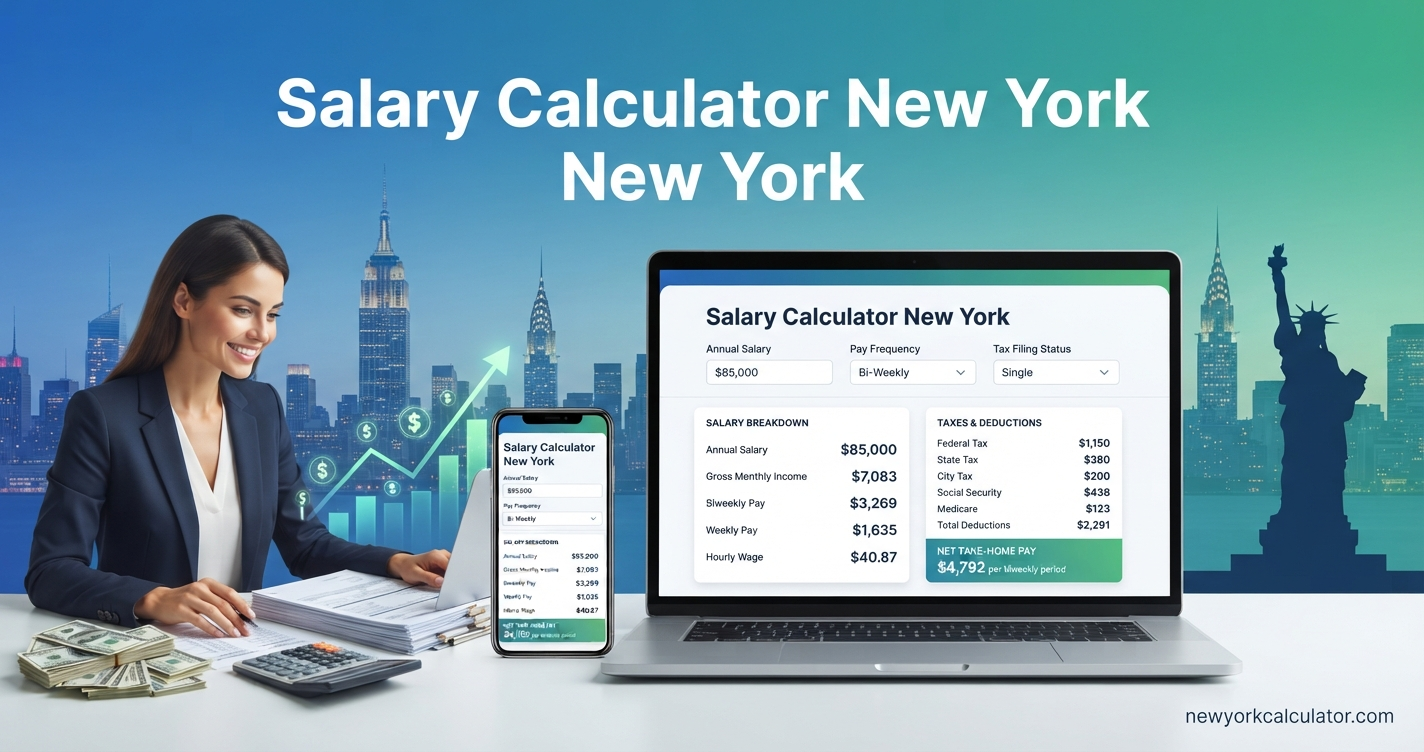
If you live or work in New York, your annual salary is only part of the story. The number that usually matters when you are planning rent, comparing job offers, deciding whether to work overtime, or building a monthly budget is your take-home pay — the amount left after estimated federal tax, New York State tax, Social Security, Medicare, local income tax where applicable, and other deductions.
New York Salary Calculator 2026
Estimate your New York take-home pay after federal tax, New York State tax, NYC or Yonkers tax, Social Security, Medicare and selected deductions.
Our New York Salary Calculator is designed to give you a practical 2026 estimate of your gross pay, taxes, deductions, and take-home income. You can start with an annual salary or hourly wage and adjust the calculation for pay frequency, filing status, overtime, bonus or commission, retirement contributions, health-related pre-tax deductions, and location.
For New Yorkers, location can make a meaningful difference. A person earning the same salary may have a different estimated take-home amount depending on whether they live in New York State outside the city, New York City, or Yonkers.
2026 estimate: This calculator is intended for personal planning and educational purposes. Your actual paycheck can differ because payroll withholding depends on your W-4 and New York withholding elections, benefits, credits, employer payroll system, and individual tax circumstances.
New York Salary Calculator
Use the calculator above to enter your income and personal payroll information.
You can calculate an estimate using:
- Annual salary
- Hourly wage
- Regular working hours
- Overtime hours
- Bonus or commission
- Pay frequency
- Federal filing status
- New York location
- 401(k) or similar pre-tax retirement contribution
- Health insurance and other pre-tax deductions
- Post-tax deductions
The result is designed to show more than one number. You can see an estimated annual take-home amount as well as monthly, semi-monthly, biweekly, weekly, daily, and hourly equivalents.
What Is a New York Salary Calculator?
A New York salary calculator estimates how much of your gross earnings may remain after common payroll taxes and deductions.
Your gross salary is the amount you earn before deductions.
Your net salary, also called take-home pay, is the amount remaining after applicable taxes and deductions.
A simplified calculation looks like this:
Gross income − estimated taxes − deductions = estimated take-home pay
However, a real New York paycheck can be more complicated.
Depending on your circumstances, your paycheck may involve:
- Federal income tax
- Social Security
- Medicare
- New York State income tax
- New York City resident income tax
- Yonkers tax rules
- New York Paid Family Leave contributions
- Certain disability-related payroll deductions
- Retirement contributions
- Health insurance premiums
- HSA or FSA contributions
- Other employer-specific deductions
That is why simply subtracting a fixed percentage from your salary is not a reliable way to estimate your paycheck.
How the New York Salary Calculator Works
The calculator starts with your gross earnings and then estimates the major payroll components.
1. Enter Your Pay
You can enter either:
Annual salary
or
Hourly wage
If you are paid hourly, the calculator can use your regular weekly hours and overtime hours to estimate annual gross earnings.
For a basic 40-hour schedule:
Hourly wage × 40 hours × 52 weeks = estimated annual regular earnings
Overtime can be calculated separately so you can see how additional working hours affect your income.
2. Select Your Pay Frequency
Your annual salary does not change simply because you are paid more frequently, but the amount appearing on each paycheck does.
Common payroll schedules include:
- Weekly — 52 paychecks
- Biweekly — 26 paychecks
- Semi-monthly — 24 paychecks
- Monthly — 12 paychecks
For example, a $78,000 annual salary paid biweekly has a gross paycheck of approximately:
$78,000 ÷ 26 = $3,000
That is the gross amount before taxes and deductions.
A semi-monthly schedule is different:
$78,000 ÷ 24 = $3,250
So a biweekly paycheck and a semi-monthly paycheck are not interchangeable even though both are commonly described as “twice a month” in casual conversation.
New York State vs NYC vs Yonkers
One of the most important details when calculating New York take-home pay is your location.
New York State
If you live in New York State outside New York City and Yonkers, your paycheck may generally include federal taxes, New York State income tax, Social Security, Medicare, and applicable payroll deductions.
New York City
New York City residents are subject to a separate NYC personal income tax in addition to New York State income tax.
For 2026, NYC personal income tax rates range from 3.078% to 3.876%, depending on taxable income and filing status.
That means two people with the same $100,000 salary can have different take-home pay if one is an NYC resident and the other lives elsewhere in New York State.
Yonkers
Yonkers has a different local tax mechanism. A Yonkers resident may be subject to a resident income tax surcharge based on New York State tax, while certain nonresidents working in Yonkers can be subject to a separate earnings tax.
New York State tax instructions distinguish between the Yonkers resident surcharge and the Yonkers nonresident earnings tax.
For that reason, the calculator should not treat “New York” as one identical tax location.
2026 New York Income Tax Rates
New York uses a progressive state income tax system.
For 2026, the state rates range from 3.9% to 10.9%, with the lower five rates reduced by 0.1 percentage point for 2026.
For a single filer, the 2026 taxable-income brackets are approximately:
| New York taxable income | Rate |
|---|---|
| Up to $8,500 | 3.9% |
| $8,501–$11,700 | 4.4% |
| $11,701–$13,900 | 5.15% |
| $13,901–$80,650 | 5.4% |
| $80,651–$215,400 | 5.9% |
| $215,401–$1,077,550 | 6.85% |
| $1,077,551–$5,000,000 | 9.65% |
| $5,000,001–$25,000,000 | 10.3% |
| Over $25,000,000 | 10.9% |
These are marginal tax brackets. Having income that reaches a higher bracket does not mean your entire salary is taxed at that highest rate.
That distinction is important when interpreting a salary calculator.
Federal Income Tax in 2026
New York workers also pay federal income tax based on their federal taxable income and filing circumstances.
For tax year 2026, the federal standard deduction is:
- $16,100 for Single
- $16,100 for Married Filing Separately
- $24,150 for Head of Household
- $32,200 for Married Filing Jointly
These figures come from the IRS’s 2026 tax guidance.
The federal tax system is also progressive, with 2026 rates of:
10%, 12%, 22%, 24%, 32%, 35%, and 37%.
For example, the 2026 22% bracket does not mean every dollar of a person’s salary is taxed at 22%. Only the taxable income falling within that bracket is taxed at that marginal rate.
This is one reason a take-home calculator is more useful than simply saying “New York taxes are X percent.”
Social Security and Medicare
Federal payroll taxes are another major part of a New York paycheck.
For 2026:
- Employee Social Security tax: 6.2%
- 2026 Social Security wage base: $184,500
- Employee Medicare tax: 1.45%
- Medicare has no regular wage-base ceiling
The IRS confirms these 2026 payroll figures.
Higher-income workers can also face the Additional Medicare Tax once applicable income exceeds the relevant threshold. A simple salary calculator may not model every tax situation, so high-income users should treat an online estimate as a planning figure rather than a tax return calculation.
New York Paid Family Leave in 2026
New York’s Paid Family Leave program is another important payroll item that is easy to overlook when estimating take-home pay.
For 2026, the employee contribution rate is 0.432% of gross wages, with a maximum annual contribution of $411.91.
This matters because a calculator that only subtracts federal tax, state tax, Social Security, and Medicare may slightly overstate the amount that actually reaches a worker’s bank account.
The exact treatment of payroll deductions can depend on the worker and employer situation, so the calculator should present this as an estimate rather than claiming to reproduce an employer’s payroll system perfectly.
401(k), HSA and Health Insurance Can Change Your Take-Home Pay
Your salary is not necessarily the same as your taxable wages.
For example, if you earn $90,000 but contribute part of your pay to a traditional 401(k), the contribution can affect the income subject to certain taxes.
The IRS increased the basic employee 401(k) contribution limit to $24,500 for 2026. The general catch-up contribution limit for eligible participants age 50 and older is $8,000, while a higher catch-up limit applies for certain participants ages 60 through 63.
Health insurance premiums and other qualifying pre-tax benefits can also affect payroll calculations.
This is why the calculator includes optional deduction fields instead of assuming that every employee has the same paycheck structure.
How Much Is $50,000 a Year in New York?
A $50,000 salary sounds straightforward, but your actual take-home amount depends on your filing status, location, deductions and payroll settings.
A useful way to think about the salary is:
$50,000 gross per year
÷ 12 = about $4,167 gross per month
÷ 26 = about $1,923 gross per biweekly paycheck
These are gross figures — not take-home pay.
Taxes and deductions will reduce the amount you actually receive.
If you are deciding whether a $50,000 job is enough for you, the better question is not only “What is the annual salary?”
Ask:
How much will I actually receive each month after taxes and deductions?
Then compare that amount with rent, transportation, food, health insurance, debt payments and savings.
How Much Is $75,000 a Year in New York?
A $75,000 salary equals approximately:
- $6,250 gross per month
- $2,885 gross biweekly
- $1,442 gross weekly
- About $36.06 gross per hour at 40 hours per week
Again, these are gross figures.
Your estimated take-home pay can be significantly different depending on whether you are single, married, have dependents, live in NYC, contribute to a 401(k), pay for health insurance, or have other deductions.
That is why using your actual circumstances in the calculator is more useful than relying on a generic salary table.
How Much Is $100,000 a Year in New York?
At $100,000 per year, the simple gross-pay conversions are:
- Annual: $100,000
- Monthly: about $8,333
- Semi-monthly: about $4,167
- Biweekly: about $3,846
- Weekly: about $1,923
- Hourly at 40 hours/week: about $48.08
But $100,000 gross is not $100,000 spendable income.
Federal income tax, New York State tax, Social Security, Medicare, possible NYC tax, Paid Family Leave and personal deductions can all reduce your actual paycheck.
For someone considering a $100,000 offer, the useful comparison is therefore:
$100,000 gross salary → estimated annual net → estimated monthly net
rather than simply comparing the advertised salary.
Salary Offer Comparison: Is a Raise Really Worth It?
One of the most useful ways to use a salary calculator is to compare two job offers.
Imagine you currently earn:
$75,000
and receive an offer for:
$90,000
The gross increase is:
$15,000
But you should not assume your spending power will increase by the full $15,000.
The additional income can produce additional federal and New York taxes.
The calculator can help you compare:
- Current gross salary
- New gross salary
- Estimated annual take-home
- Estimated monthly take-home
- Estimated biweekly take-home
- Tax difference
- Net increase
- Effective increase after estimated taxes
This is particularly useful when a new job also changes commuting costs, health insurance, retirement contributions or other benefits.
Desired Take-Home Salary Calculator
Sometimes people work backward.
Instead of asking:
“How much will I take home from a $90,000 salary?”
they ask:
“What salary do I need to take home $5,000 per month?”
That is a different problem.
A useful salary planning tool can start with a target monthly net amount and estimate the gross annual income required to reach that target under selected assumptions.
For example, someone planning a move to New York may decide that they need approximately $5,000 per month after estimated taxes and deductions.
The target-salary calculation can then help them evaluate job offers more realistically.
The result should always be treated as an estimate because the required gross salary can change with filing status, location, benefits, deductions and tax-law changes.
New York Salary vs Hourly Wage
Hourly workers often need a different calculation.
Suppose someone earns:
$30 per hour
and works:
40 hours per week
A simple annualized calculation is:
$30 × 40 × 52 = $62,400 gross annual wages
If the worker also averages five overtime hours per week, the result can be higher.
Overtime is particularly important because a salary comparison that ignores overtime can make two jobs look more similar than they really are.
Overtime and New York Salary
For many New York workers, overtime can represent a meaningful portion of annual income.
A useful calculator should let the user enter:
- Regular hourly wage
- Regular weekly hours
- Overtime hours
- Overtime multiplier
A common overtime calculation uses 1.5 times the regular hourly rate when the worker is legally entitled to overtime at that rate.
However, overtime eligibility and the applicable rules depend on the worker, employer, occupation and applicable law. A calculator should not assume that every salaried worker automatically receives overtime.
There is also an important 2026 federal development involving a deduction for certain qualified overtime compensation. The IRS explains that the federal law permits eligible individuals to deduct up to $12,500 of qualified overtime compensation, or $25,000 for married taxpayers filing jointly, subject to the applicable rules and limitations.
Because this is a tax-return provision with eligibility requirements, a basic paycheck calculator should not simply assume that all overtime is automatically tax-free.
Bonus and Commission Income
A salary is not always the complete picture.
Many New York workers receive:
- Annual bonuses
- Performance bonuses
- Sales commissions
- Tips
- Shift differentials
- Overtime
- Other supplemental compensation
Adding a bonus to your annual income can change your overall tax picture.
For example:
Base salary: $85,000
Bonus: $10,000
Total gross compensation: $95,000
The calculator can help you understand the estimated effect of that additional income on annual take-home pay.
Remember that payroll withholding on a bonus can look different from the final tax liability calculated on your tax return. A withholding amount is not necessarily the same thing as your final tax bill.
Pre-Tax vs Post-Tax Deductions
This is another area where generic salary calculators can become confusing.
Pre-tax deductions
Depending on the benefit and applicable rules, examples may include:
- Traditional 401(k)
- HSA
- Certain health insurance premiums
- Certain FSA contributions
Post-tax deductions
Examples may include certain:
- Roth retirement contributions
- Garnishments
- Other employer-specific deductions
The tax treatment is not identical for every benefit.
For that reason, the calculator should identify deductions separately rather than simply subtracting one large “deduction” number.
Gross Pay vs Take-Home Pay
This is one of the most important concepts for anyone comparing salaries.
Gross pay
The amount earned before taxes and deductions.
Net pay
The amount remaining after applicable taxes and deductions.
For example:
Gross annual salary: $90,000
The employee might have:
- Federal income tax
- New York State income tax
- Social Security
- Medicare
- NYC tax, if applicable
- Paid Family Leave
- Retirement contribution
- Health insurance
The remaining amount is the estimated take-home pay.
That is the figure you should use when building a realistic monthly budget.
Effective Tax Rate vs Marginal Tax Rate
These two numbers are often confused.
Marginal tax rate
The tax rate applied to the next dollar of taxable income within a particular bracket.
Effective tax rate
A broader percentage showing estimated total tax relative to the relevant income amount.
For example, a person may have a marginal federal tax rate of 22% while their overall federal income tax represents a substantially lower percentage of gross income.
A good salary calculator should show both concepts clearly instead of suggesting that someone’s entire salary is taxed at their highest marginal rate.
Why Two People With the Same Salary Can Have Different Take-Home Pay
Consider two employees who both earn $100,000.
Employee A:
- Single
- Lives outside NYC
- No retirement contribution
- No health deduction
Employee B:
- Single
- Lives in NYC
- Contributes to a traditional 401(k)
- Has pre-tax health deductions
Their paychecks can be different even though their salaries are identical.
That is why the question:
“How much does a $100,000 salary pay after tax in New York?”
does not have one universal answer.
The correct answer depends on the assumptions.
New York Salary Calculator for Job Seekers
If you are negotiating a job offer, don’t compare only the advertised salary.
Compare the complete compensation picture:
Salary
How much is the guaranteed base pay?
Bonus
Is it guaranteed, discretionary or performance-based?
Retirement
Does the employer offer a 401(k) match?
Health insurance
What will you pay from every paycheck?
Location
Will you become an NYC resident?
Commute
Will transportation costs increase?
Overtime
Is overtime available and are you eligible?
Pay frequency
Will you be paid weekly, biweekly or semi-monthly?
A $90,000 job with expensive insurance and a long commute may not provide the same practical value as another $90,000 job with better benefits.
How to Use the Calculator Before Moving to New York
If you are considering moving to New York, use the calculator before signing a lease.
Start with your expected salary.
Then select your likely location:
- New York State
- New York City
- Yonkers
Next, enter your filing status and expected deductions.
Then compare the estimated monthly take-home amount with:
- Rent
- Utilities
- Transportation
- Food
- Health costs
- Debt payments
- Childcare
- Savings
- Retirement contributions
This turns a salary number into a more realistic picture of your potential monthly finances.
New York Salary Calculator Limitations
No online paycheck calculator should promise to reproduce every person’s exact paycheck.
Your actual amount can differ because of:
- W-4 elections
- New York IT-2104 elections
- Tax credits
- Dependents
- Employer benefit plans
- Health insurance
- Retirement contributions
- HSA/FSA treatment
- Supplemental wages
- Multiple jobs
- Investment or other income
- Itemized deductions
- Tax-law changes
- Local tax circumstances
- Payroll adjustments
- Special tax provisions
The calculator is therefore best used as a planning and comparison tool, not as a substitute for your employer’s payroll department, a qualified tax professional, or your actual tax return.
How We Keep the Calculator Updated
Tax calculators become unreliable when they continue using old rates after a new tax year begins.
For this reason, the calculator should identify its tax year clearly.
This page is designed around 2026 tax-year assumptions and should be reviewed whenever IRS or New York State rules change.
For federal figures, the IRS publishes the annual inflation-adjusted tax brackets and standard deduction.
For payroll taxes, the IRS publishes current Social Security and Medicare rates and wage limits.
For New York Paid Family Leave, New York publishes the applicable annual employee contribution rate and maximum contribution.
New York State and New York City tax rules should also be reviewed whenever new tax-year schedules or legislation become available.
Methodology
The New York Salary Calculator uses a simplified annualized approach to estimate common payroll taxes and deductions.
The general calculation flow is:
1. Determine gross annual earnings
2. Add applicable overtime, bonus or commission
3. Apply selected pre-tax deductions where modeled
4. Estimate federal taxable income
5. Estimate federal income tax
6. Estimate Social Security and Medicare
7. Estimate New York State income tax
8. Apply NYC or Yonkers rules where selected
9. Apply modeled New York payroll deductions
10. Subtract post-tax deductions
11. Calculate estimated net income
12. Convert the result into different pay frequencies
The purpose is to make salary planning easier without pretending that an online calculator can replace a complete payroll or tax-return calculation.
Official Sources Used for Tax Information
For the most reliable tax-year information, users should verify important tax decisions against official sources.
The main reference sources include:
- Internal Revenue Service (IRS)
- New York State Department of Taxation and Finance
- New York State Paid Family Leave
- New York State Workers’ Compensation Board
- New York City Department of Finance
Tax rules can change, so always check the current official guidance when making an important financial decision.
Frequently Asked Questions
What is the New York Salary Calculator?
It is a tool that estimates your New York take-home pay after common federal taxes, New York taxes, payroll taxes and selected deductions.
Is the New York Salary Calculator accurate?
It provides an estimate based on the information entered. Your actual paycheck can differ because of payroll elections, benefits, tax credits, deductions and employer-specific rules.
How much is a $100,000 salary after taxes in New York?
There is no single answer because the result depends on filing status, location, deductions and other circumstances. An NYC resident can have a different result from someone earning the same salary elsewhere in New York State.
Does NYC have an additional income tax?
Yes. New York City residents pay a separate NYC personal income tax in addition to New York State income tax. The 2026 NYC rates range from 3.078% to 3.876%.
Does Yonkers have a local income tax?
Yonkers has its own tax rules, including a resident income tax surcharge and a nonresident earnings tax under applicable circumstances.
What is the difference between salary and take-home pay?
Salary is generally your gross compensation before deductions. Take-home pay is the amount left after applicable taxes and deductions.
How do I convert hourly pay to annual salary?
For a standard 40-hour, 52-week schedule, multiply the hourly wage by 2,080. For example, $30 per hour × 2,080 hours = $62,400 gross annual pay before overtime.
Can overtime increase my annual salary?
Yes. If you are eligible for overtime and work additional paid hours, your annual gross earnings can increase.
Does a 401(k) affect take-home pay?
Yes. A traditional pre-tax retirement contribution can reduce the amount of income subject to certain taxes, while also reducing the cash that reaches your bank account.
What is the 2026 401(k) contribution limit?
The basic employee elective deferral limit for 2026 is $24,500. Additional catch-up rules can apply depending on age and circumstances.
What is the Social Security wage limit for 2026?
The 2026 Social Security wage base is $184,500. The employee Social Security tax rate is 6.2%.
What is New York Paid Family Leave in 2026?
For 2026, eligible employees fund Paid Family Leave through a payroll contribution of 0.432% of gross wages, subject to a maximum annual contribution of $411.91.
Is the calculator tax advice?
No. It is an educational and planning tool. For a tax filing, complex compensation situation or major financial decision, verify the result with the appropriate official tax information or a qualified professional.
Final Takeaway
A New York salary is more than the number printed in a job offer.
The useful number is the amount you can realistically expect to keep after taxes, payroll deductions, retirement contributions, health costs and other expenses.
That is why a good New York Salary Calculator should allow you to move beyond a basic salary-to-tax calculation.
Use your actual salary, pay frequency, filing status and location. Add overtime, bonus, retirement contributions and other deductions when applicable. Then use the estimated take-home figure to compare jobs, plan your monthly budget and understand what your New York income may look like in real life.
Tax year: 2026
Last reviewed: October 2026
Author: Junaidul Islam
This article is intended for general educational and financial-planning purposes and does not constitute tax, legal or financial advice.