
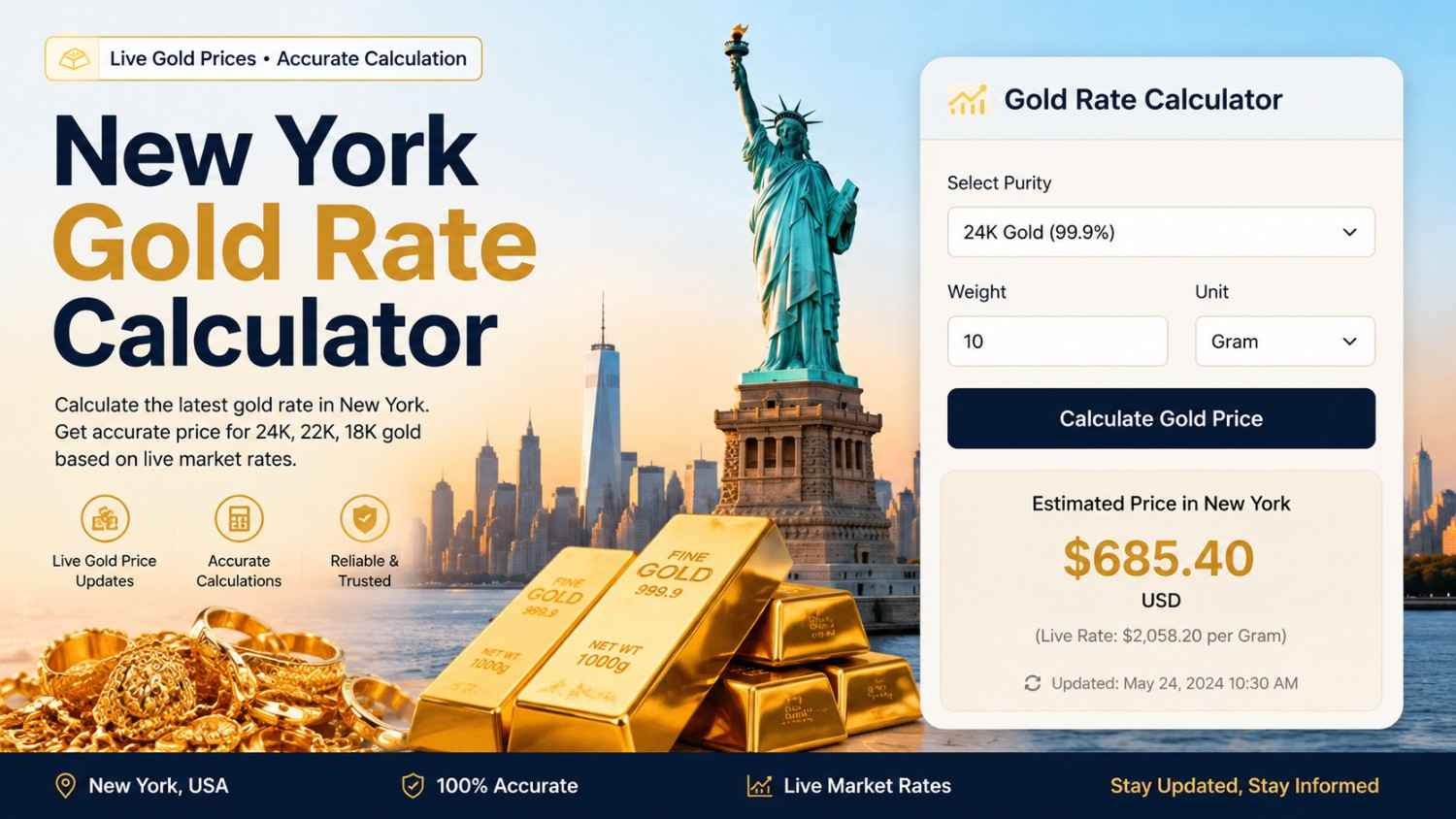
Gold prices can change throughout the trading day, and knowing the market price is only the first step when buying or selling gold in New York. The value of a gold ring, necklace, bracelet, coin, or bullion bar also depends on its purity, weight, and the price used by the buyer or seller.
The New York Gold Rate Calculator helps you estimate the value of gold in US dollars using its karat, weight, and a gold spot price per troy ounce. You can also estimate jewelry purchase costs, compare different gold purities, and calculate the potential value of scrap gold before requesting an offer from a local buyer.
Whether you are comparing jewelry prices in Manhattan, checking an inherited gold collection, or preparing to sell an old 14K chain, understanding the calculation can help you make a more informed decision.
New York Gold Rate Calculator
Calculate gold value, jewelry costs and estimated scrap gold prices in US dollars.
Gold Market Price
Gold Weight & Purity
Jewelry Purchase Cost
Calculated from your entered gold price, weight and purity. This is not a guaranteed buying or selling offer.
Your Gold Calculation Results
Jewelry Cost Breakdown
This guide explains how gold prices are calculated, how different karats affect value, what New York buyers consider when evaluating gold, and how sales tax and additional jewelry costs may affect your final purchase.
New York Gold Rate Calculator
Use the calculator on this page to estimate gold value by weight and purity. Enter a current gold spot price per troy ounce, choose the weight unit, and select the karat stamped on your item.
The calculator separates theoretical gold melt value from estimated resale proceeds and jewelry purchase costs. These figures are different: the metal’s market value is not necessarily the amount a dealer will pay or the retail price of a finished piece.
Important: Enter a current, verifiable spot price before calculating. The calculator does not treat an old or manually entered price as a live market quote.
Today’s Gold Price in New York: What Determines the Rate?
Gold is traded internationally, with market quotations commonly expressed in US dollars per troy ounce. New York buyers and sellers use international gold-market references, but the final price offered for a physical item can differ from the quoted spot price.
Several factors influence the price:
- International gold markets: Global buying and selling activity affects the benchmark price.
- US dollar movements: Changes in the dollar’s strength can influence dollar-denominated gold prices.
- Interest rates: Expectations about monetary policy and real interest rates can affect investor demand.
- Inflation expectations: Some investors use gold as a store-of-value asset during periods of economic uncertainty.
- Central-bank demand: Central-bank purchases and sales can influence market sentiment.
- Geopolitical uncertainty: Investors may increase demand for precious metals during periods of uncertainty.
- Market liquidity: Trading activity and differences between bid and ask prices can affect executable prices.
A spot price is a market reference, not a guaranteed retail or buyback price. A jewelry store may add fabrication costs, design premiums, brand value, and other charges. A scrap buyer may deduct refining, testing, handling, and business costs.
Where can you check the current gold spot price?
Before using a calculator, check a recognized market-data provider or precious-metals market source. Record the price, currency, unit, source, and observation time.
Useful reference resources include:
- LBMA: https://www.lbma.org.uk/
- CME Group: https://www.cmegroup.com/
- Kitco: https://www.kitco.com/
Different providers may publish prices with different update schedules, benchmarks, and market conventions. Check what the displayed quote represents before entering it.
Gold Price by Karat in New York
Gold jewelry is not always made from pure gold. Manufacturers combine gold with other metals to create alloys with different levels of hardness, colour, and durability.
Karat measures the proportion of gold in an alloy on a scale of 24 parts. For example, 18K gold contains 18 parts gold out of 24, while 14K contains 14 parts gold out of 24.
Here is a practical purity reference:
| Gold purity | Approximate gold content | Common context |
|---|---|---|
| 24K | 99.9% for common fine-gold products | Bullion and investment products |
| 22K | 91.67% | High-purity jewelry and some coins |
| 21K | 87.5% | Jewelry in some markets |
| 18K | 75% | Fine jewelry |
| 14K | 58.33% | Common US jewelry |
| 12K | 50% | Certain older or specialty pieces |
| 10K | 41.67% | Common US jewelry |
| 9K | 37.5% | Jewelry in some international markets |
These are mathematical reference percentages. Actual products should be checked against their fineness marks, manufacturer specifications, or an appropriate purity test.
24K Gold
24K gold is the highest commonly traded karat category and is approximately pure gold. It is commonly associated with bullion bars and investment coins. Its softness can make it less suitable for everyday jewelry that needs greater resistance to wear.
22K Gold
22K gold contains approximately 91.67% gold. It is popular in several international jewelry markets. Its higher gold content generally gives it a greater intrinsic metal value than an equal-weight lower-karat item at the same market price.
18K Gold
18K gold contains 75% gold. It offers a balance between gold content and the strength provided by alloying metals. It is frequently used in fine jewelry, including rings, necklaces, and luxury designs.
14K Gold
14K gold contains approximately 58.33% gold. It is a common choice for US jewelry because its alloy composition provides greater durability for regular use than higher-karat gold in many applications.
10K Gold
10K gold contains approximately 41.67% gold. It has a lower gold content than 14K, 18K, or 22K gold of the same eligible weight. However, its actual retail value also depends on craftsmanship, condition, brand, and design.
How to Calculate Gold Value in New York
Gold value is primarily determined by three inputs:
- The eligible weight of the gold alloy.
- The purity or karat of the item.
- The market price of pure gold.
When the market price is quoted per troy ounce, first convert the weight into troy ounces.
Gold melt value formula:
Gold Melt Value = Weight in Troy Ounces × Purity Factor × Spot Price per Troy Ounce
The purity factor is:
Purity Factor = Karat ÷ 24
For weight entered in grams, the combined formula is:
Gold Melt Value = (Weight in Grams ÷ 31.1034768) × (Karat ÷ 24) × Spot Price
One troy ounce equals approximately 31.1034768 grams.
Example: Calculate the Value of a 14K Gold Ring
Suppose you have a 10-gram 14K gold ring, and you want to calculate its theoretical metal value using an illustrative spot price of $4,000 per troy ounce.
Step 1: Calculate the purity factor.
14 ÷ 24 = 0.583333
Step 2: Calculate the pure gold content.
10 × 0.583333 = 5.8333 grams
Step 3: Convert the gold content into troy ounces.
5.8333 ÷ 31.1034768 = approximately 0.1875 troy ounces
Step 4: Calculate the melt value.
0.1875 × $4,000 = approximately $750
The estimated gold melt value is $750.
This is a mathematical example, not a current gold quote or an actual buyer offer. A real transaction may produce a different amount after testing, weight adjustments, dealer margins, and other considerations.
Gold Price Per Gram, Troy Ounce, Pennyweight and Tola
Gold is measured using several weight units. Understanding the difference is especially useful when comparing a jewelry store’s quotation with a gold buyer’s offer.
| Weight unit | Equivalent in grams |
|---|---|
| 1 gram | 1 gram |
| 1 troy ounce | 31.1034768 grams |
| 1 standard ounce | 28.349523125 grams |
| 1 pennyweight (DWT) | 1.55517384 grams |
| 1 troy ounce | 20 pennyweights |
| 1 tola | Approximately 11.6638038 grams |
What Is a Troy Ounce?
A troy ounce is the standard weight unit commonly used in precious-metals markets. It is heavier than the ordinary ounce used for many everyday products.
One troy ounce equals approximately 31.1035 grams, while one standard ounce equals approximately 28.3495 grams.
Confusing the two units can produce a meaningful calculation error.
What Is Pennyweight (DWT)?
Pennyweight, abbreviated as DWT, is used in parts of the jewelry and precious-metals trade.
One pennyweight equals approximately 1.55517 grams. There are 20 pennyweights in one troy ounce.
If a gold buyer quotes a price per DWT, make sure you compare it with another quote using the same unit and the same gold purity.
What Is a Tola?
A tola is a traditional weight unit used in several South Asian gold markets. One tola is approximately 11.6638 grams.
It is not the standard unit used for most US gold-market quotations, but it can be useful when evaluating jewelry purchased overseas.
Gold Jewelry Cost Calculator: What Will You Actually Pay?
The price of a finished gold jewelry item is not simply the gold melt value.
A jewelry purchase can include:
- The gold’s intrinsic metal value.
- Labour and manufacturing charges.
- Design and craftsmanship premiums.
- Brand premiums.
- Gemstones or other decorative materials.
- Retailer markup.
- Applicable sales tax.
- Discounts or promotional adjustments.
A useful estimated purchase-price formula is:
Jewelry Subtotal = Gold Metal Value + Making Charges + Other Product Charges
Final Estimated Cost = Jewelry Subtotal − Discount + Applicable Sales Tax
The actual tax treatment depends on the product and transaction. Do not automatically apply a bullion exemption to ordinary gold jewelry.
Example: Estimating a Gold Jewelry Purchase
Suppose a jewelry store quotes the following illustrative amounts:
- Gold metal value: $1,000
- Making charge: $150
- Additional eligible product charge: $50
- Discount: $25
The subtotal before tax is:
$1,000 + $150 + $50 − $25 = $1,175
If the applicable tax rate is 8.875% for the particular taxable transaction, the estimated tax would be approximately $104.28.
The estimated total would be approximately $1,279.28.
The 8.875% figure is an illustrative New York City general-rate example, not a universal rate for every New York purchase. Verify the applicable rate and tax treatment for the delivery location and item.
New York Sales Tax on Gold: What Buyers Should Understand
New York sales tax is an important consideration when purchasing precious metals and jewelry.
New York State’s general sales tax rate is 4%. Local jurisdictions can impose additional tax, and an additional 0.375% rate applies to taxable sales in the Metropolitan Commuter Transportation District.
The combined rate depends on the applicable tax jurisdiction and delivery location.
Official rate information is available from the New York State Department of Taxation and Finance:
https://www.tax.ny.gov/bus/st/rates.htm
Is Gold Bullion Taxable in New York?
New York provides a sales-tax exemption for qualifying precious-metal bullion and coins sold for investment under Tax Law Section 1115(a)(27).
However, this does not mean every product made from gold is automatically exempt.
The product’s classification, transaction, and applicable statutory requirements matter. Ordinary finished jewelry should not be assumed to qualify simply because it contains gold.
For official information, consult:
and the relevant provisions of New York Tax Law.
If a transaction is substantial or its classification is unclear, confirm the treatment with the seller or a qualified New York tax professional.
Does New York Sales Tax Apply to Gold Jewelry?
Gold jewelry is generally treated differently from qualifying investment bullion. A normal jewelry purchase may be subject to sales tax based on the applicable jurisdiction and transaction.
For this reason, the calculator allows users to enter their own applicable tax percentage rather than assuming every gold purchase has the same rate.
Scrap Gold Calculator: Estimate the Value of Old or Broken Jewelry
Scrap gold is gold material that is valued primarily for its recoverable metal content rather than its original retail appearance.
Examples include:
- Broken gold chains.
- Damaged rings.
- Single earrings.
- Old bracelets.
- Unwanted necklaces.
- Certain gold dental materials.
- Gold items that no longer have meaningful resale value as finished jewelry.
A broken piece can still contain valuable gold. Its condition may affect the resale market, but the intrinsic metal calculation is based primarily on its eligible gold-alloy weight and purity.
How Scrap Gold Value Is Calculated
Scrap gold value begins with the theoretical melt value.
A buyer may then apply a payout percentage to account for refining costs, testing, handling, market risk, and business margins.
Estimated Buyer Payout = Melt Value × Buyer Payout Percentage
For example, if the calculated melt value is $1,000 and a buyer offers 85% of melt:
$1,000 × 0.85 = $850
This is only an example. There is no universal payout percentage for all New York buyers, karats, or transaction sizes.
Before accepting an offer, ask how the buyer determined the item’s weight, purity, reference price, and deductions.
How to Sell Gold in New York Without Misjudging Its Value
Selling gold involves more than checking a price table. Two buyers may provide different offers for the same item.
A careful comparison can help you understand those differences.
1. Separate Different Karat Items
Do not assume that every gold item in a collection has the same purity. A 10K ring and an 18K chain have different gold-content percentages.
Ask the buyer to evaluate each item separately.
2. Check the Weight
Ask whether the weight is measured in grams, DWT, or troy ounces.
Also ask whether stones, clasps, springs, and other non-gold components have been excluded from the eligible gold weight where appropriate.
3. Ask How Purity Is Tested
Gold buyers may use several testing methods, including acid testing, electronic testing, and X-ray fluorescence (XRF) analysis.
Each method has its own limitations. XRF is generally a surface-analysis method and does not automatically establish the exact composition of every part of a complex item.
For valuable or unusual pieces, ask whether additional testing or an independent appraisal is appropriate.
4. Request a Written Breakdown
A transparent quote should make it possible to understand:
- The spot price used.
- The item’s measured weight.
- The purity determined.
- The calculated melt value.
- The payout percentage or deductions.
- The final amount offered.
5. Compare More Than One Offer
A single offer does not establish the entire market value of your gold.
Compare offers using the same reference price, weight, purity, and transaction assumptions.
A buyer advertising a high percentage of spot may still use different testing rules or conditions. Read the terms instead of relying only on a headline percentage.
Gold Buyer vs. Jewelry Store: Why the Prices Are Different
A jewelry store and a scrap-gold buyer are not necessarily pricing the same thing.
A jewelry store sells a finished product that includes design, manufacturing, presentation, inventory costs, and retail services.
A scrap buyer usually focuses on the recoverable precious-metal content and the economics of refining or resale.
A branded watch, signed designer ring, antique necklace, or rare gold coin may also have a value beyond its gold content.
For that reason, do not automatically sell a potentially collectible or branded item for scrap without considering its separate resale or appraisal value.
Gold-Plated, Gold-Filled and Solid Gold: Important Differences
Not every gold-coloured item contains a substantial amount of solid gold.
Solid gold: The item is made from a gold alloy throughout its gold components. A karat mark indicates the approximate gold proportion.
Gold-plated: A thin gold layer is applied over another material. The gold content is generally not comparable to an item made from solid gold of the same apparent size.
Gold-filled: A mechanically bonded gold layer forms a more substantial portion of the product’s construction than ordinary gold plating, but it is not the same as solid-gold jewelry.
Gold vermeil: A gold layer is applied over sterling silver under specified product standards.
These categories should not be entered into a solid-gold melt calculator as if the entire item’s weight were 10K, 14K, or 18K gold.
Check the product description, markings, and construction before estimating its metal value.
What Can Make a Gold Calculator Estimate Inaccurate?
Even a correctly programmed calculator cannot establish the exact value of every physical gold item.
Common reasons for differences include:
- Incorrect weight: A household scale may not provide the precision needed for small jewelry items.
- Mixed metals: A piece may contain gold components alongside steel, silver, or other materials.
- Gemstones: The full item weight is not necessarily eligible gold weight.
- Unverified purity: A stamp can be misleading, altered, or inaccurate.
- Price timing: Gold-market prices can change after the reference quote was recorded.
- Dealer margins: Buyers do not necessarily pay the full melt value.
- Collectible value: Coins, antiques, and branded items may have additional value.
- Currency or unit mistakes: Using a standard ounce instead of a troy ounce can distort the result.
For a reliable estimate, use an accurate weight, verify purity, and enter a properly identified market price.
Is Gold a Good Investment in New York?
Gold can play a role in a diversified investment strategy, but it is not a guaranteed way to make money.
Its market price can rise or fall. Physical gold may also involve dealer premiums, storage, insurance, authentication, and resale costs.
Before buying investment gold, consider:
- The difference between spot and retail prices.
- Whether the product is eligible investment bullion.
- The seller’s reputation and product documentation.
- Buyback policies and spreads.
- Storage and insurance arrangements.
- The potential effect of taxes.
- Your investment time horizon and risk tolerance.
A calculator can estimate metal content and compare hypothetical prices. It cannot predict future returns or determine whether an investment is appropriate for you.
Frequently Asked Questions
1. How do I calculate the gold rate in New York?
Enter the current gold spot price per troy ounce, the item’s weight, and its karat. Convert the weight into troy ounces and multiply by the purity factor and spot price.
2. How much is 14K gold worth per gram?
The theoretical metal value of 14K gold per gram is approximately 58.33% of the 24K gold price per gram, using the exact 14/24 purity fraction. The actual retail or resale price can differ.
3. How much gold is in 18K jewelry?
18K gold contains 18 parts gold out of 24, equivalent to 75% gold by weight. A 10-gram piece of 18K gold alloy therefore contains approximately 7.5 grams of gold, assuming its entire eligible alloy weight is 18K.
4. How many grams are in one troy ounce of gold?
One troy ounce equals approximately 31.1034768 grams. It is different from a standard ounce, which equals approximately 28.3495 grams.
5. How many pennyweights are in one troy ounce?
There are 20 pennyweights in one troy ounce. One pennyweight is approximately 1.55517 grams.
6. Do gold buyers in New York pay the full spot price?
Not necessarily. A buyer may deduct refining, testing, handling, and business costs. The actual offer depends on the item’s purity, weight, condition, and the buyer’s pricing policy.
7. Can I calculate the value of broken gold jewelry?
Yes. Broken gold jewelry can still have intrinsic metal value. Enter its eligible gold-alloy weight, karat, and a current spot price to estimate its melt value.
8. Is 10K gold real gold?
Yes. 10K gold contains approximately 41.67% gold and the remainder consists of other alloying metals. Its value depends on its actual gold content and market conditions.
9. Is 24K gold always exactly 100% pure?
No. The 24K designation is a karat classification. Commercial fine-gold products may carry fineness markings such as 999 or 999.9. Product documentation or an appropriate assay provides more specific information.
10. Does New York charge sales tax on gold purchases?
The tax treatment depends on the product and transaction. Qualifying investment bullion and coins may be exempt under New York Tax Law Section 1115(a)(27), while ordinary gold jewelry is generally treated differently. Always verify the applicable rules.
11. Does gold-plated jewelry have the same value as solid gold?
No. Gold-plated jewelry contains a thin gold layer over another material. Its gold content is generally much lower than an equivalent-weight solid-gold item.
12. Can I use this calculator to value gold coins?
You can estimate the intrinsic gold content of a coin if you know its actual gold weight and purity. However, collector value, rarity, condition, and coin premiums are not included in the melt-value calculation.
13. Why is my jewelry store’s price higher than the calculator result?
The calculator estimates the metal value. A finished jewelry product may include labour, design, brand premiums, gemstones, retail markup, and applicable taxes.
14. How often should I update the gold price entered into the calculator?
Use a fresh, verifiable market reference whenever you make a new calculation. Record its source and observation time, especially when comparing offers.
15. Can I use a regular kitchen scale to weigh gold?
A kitchen scale may not be precise enough for small jewelry items. A suitable calibrated jewelry scale is preferable. Ask a buyer to show the weight reading and explain the measurement.
Final Thoughts
Understanding gold prices before buying or selling can help you avoid confusing spot value, retail pricing, and actual buyer offers.
The New York Gold Rate Calculator on this page is designed to make the basic calculation easier by combining weight, karat purity, and a user-supplied market price. Its additional jewelry-cost and resale estimates help you compare different transaction scenarios without treating an estimate as a guaranteed quote.
Before completing a purchase or sale, verify the gold’s purity, eligible weight, market reference, buyer deductions, and applicable tax treatment. For rare coins, designer jewelry, or valuable antiques, consider an independent appraisal rather than relying exclusively on melt value.
Article written by Junaidul Islam
Editorial note: This calculator and guide provide educational estimates, not a dealer quotation, professional appraisal, investment recommendation, or tax advice. Gold prices fluctuate, and actual transaction values depend on the product and the parties involved.
Sources and further reading
- New York State Department of Taxation and Finance: https://www.tax.ny.gov/
- New York sales tax rate lookup: https://www.tax.ny.gov/bus/st/rates.htm
- London Bullion Market Association: https://www.lbma.org.uk/
- CME Group: https://www.cmegroup.com/
- Kitco precious metals: https://www.kitco.com/