
Author: Junaidul Islam
Last updated: October 10, 2026
Artificial intelligence can help a New York business answer customer questions, summarize documents, analyze sales, write marketing content, and automate routine work. But every new AI workflow can introduce another place where customer information is collected, transmitted, stored, or exposed.
A customer might paste an account number into an AI chatbot. An employee might upload a spreadsheet containing personal information to an unapproved AI tool. A company might send customer support conversations to an outside AI provider without fully understanding how those records are retained.
These situations raise a practical question: Is the business taking reasonable steps to protect the private information it handles?
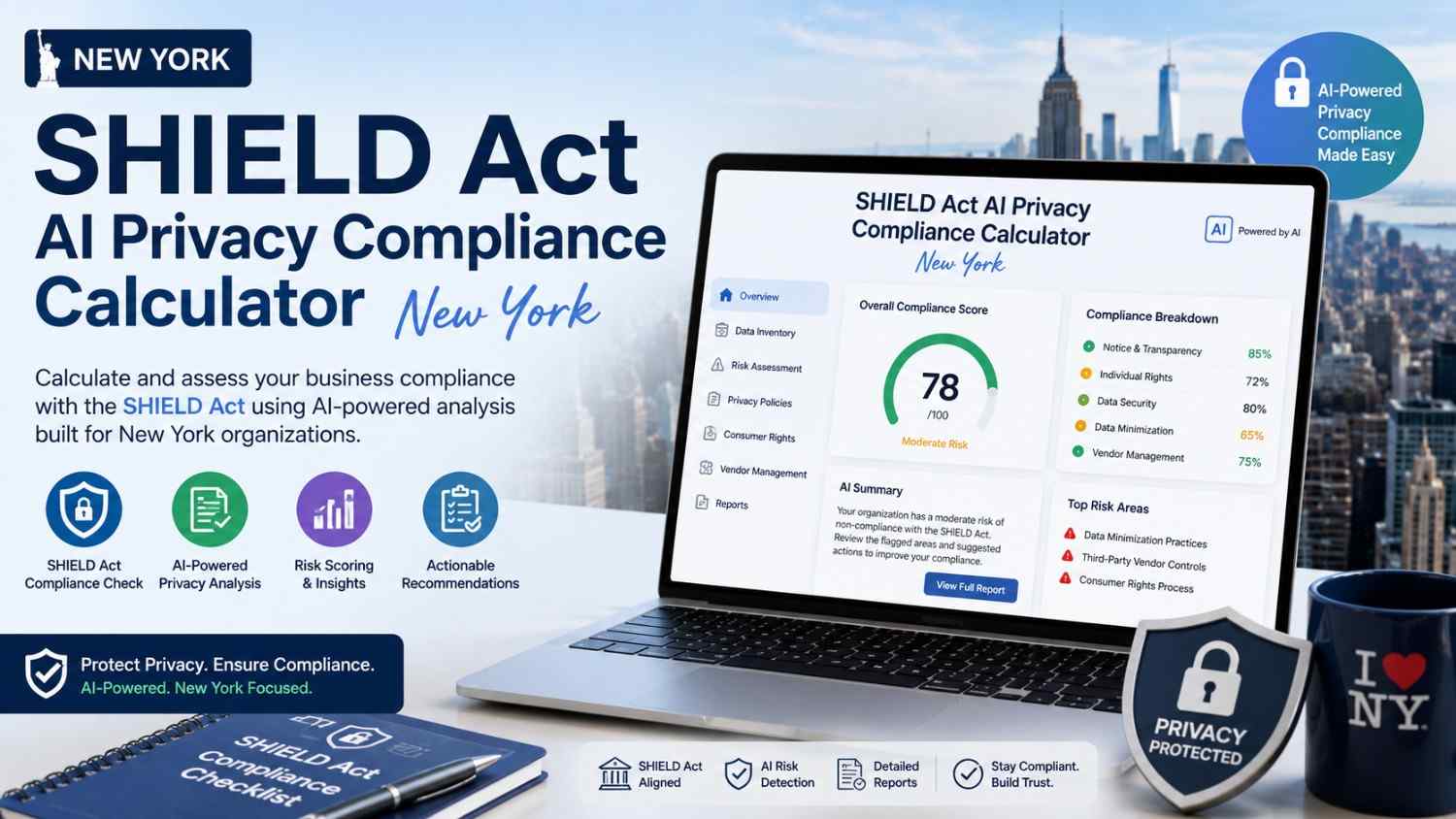
The New York SHIELD Act AI Privacy Compliance Calculator on this page helps business owners review their AI-related data practices, identify potential security gaps, and create a prioritized list of next steps. It is designed as a preliminary self-assessment, not an official government compliance test or a legal opinion.
If your organization owns or licenses computerized data containing private information of New York residents, the Stop Hacks and Improve Electronic Data Security Act, commonly called the SHIELD Act, may be relevant to your security program. The law requires reasonable safeguards and addresses notification obligations when certain data breaches occur.
This guide explains what the law covers, how AI workflows can create security risks, what to review in your business, and how to interpret your calculator results.
New York SHIELD Act AI Privacy Compliance Calculator
Use the interactive calculator below to review your business profile, AI data exposure, security controls, and vendor practices. Answer based on your actual procedures rather than what you intend to implement in the future.
SHIELD Act AI Privacy Risk Assessment
Review your New York business’s AI data practices, identify missing safeguards, and organize your next steps.
Independent educational tool · Not an official government calculator
Your Preliminary Assessment
Implementation indicator
Recommended next steps
Controls to review
All applicable checklist controls were marked implemented. Verify supporting evidence and review legal applicability before drawing conclusions.
For a real suspected breach, promptly involve your security team and qualified counsel. Do not use this tool to determine whether notification is legally required.
Privacy note: This tool processes assessment answers in your browser. It does not intentionally transmit answers to an external service. Your website’s hosting, analytics, caching, or other plugins may have their own data practices.
The results are intended to help you organize a security review. They do not establish that your business is compliant or noncompliant with New York law.
What Is the New York SHIELD Act?
The SHIELD Act is a New York data-security and breach-notification law. Its full name is the Stop Hacks and Improve Electronic Data Security Act. Signed into law in 2019, it strengthened New York’s existing data-breach framework and expanded protections involving private information.
New York General Business Law § 899-bb requires a person or business that owns or licenses computerized data containing private information of a New York resident to develop, implement, and maintain reasonable safeguards to protect the security, confidentiality, and integrity of that information.
The law identifies administrative, technical, and physical safeguards that can form part of a data-security program. It also addresses certain exceptions and alternative compliance provisions, including a provision for qualifying regulated entities.
The important point for AI users is that the SHIELD Act is not a standalone AI certification law. It does not provide a special SHIELD Act approval score for ChatGPT, generative AI, machine-learning software, or automated assistants. Instead, an organization should examine whether the computerized private information it owns, licenses, or maintains is adequately protected.
Read the official law: New York General Business Law § 899-bb.
You can also review the New York Attorney General’s SHIELD Act guidance.
Does the SHIELD Act Apply to Businesses That Use AI?
Using AI does not automatically make a business subject to every privacy law. Applicability depends on the facts, including the information involved, the business’s relationship to that information, and other potentially applicable legal requirements.
However, AI use should be included in a company’s security assessment when AI workflows process or expose protected information.
Consider these examples:
- A New York retailer uses an AI assistant to summarize customer support tickets.
- A property management company uploads tenant records to a third-party AI service.
- A software company sends user-submitted information to an AI API.
- A professional services firm uses an AI assistant to review documents containing customer identifiers.
- An employee enters login credentials or confidential records into a personal AI account.
These examples do not establish a legal violation by themselves. They illustrate why a business should map its information flows and determine what safeguards are appropriate.
A company can also face AI-related security risks even if its website does not contain an AI chatbot. Employees may use AI tools through personal accounts, browser extensions, office applications, or third-party software integrations.
A practical starting point is to create an inventory of approved AI tools, identify who uses them, and document what information each tool receives.
What Counts as Private Information Under the SHIELD Act?
The SHIELD Act’s definition of private information is specific. It is not identical to every broad definition of personal data used in other privacy laws.
Under New York General Business Law § 899-aa, private information generally includes certain personal information combined with specified sensitive data elements, as well as certain username-or-email and password combinations and biometric information used to authenticate an individual.
Relevant examples include:
- Social Security numbers.
- Driver’s license numbers or other covered identification numbers.
- Financial account numbers combined with the required access or security information.
- Online account credentials, including certain combinations of usernames or email addresses and passwords or security codes.
- Covered biometric information used to authenticate an individual.
The exact statutory definitions and conditions matter. Not every name, email address, business contact, or customer record automatically meets the SHIELD Act’s definition of private information.
Nevertheless, a business should not assume that information is harmless merely because one field appears ordinary. A username combined with a password, for example, presents a different risk from a business email address alone.
AI systems can make information exposure harder to track because a single prompt may combine several types of data. A support transcript might include a customer’s name, account details, authentication information, and a description of a financial problem.
When reviewing an AI workflow, record the categories of information involved and assess whether the statutory definition applies. If the answer is uncertain, obtain qualified legal guidance instead of relying on a calculator’s classification.
How AI Tools Can Create Data-Security Risks
AI systems introduce familiar security concerns in new workflows. The following issues deserve specific attention during a business assessment.
1. Sensitive information in prompts
Employees may paste complete customer records into a prompt when a redacted summary would be sufficient. The information may then be transmitted to an external provider or retained in conversation history.
A sensible control is to prohibit unnecessary sensitive information in prompts and provide approved examples of how employees can remove identifying details before using AI.
2. Data retention and deletion
Different AI services have different retention settings, contractual commitments, and administrative controls. Some workflows may create records in chat history, application logs, monitoring systems, backups, or connected business software.
Ask what information is retained, where it is retained, who can access it, how long it remains available, and how deletion requests are handled.
Do not assume that deleting a conversation from the user interface automatically deletes every related copy.
3. Provider access and model training
Before sending customer information to an AI provider, review the provider’s current terms, privacy documentation, security commitments, and contractual arrangements.
Determine whether submitted information may be used to improve or train models, what settings affect that use, and which parties can access the data. Do not rely on general marketing statements when a written contractual commitment is needed.
4. Employee access and shadow AI
Employees may use unapproved AI services because the official tools are inconvenient or do not meet their needs. A policy that simply prohibits AI without offering workable alternatives may fail to address what people actually do.
Maintain an approved-tool list, establish rules for sensitive information, train staff, and provide a straightforward way to request approval for a new tool.
5. Connected applications and integrations
An AI assistant may connect to email, document storage, customer relationship management software, or internal databases. Those integrations can expand the amount of information the AI application can access.
Review permissions, limit access to the minimum necessary, disable unused integrations, and test whether a user can retrieve information outside their authorized role.
6. Logs, backups, and exported reports
Security assessments often focus on the main application while overlooking exported files, diagnostic logs, analytics systems, and backups.
Document where information can be copied, who can retrieve it, and how retention and disposal procedures apply to those additional locations.
These are practical AI security recommendations. They should not be confused with a claim that the SHIELD Act expressly mandates a particular AI setting, model-training restriction, or vendor product feature.
The Three Safeguard Categories You Should Review
New York’s SHIELD Act identifies three broad categories of reasonable safeguards. The law’s examples are not an exhaustive list, and appropriate controls depend on the organization and the information involved.
Administrative safeguards
Administrative safeguards concern how the organization manages security.
Review whether your business:
- Designates one or more people to coordinate the security program.
- Identifies reasonably foreseeable internal and external risks.
- Evaluates whether existing safeguards adequately address those risks.
- Trains and manages employees in security practices.
- Selects service providers capable of maintaining appropriate safeguards and requires those safeguards by contract.
- Updates the security program when business operations or circumstances change.
For AI workflows, the assessment should also identify approved tools, permitted data categories, employee responsibilities, vendor review procedures, and a process for reporting suspected exposure.
Keep evidence of the controls. A written policy, training record, vendor assessment, or documented risk review is more useful than simply saying that a control exists.
Technical safeguards
Technical safeguards concern systems, software, data processing, and the ability to detect and respond to problems.
Review whether your business:
- Assesses security risks in network and software design.
- Evaluates information processing, transmission, and storage.
- Detects, prevents, and responds to attacks or system failures.
- Regularly tests and monitors the effectiveness of key controls, systems, and procedures.
For AI applications, examine authentication, access permissions, encryption where appropriate, integration permissions, logging, monitoring, and incident-response capabilities.
Check whether sensitive information can be entered into unapproved tools and whether staff can access AI conversation histories or exported records beyond their business needs.
The relevant question is not whether a company has purchased a particular security product. It is whether the safeguards reasonably address the risks associated with its information and operations.
Physical safeguards
Physical safeguards concern access to equipment and the protection, storage, transportation, and disposal of information.
Depending on the business, relevant controls may include:
- Restricting access to offices, server rooms, and devices.
- Protecting computers and storage media from unauthorized access.
- Reviewing how physical records and removable media are transported.
- Disposing of information securely when it is no longer needed for business purposes.
- Ensuring that electronic media are erased so that information cannot be read or reconstructed when the statutory disposal standard applies.
Cloud-based businesses should not automatically skip this category. They should determine which physical protections are managed by their organization and which are handled by service providers, then review the relevant responsibilities and evidence.
Do Small Businesses Have Different SHIELD Act Requirements?
Yes, the statute provides a specific rule for a qualifying small business.
Under General Business Law § 899-bb, a small business is defined using alternative thresholds: fewer than 50 employees, less than $3 million in gross annual revenue in each of the last three fiscal years, or less than $5 million in year-end total assets calculated in accordance with generally accepted accounting principles.
The statute states that a qualifying small business’s security program must contain reasonable administrative, technical, and physical safeguards appropriate to the business’s size and complexity, the nature and scope of its activities, and the sensitivity of the personal information it collects from or about consumers.
This does not mean that every small business is exempt from data-security obligations. Nor does meeting one threshold automatically answer every legal question about a business’s situation.
A small company using AI to process sensitive customer information still needs to evaluate its actual risks and appropriate safeguards. A smaller organization may have fewer systems, but it may also depend heavily on third-party services and have limited internal security resources.
Use the calculator to identify areas for review, not to assume that company size removes the need for a security program.
What About Regulated Businesses?
Some organizations are subject to additional federal or state data-security rules.
Section 899-bb includes a provision under which a person or business that qualifies as a compliant regulated entity under the statute is deemed compliant with the section’s reasonable-safeguards requirement.
The definition references specified regulatory frameworks, including certain requirements under the Gramm-Leach-Bliley Act, HIPAA and HITECH, New York Department of Financial Services regulations under 23 NYCRR Part 500, and other qualifying government data-security requirements.
The qualification is conditional. A business should not assume that merely operating in healthcare or finance, or claiming to follow a security framework, establishes that the statutory provision applies.
If your organization is regulated, identify the specific rules that govern it and obtain appropriate legal or compliance advice. AI applications may introduce additional questions about vendors, data flows, access permissions, and the interaction between different requirements.
The calculator should therefore treat regulated status as a reason for more careful review rather than automatically marking every safeguard as satisfied.
How to Use the SHIELD Act AI Privacy Compliance Calculator
The assessment works best when you have enough information about your business to answer accurately.
Step 1: Describe your business. Identify your business type, approximate size, use of AI, and whether computerized data involving New York residents is handled.
Step 2: Identify the information involved. Review prompts, uploaded documents, conversation histories, application logs, databases, and connected systems. Determine whether any information may fall within the SHIELD Act’s definition of private information.
Step 3: Review administrative safeguards. Check for a designated security lead, documented risk assessments, employee training, vendor review, written procedures, and periodic updates.
Step 4: Review technical and physical safeguards. Examine access restrictions, system monitoring, testing, information storage, disposal, device security, and relevant provider controls.
Step 5: Review AI-provider practices. Look at retention, deletion, training use, access, contractual safeguards, and integrations. Answer only what you can substantiate.
Step 6: Examine the results. Separate missing controls from questions you could not answer. Prioritize the most consequential exposures and assign responsibility for corrective action.
Step 7: Save the evidence. Keep policies, contracts, training records, test results, access reviews, and remediation records in a secure location.
The calculator is a starting point. A meaningful review should reflect the organization’s actual information flows and not just the number of checked boxes.
How to Interpret Your Calculator Results
A calculator may show a completion percentage or highlight missing safeguards. That result is a management aid, not a legal conclusion.
A high completion percentage does not prove that a business complies with every applicable requirement. One serious gap involving access to sensitive information can deserve more attention than several minor administrative omissions.
Similarly, an unanswered question does not automatically prove a violation. It indicates that the business needs to verify the relevant facts or obtain better documentation.
Use the results in the following way:
- Critical review: Investigate immediately when sensitive information may be exposed to unauthorized users or an unapproved external service.
- High priority: Address significant weaknesses in access controls, vendor safeguards, monitoring, or incident response.
- Medium priority: Improve documentation, employee training, retention procedures, and periodic control reviews.
- Routine maintenance: Schedule recurring assessments, remove obsolete access, and update policies as systems change.
- Unknown: Assign someone to verify the facts rather than treating the control as complete.
These are suggested internal risk-management priorities, not statutory SHIELD Act risk levels or official compliance classifications.
A Practical Example: A New York Business Using an AI Support Assistant
Imagine a small online retailer serving customers in New York. Its support team uses an AI assistant to summarize complaints and draft responses.
An employee copies a complete support ticket into the assistant. The ticket includes a customer’s name, an account reference, and information about an online account. The company has not documented whether the AI provider retains submitted conversations, and the retailer has no written rule about what staff may enter into AI tools.
The first step is not to declare the business noncompliant. It is to understand the actual data and the applicable legal requirements.
The retailer can begin by identifying what information was submitted, determining whether the relevant statutory definition of private information is met, reviewing the provider’s terms and security controls, and restricting unnecessary sensitive data in future prompts.
It should also establish an approved workflow, review access permissions, train staff, and document its assessment. If there may have been unauthorized access to protected information, the business should promptly involve appropriate security and legal professionals to determine whether breach-notification obligations apply.
The same approach can be adapted to a professional services firm, software startup, property management business, or another organization that uses AI to process customer information.
What Should You Check in an AI Vendor Agreement?
A vendor’s privacy page is useful, but it may not answer every question relevant to your business.
Before an AI service receives private information, consider reviewing:
Data use: What information can the provider use, and for what purposes? Are any model-training or service-improvement uses permitted?
Retention: How long are prompts, files, outputs, and logs kept? Are there separate retention periods for abuse monitoring, backups, or support records?
Deletion: What deletion options exist, and what limits or exceptions apply? Can the provider explain how deletion requests are handled?
Access: Which provider personnel, subprocessors, or connected applications may access the data? What controls restrict that access?
Security: What safeguards, incident-reporting commitments, and security documentation does the provider offer?
Contracts: Does the agreement contain appropriate security commitments and allocate responsibilities clearly?
Changes: How will your organization learn about material changes in the service, terms, or security practices?
Exit arrangements: If you stop using the service, what happens to your data, exports, integrations, and retained records?
The SHIELD Act expressly identifies service-provider selection and contractual safeguards as examples of administrative safeguards. The additional AI-specific questions above are practical ways to investigate the risks of a particular service; they are not a verbatim list of statutory requirements.
What Should You Do If AI-Related Data May Have Been Exposed?
Treat a suspected exposure as a security incident that needs prompt assessment.
First, take reasonable steps to contain ongoing unauthorized access without destroying evidence. Preserve relevant logs and records, identify affected systems, and involve your security or IT lead.
Next, establish what information was involved, whose information it was, when the event occurred, and whether the information was accessed or otherwise compromised. Determine whether the incident falls within the applicable statutory definitions and whether any exception is available.
The SHIELD Act addresses notification to affected individuals and reporting to relevant New York authorities in covered circumstances. The appropriate steps depend on the incident and applicable law. Do not rely on a general calculator to decide whether notice is legally required or to calculate every deadline.
Consult the New York Attorney General’s data-breach reporting resources and seek qualified legal advice when necessary.
For a real incident, speed matters. A self-assessment tool is not a substitute for incident response.
Common Mistakes to Avoid
Assuming every AI prompt is covered by the SHIELD Act. The law has specific definitions and conditions. Assess the information involved instead of assuming that all data is treated identically.
Assuming ordinary contact details always qualify as statutory private information. The precise combinations and definitions matter, even though other laws or contracts may impose additional obligations.
Treating a vendor’s security claims as proof. Review actual terms, available controls, contractual commitments, and the vendor’s role in the data flow.
Ignoring employee accounts. Personal accounts and unapproved tools can introduce data flows that the company has not documented.
Counting policies that nobody follows. A written policy is not a substitute for training, implementation, monitoring, and appropriate testing.
Treating a calculator score as legal certification. A numerical result cannot resolve every issue of statutory interpretation, regulated status, or incident-specific facts.
Forgetting disposal and backups. Information may remain in exports, logs, archived records, or storage systems after the original conversation is deleted.
Assuming small-business status means no obligations. The statute provides a tailored safeguard standard for qualifying small businesses, not a blanket exemption from the reasonable-safeguards requirement.
Frequently Asked Questions
Is there an official New York SHIELD Act AI compliance calculator?
The calculator on NewYorkCalculator.com is an independent educational self-assessment. It is not an official tool published or endorsed by the New York State government.
Does the SHIELD Act specifically regulate ChatGPT or other AI models?
The SHIELD Act is a data-security and breach-notification law, not an AI-model certification framework. Its relevance to an AI workflow depends on the information involved, the organization’s relationship to that information, and the applicable legal requirements.
Does every New York business have to follow the same safeguards?
No. The statute addresses qualifying regulated entities and provides a tailored reasonable-safeguards standard for qualifying small businesses. The appropriate assessment depends on the actual circumstances and applicable rules.
Can a business be compliant if it uses a third-party AI provider?
Using a third-party AI service does not, by itself, establish compliance or noncompliance. The organization should understand its data flows, review the provider’s security practices and contractual commitments, and determine which legal obligations apply.
What is a reasonable security safeguard?
A reasonable safeguard is a measure appropriate to the risks and circumstances of the organization. The SHIELD Act identifies administrative, technical, and physical safeguards, including risk assessment, employee training, provider selection, system monitoring, and secure disposal.
Does a high calculator score mean my company is compliant?
No. The score is a preliminary indicator based on your answers. It does not verify the underlying evidence, interpret every applicable law, or certify legal compliance.
What should I do if I cannot answer a question?
Mark the issue for verification, identify the person responsible for obtaining the answer, and review relevant policies, contracts, system settings, or security records. Do not treat an unknown control as implemented.
Does the SHIELD Act require every business to stop AI providers from training on prompts?
The statute does not establish a universal AI-model-training prohibition in the terms described here. Nevertheless, training use can be an important vendor-risk question, especially when private information is involved. Review the actual provider terms, contractual commitments, and other laws that may apply.
Where can I read the official requirements?
Start with New York General Business Law §§ 899-aa and 899-bb and the New York Attorney General’s official SHIELD Act guidance. Businesses with regulated operations or a suspected breach should obtain advice appropriate to their situation.
Final Thoughts
AI can make everyday business operations more efficient, but responsible use starts with understanding where information goes and how it is protected.
For a New York business, a practical review should connect its data inventory, administrative responsibilities, technical controls, physical safeguards, vendor arrangements, and incident-response procedures. AI-specific questions about prompts, retention, model training, integrations, and deletion can help expose gaps that a generic checklist may overlook.
Use the SHIELD Act AI Privacy Compliance Calculator to organize that review and decide what to investigate next. Then verify the answers, document the controls, and seek qualified advice when the law or the facts are unclear.
The goal is not to obtain an impressive percentage. It is to build a security program that fits the business, protects private information, and can be supported by evidence.
Legal and informational disclaimer: This article and calculator are provided for general educational purposes. They do not constitute legal advice, a formal security audit, a government certification, or a guarantee of compliance. Laws, regulations, and official guidance may change. Verify the current requirements with official sources and qualified professionals before making legal or compliance decisions.
Official resources