
By Junaidul Islam A recorded interview may last only 30 minutes, but preparing it for publication can take considerably longer. A reporter may need to transcribe the conversation, identify speakers, check names and figures, confirm quotations against the original recording, and deliver the finished transcript before a newsroom deadline.
For journalists, freelance reporters, podcast producers, documentary teams, and media researchers in New York, these extra hours can affect both project costs and publication schedules.
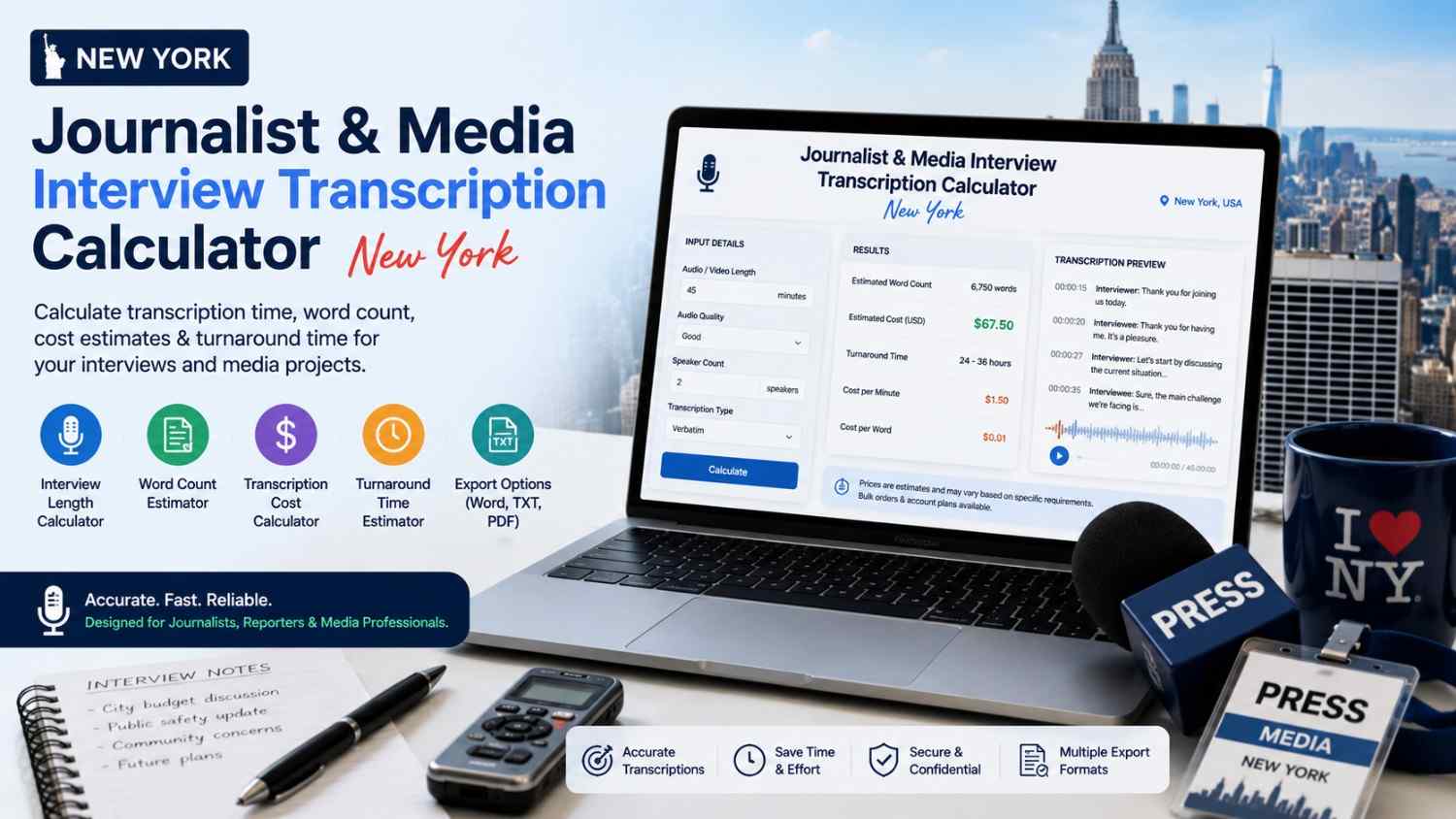
The Journalist & Media Interview Transcription Calculator New York helps estimate total audio hours, transcription expenses, manual typing time, review workload, and the combined cost of completing an interview project. Enter your own figures to compare different workflows before deciding how to handle your recordings.
Journalist & Media Interview Transcription Calculator
Estimate audio hours, transcription fees, editorial labor, and project costs for New York media assignments.
1. Interview details
Used to adjust the estimated review workload, not the vendor’s actual fee.
A planning assumption for additional manual or review time.
2. Transcription method and rates
Enter your provider’s current rate. Manual transcription has no service fee in this estimate.
An editable assumption, not a guaranteed transcription speed.
Time for corrections, speaker labels, and quote checks when using a service.
Optional extra time for formatting or preparing transcripts for editorial use.
Optional rush fees, translation, or other known charges.
3. Estimated project results
| Transcription service | $90.00 |
|---|---|
| Review and editing labor | $0.00 |
| Other expenses | $0.00 |
| Combined estimate | $0.00 |
Estimates are for planning only and are not a binding quote. The tool does not upload or record audio. Actual charges may vary by provider, subscription limits, taxes, turnaround time, and optional services. Review time is an assumption and does not guarantee transcript accuracy. Verify important quotations against the original recording.
Use the calculator above to estimate your project. Results are planning estimates, not a vendor quotation or a guarantee of transcription time.
What Is a Journalist and Media Interview Transcription Calculator?
A journalist interview transcription calculator is a planning tool that converts recorded interview duration into useful project estimates.
Instead of looking at each recording separately, you can calculate the total workload for an entire reporting assignment. This is particularly helpful when preparing a feature story, conducting a series of source interviews, covering a press conference, or producing a documentary.
Depending on the information you enter, a useful estimate can include:
- Total recorded audio hours and minutes.
- Estimated time needed for manual transcription.
- The estimated fee for an AI or human transcription service.
- Additional labor costs for reviewing transcripts.
- A combined project budget.
- The likely workload associated with several interviews.
The distinction between transcription expenses and editorial labor matters. A service may produce text quickly, but the reporter still needs to determine whether the transcript accurately reflects what the source said.
How to Use the Transcription Calculator
You do not need to upload an audio recording or provide information about your interview subjects. The calculator uses the project details you enter.
Step 1: Enter the number of interviews
Count the recordings you plan to transcribe. If you have 12 interviews for one investigation, enter 12 rather than treating every recording as a separate project.
Step 2: Enter the average recording length
Estimate the average duration of each interview in minutes. If your interviews have very different lengths, calculate their average or group similar recordings together for a more useful estimate.
Step 3: Select the transcription method
Choose manual transcription, AI transcription, or a human transcription service. Each option has different cost and time implications.
Step 4: Enter your rates and workload assumptions
For a paid service, use the provider’s current quote or published rate. For your own labor, enter an hourly rate that reasonably reflects the cost of your working time.
If you are using AI transcription, also estimate how much time you expect to spend reviewing each transcript.
Step 5: Review the results
Compare the total audio duration, estimated service fees, labor costs, and combined budget. Adjust the inputs to see how the estimate changes when you use another method or review more recordings.
The result is most useful when you treat each number as an assumption you can revise, rather than a guaranteed outcome.
How Much Does Interview Transcription Cost in New York?
There is no single transcription rate that applies to every New York journalist or media company. The total depends on the service, recording duration, requested transcript format, turnaround time, and any additional editing requirements.
For a practical starting point, consider the provider’s published price and calculate the cost using the actual duration of your recordings.
For example, Rev’s published pricing page lists AI transcription at $0.25 per audio minute and standard human transcription starting at $1.99 per audio minute. Its pricing and available options may change, and its checkout estimate may include applicable taxes or additional services.
Source: Rev transcription services and pricing.
The following table illustrates how those example rates translate into project costs.
| Total recorded audio | AI at $0.25/minute | Human at $1.99/minute |
|---|---|---|
| 30 minutes | $7.50 | $59.70 |
| 60 minutes | $15.00 | $119.40 |
| 3 hours | $45.00 | $358.20 |
| 5 hours | $75.00 | $597.00 |
| 10 hours | $150.00 | $1,194.00 |
These figures are arithmetic examples based on the cited published rates, not quotes for every provider or a claim about average New York market prices. Taxes, subscriptions, minimum charges, rush options, discounts, and other requirements can change the amount payable.
What should you include in your budget?
A realistic project budget may contain more than the transcription fee.
Service cost: The amount charged by the selected transcription provider.
Review labor: The time spent listening to recordings, correcting mistakes, and checking speaker labels.
Editorial preparation: Additional work required to produce a clean, readable transcript or prepare material for publication.
Special requirements: Possible costs for rush delivery, timestamps, verbatim formatting, translation, or additional quality review.
Administrative time: File organization, source labeling, exporting documents, and managing revisions.
Not every project requires every item. Add only the costs relevant to your workflow.
How Long Does It Take to Transcribe an Interview?
Audio duration and working time are different measurements.
A one-hour recording contains 60 minutes of audio, but manually turning that recording into an accurate transcript can take several hours. The time depends on typing speed, audio quality, speaker changes, unfamiliar terminology, and the level of detail required.
A commonly used planning assumption for nonprofessional transcribers is approximately four hours of work for every hour of audio. This is a starting estimate, not a universal rule. An experienced transcriber working with clear speech may finish faster, while a noisy recording with several speakers may take substantially longer.
Consider a project containing eight interviews, each lasting 45 minutes.
- Number of interviews: 8
- Average recording length: 45 minutes
- Total recorded audio: 360 minutes, or 6 hours
- Manual transcription assumption: 4 working hours per audio hour
- Estimated manual transcription time: 24 working hours
The calculation is straightforward:
Total audio hours × manual work hours per audio hour = estimated transcription hours
In this example, six audio hours multiplied by four working hours gives 24 working hours. This does not include separate editorial review unless you deliberately include that work in your assumption.
For a freelancer with limited working time, that difference can determine whether a project is manageable before a deadline.
Manual Transcription vs. AI vs. Human Transcription
Choosing a transcription method is not just a question of which option has the lowest advertised price. You should also consider how much correction, verification, and formatting the finished transcript will require.
Manual transcription
Manual transcription gives the reporter direct control over the text and can keep confidential material away from external transcription services if the entire process remains offline.
However, it can consume considerable working time. It may be practical for a short, important recording, but a large archive can create a substantial workload.
AI transcription
AI services can convert speech into text quickly and may be economical for long recordings. They can also help reporters search transcripts for names, phrases, or relevant passages.
Accuracy varies with recording conditions, accents, vocabulary, overlapping speech, and the transcription system. An apparently polished transcript is not necessarily a verified transcript.
AI-generated text should therefore be treated as a working document when it will inform published reporting.
Human transcription
A human transcription service may be useful when the project requires careful listening, specialist terminology, or a specific transcript format. However, human transcription does not automatically remove the need for editorial verification.
Before ordering, confirm the provider’s current price, delivery time, confidentiality terms, formatting options, and policy for correcting errors.
How to compare the true cost
Suppose an AI service costs less than a human service but requires additional review. Your comparison should include both the service fee and the time spent checking its output.
A simple comparison is:
Combined cost = transcription service fee + review hours × hourly labor rate
For example, if a project costs $45 for AI transcription and requires three hours of review at an assumed labor rate of $40 per hour, the combined estimated cost is $165.
That figure is an illustrative calculation, not a measured average. The review time and hourly rate are assumptions that should be adjusted to match your own assignment.
What Makes Journalist Interview Transcription Different?
Transcribing an interview for journalism is not exactly the same as creating general meeting notes. The transcript may become part of the reporting record, and specific wording can matter.
Speaker identification
An interview with a reporter and one source is usually easier to organize than a panel discussion with several people speaking over each other.
Correct speaker labels help you identify who made a statement. When an automated system assigns a sentence to the wrong person, that error can affect the interpretation of the conversation.
Review speaker changes carefully, particularly when participants have similar voices or interrupt one another.
Timestamps and quotation verification
Timestamps help a reporter return to the relevant point in the original recording. This is useful when checking a quote, confirming a number, or locating a statement within a long interview.
For important quotations, listen to the original audio rather than relying exclusively on the transcript. Check the surrounding context as well as the individual words.
A transcript is a research aid, not a substitute for editorial judgment.
Verbatim versus cleaned transcripts
A verbatim transcript attempts to preserve spoken words and may include fillers, repetitions, false starts, and other speech details, depending on the agreed format.
A cleaned transcript may remove some disfluencies to make the text easier to read. The appropriate choice depends on the assignment.
For a documentary or qualitative interview, a more detailed record may be useful. For routine internal research, a readable transcript may be sufficient. Whatever format you choose, do not edit a source’s words in a way that changes their meaning.
Difficult recordings
Background noise, distant microphones, phone recordings, unfamiliar names, strong accents, and overlapping speech can all increase the amount of work needed to produce a dependable transcript.
If a sentence is unclear, mark it for review instead of guessing. Verify names, dates, dollar amounts, addresses, and other details against the recording or a reliable source.
Planning a Transcription Deadline for a New York Assignment
A useful deadline plan starts with the total audio workload rather than the number of interviews alone.
Imagine a reporter has six hours of recorded interviews and expects to spend 24 working hours on manual transcription. If the reporter can dedicate only four hours each working day to transcription, the manual typing workload alone represents six working days.
That does not mean the assignment necessarily needs six calendar days. Other tasks can overlap, and a different transcription method may change the schedule. It does show why the available work hours must be part of the plan.
Before promising delivery, consider:
- The total duration of the recordings.
- The expected transcription and review workload.
- The number of people available to work on the project.
- Whether the transcript needs timestamps or verbatim formatting.
- Time for checking important quotations and correcting errors.
- The actual deadline and the working hours available before it.
For a newsroom, it can be useful to complete one representative recording first. That gives you a better indication of the review burden before you estimate the remaining interviews.
Protect Interview Sources and Recording Data
Journalists may handle interviews involving confidential sources, private individuals, sensitive allegations, or unpublished investigations. Before uploading a recording to an online service, examine how the provider processes and stores it.
Check the following points:
- Whether recordings are stored after transcription.
- Whether the service uses uploaded content to train or improve models.
- Which staff members or subprocessors may access the material.
- Where audio and transcript data are processed and stored.
- Whether deletion options and retention periods are clearly explained.
- Whether the service offers suitable contractual and security protections for your organization.
Do not assume that a service is appropriate for sensitive reporting simply because it advertises AI transcription or encryption. Its actual terms and configuration matter.
If the recording contains sensitive information, follow your newsroom’s security policy and consult the relevant editor or security lead before choosing an external service. An approved offline workflow may be more appropriate for some assignments.
Check recording rules before recording an interview
Transcription and recording are separate issues. A tool that estimates transcription costs does not determine whether a recording was lawfully made.
New York’s Penal Law contains provisions addressing eavesdropping and unlawful interception of communications. The application of recording rules can depend on the circumstances, the participants, the type of communication, and other legal considerations.
Review the current New York Penal Law, Article 250 and obtain qualified legal advice when the circumstances are uncertain. For interviews involving participants in different states or countries, additional laws may be relevant.
This article is general information, not legal advice.
How to Get a More Accurate Estimate
The calculator is only as useful as its inputs. A few practical steps can make your estimate more realistic.
Use actual recording durations. If the files are already available, add their lengths rather than guessing the average.
Separate service fees from labor. This prevents a low subscription price from hiding the time required to prepare transcripts for publication.
Account for difficult audio. If the recording includes several speakers, interruptions, or background noise, increase your review allowance.
Check subscription restrictions. Some plans impose monthly audio limits, file-count restrictions, or maximum recording lengths. Check the current terms to make sure your project fits.
Use the provider’s current quote. Published prices can change, and add-ons or taxes may affect the final bill.
Keep a record of actual project time. After completing an assignment, compare your estimate with the hours actually spent. That information can improve future calculations.
Frequently Asked Questions
How much does it cost to transcribe one hour of audio?
It depends on the provider and service. At Rev’s cited published rates of $0.25 per audio minute for AI transcription and $1.99 per audio minute for standard human transcription, one hour would cost $15 and $119.40, respectively, before any applicable additional charges. Verify current prices before ordering.
How many hours does it take to transcribe one hour of audio manually?
Four working hours per audio hour is a useful initial planning assumption for a nonprofessional transcriber. Actual time can be shorter or longer depending on audio quality, typing experience, terminology, and the required level of detail.
Is AI transcription accurate enough for journalism?
AI transcription can be useful for searching recordings and preparing a first draft, but accuracy varies. Verify important quotations, names, numbers, and statements against the original audio before publication.
Does the calculator upload my recordings?
No audio upload is required to use this calculator. It estimates costs from the figures entered into the form. This does not determine how your separate transcription provider handles recordings you upload to its service.
Should I use verbatim or cleaned transcription?
Use the format that suits your reporting purpose. Verbatim transcription preserves more details of speech, while cleaned transcription is generally easier to read. Follow the assignment’s requirements and never change a source’s meaning.
How should I estimate costs for several interviews?
Add the duration of all recordings to calculate total audio time. Apply the relevant service rate to that duration, then include estimated review labor and any additional charges that apply.
Are transcription estimates the same as a final quote?
No. A calculator gives a planning estimate based on the inputs supplied. The provider’s checkout price or written quote determines the actual service charge.
Is this calculator only for New York City?
No. It can be used by journalists and media professionals across New York State and elsewhere. The New York focus reflects the intended audience and editorial context; it does not imply that all users pay the same local rate.
Final Thoughts
Interview transcription is part of the reporting process, but the service fee is only one piece of the total workload. Audio duration, speaker changes, review time, confidentiality requirements, and editorial deadlines can all influence the final cost.
Use the Journalist & Media Interview Transcription Calculator to estimate your project before committing to a service or delivery date. Enter realistic rates, review the assumptions, and verify important quotations against the original recording.
For New York journalists and media teams, a transparent estimate is a practical first step toward managing interview projects without overlooking the time needed to produce a reliable transcript.
About the Author
Junaidul Islam writes practical online guides and calculator resources designed to help readers understand costs, compare options, and make informed decisions. His work for NewYorkCalculator.com focuses on useful calculations and clear explanations rather than unexplained estimates.
Editorial note: Pricing examples are based on the provider’s published information cited above and may change. Recheck prices and applicable terms before making a purchasing decision.