
If you need a document notarized in New York, knowing the potential cost before your appointment can help you avoid unexpected charges. Whether you are signing an affidavit, acknowledging a legal document, completing a power of attorney, or arranging an online notarization, the fee depends on the type of notarial act being performed.
New York has specific legal limits on traditional notary fees. Under New York Executive Law §136, a notary may generally charge $2 for administering an oath or affirmation and $2 for taking an acknowledgment or proof of execution, including $2 for each additional person involved. Electronic notarization follows a different rule, with a maximum fee of $25 per electronic notarial act.
However, a notary appointment may involve other proposed costs, such as travel or separately arranged services. These charges should not automatically be treated as statutory notary fees.
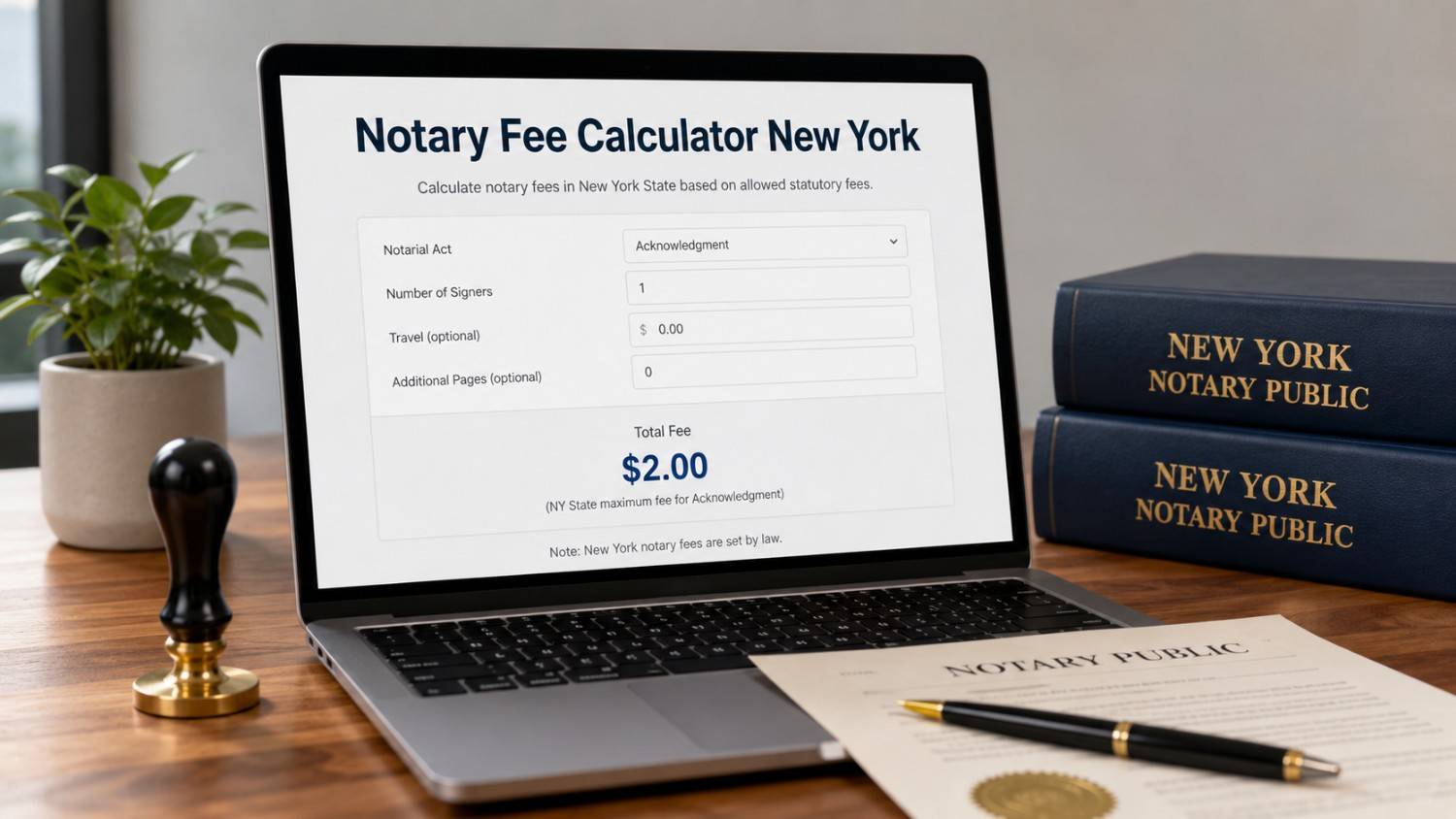
Our New York Notary Fee Calculator helps you estimate applicable notarial fees, compare traditional and electronic notarization, and organize additional quoted costs before arranging an appointment.
Whether you live in New York City, Brooklyn, Queens, Buffalo, Albany, Rochester, Syracuse, or another part of New York State, this guide explains how notary fees work and what you should know before paying.
New York Notary Fees at a Glance (2026)
Here is a quick overview of important New York notary fee limits.
| Notarial service | Statutory fee |
|---|---|
| Administering an oath or affirmation | $2 |
| Acknowledgment or proof of execution for one person | $2 |
| Each additional person for acknowledgment or proof | $2 |
| Swearing each witness | $2 |
| Electronic notarial act | Up to $25 |
| Eligible papering-out certificate of authenticity | $2 |
Traditional fees are governed by New York Executive Law §136. Electronic notarial fees are governed by 19 NYCRR §182.11(g).
2026 Legal Update: Legislative proposals have sought to increase certain traditional notary fees from $2 to $5. A proposed bill does not automatically change the law. Check the latest enacted legislation and effective date before relying on any proposed increase.
New York Notary Fee Calculator
Calculate estimated New York traditional and electronic notarization fees. See your statutory notary fee and additional quoted costs separately.
What Is a New York Notary Fee Calculator?
A New York Notary Fee Calculator is an online tool that helps individuals estimate the statutory fees associated with notarizing documents in New York State.
Instead of manually calculating different notarial services, users can enter relevant information, including the number of documents, people acknowledging an instrument, oaths, witnesses, and electronic notarial acts.
The calculator separates statutory notarial fees from optional user-entered appointment costs.
For example, if two people acknowledge one written instrument before a traditional notary, the statutory acknowledgment fee is generally $4.
However, the number of pages in a document does not automatically determine the notary fee. The actual notarial act and the number of people involved are what matter.
This distinction is especially important when dealing with real estate documents, affidavits, business agreements, and other legal paperwork.
How Much Does a Notary Cost in New York in 2026?
New York has established fee limits for specific notarial services.
Under Executive Law §136, a traditional notary may generally charge:
- $2 for administering an oath or affirmation and certifying it when required.
- $2 for taking and certifying an acknowledgment or proof of execution by one person.
- $2 for each additional person involved in the acknowledgment or proof.
- $2 for swearing each witness.
Electronic notarization has a separate maximum fee of $25 per electronic notarial act.
These are different legal fee categories. A traditional notarial act should not automatically be charged at the electronic notary rate.
Also, an electronic notary’s $25 fee includes the costs incurred by the electronic notary.
Is the New York Notary Fee Per Signature or Per Document?
This is one of the most common questions among New York residents.
The answer depends on the notarial act being performed.
For acknowledgments and proof of execution, New York law provides a $2 fee for one person and $2 for each additional person.
Consider these examples:
Example 1: One person and one acknowledgment
A person acknowledges their signature on a document.
Estimated statutory fee: $2.
Example 2: Two people and one acknowledgment
Two individuals acknowledge their execution of the same written instrument.
Estimated statutory fee: $4.
Example 3: Three people and one acknowledgment
Three individuals acknowledge the execution of an instrument.
Estimated statutory fee: $6.
Example 4: One person and three separate instruments
If three separate instruments each require a separate acknowledgment, the estimated statutory fee is $6.
A ten-page document does not automatically cost $20 simply because it contains ten pages.
The notary must determine the actual number of notarial acts and people involved.
Traditional Notary vs. Electronic Notary in New York
New York recognizes traditional notarization and electronic notarization.
Traditional Notarization
Traditional notarization generally requires the signer to appear personally before the notary.
The notary verifies the person’s identity, determines whether the person is acting voluntarily, and completes the appropriate notarial certificate.
Traditional services may include:
- Acknowledgments.
- Oaths and affirmations.
- Proof of execution.
- Witness swearing.
The applicable fee is determined under Executive Law §136.
Electronic Notarization
Electronic notarization uses electronic records and authorized audiovisual technology.
A New York notary must register with the Department of State before performing electronic notarial acts.
The maximum fee is $25 per electronic notarial act.
This is not a $25 fee for every page or every signature. The number of actual electronic notarial acts determines the applicable fee.
The electronic notary must also comply with identity verification, audiovisual communication, recording, and recordkeeping requirements.
New York Mobile Notary Fees: Are Travel Charges Allowed?
A mobile notary travels to an agreed location instead of requiring the customer to visit an office.
This service may be convenient for:
- Senior citizens.
- Hospital patients.
- Busy professionals.
- Business owners.
- Real estate clients.
- People with mobility limitations.
However, New York’s statutory notary fee schedule does not establish a general statewide mileage rate for mobile notaries.
If a provider quotes a travel or appointment charge, ask for an itemized explanation and the legal basis for the proposed amount.
A separately listed travel charge is not automatically lawful simply because it is described as a different service.
Before booking, ask the provider to explain:
- The actual notarial fee.
- The proposed travel charge.
- Whether the additional service is permitted under applicable rules.
- The complete amount you are expected to pay.
Always request a written quote before confirming your appointment.
Remote Online Notarization in New York
Remote online notarization allows a signer to complete an authorized notarial act through an approved electronic communication process.
This can be useful for people who cannot attend an in-person appointment.
New York has specific requirements for electronic notarization.
Does the Notary Need to Be in New York?
Yes. The electronic notary must be physically located within New York State while performing the electronic notarial act.
However, the signer does not necessarily have to be physically located in New York.
A signer outside the United States may also qualify under specific statutory conditions involving U.S. governmental matters, property, or transactions connected with the United States.
What Identification Is Required?
The electronic notary must use an authorized identity verification procedure.
Depending on the circumstances, this may involve credential analysis, identity proofing, personal knowledge, or another legally permitted method.
How Long Must the Recording Be Kept?
New York requires electronic notarial recordings to be retained for at least ten years.
This is important for people whose documents may need to be verified later.
Can I Use a New York Online Notary From Another State?
Potentially, yes. The electronic notary must be physically in New York when performing the act, and the applicable statutory requirements must be satisfied.
Notary Fees for Affidavits, Power of Attorney and Real Estate Documents
Different documents may require different notarial acts.
Affidavits
An affidavit is a written statement that a person swears or affirms to be true.
When a traditional oath or affirmation is required, the applicable notarial fee is generally $2.
Power of Attorney
A power of attorney allows a principal to authorize an agent to act on their behalf.
New York has specific requirements for executing a power of attorney, including applicable acknowledgment and witness formalities.
The notary’s fee should not be confused with an attorney’s fee for preparing or reviewing the document.
Real Estate Documents
Real estate transactions may involve:
- Deeds.
- Mortgage documents.
- Closing documents.
- Property transfer paperwork.
- Affidavits.
- Other instruments requiring acknowledgment.
A transaction may involve multiple signers and multiple notarial acts.
Title company charges, attorney fees, and closing-service fees are not automatically statutory notary fees.
Business Documents
Business owners may need notarized corporate documents, financial paperwork, authorization forms, or agreements.
The applicable notarial fee depends on the act performed rather than the business purpose of the document.
What Is Papering Out in New York Electronic Notarization?
Papering out refers to preparing a tangible paper copy of an electronically notarized record with an appropriate certificate of authenticity.
This can be useful when a bank, government agency, court, or another organization requires a paper document.
An eligible electronic notary may charge $2 for preparing the certificate of authenticity.
Simply printing an electronic document at home is not the same as completing the formal papering-out procedure.
Can a New York Notary Charge More Than $2?
For traditional notarial acts covered by Executive Law §136, the applicable statutory fee is $2 for the specified services.
Electronic notarial acts have a separate maximum fee of $25.
If a provider quotes a higher amount, ask for an itemized explanation.
A separate service description does not automatically establish that an additional charge is legally permissible.
Keep your written quote and receipt. If you believe a notary has violated applicable rules, you can contact the New York Department of State’s Division of Licensing Services for guidance about filing a complaint.
New York Notary Fee Increase: Is the $5 Proposal Law?
New York legislative proposals have sought to increase certain traditional notary fees from $2 to $5.
However, a bill must pass the legislative process and become effective law before it changes the applicable statutory fee.
Consumers should distinguish between:
- A proposed bill.
- A bill passed by one legislative chamber.
- An enacted law.
- An effective fee change.
Do not assume that a proposed $5 amount is the current statutory fee.
Check the official New York Senate and Assembly legislative records for the latest status.
How to Find a Notary Public in New York
You can find notarial services through several channels.
Banks: Some banks provide notary services to their customers. Availability and appointment requirements vary.
Local notary offices: Independent notary offices may provide traditional notarization.
Mobile notaries: These providers travel to an agreed location. Ask for the full quote before booking.
Electronic notaries: Choose a New York notary registered to perform electronic notarial acts.
County clerk offices: County clerks maintain certain official notary records and provide information about notary-related verification.
The New York Department of State is the primary official source for notary commission and electronic registration information.
What Should You Bring to a Notary Appointment?
Before attending your appointment, prepare:
- An acceptable form of identification.
- The complete document requiring notarization.
- All required signers.
- Any required witnesses.
- Instructions from the receiving organization.
- Confirmation of the required notarial certificate.
- An agreed fee or written price quote.
Do not sign a document beforehand if the receiving organization or notary requires signing in the notary’s presence.
A notary also cannot automatically provide legal advice or determine which legal document is best for your situation.
Does Every Document Need to Be Notarized?
No. Not every document requires notarization.
Whether notarization is necessary depends on the applicable law and the organization receiving the document.
Before arranging an appointment, contact the receiving institution and confirm whether it requires an acknowledgment, oath, witness signatures, traditional notarization, or electronic notarization.
This can help you avoid unnecessary expenses.
Frequently Asked Questions
How much does a notary cost in New York in 2026?
Traditional statutory fees are generally $2 for the specified services under Executive Law §136. Electronic notarial acts have a maximum fee of $25 per act.
Is the New York notary fee $5 now?
Do not assume so. A legislative proposal to increase certain traditional fees does not become law simply because it has been introduced.
Is the $2 fee per signature?
For an acknowledgment or proof of execution, the law provides $2 for one person and $2 for each additional person.
Can a notary charge $25 for each page?
No. The $25 electronic fee applies to each electronic notarial act, not automatically to every page.
Can I get a document notarized online in New York?
Yes, through a properly registered electronic notary who follows New York’s electronic notarization requirements.
Can a New York notary charge a travel fee?
New York does not provide a general statewide mileage rate in Executive Law §136. Verify the legal basis of any additional proposed charge before agreeing to pay.
How much does an affidavit notarization cost?
A traditional oath or affirmation covered by §136 generally carries a $2 statutory fee.
Does a power of attorney need notarization in New York?
New York power of attorney documents have specific execution requirements. Review the applicable law and document instructions to determine the required acknowledgments and witnesses.
Can I use a New York electronic notary while living abroad?
Potentially, subject to additional legal conditions for signers outside the United States.
How long are electronic notary recordings retained?
New York requires electronic notarial recordings to be retained for at least ten years.
Can a notary refuse to notarize my document?
A notary may refuse when legal requirements are not satisfied, identity cannot be established, or another valid reason prevents the act.
Where can I complain about a New York notary?
You can contact the New York Department of State’s Division of Licensing Services for information about notary complaints.
Can a notary give me legal advice?
Not simply because they are a notary. Legal advice should come from a qualified attorney.
Are notary fees the same in New York City and Buffalo?
The statewide statutory fee rules apply throughout New York. Separate service arrangements may differ, subject to applicable law.
What is a certificate of authenticity?
It is a certificate used by an electronic notary to authenticate an eligible tangible paper copy of an electronic notarial record.
Final Thoughts
Understanding New York notary fees before arranging an appointment can help you avoid confusion and unnecessary expenses.
The traditional statutory fee schedule is governed by Executive Law §136, while electronic notarial fees follow a separate regulatory provision.
The most important thing is to identify the actual notarial act, understand the number of people involved, and distinguish statutory fees from separately proposed service charges.
Use the New York Notary Fee Calculator above to estimate your costs and review the breakdown before booking an appointment.
At NewYorkCalculator.com, our goal is to make everyday New York financial, legal, and service-related costs easier to understand through practical calculators and clear information.
Written by Junaidul Islam
Disclaimer: This article is for general informational and educational purposes only. It is not legal advice and does not create an attorney-client relationship. Laws, regulations, and fee requirements may change. Verify current requirements with the New York Department of State or a qualified attorney before making a legal or financial decision.
Official Sources
- New York Department of State – Notary Public FAQs: https://dos.ny.gov/notary-public
- New York Executive Law §136 – Notarial Fees: https://www.nysenate.gov/legislation/laws/EXC/136
- New York Executive Law – Notary Public: https://www.nysenate.gov/legislation/laws/EXC/A6
- New York Senate – Legislative Information: https://www.nysenate.gov/legislation
- New York Assembly – Legislative Information: https://nyassembly.gov/leg/