
Bankruptcy can provide a legal path toward managing overwhelming debt, but the cost of filing is an important concern for many New York residents. Whether you live in New York City, Brooklyn, Queens, Buffalo, Albany, Rochester, Syracuse, or another part of the state, understanding the potential expenses before filing can help you make a more informed financial decision.
The total cost of bankruptcy in New York depends on several factors, including the bankruptcy chapter, attorney fees, court filing fees, mandatory financial education courses, and the complexity of your financial situation.
For 2026, the federal bankruptcy court filing fee is $338 for Chapter 7 and $313 for Chapter 13. These are mandatory court fees for ordinary voluntary individual cases, unless the court grants an applicable fee waiver. Attorney fees and other expenses are separate.
This guide explains the major costs of filing bankruptcy in New York, compares Chapter 7 and Chapter 13, explains possible fee-reduction options, and includes a Bankruptcy Cost Calculator to help estimate your potential expenses.
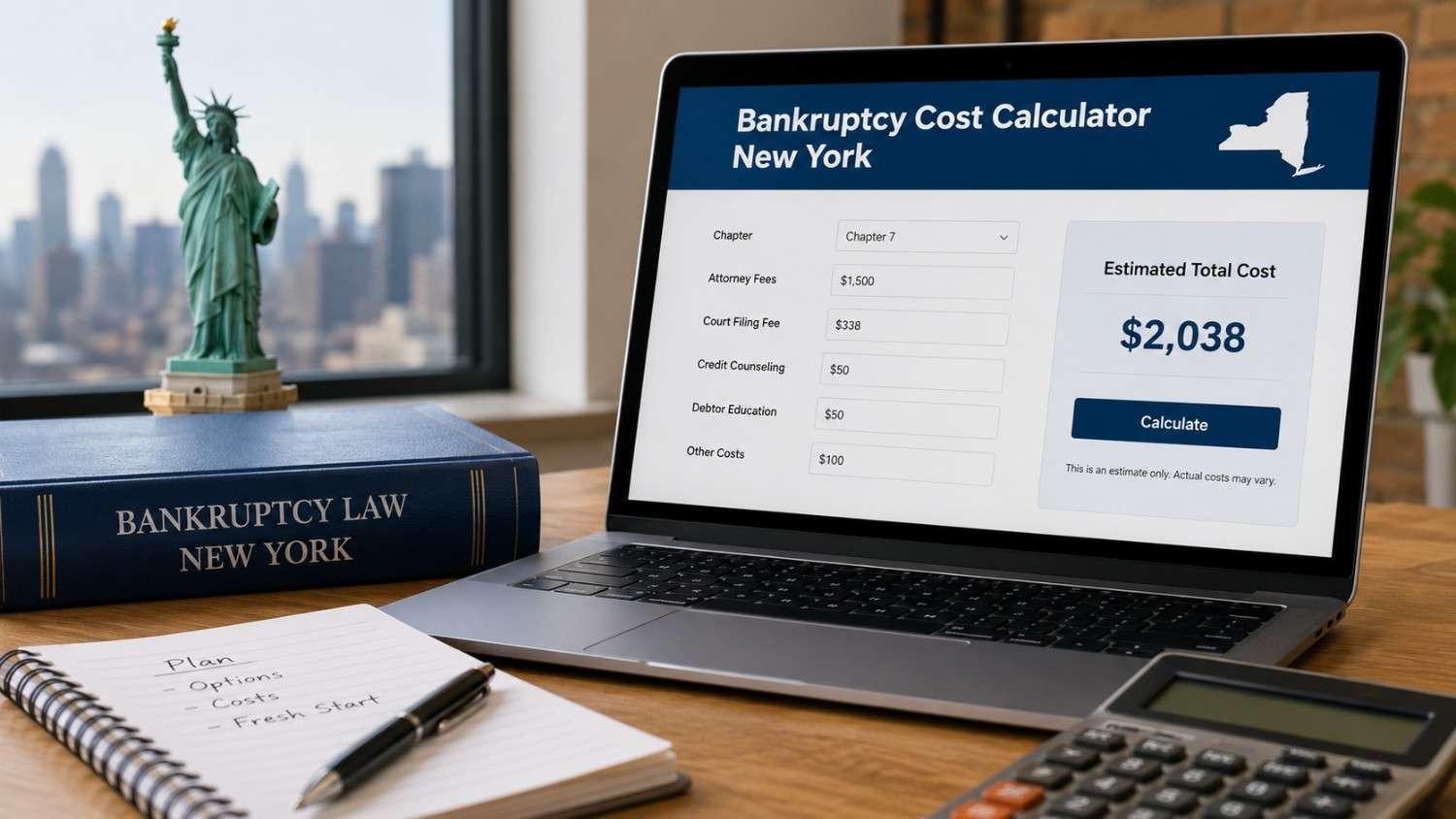
Before exploring the details, use the calculator below to estimate your potential bankruptcy expenses. You can select Chapter 7 or Chapter 13, enter an attorney fee, add financial education costs, and include other expenses.
The calculator uses the published federal filing fees for 2026. Other expenses are based on the amounts you enter, not guaranteed market prices.
New York Bankruptcy Cost Calculator
Estimate Chapter 7 and Chapter 13 bankruptcy expenses for 2026.
Enter your estimated expenses below to calculate potential bankruptcy costs. You can change the amounts to match a quote from your attorney or service provider.
| Court Filing Fee | $338.00 |
| Attorney Fee | $0.00 |
| Credit Counseling | $25.00 |
| Debtor Education | $25.00 |
| Additional Expenses | $0.00 |
| Total Estimated Cost | $388.00 |
Court filing fees: Chapter 7 $338 and Chapter 13 $313. Attorney and course amounts are user-entered estimates.
Important: This calculator provides an educational estimate, not a legal fee quote, bankruptcy eligibility determination, or guarantee of court approval. Actual expenses depend on your case and service providers.
How Much Does Bankruptcy Cost in New York in 2026?
There is no single total price for filing bankruptcy in New York. The court filing fee is set federally, but attorney fees, counseling costs, document expenses, and additional legal work can vary.
The following table shows the main expenses to consider.
| Expense | Chapter 7 | Chapter 13 |
|---|---|---|
| Federal court filing fee | $338 | $313 |
| Attorney fees | Varies | Varies |
| Pre-filing credit counseling | Provider-dependent | Provider-dependent |
| Debtor education course | Provider-dependent | Provider-dependent |
| Document and administrative expenses | If applicable | If applicable |
| Additional legal work | Case-dependent | Case-dependent |
The $338 and $313 filing fees are published federal court amounts. The other costs should be confirmed directly with the relevant attorney or approved course provider.
A person filing without an attorney may avoid attorney fees, but that does not eliminate court fees, required education expenses, or the responsibility for preparing accurate bankruptcy documents.
Chapter 7 Bankruptcy Cost in New York
Chapter 7 bankruptcy is commonly known as liquidation bankruptcy. It may allow eligible individuals to eliminate certain qualifying unsecured debts, subject to bankruptcy law and applicable exemptions.
The official Chapter 7 filing fee in 2026 is $338.
The fee consists of:
| Fee Component | Amount |
|---|---|
| Base filing fee | $245 |
| Administrative fee | $78 |
| Trustee surcharge | $15 |
| Total | $338 |
These amounts are reflected in federal bankruptcy fee information and New York federal court resources.
However, the filing fee is only one part of the total expense.
Chapter 7 Attorney Fees
Many people hire a bankruptcy attorney because the process involves financial disclosures, asset reporting, creditor information, exemptions, and legal requirements.
New York attorney fees are not fixed statewide. The price may depend on:
- Whether the case involves complicated assets.
- The amount and type of debt.
- Whether a business is involved.
- Previous bankruptcy filings.
- Income and household circumstances.
- The attorney’s experience and location.
- Whether creditors challenge an issue.
Published national and New York legal fee discussions provide different estimates. Some published guides place ordinary Chapter 7 attorney fees around $1,500–$3,500, while individual New York firms publish their own estimates.
These are planning references, not a guaranteed New York market rate. Ask for a written engagement agreement that identifies the services included and any additional charges.
Can You File Chapter 7 Without an Attorney?
Yes. Individuals can represent themselves in bankruptcy court, a process known as filing pro se.
However, self-representation does not mean the process is simple.
You are still responsible for:
- Completing the correct bankruptcy petition.
- Listing all creditors and debts.
- Reporting assets and financial accounts.
- Providing income and expense information.
- Understanding applicable exemptions.
- Completing required financial education.
- Meeting filing deadlines.
- Responding to court and trustee requests.
A mistake involving property, income, or creditor information can create serious consequences. If your situation involves a home, business, substantial assets, or disputed debts, consider speaking with a qualified bankruptcy attorney before filing.
Chapter 13 Bankruptcy Cost in New York
Chapter 13 bankruptcy is designed for eligible individuals with regular income who need a court-supervised repayment plan.
Instead of immediately liquidating nonexempt assets, a debtor generally proposes a repayment plan lasting three to five years, subject to statutory requirements and court approval.
The official Chapter 13 filing fee for 2026 is $313.
Its fee breakdown is:
| Fee Component | Amount |
|---|---|
| Base filing fee | $235 |
| Administrative fee | $78 |
| Total | $313 |
Unlike Chapter 7, Chapter 13 involves ongoing plan administration and usually requires more legal work.
Chapter 13 Attorney Fees
Attorney fees for Chapter 13 are generally higher than for a straightforward Chapter 7 case because the lawyer may need to prepare a repayment plan, attend hearings, communicate with the trustee, and address issues during the repayment period.
Published legal fee surveys and guides show that many Chapter 13 cases involve attorney fees in the thousands of dollars. Nolo’s 2026 discussion reports that many surveyed filers paid around $2,500–$5,000, with costs varying by location and complexity.
New York-specific court procedures and local fee guidelines may affect what an attorney charges and how fees are approved.
Can Chapter 13 Attorney Fees Be Paid Monthly?
In many Chapter 13 cases, an attorney may accept an initial payment and receive some remaining fees through the approved repayment plan.
However, the arrangement depends on the attorney, applicable court procedures, and the specific case.
Before signing an agreement, ask:
- How much must be paid before filing?
- Which services are included?
- Can the remaining legal fees be paid through the plan?
- Are hearings, modifications, or contested matters charged separately?
- What happens if the case is dismissed?
Chapter 7 vs. Chapter 13: Which Costs More?
The court filing fee for Chapter 7 is $25 higher than Chapter 13 in 2026. However, the total cost of a bankruptcy case is not determined by the filing fee alone.
| Comparison | Chapter 7 | Chapter 13 |
|---|---|---|
| Filing fee | $338 | $313 |
| Main purpose | Liquidation | Repayment plan |
| Typical plan duration | No 3–5 year repayment plan | Generally 3–5 years |
| Attorney expenses | Case-dependent | Often higher |
| Attorney fee payment | Generally paid before filing | Some fees may be paid through the plan |
| Means test | Applies to individual consumer cases under applicable rules | Different eligibility and income rules |
| Property treatment | Exemptions and liquidation rules apply | May allow repayment-based property protection |
| Financial education | Required | Required |
Neither chapter is automatically better or cheaper for everyone.
For example, a person who wants to catch up on missed mortgage payments may consider Chapter 13, while an eligible person with qualifying unsecured debt may consider Chapter 7.
The appropriate option depends on income, assets, debt, financial goals, and legal eligibility.
Bankruptcy Attorney Fees in New York by Location
New York has different local legal markets. A bankruptcy lawyer in Manhattan may have a different fee structure from a lawyer in Buffalo or Rochester.
However, there is no official statewide price list for bankruptcy attorneys.
The following locations are useful starting points when requesting local estimates:
| New York Location | What to Compare |
|---|---|
| Manhattan | Attorney fees and case complexity |
| Brooklyn | Chapter 7 and Chapter 13 service packages |
| Queens | Initial consultation and payment terms |
| Bronx | Flat fees and additional service charges |
| Buffalo | Local attorney pricing |
| Albany | Chapter 7 and Chapter 13 quotes |
| Rochester | Attorney fees and repayment-plan services |
| Syracuse | Legal consultation and case expenses |
| Long Island | Nassau and Suffolk County attorney quotes |
| White Plains | Southern District legal services |
Do not assume that a lawyer in a particular city will always charge more or less. Obtain at least two or three written quotes and compare what each quote actually covers.
The Four Federal Bankruptcy Districts in New York
New York State is divided into four federal bankruptcy districts. Knowing the correct district matters because bankruptcy cases are filed in the appropriate federal court, not simply in any courthouse convenient to the debtor.
The four districts are:
1. Southern District of New York (SDNY)
This district includes Manhattan, the Bronx, and several surrounding counties. It serves many residents in the New York City metropolitan area.
Official website: https://www.nysb.uscourts.gov/
2. Eastern District of New York (EDNY)
This district includes Brooklyn, Queens, Staten Island, Nassau County, and Suffolk County.
Official website: https://www.nyeb.uscourts.gov/
3. Northern District of New York (NDNY)
This district serves a large part of upstate New York, including areas around Albany, Syracuse, and other northern communities.
Official website: https://www.nynb.uscourts.gov/
4. Western District of New York (WDNY)
This district covers western New York, including the Buffalo and Rochester areas.
Official website: https://www.nywb.uscourts.gov/
Your residence and applicable venue rules determine where a case should be filed. If you are unsure, use the federal court locator or contact the appropriate bankruptcy court for procedural information.
Credit Counseling Costs Before Filing Bankruptcy
Before filing an individual bankruptcy case, most debtors must complete a credit counseling briefing from an organization approved by the U.S. Trustee Program, subject to statutory exceptions.
The counseling must generally be completed during the 180 days before filing.
The session reviews your financial situation, budget, and possible alternatives to bankruptcy.
The cost depends on the provider. Some providers charge a modest fee, while others may offer reduced fees or waivers for people who cannot afford the service.
Before paying, check:
- Whether the provider is approved for your bankruptcy district.
- Whether the fee includes the required certificate.
- Whether financial hardship discounts are available.
- Whether online or telephone sessions are offered.
A certificate of completion must generally accompany the required bankruptcy filing documents.
Official information: https://www.justice.gov/ust/credit-counseling-debtor-education-information
Debtor Education Course Costs After Filing
Credit counseling and debtor education are two separate requirements.
After filing, an individual debtor generally must complete an approved debtor education or financial management course to receive a discharge, unless an exception applies.
This course focuses on subjects such as:
- Budgeting.
- Managing personal finances.
- Using credit responsibly.
- Financial planning.
- Avoiding future debt problems.
The course fee varies by provider. Ask about hardship waivers and confirm that the provider is approved.
Do not assume that completing pre-filing credit counseling also satisfies the post-filing education requirement.
Can You Get the Bankruptcy Filing Fee Waived in New York?
Some individuals filing Chapter 7 may qualify for a court filing fee waiver.
Under federal law, the court may waive the Chapter 7 filing fee when the applicant satisfies the applicable financial eligibility requirements.
Generally, the individual must demonstrate that:
- The case is filed under Chapter 7.
- Household income is below 150% of the applicable federal poverty guideline.
- The individual cannot afford to pay the filing fee in installments.
Meeting the income threshold alone does not automatically guarantee approval.
The court reviews the application and financial information before making a decision.
How to Request a Fee Waiver
The official application is Form 103B – Application to Have the Chapter 7 Filing Fee Waived.
You can find official bankruptcy forms at:
https://www.uscourts.gov/forms/bankruptcy-forms
You should also review the instructions provided by your specific New York bankruptcy district.
Important: A Chapter 7 filing fee waiver is not the same as free attorney representation. It does not automatically cover lawyer fees, education courses, or every other bankruptcy-related expense.
Can You Pay Bankruptcy Filing Fees in Installments?
If you cannot afford the entire court filing fee immediately, you may request permission to pay in installments.
Individuals filing voluntary bankruptcy cases may generally apply using Official Form 103A.
Under the applicable rules, the court may permit up to four payments, with the final payment generally due within 120 days after filing the petition, subject to applicable court requirements.
Missing a required payment can put your bankruptcy case at risk of dismissal.
Before filing, review the payment procedure of your bankruptcy district and make sure you understand the deadlines.
Official filing fee information:
https://www.nyeb.uscourts.gov/filing-fees
What Other Expenses Can Increase Bankruptcy Costs?
The court filing fee is only one part of the financial picture.
Depending on your situation, you may need to budget for additional expenses.
1. Financial Education Courses
The two required financial education services may have separate fees. Ask providers about hardship discounts.
2. Attorney Consultation
Some attorneys provide free initial consultations, while others charge for reviewing documents or providing extended advice.
3. Document Preparation
Printing, copying, obtaining financial records, and organizing supporting documents may create small additional expenses.
4. Credit Reports
You may need to obtain information from credit reporting agencies to identify accounts and creditors accurately.
5. Additional Legal Work
A contested matter, creditor objection, complicated property issue, or repayment plan modification can increase legal costs.
6. Travel and Time Away From Work
Although these are not court filing fees, travel, parking, childcare, and missed work may affect the actual cost of completing a bankruptcy case.
A realistic budget should consider both direct expenses and the time required to complete the process.
What Happens If You Cannot Afford a Bankruptcy Lawyer?
Not everyone can afford private legal representation. There may be alternative resources for eligible New York residents.
Consider the following options:
Legal Aid Organizations: Some nonprofit legal service organizations provide assistance to qualifying low-income individuals.
Pro Bono Attorneys: Local bar associations and legal service organizations may help connect eligible individuals with volunteer attorneys.
Law School Clinics: Certain law schools operate supervised legal clinics that may provide limited assistance.
Free Bankruptcy Filing Resources: Nonprofit organizations such as Upsolve offer information and tools that may help eligible individuals prepare certain Chapter 7 filings.
These services have eligibility restrictions and may not be suitable for complicated cases.
Never assume that a free online filing service can handle every type of bankruptcy matter.
Does Bankruptcy Cost More in New York City Than Upstate New York?
It can, but the difference is not automatic.
Attorney fees are influenced by local operating costs, the attorney’s experience, the amount of work involved, and the complexity of the case.
New York City has a different legal market from smaller upstate communities. However, an experienced lawyer in Buffalo or Albany may charge more for a complicated case than another lawyer in New York City charges for a straightforward case.
The federal filing fees are the same for eligible Chapter 7 and Chapter 13 cases across New York’s four bankruptcy districts.
The best way to compare costs is to request itemized written estimates rather than relying on general city-based averages.
How to Choose a Bankruptcy Attorney Without Overpaying
Choosing the cheapest attorney is not necessarily the best financial decision.
Before hiring someone, ask:
- Does the attorney regularly handle Chapter 7 or Chapter 13 cases?
- Is the quoted fee flat-rate or hourly?
- Does the fee include court appearances?
- Are additional motions charged separately?
- Is the Chapter 13 fee subject to court review?
- What happens if the case is dismissed?
- Are payment plans available?
- Will you receive a written fee agreement?
You can verify an attorney’s license through the New York State Unified Court System attorney search.
Official website: https://iapps.courts.state.ny.us/attorneyservices/search
A written agreement helps you understand what you are paying for before committing to legal representation.
Bankruptcy Costs That Your Calculator Cannot Fully Predict
A bankruptcy calculator is useful for financial planning, but it cannot determine every expense.
For example, a calculator cannot reliably predict:
- Whether a creditor will challenge your discharge.
- Whether the trustee will investigate a particular asset.
- Whether additional hearings will be required.
- Whether you need to amend your bankruptcy schedules.
- Whether a repayment plan will be approved.
- Whether you need separate legal representation for a related dispute.
Your actual expenses may be higher or lower than the initial estimate.
Use the calculator as a starting point and obtain professional advice for case-specific decisions.
How Bankruptcy Affects Your Credit Report
Cost is not the only consideration when evaluating bankruptcy.
A bankruptcy filing can remain on your credit report for a significant period.
Generally:
- Chapter 7 bankruptcy may remain for up to 10 years from the filing date.
- Chapter 13 bankruptcy may remain for up to 7 years from the filing date.
The actual effect on a credit score varies depending on your previous credit history and other financial information.
Bankruptcy does not mean you can never rebuild credit. Responsible payment habits, controlled borrowing, and regular credit monitoring can help you work toward improving your financial position over time.
How Long Does Bankruptcy Take in New York?
The timeline depends on the chapter, court procedures, case complexity, and whether any disputes arise.
Chapter 7: Many straightforward individual cases receive a discharge within several months, often around four to six months after filing.
Chapter 13: A repayment plan generally lasts three to five years. The discharge typically comes after successful completion of the applicable requirements.
These are general timelines, not guaranteed completion dates.
Is Bankruptcy Worth the Cost?
Whether bankruptcy is worth the expense depends on your overall financial circumstances.
For someone dealing with overwhelming credit card debt, medical bills, collection actions, or other qualifying unsecured obligations, bankruptcy may provide relief that would otherwise be difficult to achieve.
However, it is not appropriate for every situation.
Before filing, consider:
- Your total unsecured debt.
- Your household income.
- Your essential monthly expenses.
- Your property and available exemptions.
- Your ability to repay debt outside bankruptcy.
- Whether the debts are dischargeable.
- The long-term consequences of filing.
You may also want to explore nonprofit credit counseling or other debt-management alternatives before making a decision.
Frequently Asked Questions
1. How much does it cost to file bankruptcy in New York in 2026?
The federal filing fee is $338 for Chapter 7 and $313 for Chapter 13. Attorney fees, education courses, and additional expenses are separate.
2. Is Chapter 7 cheaper than Chapter 13?
The Chapter 7 court filing fee is $25 higher. However, Chapter 13 usually involves more extensive legal work and a repayment plan, so the total cost can be higher.
3. Can I file bankruptcy in New York for free?
Some eligible Chapter 7 individuals may receive a court filing fee waiver. Free or reduced-cost legal assistance may also be available to qualifying residents. Not every expense is automatically waived.
4. Can I pay my bankruptcy filing fee monthly?
You may request permission to pay the court filing fee in installments using Official Form 103A. The court must approve the request.
5. How much does a Chapter 7 bankruptcy lawyer cost in New York?
Attorney fees vary by location and case complexity. Published estimates often range from approximately $1,500 to $3,500 for many ordinary cases, but an individual attorney must provide the actual quote.
6. How much does a Chapter 13 bankruptcy lawyer cost?
Chapter 13 attorney fees often run into several thousand dollars. The exact amount depends on the district, complexity, and applicable fee procedures. Some fees may be paid through the repayment plan.
7. Do I need a lawyer to file bankruptcy in New York?
Individuals may represent themselves, but they must comply with all bankruptcy rules and filing requirements. Legal advice is particularly important for complicated financial situations.
8. Are bankruptcy filing fees the same throughout New York?
The federal filing fees for Chapter 7 and Chapter 13 are the same across the four New York bankruptcy districts.
9. Does credit counseling cost extra?
It may. Approved providers set their own charges, although reduced fees or waivers may be available for individuals who cannot afford the service.
10. Do I need two financial education courses?
Generally, individual debtors must complete pre-filing credit counseling and a separate post-filing debtor education course, subject to applicable exceptions.
11. Can married couples file bankruptcy together?
Married spouses may generally file a joint bankruptcy petition. However, whether joint filing is financially and legally appropriate depends on their debts, assets, income, and individual circumstances.
12. Will bankruptcy eliminate all my debts?
No. Certain obligations, including most child support and alimony obligations, are generally not dischargeable. Many student loans are also subject to special discharge rules. The treatment of taxes and other debts depends on specific legal requirements.
13. Can I keep my house if I file bankruptcy in New York?
Possibly. The result depends on the bankruptcy chapter, equity in the property, available exemptions, mortgage status, and other facts. Chapter 13 may provide a way to catch up on certain missed mortgage payments, but it does not automatically protect every home.
14. How long does bankruptcy stay on my credit report?
Chapter 7 may remain for up to 10 years, while Chapter 13 may remain for up to 7 years, measured from the filing date.
15. Does the Bankruptcy Cost Calculator provide an exact quote?
No. It provides an estimate using your inputs and published court filing fees. It does not replace an attorney’s written quote or determine your legal eligibility.
Official Sources and Further Reading
The following resources provide primary legal, court, and educational information relevant to New York bankruptcy costs.
- U.S. Bankruptcy Courts – Official Forms: https://www.uscourts.gov/forms/bankruptcy-forms
- Eastern District of New York – Filing for Bankruptcy: https://www.nyeb.uscourts.gov/filing-bankruptcy-individuals
- Eastern District of New York – Filing Fees: https://www.nyeb.uscourts.gov/filing-fees
- Southern District of New York – Information for Petitioners: https://www.nysb.uscourts.gov/information-petitioners
- U.S. Trustee Program – Credit Counseling and Debtor Education: https://www.justice.gov/ust/credit-counseling-debtor-education-information
- Nolo – Bankruptcy Filing Fees and Costs: https://www.nolo.com/legal-encyclopedia/bankruptcy-filing-fees-costs.html
- Upsolve – How Much Does Bankruptcy Cost?: https://upsolve.org/learn/how-much-does-bankruptcy-cost/
- New York State Unified Court System – Attorney Search: https://iapps.courts.state.ny.us/attorneyservices/search
Important Legal Disclaimer
This article and the Bankruptcy Cost Calculator are provided for general educational and informational purposes only. They do not constitute legal, tax, financial, or professional advice. Bankruptcy laws and court procedures can change, and individual cases may have different requirements.
The calculator does not determine bankruptcy eligibility, predict court approval, or provide an attorney fee quotation. Always verify current filing fees and requirements with the appropriate federal bankruptcy court. Consider consulting a qualified New York bankruptcy attorney before making a filing decision.
About the Author
Junaidul Islam writes practical financial and cost-related guides for NewYorkCalculator.com. His goal is to make complicated cost information easier to understand through clear explanations, useful calculators, and references to authoritative sources.
Last reviewed: October 12, 2026.