
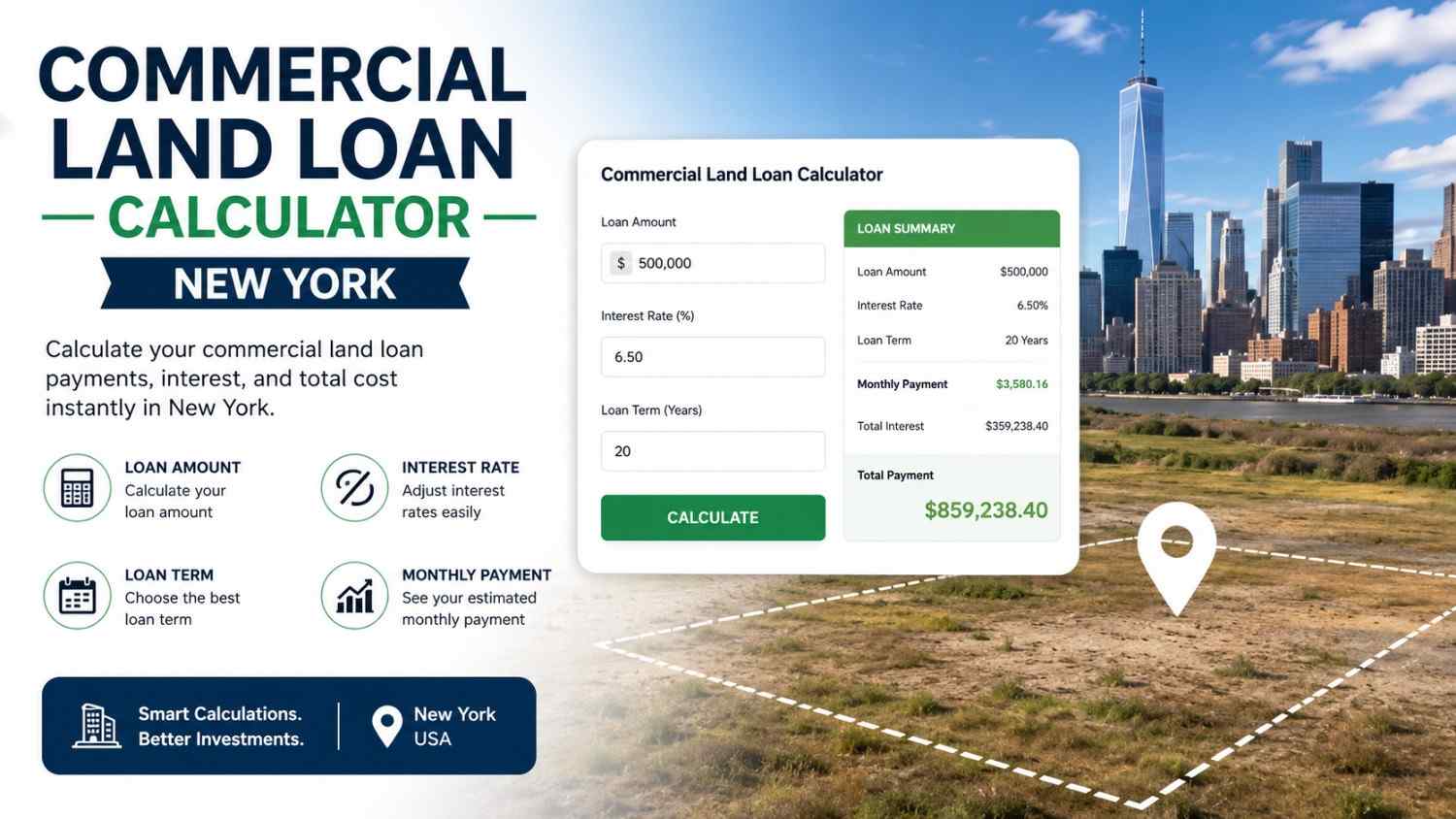
Buying commercial land in New York can be a major investment, whether you are planning to develop a warehouse, build retail space, acquire an industrial parcel, or hold vacant land for a future project. Before making an offer, it helps to understand how much you may need to borrow, how much cash you should prepare, and what your financing could cost over time.
The Commercial Land Loan Calculator New York on NewYorkCalculator.com helps you estimate your loan amount, monthly principal and interest payment, total interest, potential balloon balance, and estimated cash needed at closing. You can adjust the purchase price, down payment, interest rate, loan term, and other assumptions to compare different financing scenarios.
The results are estimates, not a loan approval or a lender quote. Actual commercial land financing terms depend on the property, its intended use, the borrower’s financial position, the lender’s underwriting criteria, and the final loan documents.
Use the calculator below to estimate financing costs for a commercial land purchase in New York. Enter your expected purchase price, down payment, annual interest rate, repayment period, and any known closing expenses. If your loan has a shorter maturity than its amortization period, you can also estimate the remaining balloon balance.
Commercial Land Loan Calculator
Estimate your land loan payment, interest, balloon balance and cash needed at closing.
| Year | Payments | Principal Paid | Interest Paid | Ending Balance |
|---|
Important: This calculator provides educational estimates, not a loan offer, approval, tax calculation, or financial advice. Actual terms and costs depend on your lender, loan documents, property, and jurisdiction. Balloon balances are not automatically refinanced. Closing costs are only as complete as the amounts you enter.
For planning purposes only · NewYorkCalculator.com
Calculator note: The monthly payment estimate assumes the interest rate and repayment structure entered by the user. Property taxes, insurance, legal fees, lender-specific charges, and mortgage recording taxes are not automatically included unless entered as separate costs.
What Is a Commercial Land Loan?
A commercial land loan is financing used to purchase land intended primarily for business, investment, or commercial development purposes. Depending on the lender and the transaction, the property might be vacant raw land, a parcel with road access and utilities, or a site prepared for future development.
Commercial land loans are not necessarily structured like standard residential mortgages. A lender may pay particular attention to the property’s permitted use, development feasibility, access, environmental condition, borrower experience, and repayment strategy.
For example, purchasing a parcel for a future warehouse is different from buying an already developed commercial building with established rental income. Vacant land may not generate cash flow while the borrower pays interest and other holding expenses.
That distinction matters when estimating how much financing you can afford.
How to Use the Commercial Land Loan Calculator
Follow these steps to create a useful estimate before speaking with a lender.
1. Enter the commercial land purchase price.
Use the expected contract price rather than the total cost of a future construction project. If you plan to build on the land, keep construction costs separate unless your financing arrangement explicitly combines the two.
2. Enter your down payment.
You can use a dollar amount or a percentage of the purchase price. Your down payment reduces the amount financed, but the lender may require additional cash for fees, reserves, or other project expenses.
3. Enter the expected annual interest rate.
Use a rate quoted by a lender when available. If you are comparing hypothetical rates, label them as assumptions rather than current New York market offers.
4. Choose the loan term and amortization period.
These are not always the same. A loan may mature in five years while payments are calculated over a longer amortization period. This structure can leave a substantial balance due when the loan matures.
5. Add estimated closing costs.
Enter known lender fees, appraisal charges, legal costs, title expenses, survey costs, and other transaction expenses where applicable. Avoid counting the same expense twice.
6. Review the results.
Compare the estimated monthly payment, total scheduled interest, remaining principal at maturity, and cash needed at closing. Try changing one assumption at a time to see how the financing changes.
Commercial Land Loan Example: A $500,000 Purchase
Consider a hypothetical commercial land purchase in New York with the following assumptions:
- Purchase price: $500,000
- Down payment: 30%, or $150,000
- Starting loan principal: $350,000
- Illustrative annual interest rate: 8%
- Amortization period: 20 years
- Loan structure: Fully amortizing, with no separate balloon maturity
Under these assumptions, the estimated monthly principal and interest payment is approximately $2,928.
Over 20 years, the total scheduled payments would be approximately $702,700, including about $352,700 in interest. The figures are rounded estimates and exclude closing costs, taxes, insurance, and other expenses.
This example illustrates why the interest rate and repayment period matter. A lower monthly payment can result from a longer amortization period, but the borrower may pay more interest over the life of the loan.
The example is not a representation of a current lender offer or a prediction of the rate you will qualify for.
How Much Down Payment Do You Need for Commercial Land in New York?
There is no single down payment percentage that applies to every commercial land loan in New York. Requirements can vary considerably by lender, land type, borrower finances, development plans, and the amount of risk associated with the project.
A lender may assess whether the parcel has road access, utilities, an acceptable zoning designation, a realistic development plan, and sufficient collateral value. Raw land without utilities or clear development prospects may be evaluated differently from a serviced commercial lot.
Your financial profile may also matter. Lenders can review liquidity, credit history, business financial statements, relevant experience, other debt obligations, and the proposed repayment strategy.
For planning purposes, compare several down payment scenarios rather than assuming one percentage is guaranteed. For example, test 20%, 30%, and 40% down in the calculator. These are comparison scenarios, not stated lending requirements.
Remember that a down payment is not the same as total cash needed to close. You may need additional funds for due diligence, professional services, lender fees, recording costs, and reserves.
Raw Land vs. Improved Land vs. Development Land
The condition and readiness of a parcel can influence financing decisions.
Raw land
Raw land may lack installed utilities, road access, drainage infrastructure, or other improvements. Its development potential may depend on future approvals and infrastructure work. These uncertainties can affect valuation, due diligence, and lender underwriting.
Improved land
Improved land may have better access, utilities, or other infrastructure already in place. That can reduce some development uncertainties, although it does not guarantee financing approval or a particular interest rate.
Development-ready land
A parcel described as development-ready should still be checked carefully. The buyer should verify permitted uses, approvals, easements, utility capacity, access rights, environmental concerns, and any conditions attached to permits.
Do not rely solely on a listing description. Verify the facts with the relevant municipality, qualified professionals, and the property’s legal records.
Interest Rate, Loan Term, and Amortization: What Is the Difference?
These three inputs affect your financing in different ways.
Interest rate: The annual rate charged on the outstanding principal. A higher rate generally increases the payment on an otherwise identical amortizing loan.
Loan term or maturity: The period before the loan must be repaid, renewed, refinanced, or otherwise settled under its contract.
Amortization period: The schedule used to calculate principal-and-interest payments. It can be longer than the actual loan term.
For instance, a five-year loan with payments calculated over 20 years may have a lower scheduled payment than a five-year fully amortizing loan. However, if the loan matures after five years, the borrower may still owe a large principal balance.
That remaining amount is commonly called a balloon payment.
Before accepting this structure, consider whether the business or investment could support the balance at maturity. Refinancing is not guaranteed, and future interest rates or property values may differ from today’s assumptions.
Interest-Only Commercial Land Financing
Some financing arrangements may allow interest-only payments for a specified period. During that period, the borrower pays interest without regularly reducing principal.
For example, a $350,000 balance at an illustrative annual rate of 8% would produce an interest-only payment of approximately $2,333 per month, assuming a constant balance and a simple monthly rate calculation.
That payment is lower than the fully amortizing payment in the example above, but the principal generally remains outstanding. Once the interest-only period ends, payments may increase, or a balloon balance may become due, depending on the agreement.
Always distinguish interest-only payments from a fully amortizing loan when comparing offers.
New York Closing Costs for a Commercial Land Purchase
Closing costs can materially affect the cash required to acquire commercial land. The exact amount depends on the transaction, the lender, the property location, and the services required.
Potential costs include:
- Lender origination or underwriting fees
- Appraisal and valuation expenses
- Title search and title insurance
- Attorney and closing services
- Boundary survey and other land-related reports
- Environmental assessments, when required
- Recording and filing charges
- Mortgage recording tax, where applicable
- Other lender-required reports, reserves, or transaction expenses
Some expenses may be paid before closing, while others may be included in the closing statement. Certain costs can also vary depending on who pays them under the purchase contract.
For this reason, enter only the costs you expect to pay and avoid treating a general percentage as a guaranteed closing-cost estimate.
Mortgage Recording Tax: New York State vs. New York City
Mortgage recording tax is an important issue to investigate when financing property in New York. State and local rules can affect the tax due when a mortgage is recorded, and local taxes may apply in addition to state taxes.
New York City’s official guidance explains that the combined state and city mortgage recording tax depends on the mortgage amount. The tax applies to mortgages recorded on property in the five boroughs, subject to applicable exceptions. NYC directs users to its Automated City Register Information System (ACRIS) to calculate the tax due.
Official resources:
- New York State Tax Department: https://www.tax.ny.gov/pit/mortgage/mtgidx.htm
- NYC Department of Finance: https://www.nyc.gov/site/finance/taxes/property-recording-property-related-documents.page
Do not assume that a property in Albany, Buffalo, Rochester, or another New York location has the same local tax treatment as a property in Manhattan, Brooklyn, Queens, the Bronx, or Staten Island. Confirm the property’s jurisdiction and the rules applicable to the actual transaction.
The calculator’s general closing-cost input is not a substitute for an official mortgage recording tax calculation. Tax treatment, exemptions, and the allocation of costs should be verified before closing.
Property Taxes and Ongoing Land Ownership Costs
Your monthly loan payment is only one part of the cost of holding commercial land.
Depending on the parcel and its use, you may need to budget for property taxes, liability coverage, security, maintenance, site inspections, utility charges, and professional services. Land held for future development may generate little or no income while these expenses continue.
Property taxes should be researched using the applicable local assessment and tax information. Do not use a statewide or NYC rate as a universal rate for every parcel. The assessment, property classification, local taxing jurisdictions, and exemptions can affect the amount owed.
If you intend to develop the property, also consider the timing of approvals, site preparation, infrastructure installation, and construction funding. Delays can increase carrying costs.
A practical affordability estimate should therefore include both financing costs and the expected cost of holding the land.
How Lenders May Evaluate a Commercial Land Loan
Commercial lenders may consider several factors before determining whether to finance a parcel.
Loan-to-value (LTV): This compares the loan amount with the property’s accepted value or another valuation basis specified by the lender. The exact calculation depends on the underwriting method.
Borrower financial strength: Lenders may review available cash, credit history, existing obligations, business financial statements, and relevant investment or development experience.
Property condition and legal status: Title issues, access rights, easements, zoning restrictions, environmental concerns, and utility availability can influence the property’s suitability.
Repayment strategy: A lender may want to understand whether repayment will come from business cash flow, other assets, a property sale, refinancing, or income generated after development.
Project feasibility: For development land, the proposed use, budget, approval status, timeline, and construction financing plan may be important.
If the land is expected to produce income, a lender may also consider net operating income and debt service coverage ratio (DSCR). However, a vacant parcel with no operating income should not be evaluated using assumed rental income that does not yet exist.
No calculator can reliably predict approval without the lender’s underwriting process.
What Is LTV, and How Can You Calculate It?
Loan-to-value is a measure of the loan relative to the property’s value.
The basic formula is:
LTV = Loan Amount ÷ Property Value × 100
For example, if a lender uses a property value of $500,000 and the loan amount is $350,000, the resulting LTV is 70%.
A 70% LTV does not automatically mean a lender will approve the loan. The lender may use its own valuation, apply additional requirements, or consider other risks. Purchase price and appraised value may not be identical.
Use LTV as a planning measure, not a guarantee of financing eligibility.
What Is DSCR, and Does It Apply to Vacant Land?
Debt service coverage ratio compares income available for debt service with the required debt payments.
A common simplified formula is:
DSCR = Net Operating Income ÷ Annual Debt Service
If a property produces $120,000 in annual net operating income and annual debt service is $100,000, the DSCR is 1.20.
However, this example assumes that the property actually produces the stated income and that the figures are calculated on a consistent basis. A vacant parcel with no operating income may have no meaningful current property-level DSCR.
Some lenders may evaluate a broader business repayment plan or the borrower’s other financial resources. Ask the lender which income and expenses it uses for underwriting.
Land Due Diligence Before You Close
A favorable payment estimate does not mean the land is suitable for your intended project. Before committing to a purchase, review the following items with qualified professionals.
1. Zoning and permitted use
Confirm whether the municipality permits your intended commercial use. Verify applicable zoning restrictions, setbacks, height limits, density rules, parking requirements, and approval processes.
2. Legal access and easements
Check whether the parcel has legally sufficient access and whether easements, rights-of-way, restrictions, or shared access arrangements could affect development.
3. Survey and boundary verification
A current survey may help identify boundaries, encroachments, access issues, and other matters that deserve further review.
4. Utilities and infrastructure
Confirm the availability and capacity of water, sewer, electricity, drainage, and other required services. A utility line near the property does not necessarily guarantee an affordable connection.
5. Environmental conditions
Depending on the property’s history and intended use, an environmental assessment may be appropriate. Wetlands, contamination, drainage, flood exposure, or other site conditions can affect development feasibility and cost.
6. Title and recorded documents
A qualified real estate attorney or title professional can help investigate ownership, liens, restrictions, and other recorded matters.
7. Total project budget
If the land is intended for development, prepare a separate budget for design, permits, engineering, site work, infrastructure, construction, contingencies, and financing costs.
New York State’s official resources can help you begin researching land-use and environmental matters:
- New York State Department of State: https://dos.ny.gov/
- New York State Department of Environmental Conservation: https://dec.ny.gov/
Local requirements differ, so verify the rules for the exact parcel rather than relying on general state-level guidance.
How to Compare Two Commercial Land Loan Offers
The loan with the lowest monthly payment is not necessarily the least expensive option.
When comparing offers, examine the following:
| Comparison factor | What to check |
|---|---|
| Interest rate | Fixed or variable, and how adjustments work |
| Loan term | Actual maturity date |
| Amortization | Period used to calculate scheduled payments |
| Balloon balance | Principal due at maturity, if any |
| Fees | Origination, underwriting, appraisal, legal, and other charges |
| Prepayment terms | Whether early repayment triggers a fee or restriction |
| Required reserves | Cash the lender requires you to retain |
| Guarantees and collateral | Personal guarantees or additional security requirements |
| Closing costs | Which expenses are paid by the borrower |
| Extension options | Conditions and fees, if an extension is available |
Compare the total cost over the same time horizon. If one loan matures in five years and another in ten, looking only at their monthly payments may hide important differences.
Request written term sheets and review the final loan documents with an appropriate professional before making a commitment.
Frequently Asked Questions
Can I get a commercial land loan in New York?
Commercial land financing may be available through banks, commercial lenders, credit unions, or other financing providers, depending on the property and borrower. Eligibility, terms, collateral requirements, and permitted uses vary. Contact lenders that finance the specific type of land you intend to purchase.
How much does a $500,000 commercial land loan cost per month?
The payment depends on the amount borrowed, interest rate, amortization period, and repayment structure. For example, a $350,000 loan at an illustrative 8% annual rate amortized over 20 years has an estimated monthly principal-and-interest payment of about $2,928. That example excludes other expenses.
Are commercial land loans more expensive than building loans?
Not necessarily in every transaction. Pricing and terms depend on the lender, property, project, borrower, and loan structure. Raw land, improved land, construction financing, and loans secured by completed income-producing property involve different risks and underwriting considerations.
Does the calculator include New York mortgage recording tax?
The calculator provides a general closing-cost input but does not automatically determine the official tax for every New York jurisdiction. For NYC property, use the official ACRIS tax calculator and verify applicable state and local rules. Other locations may have different requirements.
What is a balloon payment on a commercial land loan?
A balloon payment is a large balance due at the loan’s maturity when scheduled payments have not fully repaid the principal. A loan can have monthly payments based on a long amortization period but mature much earlier.
Can I calculate an interest-only payment?
Yes. For a simple interest-only estimate, multiply the outstanding principal by the annual interest rate and divide by 12. For example, $350,000 at 8% produces an estimated $2,333 monthly interest payment while the principal remains unchanged. Contract terms may use different calculations.
What costs should I budget for besides the down payment?
Potential costs include lender fees, legal services, appraisal, title work, surveys, environmental reports, recording charges, applicable taxes, and reserves. The exact list and amounts depend on the transaction. Add known costs individually to avoid double-counting.
Is a commercial land loan calculator an approval tool?
No. It estimates payments and financing costs using your inputs. Only a lender can evaluate your application, establish underwriting requirements, and issue a financing offer.
What documents might a lender request?
Depending on the transaction, a lender may request identification, financial statements, tax returns, bank statements, business documents, a purchase contract, property information, a survey, zoning information, environmental reports, and a development budget. Requirements vary by lender and project.
Should I buy commercial land before confirming zoning?
It is generally prudent to investigate zoning and permitted use before committing to a purchase. Contract contingencies and due diligence periods may provide important protections, but their availability and effect depend on the agreement. Consult a qualified local real estate attorney.
Final Thoughts
Commercial land financing in New York requires more than estimating a monthly payment. The loan structure, cash required at closing, maturity balance, property taxes, local recording taxes, development feasibility, and due diligence can all affect the investment.
Use the Commercial Land Loan Calculator on NewYorkCalculator.com to compare realistic scenarios before requesting lender quotes. Keep your assumptions conservative, verify transaction-specific costs, and confirm current rules with official sources and qualified professionals.
The calculator is an educational planning tool. It does not provide lending, tax, legal, or investment advice and does not guarantee a loan approval or financing rate.
Author: Junaidul Islam
Publisher: NewYorkCalculator.com
Last reviewed: October 10, 2026
Editorial note: Update this review date only after the article and its cited information have actually been reviewed. Official tax rules and lender terms can change.