
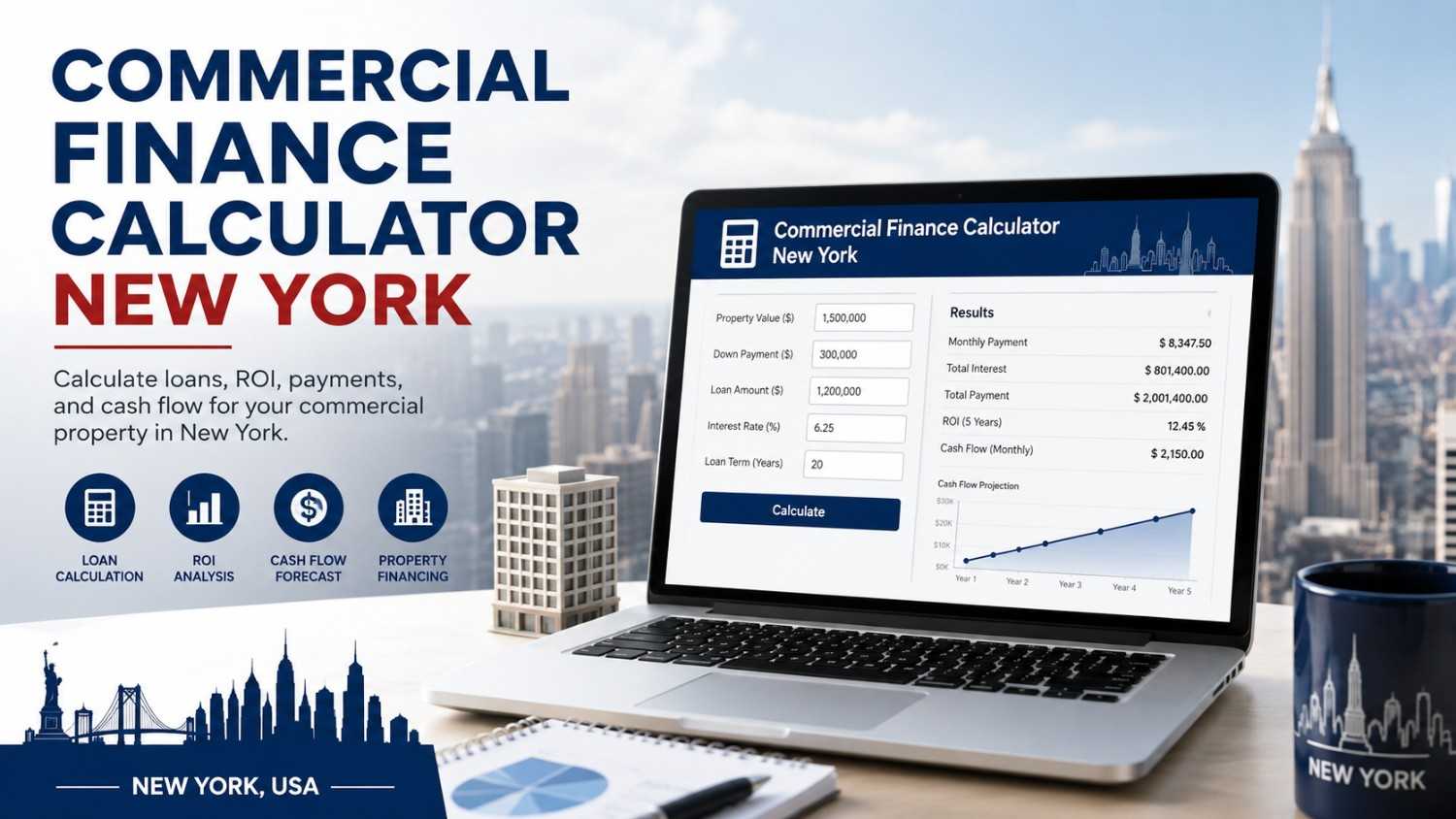
Written by Junaidul Islam Buying a commercial property, financing a business expansion, or refinancing an existing commercial mortgage in New York involves more than finding an affordable monthly payment. The interest rate matters, but so do the loan term, amortization schedule, upfront fees, property income, and the amount you may still owe when the loan matures.
Our Commercial Finance Calculator New York helps you estimate commercial loan payments, total interest, remaining loan balance, debt service coverage ratio (DSCR), loan-to-value ratio (LTV), and estimated cash required at closing. Enter your own figures to explore different financing scenarios before discussing a loan with a lender.
This calculator is designed for New York business owners, commercial property buyers, landlords, real estate investors, and borrowers comparing commercial financing options. It provides estimates rather than loan offers or guarantees of approval.
Use the calculator below to estimate your financing costs. For a more useful result, enter the actual rate and fees quoted by your lender whenever those figures are available.
Commercial Finance Calculator New York
Estimate loan payments, interest, balloon balance, cash to close and property debt coverage.
Estimated financing results
| Loan amount | — |
|---|---|
| Estimated origination fee | — |
| Principal repaid during term | — |
| Total scheduled payments during term | — |
| Interest-only monthly payment (if applicable) | — |
Estimates only. Assumes a constant interest rate and monthly payments. Interest-only payments, if selected, precede amortizing payments. The balloon balance is estimated at maturity. Cash to close includes the down payment, entered other closing costs and estimated origination fee. Do not count the same cost twice. Taxes and local charges are not automatically calculated. Verify the actual fees, tax treatment, payment conventions and loan terms with your lender and qualified professionals.
Calculator placement instruction: Insert the complete HTML calculator code provided after this article at this exact position.
What Is a Commercial Finance Calculator?
A commercial finance calculator is a financial planning tool that estimates the cost of borrowing for business-related purposes. Depending on the loan structure, it can help you calculate periodic payments, interest expenses, remaining principal, and other financing metrics.
Commercial financing can cover several different needs, including:
- Purchasing an office, retail space, warehouse, industrial property, or mixed-use building.
- Buying equipment or other assets used by a business.
- Funding eligible business expansion, improvements, or working capital.
- Refinancing an existing commercial mortgage or business loan.
- Comparing financing offers with different rates, terms, and fees.
Not every commercial loan follows the same repayment structure. A fully amortizing loan gradually repays principal throughout the repayment period. An interest-only loan initially requires payments toward interest without reducing principal during the interest-only period. A balloon loan may require a substantial remaining balance to be paid when the loan reaches maturity.
Understanding these differences is important before comparing monthly payments.
How to Use the New York Commercial Loan Calculator
You can use the calculator to explore a potential purchase, review a lender’s proposal, or compare alternative loan structures.
Step 1: Enter the purchase price and loan amount.
If you are purchasing commercial real estate, enter the property’s purchase price and the amount you intend to borrow. Your down payment is the difference between the purchase price and the loan amount, assuming there are no other adjustments.
For an existing property or a business loan that is not tied to a property purchase, use the relevant financing amount and interpret purchase-related results accordingly.
Step 2: Enter the annual interest rate.
Use the annual rate quoted by your lender. If you are still researching, test several possible rates rather than assuming that one rate is available to every borrower.
A fixed rate generally stays constant during its agreed fixed-rate period. A variable-rate loan can have changing payments or other adjustments according to its contract.
Step 3: Choose the amortization period and loan term.
The amortization period determines the schedule used to calculate principal-and-interest payments. The loan term determines how long the loan remains outstanding before its contractual maturity.
These periods can be different. For example, a loan may calculate payments using a 25-year amortization schedule but mature after five years. In that case, the borrower may still owe a large principal balance at maturity.
Step 4: Add the estimated fees and down payment.
Include lender or origination fees and any other costs you want to account for. If your transaction involves mortgage recording taxes, legal fees, appraisal costs, title expenses, or other closing charges, use the applicable amounts from your lender, attorney, title professional, or official local sources.
Do not assume that a generic percentage represents the correct closing cost for every New York property.
Step 5: Enter annual net operating income if you are evaluating an income-producing property.
Net operating income (NOI) is the property’s income after operating expenses, before debt service and certain other items. Use a consistent figure supported by the property’s operating records or your own clearly identified assumptions.
Step 6: Review the results and compare scenarios.
Look beyond the monthly payment. Check estimated interest over the selected term, the principal remaining at maturity, estimated cash needed upfront, and DSCR when NOI is available.
Change one assumption at a time to see how the result changes. This makes it easier to identify whether the biggest impact comes from the interest rate, amortization period, loan amount, or fees.
Example: Estimating Payments on a $1 Million Commercial Loan
Consider a hypothetical commercial real estate loan with the following assumptions:
| Loan detail | Example assumption |
|---|---|
| Loan amount | $1,000,000 |
| Annual interest rate | 7.00% |
| Amortization period | 20 years |
| Loan term | 5 years |
| Repayment structure | Monthly principal and interest |
With monthly payments and a constant 7% annual rate, the estimated principal-and-interest payment is approximately $7,753 per month.
The payment is calculated using a 20-year amortization schedule. However, the loan matures after five years in this example. The borrower would still have a substantial principal balance due at maturity, estimated at approximately $866,000, depending on the exact payment dates and lender’s calculation conventions.
These figures are illustrative, not current market quotes. They exclude closing costs, taxes, insurance, prepayment charges, and other contractual expenses.
The example illustrates why a low-looking monthly payment does not necessarily mean the borrower will have repaid most of the original loan before maturity.
Commercial Mortgage vs. Business Loan: Which Should You Compare?
The right comparison depends on what you intend to finance.
Commercial real estate loans
These loans are commonly used to purchase, refinance, or improve property used for business or investment purposes. Underwriting may consider the property’s value, net operating income, debt service coverage, borrower financial strength, and the property itself as collateral.
A commercial mortgage calculator is especially useful when the loan amount is linked to a property’s value or income.
Business term loans
A business term loan provides a specified amount of financing that is repaid according to an agreed schedule. It may be used for eligible business purposes, depending on the loan agreement and lender requirements.
Compare the total repayment obligation, interest or finance charges, repayment frequency, fees, collateral requirements, and any personal guarantee requirements.
SBA-backed financing
Eligible small businesses may consider financing through programs such as the U.S. Small Business Administration’s 7(a) loan program. The SBA does not generally lend 7(a) funds directly to borrowers; participating lenders make the loans, subject to program rules.
Loan amounts, permitted uses, maturity, rates, fees, and eligibility depend on the applicable program and loan structure. Review the official SBA 7(a) loan information and discuss your circumstances with a participating lender.
Equipment financing
Equipment financing may have a different repayment schedule, collateral arrangement, and end-of-term obligation from a commercial mortgage. When comparing equipment offers, account for any deposit, fees, residual or buyout amount, and restrictions in the contract.
Do not compare financing options solely by their advertised interest rates. Their fee structures and repayment schedules may differ.
New York Commercial Mortgage Recording Tax and Closing Costs
One important consideration for a New York commercial property transaction is mortgage recording tax.
New York State imposes mortgage recording tax on qualifying mortgages recorded against real property in the state. Local mortgage taxes may also apply in New York City, Yonkers, and certain counties. The applicable amount depends on the jurisdiction and the transaction.
For NYC properties in Manhattan, Brooklyn, Queens, the Bronx, and Staten Island, consult the NYC Department of Finance property recording information. New York State also publishes mortgage recording tax guidance and rates.
Do not apply a single statewide percentage to every transaction. The applicable jurisdiction, mortgage amount, property characteristics, exemptions, and other legal details can affect the final tax.
Other potential closing costs include:
- Lender origination or underwriting fees.
- Appraisal and property inspection charges.
- Attorney and document preparation fees.
- Title search, title insurance, and recording charges.
- Environmental or engineering reports, where required.
- Prepaid interest, escrow deposits, or other contractual charges.
- Applicable mortgage recording taxes and other transaction taxes.
The items above are potential costs, not a statement that every borrower will pay each one. Some expenses may be paid by a different party or may not apply.
For a reliable cash-to-close estimate, request an itemized breakdown from the lender and the professionals handling your transaction. Enter the applicable figures into the calculator instead of relying on an unsupported generic closing-cost assumption.
How Down Payment and Loan-to-Value Affect Financing
Your down payment is the portion of the purchase price you fund without borrowing, before accounting for transaction costs or adjustments.
Loan-to-value ratio, or LTV, compares the loan amount with the property’s value.
Formula:
LTV = Loan Amount ÷ Property Value × 100
For example, a $750,000 loan on a property valued at $1,000,000 produces an LTV of 75%.
A lower LTV means the loan represents a smaller share of the property’s value. This can affect a lender’s risk assessment, but it does not guarantee approval or a particular interest rate.
Lenders may also consider borrower liquidity, credit history, experience, property condition, lease terms, tenant concentration, and the property’s ability to support debt payments.
For a purchase, remember that a down payment is not the same as total cash required at closing. Fees, taxes, reserves, and other costs can increase the amount you need to bring to the transaction.
Understanding Amortization and Balloon Payments
Amortization describes how a loan balance is repaid over time through scheduled payments. In a conventional fully amortizing loan with monthly principal-and-interest payments, each payment covers interest due and reduces principal.
At the beginning of the loan, a larger portion of each payment generally goes toward interest. As principal is repaid, the interest portion typically declines and more of the payment goes toward principal.
A balloon payment arises when the scheduled loan term ends before the amortization schedule has fully repaid the principal.
For example, a commercial mortgage can have a 20- or 25-year amortization period but a five- or ten-year maturity. The unpaid principal may then need to be repaid through refinancing, a property sale, available business funds, or another permitted source.
Refinancing is not guaranteed. Future interest rates, property values, rental income, lender requirements, and the borrower’s financial position may change.
Before signing a balloon loan, ask the lender for the expected maturity balance and review the loan’s maturity, extension, prepayment, and default provisions.
What Is DSCR, and Why Does It Matter?
Debt service coverage ratio, or DSCR, compares a property’s net operating income with its required debt payments over the same period.
Formula:
DSCR = Annual Net Operating Income ÷ Annual Debt Service
Suppose a property generates $150,000 in annual NOI and has $120,000 in annual principal-and-interest debt service.
The DSCR is 1.25. In this simplified example, the property’s NOI is 1.25 times its annual debt service.
A DSCR above 1.00 indicates that the NOI exceeds the debt service used in the calculation. A DSCR below 1.00 indicates that NOI alone does not cover that debt service.
Lenders use different underwriting standards. There is no single DSCR threshold that guarantees approval for every commercial loan.
Use a consistent NOI figure and include the debt obligations required by the lender’s underwriting method. Property taxes, insurance, capital expenditures, tenant improvements, leasing commissions, reserves, and other items may require separate consideration depending on the analysis.
How Much Commercial Financing Can You Afford?
A lender’s maximum loan amount and your practical borrowing capacity are not necessarily the same.
A useful affordability review considers several limits:
Property value: A lender may limit the amount borrowed relative to the appraised value or purchase price.
Cash flow: The property’s NOI or the business’s available cash flow must be sufficient for the proposed debt structure and the lender’s requirements.
Borrower financial position: Liquidity, existing debt, credit history, guarantees, and financial statements can influence underwriting.
Total project cost: Renovations, equipment, closing costs, working capital, and reserves may require cash beyond the loan’s stated amount.
Maturity risk: A loan with a large balloon balance can create a future funding need even when monthly payments are affordable.
Use the calculator to test different loan amounts and repayment periods. Then build a separate operating budget that accounts for vacancies, unexpected repairs, slower revenue, and other business risks.
The calculator does not determine whether a lender will approve you or how much financing you qualify for.
How to Compare Commercial Loan Offers
When you receive more than one offer, compare the complete terms rather than focusing on the monthly payment alone.
| Comparison item | What to review |
|---|---|
| Interest rate | Fixed or variable, adjustment terms, and any rate floors |
| Payment amount | Required payment and repayment frequency |
| Amortization | The period used to calculate scheduled principal payments |
| Maturity | When the full outstanding balance becomes due |
| Origination fees | Charges deducted upfront or added to the amount owed |
| Net proceeds | Funds actually available after applicable deductions |
| Prepayment terms | Penalties or restrictions on early repayment |
| Collateral and guarantees | Assets pledged and obligations accepted by the borrower |
| Covenants | Financial reporting, coverage ratios, and other contractual requirements |
| Total cost | Interest, fees, and other financing charges over the relevant period |
New York has statutory commercial financing disclosure requirements for covered transactions. Depending on the financing type and applicable exemptions, disclosures can include the financing amount, disbursement amount, finance charge, and annual percentage rate (APR). Consult the relevant New York commercial financing statute and obtain the disclosures that apply to your offer.
APR and other financing metrics should be compared carefully. A calculator estimate is not a substitute for the lender’s formal disclosures or a review of the contract.
What This Calculator Does Not Include Automatically
A calculator is only as accurate as its inputs and assumptions. The results on this page should not be treated as a complete underwriting analysis or a binding payoff statement.
Unless you enter them explicitly or the tool identifies them as included, the results may not account for:
- Property taxes, insurance, utilities, and operating expenses.
- Vacancy, tenant improvements, leasing commissions, and capital expenditures.
- Variable interest rates or future rate adjustments.
- Origination, legal, appraisal, title, recording, and other transaction-specific costs.
- Prepayment penalties, default interest, late charges, or extension fees.
- Interest-only periods, irregular payment dates, or nonstandard payment conventions.
- Applicable mortgage recording taxes and exemptions.
- Lender reserves, minimum cash requirements, or underwriting adjustments.
For commercial property in New York, confirm taxes and recording charges for the property’s specific jurisdiction. For business financing, request a complete breakdown of the finance charge, repayment obligations, and any amount withheld from the proceeds.
Frequently Asked Questions
What is the best commercial finance calculator for New York?
The best calculator is one that matches your loan structure and makes its assumptions clear. For a commercial real estate loan, useful features include payment estimates, amortization, balloon balance, LTV, DSCR, and the ability to include transaction-specific fees.
How do I calculate a commercial loan payment?
For a fully amortizing loan with monthly payments, the payment is calculated using the principal, monthly interest rate, and number of monthly payments. The standard formula is:
Monthly Payment = P × r ÷ [1 − (1 + r)^−n]
Here, P is the loan principal, r is the monthly interest rate, and n is the total number of monthly payments. If the interest rate is zero, the principal is divided equally across the payment periods.
This formula does not by itself calculate every possible commercial loan structure. Interest-only periods, variable rates, irregular payment dates, and balloon maturity terms may require additional calculations.
Are commercial mortgage rates the same across New York?
No. Pricing can vary by lender, borrower financial strength, property type, loan size, LTV, DSCR, collateral, repayment structure, and market conditions. A calculator should use the rate from a current quote or clearly label any assumed rate as hypothetical.
Does New York charge mortgage recording tax on commercial property?
Mortgage recording tax can apply to mortgages recorded against New York real property. State and local rates depend on the property’s jurisdiction and applicable rules. Consult New York State tax guidance and the relevant local recording authority before estimating the amount due.
What is the difference between loan term and amortization?
The amortization period determines the schedule used to calculate payments. The loan term determines when the contractual loan maturity occurs. If the term is shorter than the amortization period, a remaining balance may be due at maturity.
Can I use this calculator for an equipment loan or working capital?
You can use a basic payment calculator to model a suitable fixed-rate, fixed-payment loan. However, equipment loans, revolving credit, merchant cash advances, and revenue-based financing can have different fee and repayment structures. A standard amortization formula may not accurately represent those products.
What does a DSCR of 1.25 mean?
It means the NOI used in the calculation is 1.25 times the annual debt service. It does not guarantee loan approval because lenders apply their own underwriting standards and may define eligible income and debt service differently.
Does this calculator guarantee loan approval?
No. It provides estimates for planning and comparison. Approval, rates, fees, collateral requirements, and loan amounts depend on the lender’s underwriting, the transaction, and the borrower’s financial circumstances.
Can I use this calculator to estimate cash needed at closing?
Yes, if you enter the applicable down payment and estimated transaction costs. The result is only as complete as the amounts entered. Verify recording taxes, lender charges, legal fees, and other expenses with the professionals handling your transaction.
Final Thoughts
Commercial financing in New York requires a clear understanding of payments, total borrowing costs, property cash flow, closing expenses, and the obligations that may arise at maturity.
Use this calculator to explore scenarios and compare offers on a consistent basis. Before committing to a loan, confirm the lender’s written terms, applicable taxes and fees, and your ability to meet both scheduled payments and any remaining balloon balance.
Financial disclaimer: This tool provides educational estimates, not financial, legal, tax, or lending advice. It does not provide loan offers, determine eligibility, or guarantee approval. Actual costs and repayment obligations depend on the loan agreement, applicable law, transaction details, and lender calculations.
Author: Junaidul Islam
Website: NewYorkCalculator.com