
Author: Junaidul Islam Have you discovered that New York State may be holding money that belongs to you? Before paying a company to help recover it, take a moment to understand what its service could cost.
A finder or recovery company may offer to locate unclaimed funds, help prepare paperwork, and assist with a claim. That convenience can come at a price. Under New York’s Abandoned Property Law § 1416, covered agreements for locating or retrieving property held by the State Comptroller cannot set a fee above 15% of the value of the recoverable property. The agreement must also meet specific legal requirements.
The important detail is that you generally do not need to hire a finder to claim eligible funds held by New York State. The Office of the State Comptroller offers a free search and claim service.
This guide explains how finder fees work, how to estimate your potential recovery, what to check before signing an agreement, and how to pursue a claim directly.
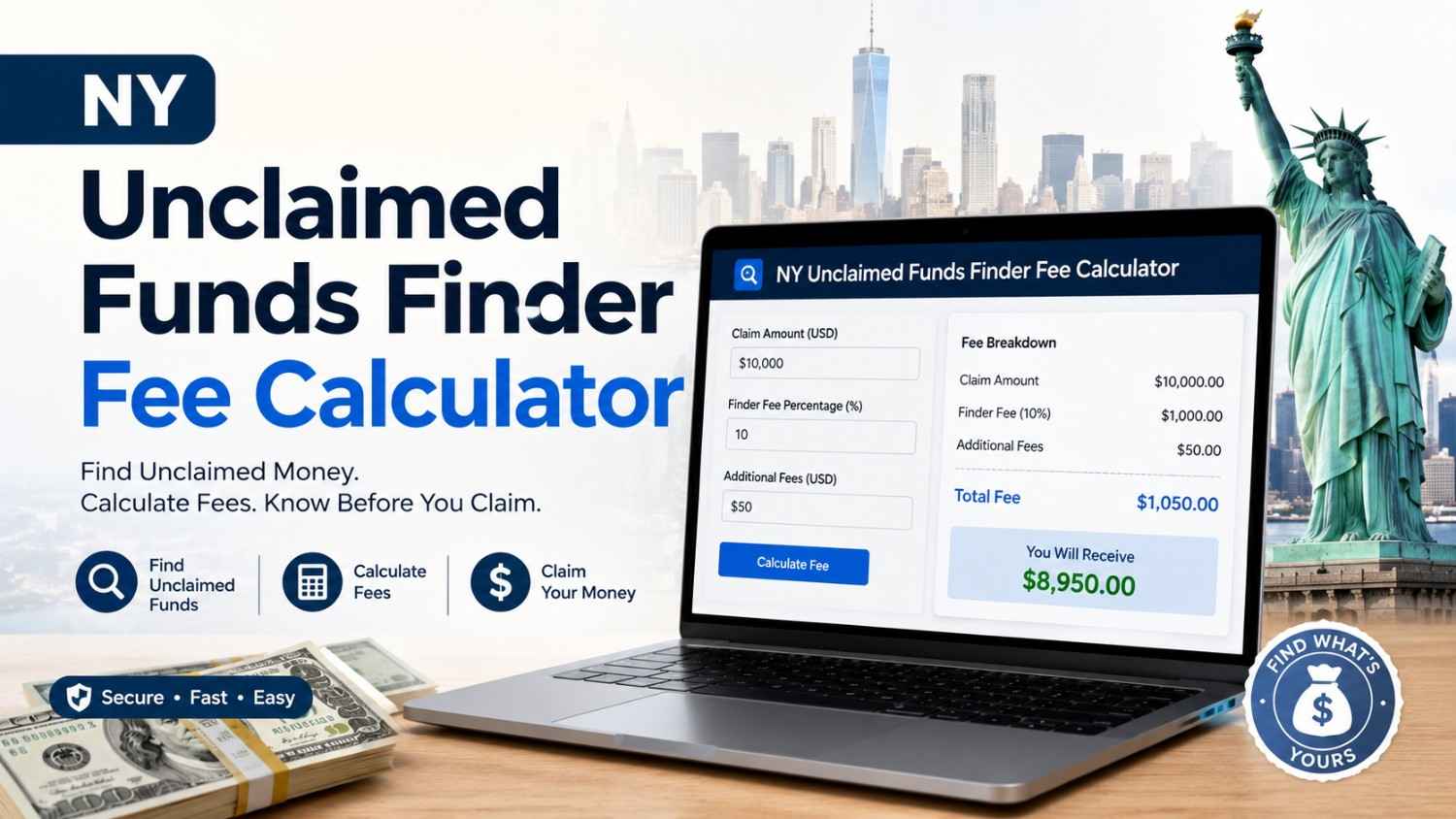
New York Unclaimed Funds Finder Fee Calculator
Estimate the finder fee, compare your options, and see how much may remain.
This tool provides an estimate for educational purposes only. It does not verify ownership, determine eligibility, reveal the amount held by the state, or guarantee payment. Actual recoverable value and contractual obligations may differ. Other costs, if any, are not included. Check your agreement and current New York law before making a decision.
Use the calculator to estimate the potential finder fee on an amount you enter. Compare the result with a direct state claim to see how much you could retain before considering any separately applicable costs.
The calculator is an estimate, not an official valuation of property held by the state. New York’s Comptroller generally does not disclose the value of a potential claim until the claim has been reviewed.
What Is a New York Unclaimed Funds Finder Fee?
Unclaimed funds are financial assets that have gone unclaimed and have been transferred to the appropriate government authority. Depending on the circumstances, they can include forgotten bank balances, uncashed checks, insurance-related payments, refunds, securities, and other financial property.
A finder, sometimes called a location service provider, is a person or business that charges to help locate or recover property held by the New York State Comptroller.
A finder might identify a possible match, explain documentation requirements, or assist with submitting a claim. However, finding a possible record does not automatically establish ownership or guarantee that a claim will be approved.
The decision to use a paid service is yours. Before agreeing to pay, compare the proposed fee with the work involved and the free service available directly from the state.
What Is the Maximum Finder Fee in New York?
New York Abandoned Property Law § 1416 states that an agreement covered by the law is not valid if it provides for a fee exceeding 15% of the value of recoverable property.
For example, if $2,000 is ultimately recoverable and a valid agreement charges the maximum 15% rate, the estimated fee would be $300. The amount remaining after that fee would be $1,700, before any other amount that is separately and lawfully payable.
The 15% figure is a legal ceiling for covered agreements, not a recommended price or a mandatory fee. A provider may quote a lower rate, and you should understand the actual agreement before signing it.
The law also requires covered agreements to be written, signed by the property owner, witnessed and acknowledged by a notary public, and to disclose specified information about the property and the Comptroller. The agreement must include a prominent notice explaining that owners can obtain their funds directly from the state without paying a fee.
Read the current statute and the Comptroller’s provider guidance before relying on a fee calculation.
How Much Would a Finder Fee Cost?
The following examples assume that the entire amount shown is recoverable and that the fee is calculated as a percentage of that amount.
| Recoverable amount | Fee at 5% | Fee at 10% | Fee at 15% | Remaining at 15% |
|---|---|---|---|---|
| $100 | $5 | $10 | $15 | $85 |
| $500 | $25 | $50 | $75 | $425 |
| $1,000 | $50 | $100 | $150 | $850 |
| $2,500 | $125 | $250 | $375 | $2,125 |
| $5,000 | $250 | $500 | $750 | $4,250 |
| $10,000 | $500 | $1,000 | $1,500 | $8,500 |
These are illustrations, not estimates of the amount the state is holding for any particular person. Your actual result depends on the property ultimately approved for payment and the terms and legal validity of the agreement.
The simple fee formula
To estimate the fee:
Finder fee = Recoverable amount × Fee percentage ÷ 100
Then calculate:
Amount remaining = Recoverable amount − Finder fee
For example, a $4,000 recoverable amount at 10% produces an estimated fee of $400 and a remaining amount of $3,600.
The calculation is straightforward, but the recoverable amount may not be known until the state reviews your claim. Enter an amount only as a planning assumption.
Can You Claim New York Unclaimed Funds for Free?
Yes. The New York State Comptroller provides a free and secure service to search for and claim eligible unclaimed funds. There is no charge from the Comptroller for processing a claim or returning the funds.
You can begin through the official New York State Unclaimed Funds search and claim guide.
Here is a practical way to start:
- Open the official search database.
- Search using your last name or business name.
- Refine the search with your first name, city, ZIP code, or a previous address when necessary.
- Try reasonable variations of your name, including nicknames or common misspellings.
- Review any matching property record and submit a claim if you believe it belongs to you.
- Provide the supporting documentation requested by the state.
A matching name is only a starting point. The state may need evidence connecting you to the reported property or address before approving payment.
The Comptroller says many claims are paid within 30 days, although additional documentation or verification can affect the timing. Treat that figure as general guidance, not a guarantee for your claim.
What If You Cannot Find Your Money?
Do not assume that no result means you have no unclaimed funds.
Try searching with a former address, a different spelling, a nickname, or the name of a business associated with you. If you received a notice from the Comptroller, use the Property ID supplied in that notice as instructed by the official website.
The state also explains that property recently transferred by the original holder may take time to appear in the database. Its guidance says that if the original holder told you the property was transferred but you cannot find it, it may take three months to appear. If it remains missing after that period, follow the official instructions for mailing a claim or contacting the office.
You can also search for eligible property associated with a business or, where appropriate, help family members identify possible matches. The person entitled to the funds must still meet the relevant ownership and documentation requirements.
Official guidance: How to Search & Claim Property.
What Should You Check Before Hiring a Finder?
A paid service may offer convenience, but do not sign an agreement simply because a company says it has found money in your name.
Review these points first:
- The exact fee: Check the percentage and the amount it would represent in dollars.
- The property covered: Confirm which claim or property the agreement concerns.
- The written agreement: Covered agreements must satisfy the requirements of New York law, including signature and notarization requirements.
- The free alternative: The agreement must include the legally required notice about claiming funds directly from the state without a fee.
- The service provided: Ask what the company will actually do and whether you can complete those steps yourself.
- Any additional charges: Ask for a clear explanation of every amount you may be expected to pay. Do not assume an extra charge is lawful simply because it appears in a contract.
- Your personal information: Use caution if someone requests sensitive information before you have verified who they are and why the information is needed.
Under § 1416, an agreement covered by the law cannot set a fee above the statutory maximum. The statute also preserves an owner’s ability to challenge an agreement as involving excessive or unjust consideration. If a contract is unclear or you suspect improper conduct, consider obtaining advice from a qualified New York attorney.
Does New York State Deduct the Finder Fee From Your Refund?
No. According to the New York State Comptroller’s guidance for location service providers, the state does not withhold the provider’s fee from the refund. The owner is responsible for remitting the agreed fee to the provider.
That distinction matters when budgeting. If your claim is approved for $2,000 and a covered agreement charges 15%, the state does not simply pay you $1,700 and send $300 to the finder. The estimated fee is $300, and the state issues payment according to its claim process. You would then handle any fee obligation under your agreement.
The exact payment arrangements and the legal validity of an agreement depend on the circumstances. Do not treat a calculator result as a determination of your contractual obligations.
Official reference: Location Service Providers — New York State Comptroller.
What If a Finder Wants More Than 15%?
For an agreement covered by Abandoned Property Law § 1416, a fee exceeding 15% of the value of recoverable property makes the agreement invalid under that provision.
Do not assume that a higher percentage becomes acceptable just because a provider calls part of it an administrative charge, recovery charge, or another kind of fee. The legal treatment of a particular charge depends on the facts and applicable law.
Ask the provider to explain every charge in writing. Compare the agreement with the current statute and the Comptroller’s requirements. If the provider pressures you to sign immediately or refuses to explain the cost, pause before proceeding.
The law includes specific provisions and exceptions, so questions about unusual agreements or professional services may require individual legal advice.
Is the 15% Limit the Same as a Required Fee?
No. The limit is not a fee that every claimant must pay.
A provider may charge less than 15%, depending on its agreement. You may also decide not to hire a provider and instead use the free state process.
For example, if you have an approved recoverable amount of $1,000, a 5% finder fee would be $50, while a 15% fee would be $150. The difference is $100. If you claim directly through the Comptroller, the state does not charge a finder fee for that service.
This is why comparing the actual fee in dollars is often more useful than looking at a percentage alone.
Frequently Asked Questions
Is the New York Unclaimed Funds Finder Fee Calculator free?
Yes. This calculator is intended as a free informational tool. It performs a mathematical estimate using the amount and fee rate you enter. It does not access state records or determine whether you qualify for a claim.
What is the maximum New York unclaimed funds finder fee?
For covered agreements under New York Abandoned Property Law § 1416, the fee cannot exceed 15% of the value of recoverable property. Other requirements apply to the agreement.
Can I recover unclaimed funds without hiring a company?
Yes. The New York State Comptroller offers a free search and claim service. Start with the official state website and follow its identity and documentation requirements.
Does the state tell me the exact amount before I claim?
Not necessarily. The Comptroller says it cannot disclose the value of funds until it has reviewed the claim. A calculator can estimate a fee only when you supply an assumed amount.
How long does a New York unclaimed funds claim take?
The Comptroller says most claims are paid within 30 days, but processing time can vary. Additional documents, ownership questions, and verification can affect an individual claim.
Can I claim money belonging to a deceased family member?
Potentially, if you have the legal authority and documentation required for the particular estate or claim. The state has separate guidance for deceased owners and estates. Do not assume that being a relative alone establishes entitlement.
What should I do if I cannot find a property record?
Try reasonable name variations and previous addresses. If you have a notice from the original holder or Comptroller, follow the instructions provided. For further help, use the official state claim guide.
Does a finder fee calculator guarantee my final payment?
No. It does not verify the property, confirm ownership, predict approval, or determine the final amount payable. It calculates an estimate from the numbers entered.
Official Sources and Legal Information
For the most reliable information, use these primary sources:
- New York State Comptroller — How to Search & Claim Property
- New York State Comptroller — Location Service Providers
- New York Abandoned Property Law § 1416
- New York General Business Law § 393-e
Legal update note: New York Assembly Bill A3372 (2025–2026) proposes changes to the required disclosures for certain finder solicitations and agreements. The legislative record currently lists the bill as being in committee. A proposed bill is not the same as an enacted law. Check the current legislative status before relying on any proposed changes.
This article was prepared for general educational purposes and is not legal, tax, or financial advice. Laws and official procedures can change, so verify current requirements with the relevant state authority.
About the author
Junaidul Islam writes practical guides and online calculators designed to help readers understand everyday financial questions. This article is based on the cited public resources and illustrative calculations. Readers should consult official sources for their individual claim requirements.