
By Junaidul Islam If you have money waiting to be claimed through the New York State Office of the State Comptroller, one question naturally comes to mind: could that money include interest?
The answer depends on the type of property, the rules that apply to it, and how long the New York State Comptroller has held it. Some eligible property can earn interest for a limited period, while other types of unclaimed funds may not qualify for interest at all.
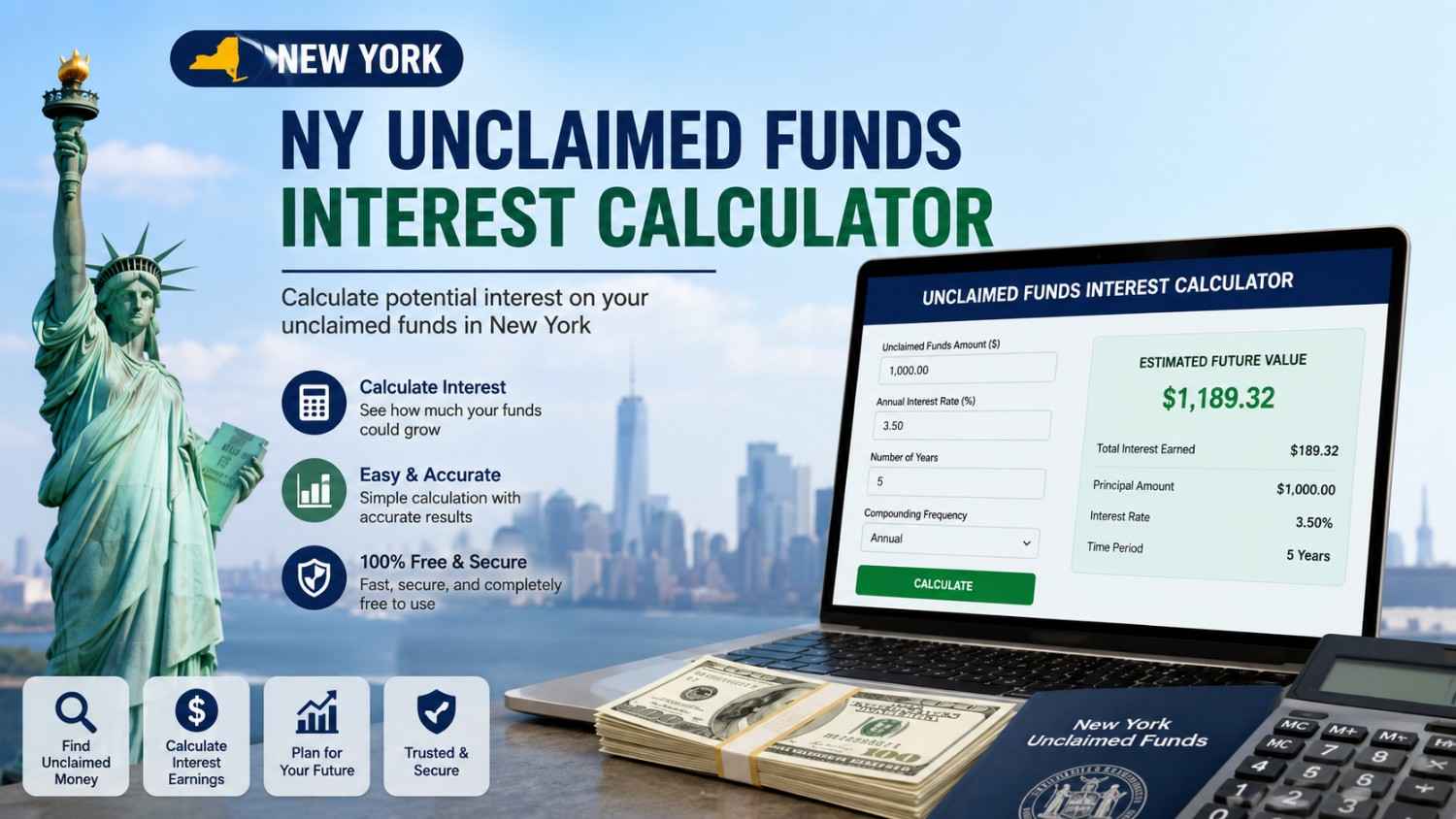
Our New York Unclaimed Funds Interest Calculator helps you estimate potential interest using your original amount, an assumed annual rate, and the eligible holding period. You can also see how different assumptions affect your estimated total.
Important: This calculator provides an estimate, not an official claim valuation. Only the New York State Office of the State Comptroller can determine the amount payable on your approved claim.
New York Unclaimed Funds Interest Calculator
Estimate potential interest on qualifying unclaimed property using your own assumptions.
Your Illustrative Estimate
This calculator is for educational estimates only. It does not check the official unclaimed funds database, verify eligibility, or determine your award. It uses one assumed rate for the selected period and caps the illustrative interest period at five years. Actual payments may differ because of quarterly rates, legal rules, property type, and other factors. Check the New York State Comptroller’s official guidance.
Use the calculator to enter your original amount, the date the state received the property, and an estimated annual interest rate. If your property does not qualify for interest, select the appropriate option.
The result uses a simplified calculation. Actual payments can differ because New York applies specific legal rules, quarterly interest rates, and property-specific requirements.
Do New York Unclaimed Funds Earn Interest?
Not all unclaimed money in New York earns interest.
According to the New York State Comptroller's official guidance, interest may be paid on property that originally earned interest, including certain bank accounts, utility refunds, and court funds. For qualifying property covered by the applicable rules, interest is paid for up to five years from the date the Comptroller receives it.
The interest rate is set by the New York State Department of Taxation and Finance and updated quarterly.
This distinction matters because finding money in the state's unclaimed funds database does not automatically mean that interest will be added to the amount you receive.
For example, a former bank account and a forgotten payment may be treated differently under the applicable abandoned-property rules. The property's legal category and history matter more than simply how many years have passed.
You can review the state's explanation on the official Taxes and Interest page.
How Is Interest Calculated on New York Unclaimed Funds?
For qualifying property, New York's Abandoned Property Law § 1405 generally links the applicable interest rate to the state's tax overpayment rate, reduced by one percentage point, for the categories covered by the statute.
The law also establishes a five-year interest period for the specified property categories.
A simplified estimate can be calculated using this formula:
Estimated simple interest = Principal × Annual interest rate × Time in years
For example, suppose you have $2,000 in eligible property and use an assumed annual rate of 5% for three years.
- Original amount: $2,000
- Assumed annual interest rate: 5%
- Assumed period: 3 years
- Estimated simple interest: $300
- Estimated total: $2,300
This example illustrates the mathematics; it does not establish what the state would pay on an actual claim.
The official rules and rate periods must be checked before relying on a calculation. If the applicable rate changes during the holding period, using one rate for every year can produce a different result from a calculation that applies the correct rate to each relevant period.
Read New York Abandoned Property Law § 1405 for the statutory basis.
What Is the Current New York Unclaimed Funds Interest Rate?
Interest rates can change, so a useful calculator should not treat one percentage as permanent.
For the period from October 1 through December 31, 2026, the New York State Department of Taxation and Finance lists a 6% annual income-tax overpayment rate. Under the applicable statutory formula for qualifying abandoned property, subtracting one percentage point produces an illustrative annual rate of 5%.
This is a rate reference for the specified period, not a guarantee that every unclaimed property claim earns 5%.
Before using the rate in an estimate, check the current official tables:
- New York interest rates for 2026
- Interest rates for October 1–December 31, 2026
- Official unclaimed funds interest rules
If you are estimating interest over several years, remember that the rate may have changed more than once. A single current rate is not a substitute for the applicable historical rates.
Does the Five-Year Rule Mean You Stop Earning Interest After Five Years?
For the property categories covered by New York's general five-year rule, interest is paid for up to five years from the date the Comptroller receives the property.
The relevant starting point is not necessarily the day you closed your bank account, moved away, or first noticed that money was missing.
Consider this example:
Suppose the state received qualifying property on July 1, 2022. Under the applicable five-year rule, the relevant interest period would generally extend for up to five years from that receipt date, subject to the property's eligibility and applicable rules.
If you discover the property in 2026, the date you discovered it does not automatically restart the interest period.
This is why the date the Comptroller received the property is important when estimating potential interest.
The calculator uses a maximum five-year period as a simplified model. It does not independently verify the state's receipt date or determine the legal eligibility of a particular property.
Which Types of Unclaimed Property May Earn Interest?
The property's original nature is an important starting point.
| Property type | What to know about interest |
|---|---|
| Bank accounts | Certain originally interest-bearing accounts may qualify. |
| Utility deposits and refunds | Certain eligible utility-related property may qualify. |
| Court funds | Some court funds may qualify under the applicable statutory category. |
| Stocks, bonds, and mutual funds | Claims may involve the original security, its cash value, and applicable dividends or accruals. |
| Other abandoned property | Eligibility depends on the relevant legal category and rules. |
This table is a guide, not a definitive eligibility determination. The same broad property description can cover situations with different legal treatment.
Securities deserve special attention. The Comptroller explains that qualifying securities claims may be paid in the original security, if available, or through its cash value. In most cases, the payment also includes dividends or accruals earned since the state received the property.
That is not necessarily the same as applying a fixed annual interest rate to a cash balance.
If your claim concerns investments, dividends, or another specialized category, use the calculator only as a preliminary illustration and consult the official claim information.
Simple Interest vs. Compound Interest
Understanding the difference between these methods helps prevent misleading estimates.
Simple interest is calculated on the original principal. If $1,000 earns simple interest at 5% annually for three years, the illustrative interest is $150.
Compound interest calculates interest on the principal and previously accumulated interest. At the same hypothetical rate of 5% compounded annually, $1,000 would grow to approximately $1,157.63 after three years, including about $157.63 in interest.
These examples use hypothetical assumptions to explain the mathematics. They do not establish that New York calculates every unclaimed funds payment using either method.
Do not select compound interest simply because it produces a larger number. The correct method must come from the rules governing the property and the state's calculation.
Why Your Actual Payment May Be Different From the Estimate
An estimate and an approved claim amount serve different purposes.
Your actual payment may differ for several reasons:
- The property may not qualify for interest. The existence of an unclaimed property record does not establish interest eligibility.
- The applicable rate may have changed. A multi-year calculation may require different rates for different periods.
- The eligible period may be shorter. The five-year limit applies to the property categories covered by the relevant rule.
- The original amount may not be the final payment basis. Securities, dividends, accruals, and other property-specific factors can affect a claim.
- The dates may be different from your assumptions. The date the state received the property is especially important.
- Tax reporting may apply. Certain payments can involve federal reporting requirements or withholding.
For these reasons, a calculator should be used to understand possible outcomes, not to promise a particular payment.
How to Find and Claim Your New York Unclaimed Money
The New York State Comptroller provides a free official service for finding and claiming unclaimed funds.
Start at the New York State Office of Unclaimed Funds.
- Search using your last name or business name.
- Refine the search with your first name, city, ZIP code, or previous addresses when necessary.
- Try reasonable name variations if you have changed your name or the original record contains a spelling difference.
- Review the matching property information.
- Follow the official claim instructions and provide supporting documents if requested.
You may have property associated with a former address, an older account, a business, or another eligible record. Searching only your current address may not be enough.
The Comptroller's How to Search and Claim Property guide explains the official process.
Remember that the calculator does not search the state's database, confirm ownership, or submit a claim. It is a separate estimation tool.
How Long Does a New York Unclaimed Funds Claim Take?
The processing time depends on the claim and whether additional verification is required.
The Comptroller states that many online claims are paid within 30 days, although that should not be treated as a guaranteed deadline for every claim. Some claims require supporting documents or further review.
If a claim is approved, the state provides payment details. The official guidance also explains what to do if a check is missing, incorrect, or not received.
For the latest instructions, visit Claim Submitted—What's Next?.
Do not confuse the claim-processing period with the five-year interest period. They measure different things.
Are New York Unclaimed Funds Interest Payments Taxable?
Some payments can have federal tax-reporting consequences.
The Comptroller explains that, when a qualifying refund paid during a calendar year includes at least $600 in interest, the recipient will receive Form 1099-INT in January following the year of payment.
Other reporting requirements may apply to securities, dividends, or certain nonresident recipients.
The relevant form and tax treatment depend on the payment. The $600 reporting threshold is not a general rule that makes all smaller interest payments tax-free.
If you receive a payment containing interest, investment proceeds, or other potentially taxable amounts, review the official guidance and consult a qualified tax professional about your circumstances.
For details, see the Comptroller's Taxes and Interest guidance.
Frequently Asked Questions
1. Does every New York unclaimed funds claim earn interest?
No. Interest may be payable on certain property that originally earned interest, including qualifying bank accounts, utility refunds, and court funds. Other property may not qualify.
2. How much interest can I receive on unclaimed money in New York?
The amount depends on the original property, its eligibility, the amount involved, the applicable rates, and the period for which interest is payable. A calculator can provide an illustration but cannot establish your official award.
3. When does the five-year interest period begin?
For the property categories covered by the rule, the period begins when the New York State Comptroller receives the property. It does not necessarily begin when you first discover the money.
4. Is the current interest rate the correct rate for older unclaimed funds?
Not necessarily. Rates change quarterly. A current rate may be useful for a preliminary estimate, but a multi-year calculation may require historical rates and the applicable legal rules.
5. Can I use compound interest for my calculation?
You can use compound interest to illustrate a hypothetical investment-style scenario. However, you should not assume that it matches the official New York unclaimed funds calculation without verifying the applicable method.
6. How do I check whether I have unclaimed money?
Search the official New York State Office of Unclaimed Funds database. Use your name and, where helpful, former addresses or other identifying search details.
7. Does the calculator guarantee my final payment?
No. The calculator does not confirm ownership, eligibility, the official receipt date, historical rate application, or the final claim amount.
8. Is it free to search for New York unclaimed funds?
Yes. The New York State Comptroller's official unclaimed funds search and claim service is free. You can use the official state website rather than paying someone merely to access the public search service.
9. Can stocks or mutual funds earn additional amounts?
Eligible securities claims may involve the original security or its cash value, along with dividends or accruals where applicable. These amounts may not be accurately represented by a simple fixed-rate calculator.
10. Where can I find the official interest rules?
Start with the Comptroller's Taxes and Interest page and review New York Abandoned Property Law § 1405.
Final Thoughts
New York unclaimed funds can be worth investigating, but the interest question is more complicated than multiplying a balance by a percentage.
The most useful approach is to check whether your property may qualify, identify when the Comptroller received it, review the applicable interest rules, and use a calculator to understand possible outcomes.
If you believe the state is holding money that belongs to you, start with the official search and claim service. Use this calculator as a planning aid—not as a replacement for the state's eligibility decision or payment calculation.
Calculation disclaimer: This tool provides an educational estimate based on user-entered assumptions. It does not determine legal eligibility, guarantee interest, or replace an official New York State Comptroller calculation. Interest rates, laws, and property-specific treatment may change. Always verify current requirements with official sources.
Author: Junaidul Islam
Last reviewed: October 10, 2026