
By Junaidul Islam Have you ever moved out of New York, changed jobs, closed an old bank account, or forgotten about a refund? You may have money waiting to be claimed without realizing it.
Unclaimed funds can come from old bank accounts, uncashed checks, insurance payments, utility deposits, stock distributions, and other financial transactions. When the rightful owner cannot be reached or the property remains inactive for the period required by law, the property may eventually be reported to a state unclaimed-property program.
The important thing to understand is that unclaimed funds are not limited to the state where you live today. If you have lived, worked, owned a business, or maintained financial accounts in multiple states, you may need to search more than one official database.
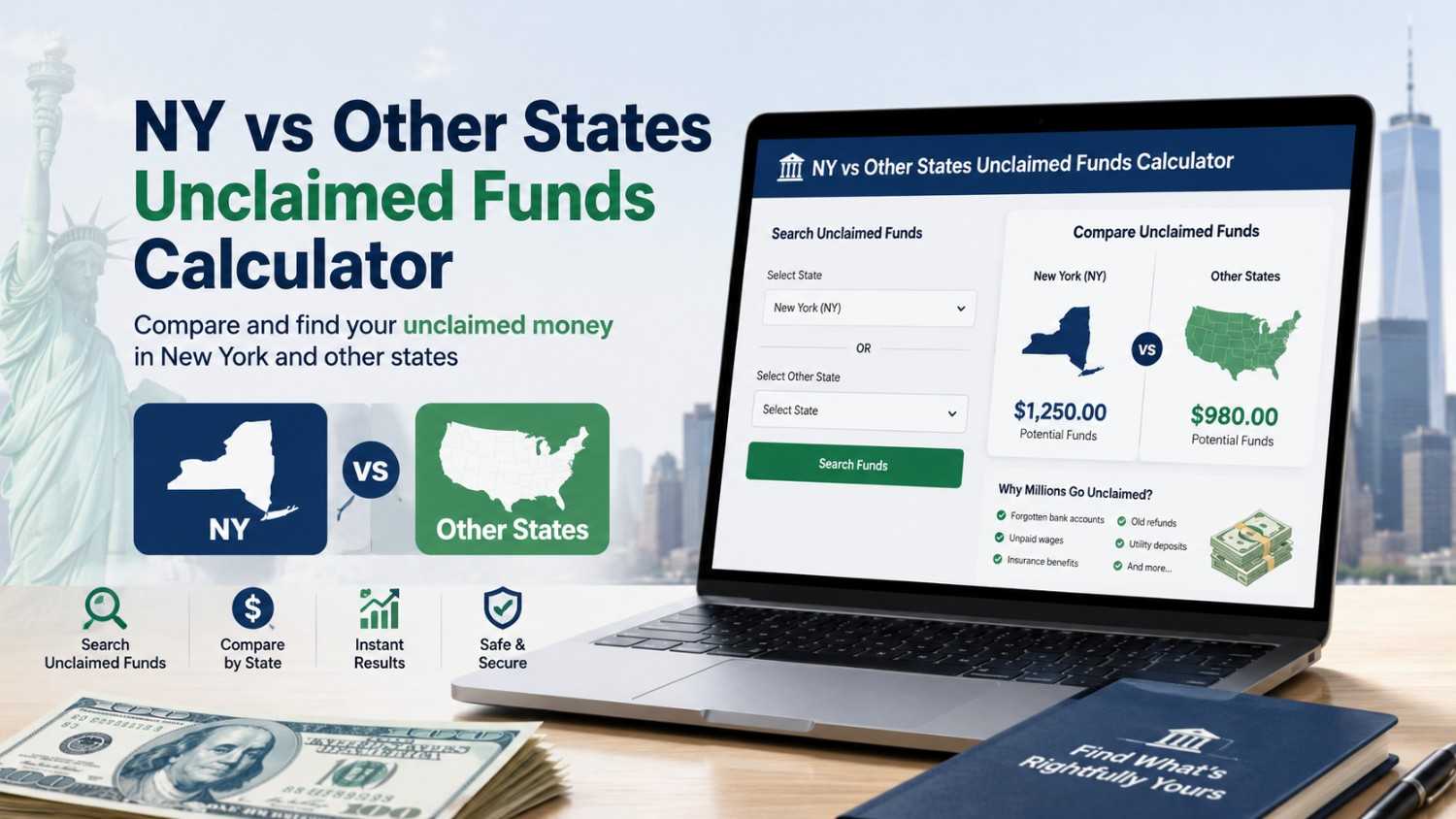
The New York vs Other States Unclaimed Funds Calculator on NewYorkCalculator.com is designed to help you organize that search. You can compare New York with another state, choose a property type, and identify the official resources to check.
One important limitation: this calculator does not search private financial accounts or reveal an unclaimed balance. Only the appropriate government database and its claim-verification process can help establish whether property belongs to you.
New York vs Other States Unclaimed Funds Calculator
Use the calculator below to create a state-by-state search plan. Choose New York as your starting point, select another state, and choose the type of property you want to investigate.
New York vs Other States Unclaimed Funds Calculator
Build a practical search plan for forgotten money and official state claim resources.
New York is the starting point for this tool.
Your Unclaimed Funds Search Plan
Official search resources
Start with these official or recognized state-search resources. Follow each agency’s instructions to search its database.
Your checklist
Tick each item as you complete it. Checklist selections stay on this page only.
After comparing the selected states, follow the official search links provided by the tool. If you previously lived in several states, repeat the process for each one rather than assuming that a single search covers your entire financial history.
What Is an Unclaimed Funds Calculator?
An unclaimed funds calculator is a tool that helps people understand where to search for potentially forgotten money and how state rules may differ.
It is not the same as a bank balance calculator or a refund estimator. A genuine unclaimed-property search depends on records maintained by the relevant state agency or another authorized institution.
For example, someone who lived in New York City before moving to New Jersey might have an old utility deposit, a forgotten payroll check, or an account associated with a previous address. Those items could be handled by different organizations, depending on the circumstances and applicable law.
A useful calculator should help answer four practical questions:
- Which states should I search?
- Which types of property might be relevant to me?
- Where can I access the official search database?
- What should I do if I find a possible match?
These questions matter more than a calculator that displays an impressive-looking dollar amount without access to verified financial records.
Why Compare New York With Other States?
Moving across a state border does not erase your financial history.
Consider a person who worked in Manhattan, rented an apartment in New Jersey, and later moved to Pennsylvania. That person may have financial connections to all three states, even if their current home is elsewhere.
A search limited to the person’s present address could overlook a property associated with an earlier residence or employer.
The federal government’s USAGov unclaimed-money guide recommends checking the unclaimed-property offices of states where you have lived. It also explains that different types of unclaimed money may be held in separate databases.
This is why comparing states is useful: it helps you build a search plan based on your actual history instead of your current mailing address alone.
New York vs. Other States: What Should You Compare?
The following table explains the key differences to investigate. It deliberately avoids assigning unverified dormancy periods to individual states or property types.
| Comparison factor | What you should check |
|---|---|
| Official search portal | Where the state maintains its unclaimed-property search |
| Property type | Whether the rules apply to bank accounts, checks, insurance, securities, or another category |
| Dormancy period | How long the relevant property generally must remain inactive before reporting |
| Reporting requirements | When and how the holder must report property to the state |
| Ownership verification | What evidence the state may require before approving a claim |
| Claim process | Whether the claim can be filed online, by mail, or through another process |
| Payment and timing | How the agency communicates decisions and distributes approved funds |
| Fees and assistance | Whether the official search and claim process is free and how to avoid recovery scams |
A state comparison is only meaningful when the property categories match. Comparing a checking account in one state with an insurance policy in another may produce a misleading conclusion because different legal rules can apply.
How New York Handles Unclaimed Funds
New York’s unclaimed-funds program is administered by the Office of the State Comptroller.
The state’s official Unclaimed Funds website explains that unclaimed property can include forgotten financial accounts, uncashed checks, stock certificates, unused gift cards, and other property transferred to the state under applicable requirements.
New York’s program also provides an important benefit: there is no fee or time limit to claim property held by the state, according to its official program information.
You can begin with the New York unclaimed-property search and claim guide.
How to Search New York’s Official Database
Step 1: Open the official search service.
Use the New York Office of Unclaimed Funds website rather than relying on an advertisement or an unfamiliar recovery company.
Step 2: Search your name.
Start with your last name or the name of your business. Refine the search with your first name, city, or ZIP code when necessary.
Step 3: Try earlier details.
A useful search may involve a former address, a nickname, a common misspelling, or a previous business name. Information from an older financial record may not match your current details exactly.
Step 4: Review possible matches.
A similar name does not automatically establish ownership. Check whether the listed information has a genuine connection to you, your previous address, your employer, or your business.
Step 5: Follow the official claim process.
If you find a potential match, follow the agency’s instructions. Depending on the claim, you may need to provide identifying information or documentation that establishes ownership.
New York’s official guide explains that claims can be filed online, although additional documents may be required. The state also notes that it cannot disclose the amount of a claim before ownership has been reviewed.
Do Unclaimed Funds Rules Differ by State?
Yes. States administer their own unclaimed-property programs, and requirements can vary according to property type and the applicable law.
However, a difference in dormancy periods does not necessarily mean that a person in one state is more likely to receive money than someone in another state.
Three separate concepts are especially important.
1. Dormancy period
The dormancy period is the period of inactivity that applies to a particular type of property before it may become reportable as unclaimed property.
The period may differ between property categories and jurisdictions. Do not assume that every bank account, paycheck, insurance payment, or utility refund follows the same timeline.
2. Reporting requirements
A business or financial institution may have reporting and due-diligence obligations before property is transferred to the state. The applicable requirements depend on the jurisdiction and property category.
This means that property may not appear in a state database immediately after you stop using an account or expect a payment.
3. Claim eligibility and deadlines
A dormancy period is not automatically a deadline for the owner to submit a claim.
New York, for example, states that there is no time limit to claim property held by its unclaimed-funds program. Other situations may involve different legal rules, so you should verify the relevant state’s official guidance instead of applying New York’s policy everywhere.
For additional background, consult the National Association of Unclaimed Property Administrators’ search resources and the relevant state’s official program.
Which Types of Unclaimed Money Should You Search For?
A complete search should go beyond checking for an old bank account.
Old checking and savings accounts
An account you stopped using years ago may be worth investigating. Search using names and addresses associated with the period when you maintained the account.
Uncashed checks and unpaid wages
A former employer, payroll provider, insurance company, or other organization may have issued a payment that never reached you or was never deposited.
If you suspect an unpaid wage claim rather than property already transferred to the state, you may also need to contact the employer or the appropriate labor agency.
Insurance proceeds
An insurance-related payment may become unclaimed if the intended recipient cannot be located. The appropriate search route depends on the type of policy and the organization that issued the payment.
Utility deposits and refunds
If you moved between apartments, closed utility accounts, or changed service providers, an old deposit or refund may be worth checking.
Keep in mind that a company may still hold a payment that has not been transferred to a state program.
Stocks, dividends, and other securities
Unclaimed property can include certain securities or payments related to investments. These claims may require additional documentation or specialized verification.
Gift cards and other financial property
Some jurisdictions include particular gift-card balances, credits, refunds, and other intangible property within their unclaimed-property programs. The exact treatment depends on the applicable law.
The best approach is to use the calculator to organize your search, then follow the official instructions for the specific property category.
How to Search Other States for Unclaimed Funds
If you have moved away from New York, start with every state that has a meaningful connection to your financial history.
You do not need to remember every old account number before beginning. Names, previous addresses, former employers, and business names can help you identify where to search.
Use these resources:
- USAGov: Find Unclaimed Money — a federal guide to state programs and other types of government-held funds.
- NAUPA: Search for Unclaimed Property — a starting point for finding participating state programs and search resources.
- New York Office of Unclaimed Funds — the official New York search and claim service.
Not every type of missing money is held by a state unclaimed-property office. For example, certain matured savings bonds, bankruptcy-related funds, and money associated with failed financial institutions may require different databases. USAGov lists separate resources for these categories.
A Practical Example: Moving From New York to New Jersey
Imagine that you lived in Queens for several years, moved to New Jersey, and later settled in Pennsylvania.
You remember closing most of your old accounts, but you are not certain whether you received every deposit and refund.
Here is a sensible search sequence:
- Search the New York official database using your current and former names.
- Review your Queens address and any earlier addresses associated with your financial accounts.
- Search New Jersey because you lived there and may have financial records linked to that period.
- Search Pennsylvania if you have accounts, employment history, or other relevant financial connections there.
- Check whether any suspected payment is held by a company or a separate federal database instead of a state program.
- Record the portals you have checked and follow the relevant claim instructions for any potential match.
This example is a search strategy, not a prediction that money will be found in any of those states.
What If the Calculator Shows a Different Dormancy Period?
Do not assume that a longer period means more money is available or that a shorter period means a claim is easier to approve.
Before relying on a comparison, verify the following:
- Does the figure refer to the same type of property in both states?
- Is it the dormancy period, a reporting deadline, or a claim deadline?
- Does the source refer to the current rule or an older version?
- Is the information published by an official agency or a reliable secondary source?
- Does the rule have exceptions that apply to your circumstances?
If the tool cannot verify a particular value, it should say so rather than display an invented number.
For a trustworthy comparison, each property-specific value should be linked to its source and accompanied by a last-verified date.
How to Claim Money After Finding a Match
Finding a potential match is the beginning of the process, not the end.
Confirm the connection
Check whether the name, former address, employer, or business information is consistent with your history. If the record belongs to someone else with a similar name, do not claim it.
Prepare the required evidence
Depending on the state and claim, you may need proof of identity, a current or former address, business ownership documents, or evidence that you are authorized to act for another person.
Claims involving a deceased owner or an estate can require additional legal documentation.
Follow the official instructions
Use the agency’s own claim form or online process. Do not send sensitive information to a third party simply because it promises to recover your money.
Track the claim
Save the confirmation number and any correspondence. If the agency requests more documentation, respond through its approved channel.
New York provides a claim status and contact resource for people who need help with an existing claim.
Understand the timing
Processing time depends on the claim and whether additional verification is required. New York’s published guidance says most claims are paid within 30 days, but that is a general statement, not a guarantee for every claim.
Do not assume that another state’s processing time will be the same.
Is It Free to Search for Unclaimed Funds?
You can search and submit claims directly through official government programs without paying a recovery company to do the work for you.
New York’s Office of Unclaimed Funds describes its service as free. Be cautious if someone demands an upfront payment, asks for unnecessary sensitive information, or pressures you to act immediately.
Before responding to a letter, email, phone call, or social-media message about lost money, verify the claim independently through the official state website.
Remember these safety practices:
- Start from an official government website.
- Do not share your Social Security number through an unverified form.
- Never assume that a message is genuine just because it contains your name.
- Check the official claim process before agreeing to pay a recovery service.
- Avoid anyone who guarantees a specific payout without verifying ownership.
What This Calculator Can and Cannot Tell You
The New York vs Other States Unclaimed Funds Calculator is intended to make research easier.
It can help you organize states to search, identify relevant property categories, compare verified rules where data is available, and find official resources.
It cannot determine whether a state owes you money, search confidential bank records, verify your identity, guarantee a claim, or calculate your actual unclaimed balance without authorized access to reliable account-level records.
A state may hold property that is not yet visible in a particular search, and a name match may not belong to you. If you find no result, try earlier names and addresses, search other relevant states, and check separate databases when appropriate.
Frequently Asked Questions
1. Can I search for unclaimed money from multiple states?
Yes. If you have lived or held relevant financial interests in multiple states, search each state’s official unclaimed-property database. A search in New York does not automatically cover every other state.
2. Does New York have a time limit for claiming unclaimed funds?
New York’s Office of Unclaimed Funds states that there is no time limit to claim property held by the state. Do not assume that this policy applies to every type of missing money or every other jurisdiction.
3. Can this calculator tell me how much money I will receive?
No. It organizes state and property searches. Only the appropriate official claim process can verify ownership and determine the amount payable.
4. Why might I not find my property online?
The record may be associated with a previous name or address, may not yet have been reported, may be held by a company, or may belong in another database. Try alternate spellings and earlier addresses before concluding that no property exists.
5. Do all property types have the same dormancy period?
No. Requirements can vary by state and property category. Check the current official rule for the exact type of property you are researching.
6. Do I have to pay to claim New York unclaimed funds?
New York’s official Office of Unclaimed Funds provides a free search and claim service. You can begin directly through its government website rather than paying a recovery company.
7. Can I claim money that belonged to a deceased family member?
You may be able to claim property on behalf of a deceased owner if you meet the applicable legal requirements. The agency may require proof of your relationship, authority, or status as an estate representative.
8. What should I do if I find a possible match?
Review the record, confirm your connection to the listed information, and follow the official agency’s instructions. Keep your confirmation details and provide documentation only through approved channels.
Final Thoughts
Searching for unclaimed funds does not have to be complicated, but it does require checking the right sources.
If you have lived in New York and other states, do not stop after searching your current state. Use the New York vs Other States Unclaimed Funds Calculator to organize your search, compare relevant rules where verified information is available, and open the official portals that apply to your history.
The most reliable result is not a promise that you will receive money. It is a clear path to checking your records, verifying a possible match, and making a claim through the correct government agency.
About the author: Junaidul Islam writes practical calculator guides for NewYorkCalculator.com, helping readers understand financial and government-related tools through clear explanations and official resources.
Sources and further reading
- New York State Office of the State Comptroller — How to Search and Claim Property
- New York Office of Unclaimed Funds
- USAGov — How to Find Unclaimed Money
- National Association of Unclaimed Property Administrators — Search Resources
Last reviewed: October 10, 2026. State requirements and agency procedures can change. Confirm current details with the relevant official source before filing a claim.