
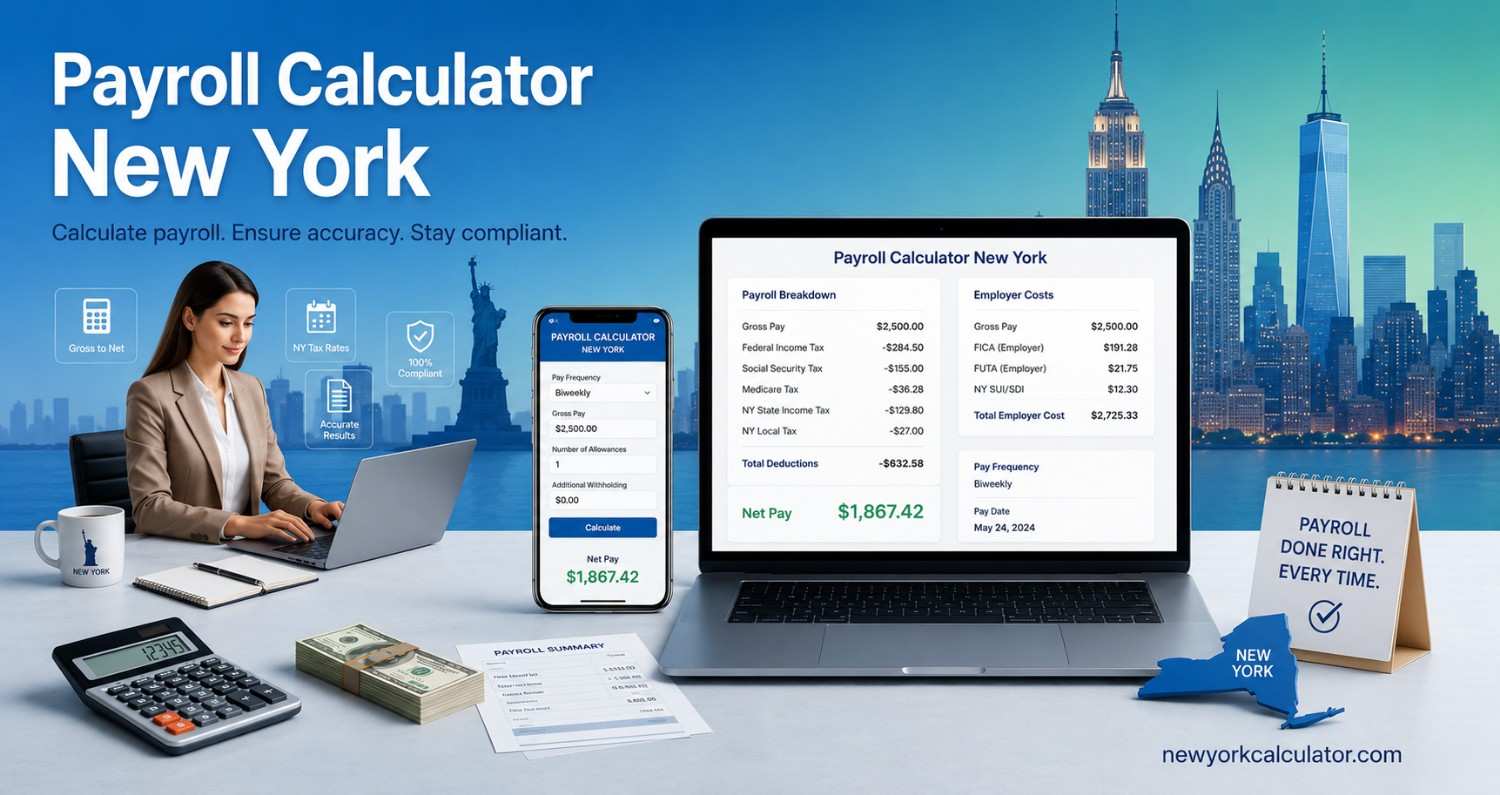
Written by Junaidul Islam If you work in New York or run payroll for a New York employee, knowing your gross salary is only the beginning. The amount you actually receive in your bank account can be affected by federal income tax withholding, New York State income tax, Social Security, Medicare, New York Paid Family Leave, local taxes, retirement contributions, health benefits and other deductions.
Our New York Payroll Calculator 2026 is designed to give you a practical estimate of your paycheck after the most common payroll taxes and deductions.
Use the calculator below to estimate your New York gross pay, payroll taxes and take-home pay.
New York Payroll Calculator 2026
Estimate your New York gross pay, federal taxes, NY State tax, NYC/Yonkers tax, payroll deductions and take-home pay.
1. Pay Information
2. New York Details
3. Pre-Tax Deductions
4. Post-Tax Deductions
Important: This calculator provides an estimate for educational and planning purposes. Actual payroll withholding can differ because employers use the employee’s W-4, New York withholding certificate, payroll records, benefits, credits, year-to-date wages and other payroll information.
What Does a New York Payroll Calculator Do?
A payroll calculator works backward from your gross earnings to estimate what may be withheld before you receive your net paycheck.
For example, suppose your annual salary is $75,000.
Your annual salary is not necessarily the amount that reaches your bank account. Depending on your circumstances, your payroll may include:
- Federal income tax withholding
- Social Security tax
- Medicare tax
- New York State income tax
- New York City or Yonkers tax, when applicable
- New York Paid Family Leave deduction
- Retirement contributions
- Health insurance premiums
- Other pre-tax deductions
- Other post-tax deductions
The calculator brings these items together so you can see the difference between gross pay and estimated take-home pay.
Gross Pay vs. Net Pay in New York
The easiest way to understand payroll is to separate three numbers.
Gross Pay
Gross pay is your earnings before taxes and deductions.
For a salaried employee, annual gross pay may be divided across 52 weekly, 26 biweekly, 24 semi-monthly or 12 monthly pay periods.
For an hourly employee, gross pay normally depends on the hourly rate and hours worked.
Payroll Taxes and Deductions
These are amounts removed from your paycheck for taxes, benefits or other authorized deductions.
Net Pay
Net pay is the amount left after applicable taxes and deductions.
In simple terms:
Gross Pay − Taxes − Deductions = Estimated Net Pay
The actual payroll calculation can be more complicated because different taxes and deductions have different rules.
How to Use the New York Payroll Calculator
Start by selecting whether you are paid a salary or hourly wage.
If you are salaried
Enter your annual salary.
For example:
Annual salary: $75,000
Then choose your pay frequency.
If you are paid hourly
Enter:
- Hourly wage
- Regular hours
- Overtime hours, if applicable
- Pay frequency
For example:
$25/hour × 40 hours = $1,000 regular weekly gross pay
If you work qualifying overtime, the calculator can add your overtime earnings to the regular wages.
Choose Your New York Location
New York payroll is not identical everywhere.
For calculator purposes, it is important to distinguish between:
- New York State outside NYC and Yonkers
- New York City
- Yonkers
- New York resident working in another location
- New York nonresident working in New York
New York City residents can be subject to a separate NYC personal income tax, while Yonkers residents can be subject to a Yonkers income-tax surcharge. New York also has rules affecting nonresidents who earn wages from work performed in the state.
That is why simply applying one “New York tax rate” to every employee can produce a misleading estimate.
New York State Income Tax in 2026
New York uses a progressive personal income tax system. This means the entire salary is not automatically taxed at the highest rate that applies to the taxpayer’s income.
For 2026, New York reduced the first five personal income-tax rates compared with 2025. The revised rates include 3.90%, 4.40%, 5.15%, 5.40% and 5.90% in the lower and middle brackets, while the higher statutory rates remain in place. The 2026 withholding tables became effective for payrolls made on or after January 1, 2026.
For a single filer, the basic 2026 statutory schedule begins approximately as follows:
| New York taxable income | Rate |
|---|---|
| Up to $8,500 | 3.90% |
| $8,500–$11,700 | 4.40% |
| $11,700–$13,900 | 5.15% |
| $13,900–$80,650 | 5.40% |
| $80,650–$215,400 | 5.90% |
| $215,400–$1,077,550 | 6.85% |
| $1,077,550–$5 million | 9.65% |
| $5 million–$25 million | 10.30% |
| Over $25 million | 10.90% |
These are statutory marginal rates, not a percentage that should simply be multiplied by your entire gross salary. Higher-income taxpayers can also encounter special New York tax calculations, so a simple bracket calculation should not be treated as a final tax return calculation.
Does New York City Have Its Own Payroll Tax?
Yes.
New York City residents can pay NYC personal income tax in addition to New York State income tax.
The 2026 NYC resident rate schedule uses four rates:
- 3.078%
- 3.762%
- 3.819%
- 3.876%
The applicable rate depends on taxable income and filing status.
This means a person earning the same salary can have a different estimated take-home amount depending on whether they live in New York City or elsewhere in New York State.
Example
Consider two employees with the same salary:
Employee A: Lives outside NYC
Employee B: Lives in NYC
Their federal and New York State calculations may be similar, but Employee B may also have NYC personal income tax.
That difference can reduce the amount of take-home pay.
What About Yonkers?
Yonkers has its own special tax treatment.
A Yonkers resident can be subject to a resident income-tax surcharge calculated as a percentage of New York State tax. New York’s employer guidance states that the Yonkers resident surcharge is 16.75% of the New York State tax amount.
There is also a separate Yonkers nonresident earnings tax for certain people who work in Yonkers but do not live there.
The 2026 Yonkers withholding tables were updated to reflect the 2026 New York State tax changes. The Yonkers nonresident earnings tax rate did not change in the 2026 update.
This is one reason a calculator should not treat every New York resident as having the same local tax.
Federal Income Tax on a New York Paycheck
New York employees are also subject to federal income tax withholding.
Federal income tax is progressive. For 2026, the federal individual income-tax rates remain 10%, 12%, 22%, 24%, 32%, 35% and 37%.
For example, the 2026 federal brackets for a single filer begin at:
| 2026 taxable income | Federal rate |
|---|---|
| $0–$12,400 | 10% |
| $12,400–$50,400 | 12% |
| $50,400–$105,700 | 22% |
| $105,700–$201,775 | 24% |
| $201,775–$256,225 | 32% |
| $256,225–$640,600 | 35% |
| Over $640,600 | 37% |
For 2026, the federal standard deduction is $16,100 for a single filer, $32,200 for married filing jointly and $24,150 for head of household.
Your actual paycheck withholding, however, is not simply your annual tax divided by the number of paychecks. Employers use withholding rules and the information supplied on Form W-4.
Social Security Tax in 2026
Social Security is part of FICA payroll tax.
For 2026:
Employee Social Security rate: 6.2%
Employer Social Security rate: 6.2%
The 2026 Social Security wage base is $184,500. Once covered wages reach the annual wage base, additional wages are no longer subject to the regular 6.2% Social Security tax.
This matters particularly for high-income employees and employees who have more than one job during the year.
Medicare Tax in 2026
The standard Medicare payroll tax is:
1.45% for the employee
and
1.45% for the employer
Unlike Social Security, Medicare does not have a standard annual wage base limit.
Employees with wages above $200,000 can also be subject to the additional 0.9% Medicare withholding. Employers begin withholding that additional amount once an employee’s wages exceed $200,000 during the calendar year. There is no employer matching contribution for the additional 0.9%.
New York Paid Family Leave Payroll Deduction in 2026
One of the important New York-specific payroll items is Paid Family Leave, commonly called PFL.
For 2026, the employee contribution rate is:
0.432% of gross wages
with a maximum annual employee contribution of:
$411.91
The maximum 2026 PFL benefit is $1,228.53 per week, and eligible employees can receive up to 12 weeks of leave under the program.
PFL is funded through employee payroll deductions. Employers generally collect the contribution through payroll rather than paying the employee contribution themselves.
Why this matters
A worker may see a small PFL deduction on every paycheck. The amount can look insignificant on one paycheck but becomes more noticeable over an entire year.
Our calculator therefore separates PFL from the larger federal and state income-tax categories.
New York Disability Insurance and Payroll Deductions
New York also has disability-benefit requirements that can affect payroll arrangements.
However, disability insurance should not be treated exactly like federal FICA or New York State income tax.
The amount and responsibility can depend on the employer’s coverage arrangement and applicable New York rules.
For that reason, users should compare the calculator estimate with the actual deductions shown on their pay stub rather than assuming that every employee will have an identical disability deduction.
This is an important distinction because some online calculators simplify state insurance deductions too aggressively.
What Is the Difference Between Salary and Hourly Payroll?
The calculation starts differently depending on how you are paid.
Salary employee
If you earn $78,000 per year and receive 26 biweekly paychecks:
$78,000 ÷ 26 = $3,000 gross per paycheck
Hourly employee
If you earn $30 per hour and work 40 regular hours:
$30 × 40 = $1,200 gross weekly pay
Overtime, bonuses, commissions and other taxable earnings can increase the gross amount.
Overtime Pay and Your New York Paycheck
Overtime can make payroll calculations more complicated because the extra wages may affect federal, state and payroll-tax calculations.
For example:
Regular wage: $25/hour
Regular hours: 40
Overtime hours: 8
At 1.5 times the regular hourly rate:
Overtime rate = $37.50/hour
8 overtime hours = $300
Regular pay = $1,000
Total gross pay = $1,300
This is why a payroll calculator should allow overtime rather than asking an hourly worker to manually combine regular and overtime earnings.
There is also an important 2026 federal development concerning qualified overtime compensation. Federal law allows a deduction for certain qualified overtime compensation for tax years beginning after 2024 and before 2029, subject to statutory limits and eligibility rules. This deduction is not the same thing as simply removing all overtime pay from payroll withholding.
How Bonuses Can Change a Paycheck
A bonus can make one paycheck look very different from a normal paycheck.
For example:
Regular salary: $80,000
Annual bonus: $10,000
The bonus increases total earnings, but the withholding method can differ depending on how the employer pays and identifies the supplemental wages.
New York’s 2026 withholding guidance includes specific supplemental-wage withholding methods for bonuses and commissions.
Therefore, a bonus paycheck should not automatically be interpreted as your normal tax rate for the rest of the year.
Pre-Tax and Post-Tax Deductions
Your employer may deduct money for benefits or retirement accounts.
Common deductions include:
- 401(k)
- 403(b)
- Health insurance
- Dental insurance
- Vision insurance
- HSA
- FSA
- Commuter benefits
- Life insurance
- Other employee benefits
A pre-tax deduction can reduce the amount of wages subject to certain taxes, depending on the type of benefit and applicable rules.
A post-tax deduction generally comes out after the relevant taxes have been calculated.
Because every benefit plan is different, users should enter the deductions according to their payroll plan documents or pay stub.
Why Your Paycheck May Be Different From Someone With the Same Salary
Two New Yorkers can earn exactly the same annual salary and still receive different net pay.
The reasons can include:
- Different filing status
- Different W-4 information
- Different New York withholding information
- NYC residence
- Yonkers residence
- Dependents
- Additional withholding
- Retirement contributions
- Health insurance
- Other benefits
- Multiple jobs
- Year-to-date wages
- Bonus or commission income
- Tax exemptions
- Different payroll frequency
That is why salary alone is not enough to determine an exact paycheck.
What Is a W-4?
Form W-4 is the federal Employee’s Withholding Certificate.
Your employer uses the information you provide to determine federal income-tax withholding.
The modern W-4 does not work like the old allowance system. Employees generally provide filing-status information and, where applicable, information about multiple jobs, dependents, other income, deductions and additional withholding.
New York has its own withholding certificate, including Form IT-2104 for many employees. New York’s 2026 withholding guidance was updated for the new tax-year schedules.
What Does “Effective Tax Rate” Mean?
Your marginal tax rate and effective tax rate are not the same.
Marginal tax rate
This is the tax rate that applies to the next dollar of taxable income within the applicable bracket.
Effective tax rate
This is a broader measurement of total tax compared with the income used in the calculation.
For example, if someone has an effective tax rate of 18%, that does not mean every dollar of their income was taxed at exactly 18%.
Understanding this difference helps prevent one of the most common misunderstandings about progressive tax systems.
New York Payroll Calculator vs. Paycheck Calculator
These terms are often used interchangeably online, but there is a useful distinction.
A paycheck calculator is generally focused on:
“How much will I take home?”
A broader payroll calculator can also help employers understand:
“What taxes and deductions are involved in this employee’s payroll?”
That is why this New York Payroll Calculator is designed around both sides of the payroll process where practical.
For employer planning, remember that employer-side costs can vary by factors such as unemployment-insurance experience and other business-specific circumstances. A simple employee paycheck calculation should not be treated as a complete employer payroll quote.
How Much Is $25 an Hour in New York?
A $25 hourly wage does not automatically equal a specific take-home amount.
Your annual gross earnings depend on the number of hours worked.
At 40 hours per week for 52 weeks:
$25 × 40 × 52 = $52,000 gross annual wages
But the amount deposited into your bank account can be lower after federal, state, local and payroll deductions.
Use the calculator above to change the pay frequency, filing status, location and deductions for a more useful estimate.
How Much Is a $75,000 Salary After Taxes in New York?
A $75,000 salary is a useful example, but there is no single net-pay answer for every New Yorker.
A $75,000 employee living outside New York City can have a different take-home amount from a $75,000 employee living in NYC.
Likewise, two people living in the same city can receive different net pay because of filing status, W-4 information, benefits and retirement contributions.
Instead of publishing one “universal” take-home number, enter your own information into the calculator.
That approach is more useful because it lets you test different real-life scenarios.
Why Year-to-Date Pay Matters
Year-to-date, or YTD, wages can matter when payroll taxes have annual wage limits.
The most obvious example is Social Security.
For 2026, the Social Security wage base is $184,500. Once an employee reaches the applicable annual wage base, the regular Social Security tax no longer applies to additional wages for that year.
Employees with multiple jobs should be particularly careful when comparing a calculator estimate with their actual pay stub because each employer may not know the employee’s complete earnings from other employers.
What If I Live Outside New York but Work in New York?
This is one of the situations where a basic salary calculator can be misleading.
New York has withholding rules for nonresident employees who perform services in New York.
New York’s employer guidance states that New York personal income tax must generally be withheld from wages paid to nonresident employees for services performed in New York, subject to the applicable rules.
Remote-work and multi-state situations can become considerably more complicated because residency, work location, allocation rules and employer circumstances may matter.
If you work across state lines, treat a simple online estimate as a starting point rather than a final tax determination.
2026 New York Payroll Changes You Should Know
2026 is important because New York updated its State and Yonkers withholding tables.
The New York Department of Taxation and Finance says the 2026 New York State and Yonkers withholding changes apply to payrolls made on or after January 1, 2026. The department also notes that New York City wage-bracket tables and exact calculation methods did not change in the same way.
Another important 2026 change is the New York Paid Family Leave contribution rate.
The 2026 PFL contribution is 0.432%, with a maximum annual employee contribution of $411.91.
At the federal level, the 2026 Social Security wage base is $184,500, while the employee and employer Social Security rates remain 6.2%.
These updates are why a calculator built around old tax-year figures can produce outdated results.
Why You Should Not Use an Old New York Payroll Calculator
Tax calculators are not permanent mathematical formulas.
A calculator can become outdated when:
- Federal tax brackets change
- Standard deductions change
- Social Security wage limits change
- New York withholding tables change
- PFL contribution rates change
- Local tax rules change
- Employer payroll rules change
For 2026, New York specifically updated its State and Yonkers withholding tables.
For that reason, always check the tax year shown on a payroll calculator before relying on its result.
What Our Calculator Estimates
The New York Payroll Calculator on this page is intended to help estimate:
- Gross pay
- Federal income-tax estimate
- Social Security
- Medicare
- New York State income-tax estimate
- NYC income tax where applicable
- Yonkers resident surcharge where applicable
- New York Paid Family Leave
- Pre-tax deductions
- Post-tax deductions
- Estimated net pay
- Annualized net pay
- Effective estimated tax rate
The tool also allows you to compare salary and hourly scenarios.
What the Calculator Does Not Replace
An online calculator should not replace:
- Your employer’s payroll system
- Your official pay stub
- IRS tax guidance
- New York Department of Taxation and Finance guidance
- A CPA
- An enrolled agent
- A qualified tax professional
This is especially important for high-income earners, multi-state workers, self-employed people, people with multiple jobs, complex benefits, unusual withholding arrangements and people with substantial investment or non-wage income.
Calculator Accuracy and Methodology
This calculator is designed as an estimate, not a payroll-processing system.
The calculations use 2026 tax-year assumptions and publicly available federal and New York tax information. New York State confirms that its 2026 withholding tables apply to payrolls made on or after January 1, 2026.
Federal payroll-tax assumptions use the 2026 Social Security and Medicare figures published by the IRS.
New York Paid Family Leave assumptions use the official 2026 contribution rate and annual maximum.
Actual employer payroll calculations may differ because official withholding methods can use W-4/IT-2104 information, payroll-period calculations, credits, allowances or other factors that are not fully represented in a simplified online calculator.
Frequently Asked Questions
Is the New York Payroll Calculator free?
Yes. The calculator on this page is designed as a free tool for estimating New York payroll and take-home pay.
Is the calculator for 2026?
Yes. The calculator is designed around 2026 federal and New York payroll assumptions.
Does New York have state income tax?
Yes. New York has a progressive personal income-tax system.
Does NYC have an additional income tax?
Yes. New York City residents can be subject to NYC personal income tax in addition to New York State income tax.
Does Yonkers have an additional tax?
Yes. Yonkers residents can be subject to a resident income-tax surcharge, and separate rules apply to certain nonresident earnings.
How much is Social Security tax in 2026?
The employee Social Security tax rate is 6.2%, with a 2026 wage base of $184,500.
How much is Medicare tax?
The standard employee Medicare rate is 1.45%. There is no regular Medicare wage-base limit. An additional 0.9% withholding can apply to wages above $200,000.
What is the 2026 New York PFL rate?
The 2026 employee contribution rate is 0.432% of gross wages, subject to the annual maximum contribution of $411.91.
Can I use this calculator for hourly work?
Yes. Enter your hourly wage, regular hours and overtime information.
Can I calculate salary pay?
Yes. Enter your annual salary and select your pay frequency.
Why is my actual paycheck different from the calculator?
Your employer’s payroll system may use exact W-4 and New York withholding information, benefit deductions, year-to-date wages, tax credits, payroll-period rules and other information that a public calculator cannot fully know.
Is this calculator a tax return calculator?
No. It estimates payroll withholding and take-home pay. It is not a substitute for preparing or filing a tax return.
Can I use this calculator for a New York nonresident?
It can provide a starting estimate, but multi-state and nonresident taxation can require additional allocation and residency analysis.
Final Takeaway
A New York paycheck is affected by much more than your advertised salary.
Your final take-home pay can depend on your:
- Salary or hourly wage
- Pay frequency
- Federal withholding information
- New York withholding information
- Filing status
- NYC or Yonkers residency
- Social Security wages
- Medicare wages
- Paid Family Leave deduction
- Benefits
- Retirement contributions
- Other deductions
- Year-to-date earnings
The most useful way to estimate your take-home pay is therefore to use your own numbers rather than relying on a generic salary table.
Enter your information into the New York Payroll Calculator above and review the estimated gross pay, taxes, deductions and net pay.
Important Disclaimer
This calculator and article are provided for general educational and planning purposes. They are not tax, legal, accounting or payroll advice. Tax withholding can vary according to individual circumstances and official payroll rules. Always compare an estimate with your actual pay stub and consult the IRS, New York State Department of Taxation and Finance, your payroll administrator or a qualified tax professional when you need a definitive answer.
Last reviewed for 2026 information: October 2026.
Author: Junaidul Islam
Primary Sources
IRS 2026 employer/payroll guidance and New York State Department of Taxation and Finance 2026 withholding guidance were used when preparing this guide.
This site was… how do I say it? Relevant!! Finally I have found something which helped
me. Thank you!
I like the valuable info you provide for your articles. I will bookmark your blog and check again right here regularly.
I’m relatively sure I’ll be told many new stuff proper right here!
Good luck for the following!
Hi there just wanted to give you a quick heads up.
The words in your post seem to be running off the screen in Opera.
I’m not sure if this is a formatting issue or something to do with browser compatibility but I
figured I’d post to let you know. The design and style look
great though! Hope you get the issue solved soon. Kudos
Heya i’m for the first time here. I found this board and I find It truly useful &
it helped me out much. I hope to give something back and aid others like you aided me.
Excellent breakdown and very helpful information. Bookmarked this page for future reference. Thanks!