
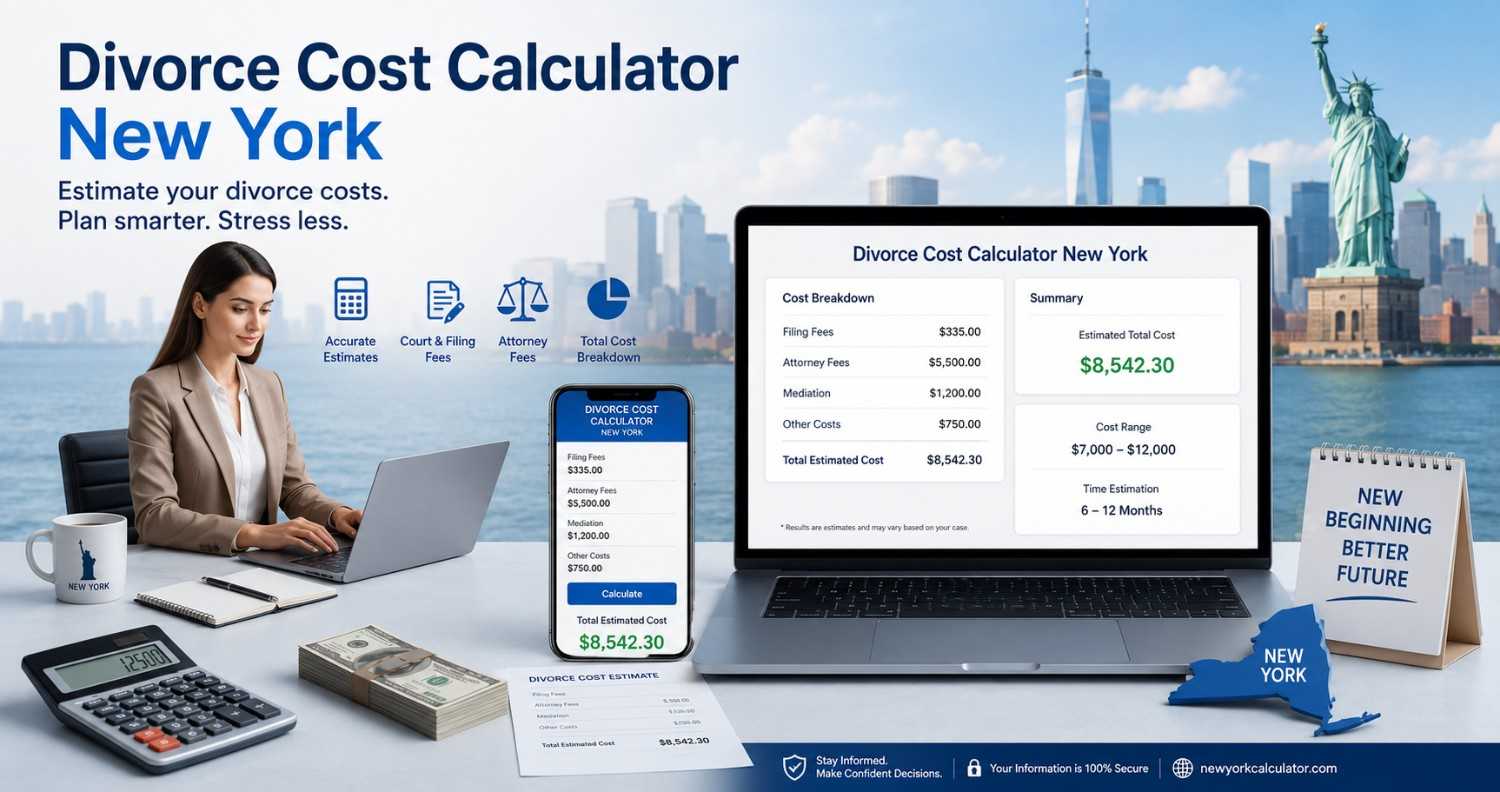
By Junaidul Islam Divorce in New York does not have one fixed price. The court fee is only the starting point. What you actually spend can depend on whether your divorce is uncontested or contested, whether you hire an attorney, how much property or debt must be divided, whether you have children, and whether the case requires mediation, financial experts, appraisals, retirement-account orders or repeated court appearances.
Our New York Divorce Cost Calculator is designed to help you build a realistic planning estimate before you start spending money. Instead of giving every New Yorker the same number, the calculator lets you account for the major cost drivers in your own situation.
Important: This calculator is an educational planning tool, not a quote from a lawyer or the New York courts. Actual fees can be higher or lower. Always verify current court fees and legal requirements with New York State Courts or a qualified New York attorney before filing.
New York Divorce Cost Calculator
Estimate your potential New York divorce expenses using your own attorney, mediation, property, custody and case-complexity assumptions.
1. Basic Case Information
2. Attorney Costs
3. Children & Custody
4. Mediation & Service
5. Property & Financial Complexity
6. Motions & Other Costs
7. Lost Work Income
Your Estimated New York Divorce Budget
| Cost Category | Estimated Amount |
|---|
How Much Does a Divorce Cost in New York?
The simplest answer is: there is no single total cost for every New York divorce.
For an uncontested divorce, New York State Courts says the court filing fees are at least $335, before additional expenses such as attorney fees, photocopies, notary fees, transportation, mailing and process-server costs.
That $335 should therefore not be confused with the total cost of getting divorced.
A person who handles a simple uncontested case without an attorney may spend relatively little beyond court-related expenses. On the other hand, a contested divorce involving custody, real estate, retirement accounts, business interests, financial investigations or multiple motions can become much more expensive.
The most useful question is not simply:
“How much does divorce cost in New York?”
It is:
“What costs are likely to apply to my particular divorce?”
That is what this calculator is designed to help you estimate.
New York Divorce Filing Fees: Why You May See $210 and $335
One reason online divorce-cost information can be confusing is that different websites quote different filing-fee numbers.
The $210 figure generally refers to the index number fee used to commence the Supreme Court action.
The commonly cited $335 total reflects the $210 index-number fee plus the applicable $95 Request for Judicial Intervention fee and $30 Note of Issue fee. New York court materials and county court-help information describe the relevant charges separately.
That means:
| Court-related item | Amount |
|---|---|
| Index number | $210 |
| Request for Judicial Intervention | $95 |
| Note of Issue | $30 |
| Common total | $335 |
The exact circumstances and timing of fees matter, so do not assume that paying $335 covers every expense associated with your divorce.
For example, the court itself lists possible additional expenses including service, lawyer fees, copies, notary services, transportation and mailing.
Uncontested vs. Contested Divorce in New York
The difference between an uncontested and contested divorce can have a major effect on cost.
Uncontested Divorce
An uncontested divorce generally means both spouses agree on the issues that must be resolved, including matters such as property, finances, and—when applicable—custody and child support.
New York Courts provides forms and a DIY program for eligible uncontested cases.
A simple uncontested case may therefore avoid many of the expenses associated with prolonged litigation.
You may still have expenses for:
- Court filing fees
- Service of process
- Notary services
- Copies and mailing
- Attorney document review
- Online document preparation, if used
- Certified copies
- Other case-specific expenses
Contested Divorce
A contested divorce can become substantially more expensive because disagreement may require:
- Attorney negotiations
- Discovery
- Motions
- Court conferences
- Depositions
- Expert witnesses
- Property valuation
- Financial investigation
- Custody-related professionals
- Trial preparation
- Additional attorney hours
New York court guidance specifically notes that contested cases can incur additional costs depending on motion practice.
This is why a calculator based only on “filing fee + attorney fee” can underestimate the real budget for a complicated case.
What Is Usually the Biggest Divorce Expense?
For many people, the largest variable cost is professional time.
An attorney may charge by the hour, use a flat fee for certain services, or use a retainer arrangement where money is deposited in advance and billed against as work is performed.
A retainer is not necessarily the final cost of the divorce.
For example, suppose an attorney charges:
- $450 per hour
- 20 hours of work
The estimated attorney time would be:
$450 × 20 = $9,000
If the case requires 50 hours instead:
$450 × 50 = $22,500
The court filing fee has not changed, but the legal bill has changed dramatically.
That is why the calculator above allows you to enter your own estimated attorney rate and hours instead of pretending that one statewide attorney price applies to everyone.
Current online New York calculators commonly use broad attorney-rate assumptions, but even those sites acknowledge that the numbers are estimates rather than guaranteed quotes.
Mediation Can Change the Cost
If you and your spouse disagree about some issues but are willing to negotiate, mediation may be an alternative to prolonged litigation.
A mediator can help the parties work through issues such as:
- Property division
- Debt
- Parenting arrangements
- Child-related expenses
- Spousal maintenance
- Other settlement terms
The cost depends on the mediator, number of sessions and complexity of the dispute.
The important point is that mediation is not automatically a fixed-cost service.
Our calculator therefore allows mediation to be included as a separate expense rather than hiding it inside a generic “divorce cost.”
Process Server Costs
Starting a divorce action does not necessarily mean your only expense is the court filing fee.
The other spouse generally needs to be properly served with the divorce papers unless the applicable procedure provides otherwise.
New York Courts identifies process-server expenses among the costs that may exist beyond the court filing fee.
Your actual service cost can depend on:
- Where your spouse lives
- How easy the person is to locate
- Number of attempts
- Whether special service arrangements are required
- Local provider pricing
For that reason, the calculator treats service as a separate editable cost.
Children Can Make a Divorce More Complicated
Having children does not automatically mean your divorce will be expensive.
However, disagreements involving children can increase legal work significantly.
Potential issues include:
- Legal custody
- Physical custody
- Parenting time
- Child support
- Health insurance
- Child-care expenses
- Education-related expenses
- Modification issues
- Disputes over parenting schedules
New York Courts maintains separate maintenance and child-support tools and updated its matrimonial forms in 2026. The March 1, 2026 revisions increased the combined-income cap under the Child Support Standards Act from $183,000 to $193,000 and increased the maintenance payor income cap from $228,000 to $241,000.
These figures are important because a divorce-cost calculator should not simply assume that child support is part of the one-time legal bill.
Child support is generally an ongoing financial obligation, not simply a one-time divorce expense.
That distinction is important when planning your budget.
Property Division Can Increase the Cost Quickly
New York uses an equitable distribution approach to marital property.
Equitable does not necessarily mean every asset is automatically divided 50/50.
A divorce involving a basic bank account and two vehicles is very different from one involving:
- A marital home
- Investment accounts
- Multiple properties
- Business interests
- Stock options
- Retirement plans
- Pensions
- Significant debt
- Separate-property claims
The more financial questions that must be investigated and documented, the more professional time may be required.
Real Estate Can Add Several Separate Costs
If you own a home or other real estate, divorce expenses may extend beyond your attorney bill.
Possible costs include:
- Real-estate appraisal
- Property valuation
- Title-related work
- Deed preparation
- Recording-related expenses
- Mortgage refinancing
- Financial analysis
- Tax advice
For example, if one spouse wants to keep the marital home, the legal settlement may be only one part of the financial problem.
You may also need to determine:
What is the home’s current value?
How much equity exists?
Who will refinance the mortgage?
How will the other spouse receive their share?
Those decisions can create additional professional expenses.
Retirement Accounts and QDRO Costs
Retirement assets can create another cost that is easy to overlook.
If a retirement plan must be divided, the parties may need a Qualified Domestic Relations Order (QDRO) or another appropriate order depending on the type of account.
Potential costs can include:
- Attorney preparation
- Plan-specific review
- Retirement valuation
- Pension analysis
- Additional revisions
The number of retirement accounts can therefore matter.
For example:
One retirement account ≠ several retirement accounts.
A calculator that asks only “Do you have retirement assets?” may therefore be less useful than one that allows the user to identify how many accounts may require additional work.
Business Ownership Can Make a Divorce Much More Expensive
If either spouse owns a:
- Business
- LLC
- Corporation
- Professional practice
- Partnership
- Investment business
the value of that business may become an important part of the divorce.
Possible expenses include:
- Business valuation
- Financial records analysis
- Forensic accounting
- Tax analysis
- Expert reports
- Attorney review
The complexity can increase further if one spouse disputes the reported business income or believes assets have not been properly disclosed.
For this reason, our calculator treats business valuation as a separate potential expense.
Forensic Accounting and Financial Investigation
A straightforward divorce may not require a forensic accountant.
A complicated financial case might.
Forensic financial work may be relevant where there are questions involving:
- Hidden assets
- Unreported income
- Business cash flow
- Transfers to third parties
- Complex investment accounts
- Separate versus marital property
- Financial records that require detailed tracing
Current New York divorce-cost guides identify forensic accounting as a potentially significant expense in complex cases.
This is another reason the calculator should not use only a generic “contested divorce” multiplier.
Motions Can Increase Your Legal Bill
A contested divorce may involve requests that require the court to decide an issue before the final judgment.
For example, parties may seek temporary relief concerning:
- Custody
- Parenting time
- Child support
- Property
- Other interim matters
New York court guidance explains that contested matrimonial cases can involve motions and court conferences.
Each additional motion can require attorney drafting, review, filing and court appearances.
Therefore, our calculator includes number of expected motions as a planning variable.
This is one of the details that many simple divorce calculators leave out.
Don’t Forget the Cost of Your Time
Legal bills are not the only economic cost of divorce.
You may need to take time away from:
- Work
- Business
- Childcare
- Travel
- Court appearances
- Meetings with attorneys
- Mediation
- Document preparation
Suppose you earn $35 per hour and lose 30 paid working hours dealing with the divorce.
Your estimated lost income would be:
$35 × 30 = $1,050
This does not mean every person will actually lose $1,050. Some people have paid leave, flexible schedules or no direct income loss.
The purpose of including the option is simply to help you see the broader financial impact.
New York Divorce Costs Can Be Higher in Complex Cases
There is no responsible single number that can describe every New York divorce.
Current online estimates show very broad ranges, particularly when comparing simple uncontested cases with high-conflict or high-asset litigation.
That is why this page focuses on cost drivers rather than one dramatic headline number.
A useful planning estimate should answer:
- What court fees apply?
- Will I hire an attorney?
- How many attorney hours might be needed?
- Will mediation be used?
- Is service required?
- Are children involved?
- Is custody disputed?
- Is there real estate?
- Are retirement accounts involved?
- Is a business involved?
- Could experts be needed?
- How much work might I miss?
2026 New York Divorce Law Update: Six-Month Separation Change
There is an important 2026 update that older divorce articles may not reflect.
New York Courts says the 2026 matrimonial forms were revised to reflect Chapter 673 of the Laws of 2025. That law changed separation-based divorce provisions, reducing the required living-apart period under certain separation-judgment and separation-agreement grounds from one year to six months.
This should not be confused with the ordinary no-fault divorce ground under DRL §170(7).
Under that no-fault ground, the relationship must have broken down irretrievably for at least six months, and the economic and child-related issues must be resolved by agreement or determined by the court before a judgment can be granted. Recent 2026 New York Supreme Court decisions continue to apply this rule.
So, when you read an older website saying that every New York separation-based divorce requires a one-year period, check the publication date. That information may now be outdated.
New York Divorce Residency Requirements
Before worrying about the cost, you should make sure New York is an appropriate place to file.
New York has specific residency rules, and the applicable pathway can depend on factors such as:
- How long either spouse has lived in New York
- Where the marriage occurred
- Whether the spouses lived together as a married couple in New York
- Where the grounds for divorce occurred
Do not assume that simply moving to New York recently automatically gives you the right to file there.
Because residency rules are legal requirements rather than cost estimates, this calculator does not pretend to make a legal eligibility determination.
If you are unsure, verify your circumstances with New York Courts or a qualified New York matrimonial attorney before filing.
Can You Get a Divorce Without a Lawyer in New York?
Yes, eligible people can use New York’s uncontested divorce resources and DIY forms.
New York Courts provides an uncontested divorce DIY program for eligible cases, particularly where the parties agree on the necessary issues.
However, “I can file without a lawyer” does not necessarily mean “I should file without legal advice.”
Consider getting professional advice if your case involves:
- Significant property
- Business ownership
- Retirement accounts
- High income
- Tax questions
- Child custody disputes
- Domestic-violence concerns
- Hidden-asset concerns
- A spouse who refuses to cooperate
- A complicated separation agreement
Even if you ultimately handle the filing yourself, paying for limited legal review can sometimes be very different from paying for full litigation.
What If You Cannot Afford the Filing Fee?
New York has procedures for people who may qualify for relief from court costs and fees.
Do not simply assume that you must borrow money or postpone a necessary filing because you cannot immediately afford the standard court fee.
New York court materials describe poor-person/fee-waiver procedures, and some court guidance notes that certified-copy fees may also be waived when a poor-person waiver applies.
Eligibility and procedure are legal matters, so check the current court forms and instructions before relying on a waiver.
How to Lower Your New York Divorce Cost
If your goal is to keep the cost under control, focus on the factors that create legal work.
1. Resolve as many issues as possible before litigation
Agreement can reduce attorney time.
2. Consider mediation where appropriate
Mediation may be useful when both spouses are willing to negotiate.
3. Organize your financial documents
Prepare:
- Bank statements
- Tax returns
- Pay stubs
- Retirement statements
- Mortgage information
- Investment records
- Business records
Well-organized information can reduce unnecessary attorney time.
4. Understand your assets and debts
Make a basic list before your first attorney meeting.
5. Ask how your attorney bills
Understand:
- Hourly rate
- Retainer
- Minimum billing increments
- Expenses
- Expert fees
- Court costs
6. Avoid unnecessary disputes
Every additional disagreement can potentially create more professional work.
7. Do not choose an attorney based only on the lowest advertised price
A low initial quote does not always mean the lowest final cost.
Ask what is included and what is not.
Example: A Simple New York Divorce Budget
Imagine a hypothetical uncontested case:
- Court fees: $335
- Service: $100
- Attorney: $2,500
- Notary/copies/mailing: $100
Estimated total:
$3,035
Now imagine a more complicated case:
- Court fees: $335
- Service: $150
- Attorney: $15,000
- Mediation: $2,500
- Real-estate appraisal: $500
- QDRO: $1,000
- Financial expert: $5,000
Estimated planning total:
$24,485
These are illustrative examples only, not New York statewide price quotes.
The purpose is to show why two people can both ask “How much does a divorce cost in New York?” and receive completely different real-world answers.
What Our New York Divorce Cost Calculator Includes
Unlike a basic calculator that asks only whether the divorce is contested, this tool lets you consider multiple potential cost drivers.
It can account for:
- New York court fees
- Attorney hourly rate
- Estimated attorney hours
- Mediation
- Process service
- Minor children
- Custody dispute
- Real estate
- Property appraisal
- Retirement/QDRO work
- Business valuation
- Forensic accounting
- Motions
- Other professional costs
- Lost work income
The result is intended to help you create a personal planning budget, not to predict what a judge or attorney will charge.
What the Calculator Does Not Include Automatically
Some divorce-related financial obligations should not be confused with the legal cost of obtaining the divorce.
For example:
- Long-term child support
- Spousal maintenance
- Mortgage payments
- Property buyout
- Debt repayment
- Tax liability
- Asset transfers
These can be financially important, but they are not necessarily one-time divorce costs.
That is why the calculator separates professional/legal expenses from broader financial obligations.
Why a Range Is Better Than a Fake Exact Number
Suppose a website tells you:
“Your New York divorce will cost exactly $12,500.”
That may look useful, but it can create a false sense of accuracy.
The final cost can change if:
- Your spouse stops cooperating
- A property dispute develops
- More attorney hours are needed
- A custody dispute begins
- A financial expert becomes necessary
- A retirement account requires additional work
- Motions are filed
- The case goes to trial
A range is often more honest for planning.
The calculator therefore uses your own assumptions rather than claiming to know the exact final bill.
Frequently Asked Questions
What is the minimum cost of divorce in New York?
New York Courts states that an uncontested divorce costs at least $335 in court filing fees, before additional expenses such as lawyers, copies, notary fees, transportation, mailing and process-server costs.
Is $335 the total cost of a New York divorce?
No. $335 is not a complete divorce budget. It is the commonly cited minimum court-fee total for an uncontested case. Additional expenses may apply.
Can I get divorced in New York without a lawyer?
Eligible people can use New York Courts’ uncontested divorce DIY resources.
Is an uncontested divorce cheaper?
Usually, an uncontested case can require much less professional time than a contested case because the spouses have already reached agreement.
What makes a New York divorce expensive?
Common cost drivers include attorney time, disputes over custody or property, motions, financial investigation, business valuation, real estate, retirement accounts and expert services.
Does having children automatically make divorce expensive?
No. Children can add financial and legal issues, but the effect on cost depends heavily on whether custody, support and parenting arrangements are agreed upon.
Do retirement accounts increase divorce costs?
They can. Dividing retirement benefits may require valuation and additional legal work, including a QDRO or other appropriate order depending on the account.
Can a business make divorce more expensive?
Yes. A business may require valuation, financial analysis, tax review or expert assistance.
Is there a waiting period after filing for divorce in New York?
Do not confuse the six-month irretrievable-breakdown requirement with a universal six-month waiting period after filing. New York’s no-fault ground requires the relationship to have broken down irretrievably for at least six months, while the 2026 law also changed certain separation-based divorce periods.
Did New York change its separation-divorce rules in 2026?
Yes. New York Courts says the 2026 revised matrimonial forms reflect changes under Chapter 673 of the Laws of 2025, including reducing certain separation-based divorce periods from one year to six months.
Can divorce filing fees be waived?
Some people may qualify for relief from court costs and fees. Check the current New York court forms and eligibility requirements rather than assuming you qualify.
Can this calculator tell me exactly what my divorce will cost?
No. It provides a planning estimate based on the numbers you enter. Your actual cost depends on your attorney, court activity, agreements, disputes and case-specific circumstances.
Final Thoughts
The biggest mistake people make when estimating a New York divorce is looking only at the filing fee.
The court fee is relatively easy to identify.
The difficult part is estimating everything that can happen around it.
A simple uncontested case may require relatively little professional work. A contested divorce involving children, a house, retirement accounts, business interests or complicated finances can require substantially more time and expertise.
That is why the best way to estimate your cost is to identify the individual expenses that are likely to apply to your case.
Use the New York Divorce Cost Calculator at the top of this page to build your own planning estimate, then verify important legal and fee information with the New York State Unified Court System or a qualified New York matrimonial attorney before making filing decisions.
Information reviewed for 2026: New York court materials, current matrimonial forms and current New York divorce-cost research. Court fees, laws and professional prices can change, so verify current information before filing.
Author: Junaidul Islam
Website: NewYorkCalculator.com
Disclaimer: This article and calculator provide general educational information and estimates only. They are not legal advice, do not create an attorney-client relationship, and do not guarantee the actual cost or outcome of a divorce. For advice about your specific circumstances, consult a qualified New York attorney.