
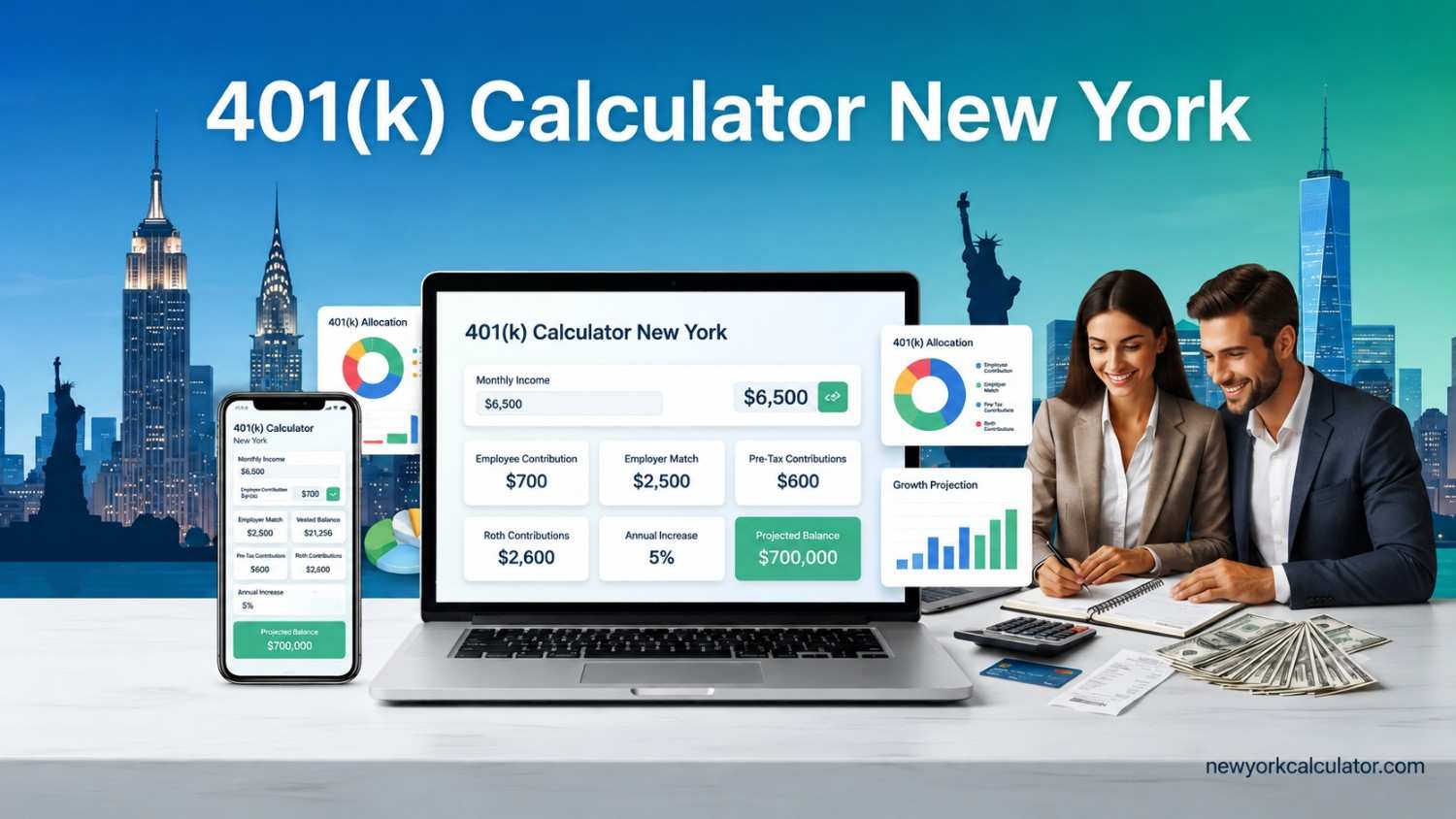
Planning for retirement in New York is not simply a matter of choosing a contribution percentage and watching an account balance grow. Your salary, current 401(k) balance, employer match, investment return, inflation, fees, retirement age, tax treatment and even where you live in New York can change the outcome.
Our New York 401(k) Calculator is designed to help you estimate how much your 401(k) could be worth when you retire and how that balance could translate into retirement income.
Calculator last reviewed: October 2026
New York 401(k) Calculator
Estimate your projected 401(k) balance, employee contributions, employer match, investment growth and inflation-adjusted retirement value.
Your Information
401(k) Contributions
Investment Assumptions
Projected Growth
Year-by-Year Projection
| Age | Salary | Your Contribution | Employer Match | Growth | Ending Balance |
|---|
Use the calculator above before changing your contribution rate or making a retirement decision. It is intended as an educational planning tool, not personalized investment or tax advice.
What Is a 401(k)?
A 401(k) is an employer-sponsored retirement savings plan that allows eligible employees to contribute part of their compensation to an individual retirement account within the employer’s plan.
With a traditional 401(k), eligible employee contributions generally aren’t included in federal income-taxable wages when contributed, although they remain subject to Social Security and Medicare taxes. Roth 401(k) contributions are made after tax instead. Employer contributions may also be added to the account depending on the employer’s plan.
The important point is that your retirement outcome is not determined by your contribution alone.
For example, someone earning $100,000 who contributes 6% may be saving $6,000 a year personally, but an employer match could add thousands more. Investment growth can eventually become a much larger part of the account than the original contributions.
That is why a useful 401(k) calculator should show more than one final number.
How the New York 401(k) Calculator Works
The calculator considers several factors that can materially affect a retirement projection:
- Current age
- Planned retirement age
- Current annual salary
- Current 401(k) balance
- Employee contribution percentage
- Employer match
- Employer match limit
- Expected investment return
- Salary growth
- Inflation
- Estimated investment fees
- Retirement withdrawal rate
- New York retirement considerations
The result separates your projected balance into major components so you can see where the money comes from.
Your projected balance can include:
Starting balance + employee contributions + employer contributions + investment growth − applicable costs
This is more useful than looking only at how much you personally put into the plan.
2026 401(k) Contribution Limit
One of the most important numbers to know in 2026 is the annual employee contribution limit.
The IRS says the basic employee elective-deferral limit for most 401(k) plans is $24,500 in 2026, up from $23,500 in 2025.
If your employer’s plan permits catch-up contributions, employees who are age 50 or older can generally contribute an additional $8,000 in 2026.
That means a qualifying employee age 50 or older can generally contribute up to $32,500 through regular deferrals plus the standard catch-up amount.
There is also a special higher catch-up rule.
For employees who attain age 60, 61, 62 or 63 during 2026, the higher catch-up limit is $11,250 rather than $8,000.
Therefore, depending on age and plan eligibility, the 2026 employee contribution ceiling can be:
| Age | 2026 employee contribution opportunity |
|---|---|
| Under 50 | $24,500 |
| 50–59 | Up to $32,500 |
| 60–63 | Up to $35,750 |
| 64+ | Generally up to $32,500 |
Your specific employer plan can impose its own restrictions, so always check your plan documents before assuming you can contribute the maximum.
A 2026 Rule Higher-Earning New Yorkers Should Know
There is another change that deserves attention.
Beginning in 2026, certain catch-up contributions must be made as Roth contributions when the employee’s prior-year wages from the plan sponsor exceed the applicable threshold. For 2026, the IRS says the threshold is $150,000.
This does not mean every high-income employee suddenly has to make their entire 401(k) contribution Roth.
The rule concerns the catch-up portion for affected participants and depends on the plan having the required Roth feature.
If you are approaching the catch-up contribution limit and earned more than $150,000 from the relevant employer in the previous year, this is something worth discussing with your plan administrator or tax professional.
Traditional 401(k) vs. Roth 401(k)
The choice between traditional and Roth contributions is not simply a question of which one is “better.”
It is largely a question of when you want to pay income tax.
Traditional 401(k)
With a traditional 401(k), eligible contributions generally reduce current federal taxable wages.
The trade-off is that taxable distributions may create income tax later.
Roth 401(k)
Roth contributions are made after tax.
You do not generally receive the same current federal income-tax benefit from the contribution, but qualified Roth distributions can receive tax-free treatment under the applicable rules.
For a New York resident, the decision can become even more interesting because current and future state tax situations may differ.
The best choice depends on your income, tax bracket, expected retirement income, future location and other retirement assets.
How Much Does a 401(k) Contribution Reduce Your Paycheck?
This is one of the most misunderstood parts of retirement planning.
Suppose you earn $100,000 and contribute 10% to a traditional 401(k).
Your contribution would be:
$10,000 per year
But that does not necessarily mean your take-home pay falls by exactly $10,000.
Eligible traditional 401(k) deferrals generally reduce federal income-taxable wages, although they remain subject to Social Security and Medicare taxes.
That means part of the contribution can effectively be funded by the income-tax savings associated with the pre-tax contribution.
However, actual paycheck changes depend on your payroll frequency, filing status, other deductions, withholding and tax circumstances.
For this reason, do not use a simple “401(k) contribution × tax rate” formula as a substitute for an actual paycheck calculation.
Why Employer Matching Matters So Much
Imagine that your salary is $100,000 and your employer matches 100% of the first 4% you contribute.
If you contribute 4%:
Your contribution: $4,000
Employer contribution: $4,000
Total annual contribution: $8,000
If you contribute only 2%, you may receive only $2,000 of the potential $4,000 employer contribution, depending on the plan’s rules.
That is why one of the first questions to ask your employer is:
“How much do I need to contribute to receive the full employer match?”
Your company’s matching formula may be more complicated than a simple percentage. Some employers use tiered formulas, such as matching 100% of the first 3% and 50% of the next 2%.
Your plan document is the final authority.
Are You Leaving Employer Match Money Behind?
A useful retirement calculator should not only tell you what your balance could become.
It should also help answer:
“Am I contributing enough to receive the employer match available under my plan?”
If your employer matches contributions up to 5% of salary and you are contributing only 2%, there may be additional employer money you are not receiving.
This is one of the easiest retirement-planning mistakes to identify because it does not require predicting the stock market.
You simply need to understand your plan’s matching formula.
New York State and 401(k) Taxes
New York residents should be careful when reading generic retirement calculators.
A calculator designed for the entire United States may not reflect the same state-specific considerations that apply to someone living in New York.
Traditional 401(k) contributions can receive current tax treatment under federal rules, while distributions from a traditional 401(k) can become taxable when withdrawn, subject to the applicable rules.
New York also has specific rules governing retirement income.
For eligible taxpayers age 59½ or older, New York generally allows an exclusion of up to $20,000 of qualifying pension and annuity income from New York adjusted gross income.
Importantly, this does not mean every dollar in every retirement account is automatically tax-free in New York.
The eligibility and definition of qualifying income matter.
New York’s tax instructions specifically include qualifying distributions from certain 401(k) arrangements within the pension and annuity income rules.
That distinction is important enough that retirement planning should not simply assume:
“New York taxes every dollar of my 401(k) at the highest rate.”
Your actual tax situation can be different.
New York City Is Different From New York State
If you live in New York City, you should not assume that a New York State-only calculation tells the entire story.
New York City has its own personal income tax system.
Yonkers also has separate local income-tax considerations.
Therefore, someone retiring in Manhattan and someone retiring elsewhere in New York State can have different local tax considerations even if their 401(k) balances are identical.
This is one reason a New York-focused calculator is more useful than a generic national 401(k) calculator.
Why Inflation Matters
Seeing a future 401(k) balance of $2 million can sound impressive.
But $2 million several decades from now will not buy what $2 million buys today.
Inflation reduces purchasing power.
For example, if a calculator assumes 3% annual inflation, the future value of money can be significantly lower in today’s purchasing power.
That is why our calculator can show an inflation-adjusted value alongside the projected nominal balance.
When evaluating retirement, ask two questions:
How many dollars might I have?
and
What might those dollars be worth in today’s purchasing power?
The second question is often more useful.
Investment Return Is an Assumption, Not a Promise
A retirement calculator needs an expected rate of return to make a projection.
But nobody knows the exact return an investment portfolio will produce over the next 20 or 30 years.
A 7% return assumption does not mean your account will earn exactly 7% every year.
Markets can rise sharply, fall sharply or remain relatively flat for extended periods.
That is why you should test multiple assumptions rather than trusting a single optimistic number.
For example, run the calculator using:
- 5%
- 7%
- 9%
Then compare the results.
If your retirement plan works only under the most optimistic assumption, that is useful information.
It tells you that the plan may need a larger contribution, a later retirement date, lower spending or another adjustment.
Investment Fees Can Quietly Change the Result
Two people can have the same salary, contribution rate and investment return but end up with different retirement balances if their investment expenses differ.
Even a small annual fee can compound over many years.
For example, a calculator can compare a hypothetical portfolio with:
0.25% annual fee
versus
1.00% annual fee
The difference may appear small in a single year.
Over decades, however, the lost compounding can become meaningful.
That is why it is useful to look at your 401(k)’s investment expense ratios and plan-level administrative fees rather than focusing only on the advertised investment return.
What Happens If You Retire Five Years Later?
Your retirement age can have a surprisingly large effect on your projected balance.
Suppose your original plan is to retire at 62.
Now run the same assumptions again with retirement at 67.
You have:
- More years of contributions
- More years of employer contributions
- More years for investment growth
- Fewer years during which the account needs to support retirement withdrawals
That does not automatically mean working longer is the right decision.
It simply shows why retirement age is one of the most powerful variables in a retirement projection.
How Much Could You Withdraw in Retirement?
A retirement balance is only useful if you understand what it might support.
A common planning shortcut is to test a withdrawal rate.
For example, a hypothetical $1,000,000 retirement balance would produce:
3% withdrawal
$30,000 per year
4% withdrawal
$40,000 per year
5% withdrawal
$50,000 per year
These are mathematical scenarios, not guarantees of sustainable income.
A real retirement plan also needs to consider market volatility, taxes, inflation, healthcare costs, Social Security, longevity and spending changes.
That is why our calculator allows a user to change the withdrawal assumption instead of presenting one number as universally correct.
What If You Need Your 401(k) Money Before Retirement?
This is where caution becomes especially important.
The IRS generally says distributions from qualified retirement plans before age 59½ can be subject to an additional 10% tax unless an exception applies.
The distribution may also be taxable depending on the type of account and circumstances.
Some plans allow hardship distributions or other forms of early access, but the plan document controls what is actually available.
Taking money out early can also reduce the amount that remains invested for your retirement.
For example, withdrawing $50,000 today is not only a $50,000 reduction in the account.
You may also lose decades of potential compounding on that money.
That opportunity cost can be much larger than the original withdrawal.
Don’t Confuse a 401(k) Loan With Free Money
Some employer plans permit participants to borrow from their 401(k).
That does not make the money free.
A loan can affect your retirement savings, and leaving employment can create additional repayment or tax considerations depending on the circumstances and plan rules.
Before taking a retirement-plan loan, check the specific terms of your plan and understand what happens if you change jobs.
Example: A New York Worker Saving for Retirement
Consider a hypothetical New York employee:
Age: 35
Salary: $90,000
Current 401(k): $35,000
Employee contribution: 8%
Employer match: 50% of contributions up to 6% of salary
Retirement age: 65
Expected return: 7%
Inflation: 3%
This person is not simply investing 8% of salary.
The employer may add additional money according to the matching formula.
The account can also receive investment growth over 30 years.
If salary increases over time, the dollar amount of future contributions may increase as well.
The important lesson is not the exact projected balance.
The lesson is that contribution rate + employer match + time + investment growth + salary growth work together.
Change any one of those assumptions and the projection changes.
What If You Increase Your Contribution by 1%?
A practical way to use a 401(k) calculator is to test small changes.
Run your current contribution first.
Then increase it by 1%.
Then by another 1%.
You may discover that increasing your contribution slightly has a much smaller impact on your current lifestyle than you expected while having a meaningful impact on your long-term retirement balance.
This is often more realistic than deciding overnight to jump from 3% to the maximum contribution.
Should You Max Out Your 401(k)?
Not necessarily.
Maxing out a retirement account can be attractive, but retirement saving should be considered alongside:
- Emergency savings
- High-interest debt
- Health insurance
- Housing costs
- Family expenses
- Other investments
- Employer matching
- Near-term financial goals
For many employees, getting the full employer match is an important first milestone.
After that, the right savings level depends on the individual’s circumstances.
A calculator can show what happens mathematically, but it cannot determine what you can comfortably afford.
401(k) Calculator Mistakes to Avoid
1. Using an unrealistically high return
A higher assumed return produces a more attractive result, but it can also create a false sense of security.
2. Ignoring inflation
A future balance is not the same as today’s purchasing power.
3. Forgetting employer contributions
Employer matching can represent a meaningful part of retirement savings.
4. Ignoring fees
Small annual expenses can compound over long periods.
5. Assuming the current salary never changes
Career progression can change both salary and contribution amounts.
6. Treating the projection as a guarantee
The calculator is a model, not a prediction of what the market will definitely do.
7. Assuming every New York resident has the same tax situation
NYC, Yonkers and other New York locations can have different local considerations.
8. Assuming every retirement distribution is taxed identically
Traditional, Roth and qualifying retirement-income rules can produce different outcomes.
What Makes a New York 401(k) Calculator Different?
A generic 401(k) calculator usually focuses on:
Contribution → investment growth → retirement balance
A New York-focused calculator should go further.
It should help users understand:
Contribution → employer match → growth → inflation → retirement income → New York tax considerations
That is the reason a New York-specific calculator can be useful even when many general 401(k) calculators already exist.
Frequently Asked Questions
What is the 401(k) contribution limit for 2026?
The basic employee elective-deferral limit for most 401(k) plans is $24,500 in 2026. Eligible participants age 50 or older may generally contribute an additional $8,000, while the special age 60–63 catch-up limit is $11,250 for 2026.
How much should I contribute to my 401(k)?
There is no single percentage that works for everyone. Start by understanding your employer’s match and then compare different contribution rates using a retirement projection.
Is a traditional 401(k) contribution tax deductible?
Traditional 401(k) elective deferrals generally aren’t included in federal income-taxable wages when contributed, subject to the applicable rules. They are still generally subject to Social Security and Medicare taxes.
Is a Roth 401(k) tax-free?
Qualified Roth 401(k) distributions can receive tax-free treatment under the applicable rules. Roth contributions are made after tax rather than providing the same current federal income-tax treatment as traditional deferrals.
Does New York tax 401(k) withdrawals?
Traditional 401(k) distributions can be taxable, but New York has specific retirement-income rules and exclusions. Eligible taxpayers age 59½ or older may generally qualify for up to a $20,000 New York pension and annuity income exclusion for qualifying income.
Does New York City have an additional income tax?
Yes. NYC has its own local personal income tax system, so an NYC resident can have a different tax situation from someone living elsewhere in New York State.
Can I withdraw money from my 401(k) before age 59½?
Some plans allow certain early distributions, but taxable amounts may be subject to an additional 10% federal tax unless an exception applies. Check your plan rules and the applicable IRS exceptions before taking a distribution.
What happens if I change jobs?
Depending on the plan and your circumstances, you may have options such as leaving the money in the old plan, rolling it into another eligible retirement plan or rolling it into an IRA. A rollover can have important tax consequences, so understand the rules before moving the money.
Should I use 5%, 7% or 9% as my expected return?
Rather than relying on one number, test several assumptions. A lower-return scenario can help you understand how dependent your retirement plan is on investment performance.
Is this calculator financial advice?
No. The calculator provides estimates based on the assumptions entered by the user. Actual investment returns, taxes, employer contributions, plan rules and retirement income can differ substantially.
Final Thoughts
A 401(k) is not just an account balance.
For a New York worker, retirement planning involves understanding how much you save, how much your employer contributes, how long the money remains invested, how inflation affects purchasing power and how taxes may affect money when you eventually use it.
The most useful approach is to run several scenarios rather than searching for one “perfect” retirement number.
Try your current contribution rate.
Then increase it by 1% or 2%.
Change your retirement age.
Reduce your expected investment return.
Add inflation.
Look at the employer match.
Then compare the results.
The goal is not to predict the future perfectly.
The goal is to make better decisions today with the information available today.
Methodology and Sources
This guide uses publicly available information from the Internal Revenue Service and New York State Department of Taxation and Finance. IRS 2026 retirement-plan limits, catch-up rules and distribution guidance were checked against current IRS material. New York retirement-income and withholding information was checked against New York State tax guidance.
Tax rules and retirement-plan rules can change. Readers should verify current rules with the IRS, New York State Department of Taxation and Finance, their employer’s plan administrator or a qualified tax professional before making financial decisions.
Written by Junaidul Islam
NewYorkCalculator.com provides calculators and educational information for general planning purposes. Results are estimates and should not be treated as individualized financial, investment or tax advice.