
By Junaidul Islam
Last updated: October 8, 2026
Planning for retirement in New York is not only about asking, “How much can my IRA grow?” A more useful question is: How much could I actually have available after taxes when I retire?
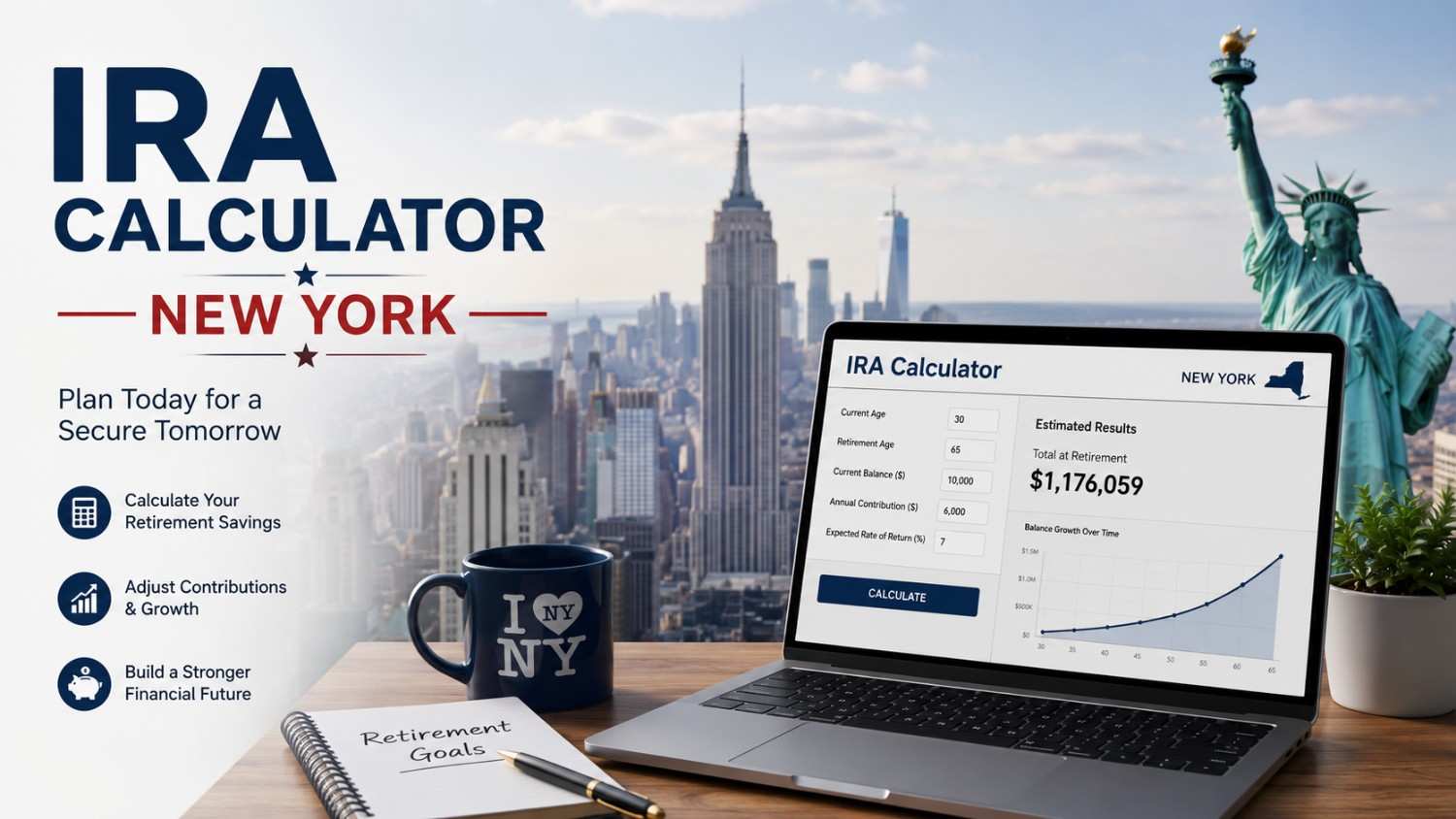
Our New York IRA Calculator is designed to give you a practical estimate of your future IRA value while considering factors such as your age, retirement age, current IRA balance, annual contributions, expected investment return, inflation, IRA type, income and estimated retirement tax rates.
Unlike a basic IRA growth calculator, this tool is designed around the questions New York residents are more likely to have: how Traditional and Roth IRAs differ, how New York retirement-income rules can affect the result, how much you can contribute in 2026, and how inflation can change the purchasing power of your future savings.
Calculator results are estimates for educational and planning purposes. They are not tax, legal, investment or financial advice. Your actual tax liability can be different.
New York IRA Calculator 2026
Estimate your IRA growth, total contributions, investment earnings, inflation-adjusted value and estimated after-tax retirement value.
Your Retirement Profile
IRA & New York Assumptions
Year-by-Year Projection
| Age | Annual Contribution | Investment Growth | Ending Balance |
|---|
The calculator above is designed to estimate your potential retirement balance, total contributions, investment growth, estimated after-tax value and inflation-adjusted purchasing power.
For the most useful result, enter realistic assumptions rather than simply choosing a very high investment return.
What Is a New York IRA Calculator?
A New York IRA Calculator is a retirement-planning tool that helps estimate how an Individual Retirement Account could grow over time for someone living in New York.
A typical IRA calculator may only show the projected account balance. That number is useful, but it does not necessarily represent the amount you will ultimately be able to spend.
For example, suppose a Traditional IRA grows to $800,000 by retirement. That does not automatically mean you will have $800,000 of after-tax retirement spending money. Traditional IRA withdrawals can generally create taxable income, while qualified Roth IRA distributions receive different federal tax treatment.
New York also has its own rules for certain retirement income. For eligible taxpayers age 59½ or older, New York generally allows a pension and annuity income subtraction of up to $20,000, subject to the applicable requirements. New York’s current instructions specifically include certain periodic and lump-sum IRA distributions within qualifying pension and annuity income.
That is why a New York-focused retirement calculator can be more useful than a calculator that only compounds contributions.
How the New York IRA Calculator Works
The calculator uses several inputs to create a long-term estimate.
Current age
Your current age determines how many years your money may have to grow.
Someone who starts at age 30 has a much longer investment period than someone starting at age 55.
Retirement age
Your planned retirement age determines the projection period.
For example:
- Age 35 to age 65 = 30 years
- Age 40 to age 67 = 27 years
- Age 50 to age 70 = 20 years
The longer the time period, the more opportunity there is for compound growth.
Current IRA balance
Enter the amount already saved in your IRA.
If you have no existing IRA savings, enter $0.
Annual contribution
This is the amount you expect to add each year.
For 2026, the combined contribution limit for Traditional and Roth IRAs is generally $7,500, or $8,600 for someone age 50 or older, subject to the taxable-compensation rule and other applicable rules. The $7,500/$8,600 limit is shared across your Traditional and Roth IRAs rather than being available separately for each account.
Expected investment return
This is the annual return assumption used by the calculator.
A higher return produces a higher projection, but it should not be interpreted as a guaranteed investment return.
For retirement planning, it is often useful to test several scenarios rather than relying on one number.
For example:
- Conservative scenario: 4%
- Moderate scenario: 6%
- Higher-growth scenario: 8%
These are planning assumptions, not promises.
Inflation rate
Inflation matters because $1 million in the future will not have the same purchasing power as $1 million today.
The calculator can show an estimated inflation-adjusted value so you can see the difference between:
Future dollars and today’s purchasing power.
2026 IRA Contribution Limit in New York
New York residents follow the federal IRA contribution limits.
For 2026, the general IRA contribution limit is:
| Age | 2026 IRA contribution limit |
|---|---|
| Under 50 | $7,500 |
| 50 or older | $8,600 |
The limit applies collectively to your Traditional and Roth IRA contributions. You generally cannot contribute $7,500 to a Traditional IRA and another $7,500 to a Roth IRA simply because you have two different accounts.
The IRS also states that your contribution cannot exceed your taxable compensation for the year when that compensation is lower than the applicable IRA limit. Rollover contributions are treated differently from regular annual contributions.
This distinction is important when using an IRA calculator.
Roth IRA Income Limits for 2026
One of the most important parts of IRA planning is understanding that the Roth IRA contribution limit can depend on income.
For 2026, the Roth IRA phase-out ranges include:
Single or Head of Household
- Below $153,000 MAGI: generally eligible for the full contribution
- $153,000 to below $168,000: contribution is reduced
- $168,000 or more: direct Roth IRA contribution is generally not allowed
Married Filing Jointly
- Below $242,000 MAGI: generally eligible for the full contribution
- $242,000 to below $252,000: contribution is reduced
- $252,000 or more: direct Roth IRA contribution is generally not allowed
Married Filing Separately
If you lived with your spouse at any time during the year, the phase-out range remains very low: more than $0 and less than $10,000.
These are federal rules and apply to New York taxpayers as well.
The calculator therefore includes income-related information rather than treating every user as automatically eligible for the maximum Roth contribution.
Traditional IRA Deduction: Why Your Income Matters
Traditional IRA contributions and Traditional IRA deductions are not always the same thing.
You may be able to contribute to a Traditional IRA but receive a reduced or no deduction depending on your income and whether you or your spouse participates in an employer retirement plan.
For 2026, if you are covered by a workplace retirement plan, the Traditional IRA deduction phase-out is:
Single or Head of Household
$81,000 to $91,000 MAGI
Married Filing Jointly
$129,000 to $149,000 MAGI
Married Filing Jointly when you are not covered but your spouse is
The applicable phase-out range is $242,000 to $252,000.
The rules are more complicated for married filing separately taxpayers. The IRS should be used as the final authority for determining the deductible amount in an individual case.
This is one reason a good IRA calculator should not simply tell every user that a Traditional IRA contribution is deductible.
Traditional IRA vs. Roth IRA for a New York Resident
The biggest difference between these accounts is the timing and treatment of taxes.
Traditional IRA
A Traditional IRA may provide a tax deduction when eligible.
The money can grow tax-deferred, but withdrawals are generally included in taxable income to the extent applicable.
This can be attractive if your current marginal tax rate is higher than the rate you expect to face in retirement.
Roth IRA
Roth IRA contributions are made with after-tax money.
Qualified distributions can generally be tax-free federally.
New York State has also stated that it conforms to the federal treatment of Roth IRAs for New York State, New York City and Yonkers resident personal income tax purposes. A qualified Roth distribution that is exempt from federal income tax is therefore generally exempt from those New York taxes as well. Nonqualified taxable Roth distributions can receive different treatment.
The practical question
Instead of asking:
“Is Traditional or Roth always better?”
A better question is:
“Which tax treatment is more valuable for my situation today and in retirement?”
Your current tax bracket, future income, retirement withdrawals, eligibility and expected tax rates all matter.
New York IRA Tax Rules You Should Know
New York retirement taxation can be different from what a simple federal IRA calculator shows.
One particularly important rule is New York’s pension and annuity income exclusion.
For eligible taxpayers who meet the requirements, New York allows up to $20,000 of qualifying pension and annuity income to be subtracted from New York adjusted gross income.
The current New York instructions explain that qualifying income can include certain IRA distributions. The exclusion has eligibility requirements, including the age requirement, and it should not be assumed that every IRA withdrawal automatically receives the $20,000 exclusion.
This is an important difference between a general IRA calculator and a New York-focused calculator.
Example
Imagine an eligible New York resident age 65 receives:
$35,000 of qualifying IRA income
If the person qualifies for the New York pension and annuity subtraction, up to $20,000 may potentially be subtracted for New York purposes.
That does not mean the entire $35,000 is tax-free everywhere.
Federal tax rules and the individual’s complete New York return still matter.
The purpose of the calculator is to help you understand the possible planning effect, not to prepare your tax return.
What About New York State Government and Federal Pensions?
New York provides additional tax treatment for certain government pensions.
The New York Department of Taxation and Finance states that qualifying pensions and distributions from New York State or local government pension plans and federal government pension plans may be subtracted from federal adjusted gross income for New York purposes.
That is another reason why retirement income should not be treated as one simple number.
An IRA, pension, Social Security benefit and other retirement income can have different tax treatment.
Social Security and Your New York Retirement Plan
If you are planning retirement in New York, your IRA may be only one part of your income.
Social Security is another important source.
New York allows qualifying Social Security benefits that are included in federal adjusted gross income to be subtracted when calculating New York adjusted gross income.
This creates an important planning difference:
Federal taxable income and New York taxable income are not always identical.
That is why a New York retirement calculation should not simply multiply the entire retirement balance by one tax rate and call the result your final tax bill.
New York City Residents Need Extra Attention
Living in New York City can create additional local tax considerations compared with living elsewhere in New York State.
A calculator designed specifically for New York should therefore clearly tell users that:
New York State tax and New York City tax are not the same thing.
The calculator on this page uses an estimated retirement tax-rate approach rather than pretending to reproduce a complete federal, New York State and New York City tax return.
For an actual retirement distribution decision, review your situation with current IRS and New York tax guidance or a qualified tax professional.
Why Inflation Can Change Your Retirement Number
Suppose your IRA projection says:
$1,000,000 at retirement.
That sounds impressive.
But if retirement is several decades away, inflation can substantially reduce what that $1 million can buy.
For example, using a hypothetical 3% annual inflation assumption:
Future balance: $1,000,000
Purchasing power: lower than $1,000,000 in today’s dollars
The exact result depends on the number of years and the inflation assumption.
This is why our calculator provides an inflation-adjusted estimate instead of showing only the headline future balance.
Compound Growth Is the Reason Starting Early Matters
IRA growth is not simply the sum of your contributions.
Your investment returns can themselves generate additional returns.
For example, assume a hypothetical investor contributes $7,500 each year for 30 years and earns an average 7% annual return.
The final balance can be substantially higher than the amount personally contributed because investment growth compounds over time.
But remember:
7% is an assumption, not a guaranteed return.
Actual market performance can be higher or lower, and investments can lose value.
What Happens If You Start an IRA at 50?
Starting at 50 is different from starting at 25, but that does not mean retirement investing is pointless.
Someone age 50 may still have many years for compound growth.
The 2026 IRA limit also gives people age 50 and older an additional catch-up contribution amount, bringing the general IRA limit to $8,600.
If you are behind on retirement savings, increasing contributions, reviewing expenses and coordinating IRA savings with employer retirement plans can be more useful than focusing on a single investment-return assumption.
What Is an RMD and Why Does It Matter?
Traditional IRAs are generally subject to Required Minimum Distribution rules.
Under current rules, the applicable RMD starting age is generally 73 for people who reach the relevant age under the current SECURE 2.0 schedule, while the age becomes 75 for people born in 1960 or later under the statutory schedule. The IRS’s 2026 guidance continues to describe the applicable age framework.
Roth IRAs owned by the original owner do not generally require lifetime RMDs.
This matters because Traditional IRA owners eventually need to plan for mandatory distributions, which can affect taxable income and retirement cash flow.
The exact RMD calculation depends on the applicable IRS rules and life-expectancy table.
Can You Withdraw IRA Money Before Retirement?
You can generally take money from an IRA before traditional retirement age, but an early withdrawal can create tax consequences and potentially an additional penalty unless an exception applies.
The treatment depends on:
- IRA type
- Your age
- Amount withdrawn
- Whether the distribution is qualified
- Applicable exceptions
- Tax basis
- Federal rules
- New York treatment
Therefore, the calculator should not be used as a recommendation to withdraw money early.
If you are considering a major withdrawal, check the current IRS distribution rules and New York rules before taking action.
A Better Way to Use the Calculator
Instead of entering one set of numbers and accepting the result, try three scenarios.
Scenario 1: Conservative
Use a lower expected investment return.
Scenario 2: Moderate
Use a middle-of-the-road assumption.
Scenario 3: Higher Growth
Use a higher assumption, but remember that higher projected returns also mean greater uncertainty.
Then compare:
- Retirement balance
- Total contributions
- Investment earnings
- Estimated after-tax value
- Inflation-adjusted value
This gives you a range instead of pretending that the future can be predicted exactly.
Example: Why After-Tax Value Matters
Suppose two hypothetical investors each reach:
$750,000
at retirement.
Investor A has a Traditional IRA.
Investor B has a qualified Roth IRA.
The headline balances are identical.
But the tax treatment can be very different.
That means comparing only the account balance does not necessarily tell you which strategy created more usable retirement wealth.
This is why our calculator focuses on estimated after-tax value, not just the future account balance.
What Our New York IRA Calculator Does Differently
The tool is designed around several practical questions:
1. How much could my IRA grow?
It projects the future value based on your assumptions.
2. How much am I contributing?
It separates contributions from investment growth.
3. How much could inflation reduce purchasing power?
It provides an inflation-adjusted estimate.
4. Traditional or Roth?
It lets you select the IRA type and compare the different tax assumptions.
5. What could my after-tax value look like?
It estimates the amount remaining after the retirement tax assumptions entered into the calculator.
6. Does New York matter?
Yes. The calculator allows New York-specific planning assumptions and highlights the state’s retirement-income rules.
Important Limitations of This Calculator
No online retirement calculator can predict your exact retirement tax bill.
The result can change because of:
- Future federal tax laws
- Future New York tax laws
- Investment performance
- Inflation
- Changes in income
- Filing status
- Retirement income
- Social Security
- Pension income
- Deductions and credits
- Roth qualification rules
- IRA basis
- Early-withdrawal exceptions
- RMD requirements
The calculator therefore provides an estimate, not a tax-return calculation.
Do not use a calculator result as the sole reason to make a large investment, conversion or withdrawal decision.
Frequently Asked Questions
Is there a New York-specific IRA calculator?
Yes. A New York-specific calculator can combine normal IRA growth assumptions with New York retirement-income considerations. However, it should be treated as a planning tool rather than a substitute for a tax return.
How much can I contribute to an IRA in 2026?
The general 2026 IRA contribution limit is $7,500, or $8,600 for people age 50 and older, subject to the taxable-compensation rule and other applicable requirements.
Is a Roth IRA tax-free in New York?
Qualified Roth IRA distributions generally receive favorable federal treatment, and New York has stated that it conforms to federal Roth IRA treatment for New York State, New York City and Yonkers resident personal income tax purposes. Nonqualified distributions can be different.
Does New York tax Traditional IRA withdrawals?
Traditional IRA distributions can be taxable, but New York has specific subtraction rules that may apply to qualifying pension and annuity income, including certain IRA distributions. Eligibility and the amount of the subtraction depend on the applicable rules.
Does New York tax Social Security?
New York generally allows Social Security benefits included in federal adjusted gross income to be subtracted when calculating New York adjusted gross income.
Is the $20,000 New York retirement exclusion available to everyone?
No. The exclusion has specific eligibility requirements. For qualifying taxpayers, the maximum exclusion is generally $20,000 per person, and the rules should be checked for the tax year involved.
What is better in New York: Traditional IRA or Roth IRA?
There is no universal answer. Your current tax rate, expected retirement tax rate, income, eligibility and withdrawal plans all matter.
Does an IRA contribution limit apply separately to Traditional and Roth IRAs?
No. The annual IRA limit generally applies to the combined contributions you make to your Traditional and Roth IRAs.
What happens if my income is too high for a direct Roth IRA contribution?
Your ability to make a direct Roth IRA contribution can be reduced or eliminated depending on your filing status and modified adjusted gross income. For 2026, the phase-out ranges are $153,000–$168,000 for single/head-of-household filers and $242,000–$252,000 for married filing jointly.
When do Traditional IRA RMDs begin?
The applicable starting age depends on your birth year under the SECURE 2.0 rules. Current IRS guidance generally uses age 73 for the applicable earlier cohort and age 75 for people born in 1960 or later.
Final Thoughts
A retirement number can look impressive on a screen, but the number that matters most is the amount you can realistically use.
For a New York resident, that means looking beyond simple compound growth.
Consider:
Contribution limits → investment growth → inflation → Traditional vs. Roth → federal tax → New York treatment → retirement income → RMDs
The New York IRA Calculator is designed to help you see that bigger picture.
Use conservative assumptions, test multiple scenarios and review important tax decisions against current IRS and New York State guidance before acting.
Author: Junaidul Islam
This article is intended for general educational and informational purposes only. It does not provide individualized tax, legal, investment or financial advice. Tax rules can change, and your actual result may differ from the calculator estimate.