
By Junaidul Islam
Last Updated: October 8, 2026
Planning for retirement in New York can be confusing because your pension is not determined by salary alone. Your retirement system, pension tier, retirement plan, years of credited service, final average earnings, and age when you retire can all affect the amount you receive.
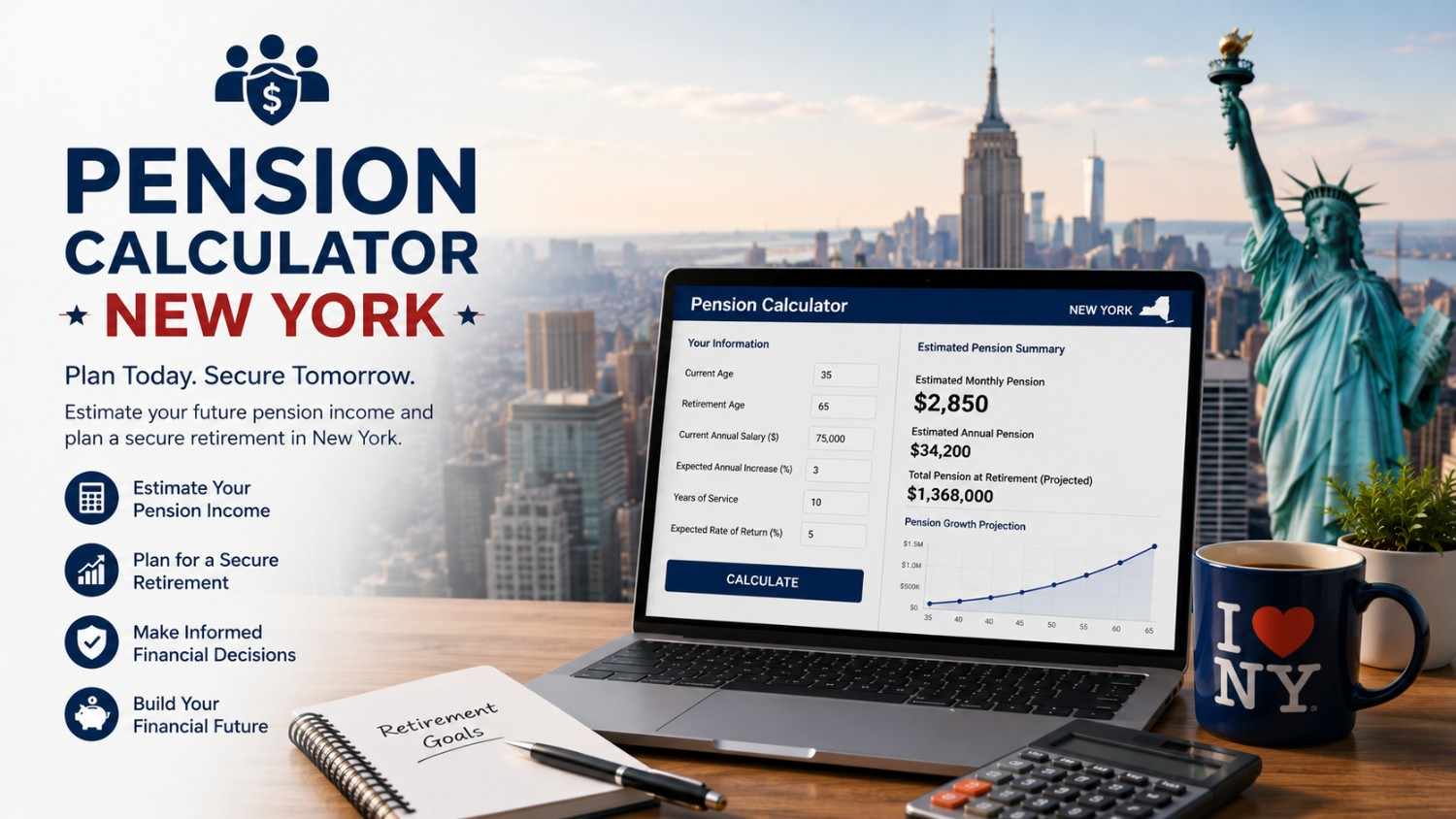
The New York Pension Calculator below is designed to give you a quick educational estimate based on common NYSLRS Tier 6 Employees’ Retirement System rules. It can help you understand how your age, service years and final average earnings can change your estimated pension.
Important: This calculator is an educational estimate, not an official pension calculation. Your actual benefit is determined by your retirement system and specific retirement plan.
Use the calculator below to estimate your potential annual and monthly pension.
New York Pension Calculator 2026
Estimate your potential New York pension using age, years of service, final average earnings and the current regular NYSLRS Tier 6 ERS formula.
How the estimate was calculated
What Is a New York Pension?
A New York public employee pension is generally a defined-benefit retirement benefit. Unlike a simple savings account, your pension is generally calculated using a statutory formula rather than simply returning the money you personally contributed.
For NYSLRS members, the retirement benefit can depend on your retirement plan, tier, service credit, final average earnings and, for many members, your age at retirement. NYSLRS also explains that pension payments are generally payable for life, subject to the applicable retirement plan and payment option.
That is why two New York employees with similar salaries can have very different pension benefits.
How Does the New York Pension Calculator Work?
For a regular NYSLRS Tier 6 ERS member, a simplified pension calculation starts with your Final Average Earnings (FAE) and years of credited service.
For the standard Tier 6 ERS Article 15 formula:
- Less than 20 years of service: 1.66% of FAE for each year
- 20 years of service: 35% of FAE
- More than 20 years: an additional 2% of FAE for each year above 20
The official Tier 6 ERS benefit publication also states that members generally become eligible for a service retirement benefit at age 55 with at least five years of credited service, but an unreduced benefit is generally available at age 63.
The exact rules can differ for special retirement plans, police and fire plans, NYCERS plans, teachers and other public retirement systems. Therefore, the calculator should be viewed as a planning tool rather than an official pension quote.
What Is Final Average Earnings?
Final Average Earnings, often called FAE, are one of the most important parts of a New York pension calculation.
A major change occurred for Tier 6 members in 2024. NYSLRS states that Tier 6 FAE is now generally based on the average of the member’s three highest consecutive years of earnings, instead of the previous five-year calculation. The change applies to qualifying Tier 6 members who retire on or after April 1, 2024 for PFRS and April 20, 2024 for ERS.
That means using an old five-year Tier 6 formula can produce an outdated estimate.
For example, if your three highest consecutive eligible earnings years are:
- Year 1: $72,000
- Year 2: $78,000
- Year 3: $81,000
A simple average would be:
($72,000 + $78,000 + $81,000) ÷ 3 = $77,000
Your actual FAE can be affected by statutory limitations and the treatment of certain earnings, so the figure in an online calculator should not automatically be considered your official FAE. NYSLRS specifically notes that earnings limitations and overtime rules can affect FAE.
Why Your Years of Service Matter
Years of credited service can have a major impact on your pension.
For a regular Tier 6 ERS calculation, the benefit factor changes after 20 years of service.
For example, using a hypothetical FAE of $80,000:
15 years of service
15 × 1.66% = 24.9%
Estimated annual pension before any applicable reduction:
$80,000 × 24.9% = $19,920
20 years of service
Tier 6 provides a 35% factor at 20 years.
$80,000 × 35% =
$28,000 per year
25 years of service
The simplified factor becomes:
35% + (5 × 2%) = 45%
$80,000 × 45% =
$36,000 per year
These examples are illustrations, not personalized pension quotes.
What Happens If You Retire Before Age 63?
This is one of the most important sections to understand before making a retirement decision.
For the standard NYSLRS ERS Tier 6 coordinated plan, a member can generally retire between ages 55 and 63 with a permanent reduction. The official NYSLRS reduction table lists the following reductions:
| Retirement Age | Reduction |
|---|---|
| 55 | 52.0% |
| 56 | 45.5% |
| 57 | 39.0% |
| 58 | 32.5% |
| 59 | 26.0% |
| 60 | 19.5% |
| 61 | 13.0% |
| 62 | 6.5% |
| 63 | 0% |
The reduction is permanent; it does not disappear when you later reach age 63.
This is why a calculator that only multiplies salary by years of service is incomplete.
Your planned retirement age can materially change your result.
Example: Retiring at 55 vs. 63
Suppose a hypothetical Tier 6 ERS employee has:
Final Average Earnings: $80,000
Service: 25 years
The simplified unreduced pension factor is:
35% + 10% = 45%
So the unreduced annual pension would be approximately:
$80,000 × 45% = $36,000
That equals approximately:
$3,000 per month
But if the member retires at age 55, the applicable early-retirement reduction can dramatically lower the benefit.
At age 63, there is no standard early-retirement reduction under this plan.
This is an important reason to compare several retirement ages rather than looking at only one number.
Are You Vested in the New York Pension System?
For regular NYSLRS Tier 6 ERS members, five years of credited service generally makes you vested.
Vesting means you have earned a right to a future retirement benefit even if you leave public employment before reaching your retirement age, subject to the rules of your plan.
For example:
3 years of service: generally not vested under the regular Tier 6 ERS rule.
5 years of service: generally vested.
10+ years: additional rules and benefits may apply depending on your plan.
Special retirement plans can have different requirements.
New York Pension Rules Changed in 2026
If you are researching your New York pension in 2026, using information from an old calculator can be misleading.
The 2026–27 New York State Budget introduced changes affecting Tier 5 and Tier 6 members. One of the major changes is a reduction in Tier 6 contribution rates beginning October 1, 2026.
The new Tier 6 contribution schedule is:
| Annualized Wage / Earnings | Rate Effective Oct. 1, 2026 |
|---|---|
| $45,000 or less | 3.00% |
| $45,000.01–$55,000 | 3.00% |
| $55,000.01–$75,000 | 3.00% |
| $75,000.01–$100,000 | 4.00% |
| $100,000.01–$125,000 | 5.25% |
| $125,000.01 or more | 5.75% |
These rates are important when estimating your current pension contribution, but remember that your pension benefit is not simply the amount you personally contributed. NYSLRS describes its pension as a defined-benefit plan calculated under a statutory formula.
2026 Overtime Rule: An Important Update
Another easily missed 2026 change involves overtime.
For qualifying Tier 6 members, New York law temporarily excludes certain overtime earnings from the calculation used to determine Tier 6 contribution rates for the applicable period. NYSLRS also explains that overtime treatment can differ between contribution-rate calculations and final-average-earnings calculations.
There are also changes to overtime limits used in determining FAE for Tier 5 and Tier 6 members.
This is one reason you should not simply enter your total gross income and assume every dollar will be treated as pensionable earnings.
Can Overtime Increase Your New York Pension?
Potentially, but not necessarily dollar-for-dollar.
The pension system has rules governing which earnings can be included in your FAE and how unusually high earnings may be limited.
For ERS Tiers 3–6 and certain PFRS members, NYSLRS states that if earnings in a 12-month period exceed the average of the previous two years by more than 10%, the amount above that limit may be excluded from the FAE calculation.
Therefore, someone with a large amount of overtime immediately before retirement should not assume that every overtime dollar will automatically increase the pension calculation.
NYSLRS vs. NYCERS: They Are Not the Same
The term “New York pension” can refer to several different retirement systems.
For many state and local public employees outside New York City, NYSLRS is relevant. NYSLRS includes the Employees’ Retirement System (ERS) and Police and Fire Retirement System (PFRS).
New York City employees may instead belong to systems such as NYCERS.
NYCERS states that a retirement benefit depends on the member’s tier and plan, along with factors such as service and salary. It also provides its own online benefit calculator for registered members.
NYCERS Tier 6 also has plan-specific rules. For example, NYCERS notes that members who joined on or after April 1, 2012 are generally Tier 6, but certain titles have different treatment.
Therefore:
Do not use a NYSLRS formula as an official NYCERS pension calculation.
If you are a NYC employee, check your specific NYCERS tier and retirement plan before making a retirement decision.
What About New York Police and Fire Employees?
Police and fire employees can have different retirement provisions.
NYSLRS PFRS includes special plans, and some members may qualify for retirement after reaching a specified number of years of service. For example, certain Tier 6 PFRS members can have 25-year retirement-plan provisions, while other rules apply to different plans.
That means a generic pension calculator should never tell every police officer or firefighter that the same retirement-age rule applies to them.
If you work in law enforcement, fire service or another special plan, use your specific plan information or an official retirement estimate.
What Information Should You Have Before Using a Pension Calculator?
For a more useful estimate, gather:
- Your retirement system
- Your pension tier
- Your retirement plan
- Current age
- Planned retirement age
- Years of credited service
- Estimated final average earnings
- Relevant pensionable earnings
- Any special retirement-plan information
- Whether you expect to purchase additional service credit
NYSLRS explains that its official Retirement Online estimate can use information already on file, including service and earnings, while a quick calculator requires the member to know their tier, retirement plan, earnings and service.
Why an Online Pension Calculator Cannot Guarantee Your Benefit
An online calculator is useful for planning, but it cannot replace your official pension estimate.
Your actual retirement benefit may depend on:
- Your specific retirement plan
- Tier
- Credited service
- Final average earnings
- Earnings limitations
- Overtime rules
- Retirement age
- Special plan provisions
- Payment option
- Beneficiary election
- Outstanding retirement-system loans
- Service credit purchases
- Legislative changes
NYSLRS itself describes online estimates as estimates rather than guarantees.
For a final retirement decision, always verify your numbers through your retirement system.
Can Your Pension Continue to a Beneficiary?
Your pension payment option matters.
Depending on the retirement system and plan, you may have payment options that provide continuing benefits to a beneficiary after your death.
Choosing a survivor or beneficiary option can affect the amount of your own monthly payment.
For that reason, your “maximum monthly pension” and your “beneficiary protection option” may not produce the same monthly amount.
The calculator on this page does not attempt to replace the official payment-option calculation because those choices are plan-specific.
New York Pension and Taxes
Taxes are another area where pension calculators can become misleading.
For example, NYCERS states that its benefit payments are subject to federal taxation but are exempt from New York State and local income taxes under its applicable rules. Certain portions can have different federal treatment depending on contributions and circumstances.
Tax treatment can vary depending on your retirement system and personal situation.
Therefore, do not treat an online “after-tax pension” number as a guaranteed amount.
For a personal tax decision, consult a qualified tax professional.
New York Pension + Social Security
Your pension is only one part of your retirement-income picture.
A New York public employee may also have:
- Social Security
- Personal retirement savings
- 401(k) or 403(b)
- Deferred compensation
- IRA
- Other investment income
- Spousal retirement income
A pension calculator can estimate the pension portion, but your total retirement income should be evaluated separately.
For example:
Estimated pension: $3,200/month
Estimated Social Security: $2,100/month
Personal retirement income: $700/month
Potential combined retirement income:
$6,000/month
The Social Security figure should come from your own Social Security estimate rather than being invented by a pension calculator.
How to Get an Official New York Pension Estimate
If you are a NYSLRS member, the best place to verify your actual retirement information is your official NYSLRS/Retirement Online account.
NYSLRS says many Tier 2–6 members can use Retirement Online to estimate their pension, and the official system can use information already on file.
This is particularly useful because the official system can account for information that a public calculator cannot know.
Use the calculator on this page to understand the numbers.
Use your official retirement account to verify them.
Frequently Asked Questions
What is the New York Pension Calculator?
The New York Pension Calculator is an online planning tool that estimates a potential retirement pension using information such as age, service years and final average earnings.
It is not an official pension determination.
How is a New York pension calculated?
The calculation depends on your retirement system, tier, retirement plan, service credit, final average earnings and retirement age. Different New York retirement systems can use different formulas.
What is the Tier 6 pension formula?
For the regular NYSLRS ERS Tier 6 coordinated plan, members with fewer than 20 years receive 1.66% of FAE for each year. At 20 years the factor is 35%, with an additional 2% for each year over 20, subject to the applicable plan rules.
Can I retire at 55 with Tier 6?
Regular Tier 6 ERS members can generally retire beginning at age 55 if they have at least five years of credited service, but retiring before 63 generally results in a permanent reduction. Special plans can have different rules.
What is the full retirement age for regular Tier 6 ERS?
For the regular Tier 6 ERS coordinated plan, the full retirement benefit is generally available at age 63.
Is Tier 6 FAE based on five years?
Not under the current general NYSLRS Tier 6 rule. Qualifying Tier 6 members now generally use the average of their three highest consecutive years, subject to applicable limitations.
Does overtime count toward a New York pension?
Certain overtime can be considered, but statutory limits and separate rules apply. You should not assume that all overtime will automatically be included in your final average earnings.
How many years do I need to be vested?
For regular NYSLRS Tier 6 ERS members, five years of credited service generally provides vesting. Special plans can have different requirements.
Is NYCERS the same as NYSLRS?
No. NYCERS is a New York City retirement system, while NYSLRS covers participating New York State and local employers through ERS and PFRS. Their plans and calculations can differ.
Is the calculator an official pension estimate?
No. It is an educational planning estimate. Your official retirement system should be used for a final benefit estimate. NYSLRS specifically notes that official estimates are estimates rather than guarantees.
Final Thoughts
A good New York pension estimate should go beyond multiplying salary by years of service.
Your tier, retirement plan, credited service, final average earnings and retirement age can all make a meaningful difference. The 2024 Tier 6 FAE improvement and the 2026 Tier 6 contribution changes also mean that older online pension information may no longer reflect current rules.
Use the calculator above to understand your potential retirement income, compare retirement ages and see how service and earnings can affect your estimate.
But before submitting a retirement application, verify your numbers with your actual retirement system.
A calculator can help you plan. Your official retirement system determines your benefit.
Author: Junaidul Islam
This article is for general educational and planning purposes and does not provide legal, tax, financial or official pension advice. Retirement rules can change, and special plans may have different requirements. Always verify your individual benefit with the appropriate New York retirement system before making a retirement decision.