
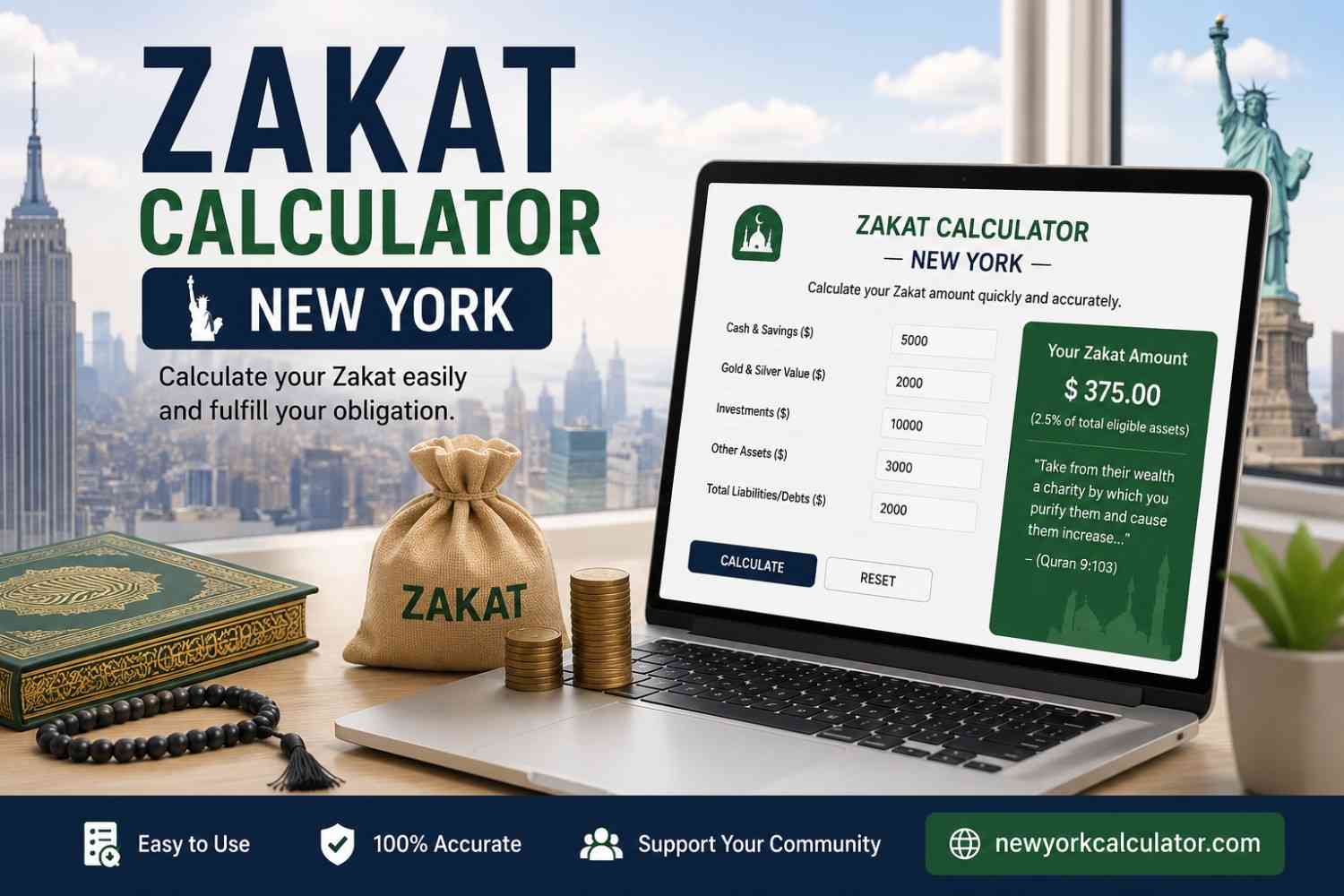
Calculating Zakat can become complicated when your wealth includes more than money in a bank account. Gold jewelry, silver, savings, investment portfolios, cryptocurrency, retirement accounts, business assets, and outstanding debts may all affect your annual Zakat calculation.
For Muslims living in New York, there is another consideration: understanding how Islamic Zakat principles apply to financial products commonly used in the United States.
The NewYorkCalculator.com Zakat Calculator helps you estimate your Zakat in US dollars (USD). You can enter your cash, bank balances, gold, silver, investments, cryptocurrency, business assets, eligible receivables, and retirement savings. The calculator then provides an itemized estimate of your zakatable wealth and potential Zakat payment.
This guide explains how the calculation works, what assets you may need to consider, how Nisab and the lunar year (Hawl) affect your obligation, and what New York residents should understand about 401(k), IRA, mortgages, and investment accounts.
Important: Zakat rulings can differ among Islamic schools of thought and qualified scholars. This calculator is an educational estimation tool, not a religious ruling (fatwa). Review the method that you follow and consult a qualified scholar about complicated financial situations.
Calculate Your Zakat Online
If you live in New York City, Brooklyn, Queens, Manhattan, the Bronx, Staten Island, or another part of New York State, you can use this calculator to estimate your annual Zakat in USD.
Zakat Calculator New York
Calculate your estimated annual Zakat in USD. Review your savings, precious metals, investments, retirement accounts and eligible debts.
1. Cash & Bank Accounts
2. Gold & Silver
Enter metal weights in grams and the price per gram in USD. Use current prices from a reliable market source.
3. Investments & Cryptocurrency
4. Business Assets & Money Owed to You
5. Retirement Accounts
Retirement account treatment varies by scholarly opinion and account accessibility. Enter your account values and select the approach you want to examine.
6. Eligible Debts & Liabilities
7. Nisab Settings
8. Hawl – Lunar Year Confirmation
This confirmation is for calculation guidance only. It does not independently establish a religious obligation.
Your Zakat Calculation Results
Enter your figures and select Calculate to see your estimate.The calculator allows you to enter:
- Cash held at home and in your financial accounts.
- Checking and savings account balances.
- Gold jewelry, coins, and bullion.
- Silver jewelry, coins, and bullion.
- Stocks, ETFs, mutual funds, and other investments.
- Cryptocurrency holdings.
- Business inventory and eligible business assets.
- Money you reasonably expect to recover.
- Eligible portions of retirement accounts.
- Short-term debts and immediately payable obligations.
You can select a Gold or Silver Nisab benchmark, enter the relevant metal prices, and review the calculation breakdown.
The tool uses your entered financial figures. It does not assume that every mortgage, retirement account, or personal asset must be treated identically under all Islamic interpretations.
What Is Zakat?
Zakat is one of the five pillars of Islam. It is an obligatory form of wealth purification and a means of supporting eligible recipients.
For qualifying monetary wealth, the commonly used Zakat rate is 2.5% when the relevant conditions are satisfied.
However, Zakat is not simply 2.5% of everything you own. Islamic rules distinguish between zakatable assets, personal necessities, eligible deductions, the Nisab threshold, and the required holding period.
For example, money saved in a bank account may be treated differently from the home you live in or the car you use for everyday transportation.
A person may own valuable property but still need to determine which portion actually qualifies for Zakat.
How to Calculate Zakat in New York
The basic calculation involves identifying your zakatable assets, considering eligible liabilities, checking the Nisab threshold, and applying the appropriate Zakat rate.
For a common cash-and-wealth calculation, the formula is:
Net Zakatable Wealth = Zakatable Assets − Eligible Deductible Liabilities
If your qualifying wealth meets the applicable Nisab and the required Hawl condition is satisfied:
Zakat = Net Zakatable Wealth × 2.5%
For example, imagine a New York resident has:
| Financial category | Amount |
|---|---|
| Cash and bank savings | $14,000 |
| Gold and silver | $4,000 |
| Stocks and investments | $7,000 |
| Eligible business assets | $3,000 |
| Recoverable money owed | $2,000 |
| Total assets | $30,000 |
| Eligible short-term debts | −$2,000 |
| Net zakatable wealth | $28,000 |
If the applicable Nisab and Hawl conditions are satisfied:
$28,000 × 0.025 = $700
The estimated Zakat is $700.
This is an illustrative example, not a determination of an individual’s religious obligation. Asset-specific rulings may change the amount that should be included.
Understanding Nisab: Gold vs. Silver
Nisab is the minimum qualifying wealth threshold associated with the obligation of Zakat.
Two commonly used precious-metal benchmarks are:
- Gold Nisab: approximately 85 grams of pure gold.
- Silver Nisab: approximately 595 grams of pure silver.
Some published calculators and scholarly resources use slightly different gram conversions based on traditional weight standards. It is important to follow one consistent standard rather than combining different conventions.
The dollar value of Nisab changes as gold and silver market prices change.
For example, if the pure gold price is $150 per gram:
85 × $150 = $12,750
The illustrative Gold Nisab would be $12,750.
If the pure silver price is $2 per gram:
595 × $2 = $1,190
The illustrative Silver Nisab would be $1,190.
These are hypothetical prices used to explain the calculation, not October 2026 market quotations.
Should You Choose Gold or Silver Nisab?
The choice can significantly affect whether someone qualifies for Zakat.
A Silver Nisab threshold is usually lower than a Gold Nisab threshold. Consequently, more people may meet the minimum threshold when the Silver standard is used.
Different scholars and schools of thought may recommend different approaches, particularly when cash, gold, and silver are combined.
For this reason, NewYorkCalculator.com lets you select your preferred Nisab benchmark instead of silently choosing a religious interpretation for you.
If you are uncertain, ask a qualified scholar or your local Islamic center which standard you should follow.
Zakat on Cash and Bank Accounts in New York
Cash and bank balances are among the most straightforward categories to review.
You may need to consider:
- Cash in your wallet.
- Money kept at home.
- Checking accounts.
- Savings accounts.
- Money market deposit accounts.
- Certificates of Deposit (CDs).
- Eligible digital wallet balances.
- Other accessible monetary savings.
If you have accounts at multiple financial institutions, add the relevant balances together.
For example, someone might maintain:
| Account | Balance |
|---|---|
| Chase checking | $3,500 |
| Bank of America savings | $8,000 |
| Capital One savings | $4,500 |
| Cash at home | $500 |
| Total | $16,500 |
The example uses fictional account balances. The relevant amount for your calculation should be the balance applicable on your Zakat due date.
Interest-bearing accounts introduce an additional religious question. Zakat on the qualifying principal and treatment of interest income should not be confused. Interest income has separate Islamic rules, so consult a qualified scholar about how to handle it.
Zakat on Gold and Silver Jewelry
Gold and silver jewelry can represent a significant portion of a household’s wealth.
New York residents may own:
- 24-karat gold bars.
- 22-karat gold jewelry.
- 21-karat gold jewelry.
- 18-karat gold jewelry.
- Gold coins.
- Silver jewelry.
- Silver bullion.
The purity of gold matters because a piece of 18-karat jewelry does not contain the same amount of pure gold as an equal weight of 24-karat gold.
A simple purity-adjusted valuation is:
Pure Gold Weight = Total Gold Weight × Karat ÷ 24
For example, 20 grams of 18-karat gold contains:
20 × 18 ÷ 24 = 15 grams of pure gold.
However, this does not automatically settle the religious question of whether all jewelry is zakatable. Scholars differ on personal-use jewelry, particularly jewelry worn regularly.
If your jewelry is held as an investment, the applicable treatment may also differ from personal-use jewelry.
Use a reasonable valuation method and follow the scholarly position you trust.
Zakat on Stocks, ETFs, and Investment Accounts
Many people in New York invest through brokerage platforms and retirement-independent investment accounts.
Common holdings include:
- Individual company stocks.
- Exchange-traded funds (ETFs).
- Mutual funds.
- Money market funds.
- Investment portfolios.
- Brokerage cash balances.
Investment Zakat is more complicated than simply adding every account balance.
Some commonly discussed approaches distinguish between:
- Shares purchased for short-term trading.
- Shares purchased for long-term investment.
- Funds that contain different underlying assets.
- Dividends and distributions received.
- Investments containing non-compliant business activities or interest-based components.
Shares held for trading are often valued using their market value on the Zakat calculation date.
For long-term investments, some scholars and Islamic finance methodologies distinguish between the zakatable portion of underlying company assets and the entire share price.
The correct treatment can depend on the investment structure and scholarly methodology.
Practical tip: Keep a statement of your holdings on your Zakat date. Do not automatically assume that the original purchase price is the correct valuation.
Zakat on 401(k), Traditional IRA, and Roth IRA
Retirement accounts deserve special attention for people living and working in the United States.
A New York employee may have wealth spread across a workplace 401(k), a Traditional IRA, a Roth IRA, and other retirement plans.
These accounts are not always treated identically in Zakat calculations.
401(k) Accounts
A 401(k) is an employer-sponsored retirement savings plan.
Important factors may include:
- Current account value.
- Vested employer contributions.
- Whether withdrawals are currently available.
- Early-withdrawal penalties.
- Applicable taxes.
- The scholarly method you follow.
Some methodologies consider the accessible amount after relevant restrictions and deductions. Other scholarly approaches may include a different portion of the account.
Do not assume that every dollar in a 401(k) is automatically included or automatically excluded.
Traditional IRA
Traditional IRA contributions and investment growth may be subject to different tax and withdrawal conditions.
Consider:
- The current account value.
- Your access to the funds.
- Potential withdrawal penalties.
- Applicable taxes.
- Whether your selected Zakat methodology includes the entire balance or an accessible portion.
Roth IRA
Roth IRA contributions are generally made with after-tax money, and qualified withdrawals have different tax treatment from Traditional IRA withdrawals.
This does not automatically settle its Zakat treatment. Accessibility, ownership, account restrictions, and the scholarly approach still matter.
How Should You Calculate Retirement Account Zakat?
There are different approaches, and a calculator should not present one disputed percentage as universally accepted.
A practical method is to calculate multiple scenarios:
| Scenario | What it represents |
|---|---|
| Full balance | Includes the full eligible account value |
| Accessible balance | Includes the amount considered accessible under your chosen method |
| Custom percentage | Allows a user or adviser to enter a selected zakatable portion |
NewYorkCalculator.com provides a retirement-account input that lets users compare different calculation assumptions.
For an individual ruling, consult a qualified scholar familiar with US retirement plans.
Zakat on Cryptocurrency in the United States
Cryptocurrency has become another financial asset that some Muslims hold.
Examples include:
- Bitcoin (BTC).
- Ethereum (ETH).
- Other cryptocurrencies.
- Certain digital tokens.
- Cryptocurrency held on exchanges.
- Eligible crypto held in personal wallets.
Many contemporary scholars consider qualifying cryptocurrency holdings zakatable, particularly when held as tradeable wealth.
However, the treatment of particular tokens, staking arrangements, locked assets, and unusual digital financial products can vary.
For a straightforward market-value estimate:
Crypto Value = Quantity Held × Market Price on Your Zakat Date
For example, if your qualifying crypto holdings are worth $4,000 on your calculation date, you would use that valuation according to the method you follow.
Avoid using an old purchase price when the relevant methodology requires current market value.
Zakat on Business Assets and Self-Employment Income
New York has a large community of business owners, freelancers, independent contractors, retailers, and service providers.
Business Zakat can involve more than the money in a business checking account.
Potentially relevant items include:
- Business cash.
- Bank balances.
- Inventory held for sale.
- Merchandise.
- Raw materials and trade goods.
- Recoverable business receivables.
- Qualifying trading assets.
Business premises, equipment, vehicles, and tools used to operate a business are generally distinguished from merchandise held for sale.
For example, a store owner may have $20,000 in business inventory and $8,000 in business cash. The inventory and cash may need to be considered, while the shop’s shelves, computers, and equipment used to run the business are not automatically treated as saleable inventory.
Business accounting methods can differ, so obtain appropriate guidance if you own a partnership, LLC, corporation, or complex business structure.
Which Debts Can You Deduct From Zakat?
Debt treatment is one of the most misunderstood parts of Zakat calculation.
Some scholars permit deductions for debts that are immediately due or payable in the near term. Other approaches may consider liabilities differently.
Examples of potentially relevant obligations include:
- Overdue credit card balances.
- Personal loan payments due.
- Unpaid rent.
- Current utility bills.
- Outstanding essential expenses.
- Other immediately payable liabilities.
What About a Mortgage?
A mortgage should not automatically be deducted in full just because you still owe money to a lender.
For example, if your remaining mortgage balance is $300,000, it does not necessarily mean you can subtract $300,000 from your zakatable wealth.
The treatment of long-term debt differs among scholars and methodologies.
Some approaches focus on installments currently due, while others consider different portions of qualifying liabilities.
The same caution applies to car loans and other long-term financing.
Use the debt method recommended by your trusted scholar. Do not enter the entire outstanding mortgage balance into a short-term debt field unless your chosen methodology specifically supports that treatment.
Is Your Home or Personal Car Subject to Zakat?
A home used as your primary residence is generally not included as ordinary zakatable cash or trade inventory.
Similarly, personal-use possessions are generally distinguished from wealth held for trade.
Common examples include:
- Your primary residence.
- Your personal vehicle.
- Everyday clothing.
- Household furniture.
- Appliances.
- Personal-use computers and phones.
- Normal household necessities.
However, property held for resale, investment, or business purposes may receive different treatment.
For example, someone who buys property with the intention of reselling it for profit may need to consider its treatment as a trading asset.
A property purchased for rental income may require a different calculation, often focusing on qualifying income or cash retained rather than automatically including the entire property value.
Always distinguish between personal-use property and assets held for commercial purposes.
What Is Hawl? Understanding the One Lunar Year Requirement
Hawl refers to the completion of a lunar year of ownership under the relevant Zakat rules.
The Islamic lunar calendar is shorter than the Gregorian calendar used in New York.
A lunar year is approximately 354 or 355 days.
This difference matters when calculating annual Zakat.
For example, if your Zakat anniversary falls on the 10th day of Ramadan, you should generally use that recurring lunar date rather than assuming it will always fall on the same Gregorian date.
A practical approach is to:
- Identify your Zakat anniversary.
- Record the value of your relevant assets on that date.
- Review your eligible deductions.
- Check the applicable Nisab.
- Calculate your Zakat using the method you follow.
- Keep a record for the next lunar year.
The details of Hawl can vary depending on the type of wealth and scholarly methodology. A qualified scholar can help with situations involving fluctuating balances, newly acquired wealth, and different asset categories.
How to Value Gold and Silver in USD
The calculator uses manual price inputs to avoid presenting an outdated or invented market price as current.
Before calculating, check a reliable precious-metal market source.
For a consistent calculation:
- Find the current price per gram of pure gold.
- Find the current price per gram of pure silver.
- Enter both prices in USD.
- Enter your actual metal weight in grams.
- Select the Nisab standard you follow.
- Review the calculated threshold.
If you own jewelry with a purity below 24 karats, the calculator should account for the difference in pure gold content.
Remember that retail jewelry prices can include craftsmanship, brand premiums, and other charges. These are not necessarily the same as the metal’s underlying market value.
Common Zakat Calculation Mistakes to Avoid
A small mistake in asset classification can lead to a misleading result.
Here are some common issues to watch for:
1. Forgetting old bank accounts
Include relevant balances from all financial institutions, not only the account you use most often.
2. Using the original gold purchase price
Use an appropriate valuation for your calculation date and selected method.
3. Treating every retirement account the same
401(k), Traditional IRA, and Roth IRA accounts may have different access and tax characteristics.
4. Deducting an entire mortgage automatically
Long-term debt treatment varies. Do not assume the entire remaining balance is deductible.
5. Ignoring business inventory
Qualifying goods held for sale may be relevant even if the business has little cash.
6. Using an outdated Nisab threshold
Gold and silver prices change. Update the price inputs before calculating.
7. Forgetting the lunar calendar
A Gregorian anniversary and a lunar Zakat anniversary are not identical.
8. Counting personal possessions as trading assets
A personal car, ordinary household furniture, and a primary residence are generally treated differently from assets held for sale.
9. Counting doubtful receivables as guaranteed cash
Money you are unlikely to recover may receive different treatment from a reliable loan or expected payment.
10. Mixing different scholarly methods
Use a consistent method. If you are comparing different approaches, keep the results separate rather than combining assumptions.
How to Prepare for Your Annual Zakat Calculation in New York
You can make the process easier by keeping a simple financial record throughout the year.
Consider organizing your information into these categories:
| Category | Information to prepare |
|---|---|
| Cash | Cash at home and in wallets |
| Banking | Checking, savings, CDs |
| Precious metals | Gold and silver weights and purity |
| Investments | Stocks, ETFs, mutual funds |
| Cryptocurrency | Current eligible holdings |
| Retirement | 401(k), IRA, and pension statements |
| Business | Cash, inventory, receivables |
| Debts | Amounts currently due |
| Nisab | Gold or silver benchmark |
| Date | Your Zakat anniversary |
A personal spreadsheet or financial statement can help you avoid overlooking assets.
You should also keep previous calculation records so you can understand how your wealth changes from one Zakat year to another.
Privacy and Security: Is It Safe to Use an Online Zakat Calculator?
Financial information is personal. A Zakat calculator should not require unnecessary information about your identity or bank accounts.
For an estimate, you generally only need to enter financial amounts.
NewYorkCalculator.com’s calculator is designed to perform calculations within your browser. It does not need your bank login, Social Security number, account number, or payment card information.
Do not enter passwords or confidential banking credentials into a Zakat calculator.
For additional privacy, you can calculate using rounded figures when an exact amount is not necessary for your initial estimate.
Frequently Asked Questions
1. How do I calculate Zakat in New York?
Add your qualifying zakatable assets, consider eligible deductions, compare your net wealth with the applicable Nisab, and apply the 2.5% rate when the relevant conditions, including Hawl, are satisfied. Use the NewYorkCalculator.com tool to estimate the amount in USD.
2. How much Zakat do I pay on $10,000?
If the entire $10,000 qualifies as zakatable wealth, meets the applicable Nisab, and satisfies the relevant holding-period requirements, 2.5% would be $250.
3. Is Zakat calculated in US dollars?
Yes. If your assets and financial accounts are denominated in US dollars, you can calculate their relevant values in USD. Assets held in another currency should be converted consistently using an appropriate exchange rate on your calculation date.
4. Do I pay Zakat on my 401(k)?
Retirement accounts are subject to different scholarly approaches. Some methods consider an accessible portion, while others use a different valuation. Consider account restrictions, taxes, and penalties, and consult a qualified scholar.
5. Is Roth IRA subject to Zakat?
Its treatment depends on the scholarly method and the account’s accessibility and ownership conditions. Do not assume that the full balance is always included or excluded.
6. Do I pay Zakat on my checking account?
Qualifying cash and bank balances are generally included in Zakat calculations when the relevant conditions are satisfied.
7. Is my mortgage deductible from Zakat?
The entire remaining mortgage balance is not automatically deductible under every scholarly approach. Some methods focus on payments due in the near term. Follow the debt method recommended by your scholar.
8. Do I pay Zakat on my personal car?
A car used for ordinary personal transportation is generally not treated as zakatable trading inventory. A vehicle purchased for resale or commercial trading may be treated differently.
9. Should I use Gold or Silver Nisab?
Both are recognized Nisab benchmarks, but scholars differ on which standard to apply in particular circumstances. Select the approach that follows your trusted scholarly guidance.
10. Does Zakat apply to cryptocurrency?
Many contemporary scholars consider qualifying cryptocurrency holdings zakatable, especially when held as tradeable wealth. Particular tokens, locked holdings, and other arrangements may need individual review.
11. Can I pay Zakat monthly?
Some scholars permit advance Zakat payments in appropriate circumstances. Your annual obligation should still be reviewed using the relevant Zakat date and method. Consult a scholar if you intend to use monthly installments.
12. Can I deduct credit card debt from Zakat?
Some methodologies permit deduction of eligible amounts currently due. Do not automatically deduct the entire available credit limit or all future obligations.
13. Do I pay Zakat on rental property?
Rental property held to generate income is often treated differently from property held for resale. Qualifying rental income retained as wealth may be relevant, depending on the method followed.
14. What happens if my wealth falls below Nisab?
If your wealth falls below Nisab, the effect depends on the rules of the school or methodology you follow. Ask a qualified scholar how to handle fluctuations during the Hawl period.
15. Is this Zakat calculator a religious authority?
No. It is an educational calculation tool. It helps organize financial information and estimate a possible amount. It does not issue fatwas or replace advice from a qualified Islamic scholar.
Final Thoughts: Calculate Your Zakat With Greater Confidence
For Muslims living in New York, calculating Zakat can involve more than adding up savings and multiplying by 2.5%.
Modern financial life may include multiple bank accounts, retirement plans, brokerage investments, cryptocurrency, business ownership, and long-term debt.
Understanding these categories can help you prepare a more complete calculation.
Use the NewYorkCalculator.com Zakat Calculator to organize your financial figures, compare Nisab benchmarks, review the result, and identify areas that may need scholarly guidance.
The most important step is not simply obtaining a number. It is understanding how that number was calculated and making sure the method reflects the Islamic guidance you follow.
Author Information
Junaidul Islam is the author of this guide for NewYorkCalculator.com. His editorial focus is on creating practical online calculators and easy-to-understand financial guides that help readers make informed everyday decisions.
Editorial and Religious Disclaimer
This article is for educational and informational purposes only. It is not financial, tax, legal, or religious advice. Zakat calculations may differ based on Islamic jurisprudence, asset ownership, investment structure, debt treatment, and individual circumstances. Consult a qualified Islamic scholar for religious rulings and an appropriately licensed professional for tax or financial questions.
Research and Further Reading
- Zakat Foundation of America – Zakat Calculator
- Zakat Foundation of America – Conditions and Calculations
- MoneyDeck – Zakat Calculator
- Zakat Finance – Zakat Calculator and Guides
- Zakat Foundation of America – Zakat Resources
Article written by Junaidul Islam for NewYorkCalculator.com. Last Updated: October 11, 2026