
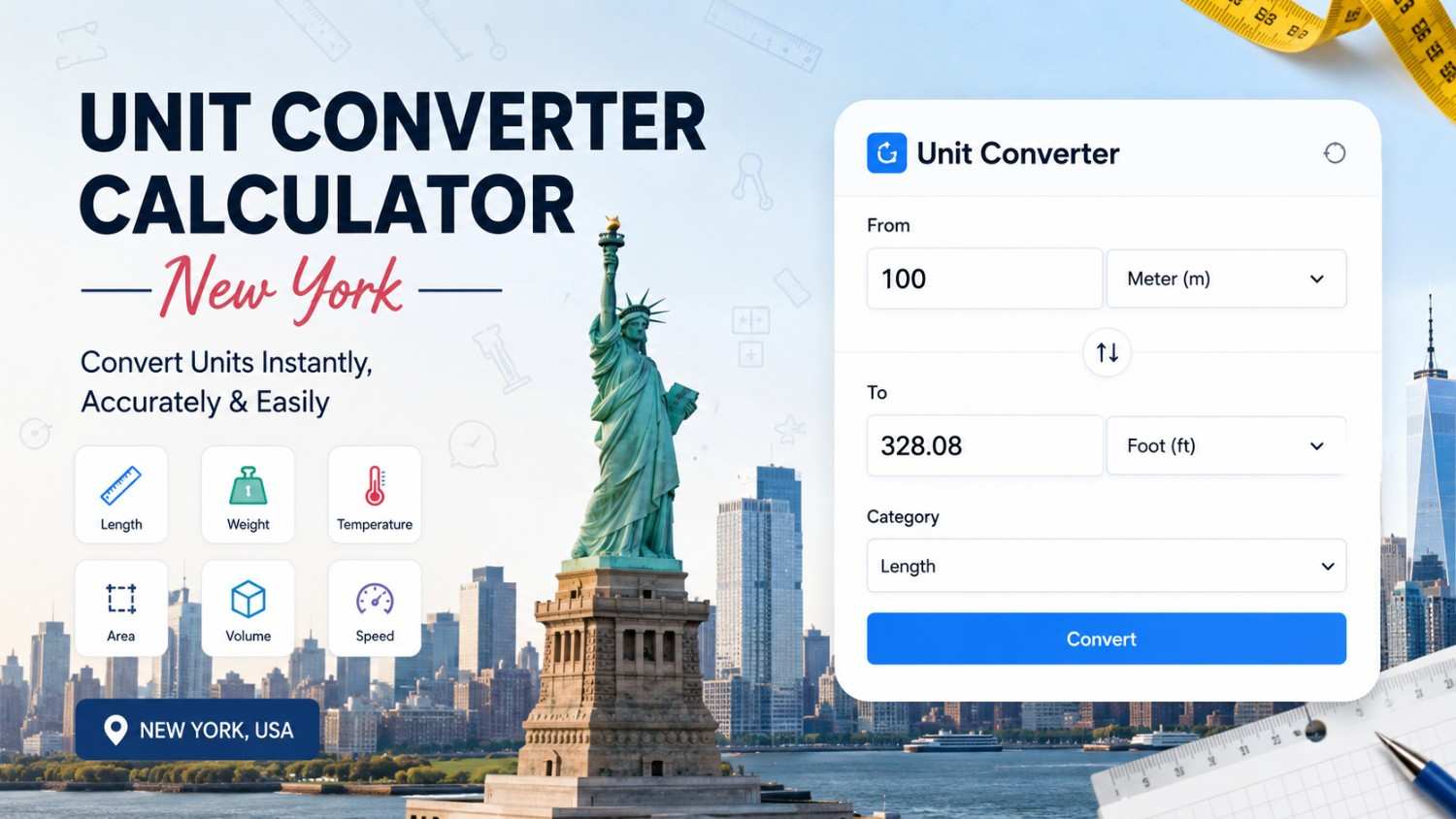
When you need to convert miles to kilometers, inches to centimeters, pounds to kilograms, or Fahrenheit to Celsius, a reliable unit converter can save time and help you avoid arithmetic mistakes. If you live in New York or are working with US measurements, you may also need to compare familiar US customary units with the metric units used in science, international product specifications, travel, and many online resources.
Our Unit Converter Calculator helps you convert common measurements in one place. Choose a measurement category, enter your value, select the original and target units, and read the result. You can use the calculator for everyday conversions involving length, weight or mass, temperature, volume, area, and speed.
Unit Converter Calculator
Convert US customary, Imperial and metric measurements instantly. Choose a category, enter a value and select your units.
All units in this category
Compare the entered measurement in every supported unit below.
| Unit | Symbol | Converted value |
|---|
Results are calculated in your browser. Displayed values are rounded according to your selected precision. US and UK liquid measures are treated separately. For regulated, scientific or safety-critical work, verify the applicable standard and required tolerance.
Website implementation note: Replace this placeholder with the interactive calculator provided separately. Do not publish the placeholder as if it were a working calculator.
How to Use the Unit Converter Calculator
You do not need to memorize conversion factors to use the calculator. Follow these steps:
- Choose a category. Select length, weight, temperature, volume, area, or speed, depending on what you want to measure.
- Enter your value. Type the number you want to convert. Decimal values such as 12.5 are supported.
- Select the original unit. For example, choose miles if your distance is measured in miles.
- Select the target unit. Choose kilometers if you want the same distance expressed in kilometers.
- Read the result. The converted value appears automatically as you change the input or units.
- Swap the units when needed. Use the swap control to reverse the conversion direction.
For example, entering 10 miles and selecting kilometers produces approximately 16.09344 kilometers. The distance itself has not changed; only the unit used to express it has changed.
For critical engineering, laboratory, construction, or regulated measurements, verify the applicable specification and required precision before using a result.
Why Unit Conversion Matters in New York
New York residents regularly encounter measurements in different contexts. A road sign or driving instruction may use miles, a home listing may describe floor space in square feet, and an imported appliance specification may list dimensions in millimeters. A recipe from another country may use grams or milliliters instead of cups and fluid ounces.
A converter is useful when the source measurement and the measurement you need do not use the same unit.
Everyday situations where a converter helps
- Travel: Convert kilometers to miles when comparing distances from international travel guides.
- Home improvement: Convert inches and feet to centimeters and meters when checking product dimensions.
- Housing: Compare square feet with square meters when reviewing international floor plans.
- Cooking: Convert US liquid measurements into milliliters or liters when following a recipe.
- Shopping: Compare package dimensions or product weights shown in different measurement systems.
- Education: Check conversions when working on mathematics, physics, or science assignments.
- Weather: Convert Fahrenheit to Celsius when reading international weather reports.
- Fitness: Convert miles to kilometers or pounds to kilograms when using an app that expects a different unit.
The correct conversion depends on the type of quantity and the precise unit definition. A liquid gallon, for example, is not the same quantity in the US customary and UK Imperial systems.
US Customary, Metric, and UK Imperial Units Explained
Three measurement systems are particularly useful to understand when converting measurements.
US customary units
US customary units are familiar in everyday American life. Common examples include inches, feet, yards, miles, ounces, pounds, cups, fluid ounces, quarts, gallons, and degrees Fahrenheit.
These units appear in many American recipes, product descriptions, property measurements, and driving contexts.
Metric units
The metric system uses units such as millimeters, centimeters, meters, kilometers, grams, kilograms, milliliters, and liters. Its decimal structure makes many conversions within the system straightforward.
For example:
- 1 meter = 100 centimeters.
- 1 kilometer = 1,000 meters.
- 1 kilogram = 1,000 grams.
- 1 liter = 1,000 milliliters.
UK Imperial units
The UK Imperial system shares some unit names with US customary measurements, but certain units have different definitions. Liquid volume is one of the most important examples.
One US liquid gallon equals exactly 3.785411784 liters. One UK Imperial gallon equals exactly 4.54609 liters. These are different quantities, so choosing the correct gallon matters.
When a recipe, specification, or reference simply says “gallon,” check the country or measurement system before converting it.
Common Unit Conversion Formulas
The following formulas are useful for checking calculator results and understanding how a conversion works.
Length and distance
| Conversion | Formula | Example |
|---|---|---|
| Inches to centimeters | Inches × 2.54 | 10 in = 25.4 cm |
| Feet to meters | Feet × 0.3048 | 10 ft = 3.048 m |
| Miles to kilometers | Miles × 1.609344 | 10 mi = 16.09344 km |
| Kilometers to miles | Kilometers ÷ 1.609344 | 10 km ≈ 6.21371 mi |
These factors allow you to convert measurements in either direction. For the reverse conversion, divide by the same factor or use its reciprocal.
Weight and mass
In everyday conversation, people often say “weight” when referring to a value measured in pounds or kilograms. In technical contexts, mass and weight are distinct physical quantities. The following factors refer to mass units.
| Conversion | Formula | Example |
|---|---|---|
| Pounds to kilograms | Pounds × 0.45359237 | 10 lb = 4.5359237 kg |
| Kilograms to pounds | Kilograms ÷ 0.45359237 | 10 kg ≈ 22.0462 lb |
| Ounces to grams | Ounces × 28.349523125 | 10 oz = 283.49523125 g |
| Grams to ounces | Grams ÷ 28.349523125 | 100 g ≈ 3.5274 oz |
Make sure you select the correct ounce unit. An ounce used for mass is different from a fluid ounce used for volume.
Temperature
Temperature conversion requires a different formula from ordinary length or mass conversion because the scales have different zero points.
Fahrenheit to Celsius:
°C = (°F − 32) × 5/9
Celsius to Fahrenheit:
°F = (°C × 9/5) + 32
Celsius to Kelvin:
K = °C + 273.15
For example, 68°F equals 20°C. To check the result, subtract 32 from 68 to get 36, then multiply 36 by 5/9 to get 20.
Kelvin temperatures cannot be below absolute zero, which is 0 K or −273.15°C.
Volume
Volume conversions require particular care because US and Imperial liquid units are not interchangeable.
| Conversion | Formula | Example |
|---|---|---|
| US gallons to liters | US gallons × 3.785411784 | 1 US gal = 3.785411784 L |
| Liters to US gallons | Liters ÷ 3.785411784 | 10 L ≈ 2.64172 US gal |
| US fluid ounces to milliliters | US fl oz × 29.5735295625 | 1 US fl oz ≈ 29.57353 mL |
| US cups to milliliters | US cups × 236.5882365 | 1 US cup ≈ 236.58824 mL |
These examples use US customary liquid measures. Do not substitute an Imperial gallon or another country’s cup definition without checking the source recipe or specification.
Volume and mass also cannot be converted directly into one another without additional information. For example, converting cups of flour to grams depends on the ingredient’s density and how the ingredient is measured.
Area
Area measures a two-dimensional surface. Its conversion factors are squared length factors, not ordinary length factors.
| Conversion | Formula | Example |
|---|---|---|
| Square feet to square meters | Square feet × 0.09290304 | 100 ft² = 9.290304 m² |
| Square meters to square feet | Square meters ÷ 0.09290304 | 10 m² ≈ 107.6391 ft² |
| Acres to square meters | Acres × 4,046.8564224 | 1 acre = 4,046.8564224 m² |
When comparing property measurements or planning a home improvement project, confirm whether the quoted area refers to floor area, land area, or another defined measurement.
Speed
Speed conversions are useful when comparing driving speeds, sports performance, or international specifications.
| Conversion | Formula | Example |
|---|---|---|
| Miles per hour to kilometers per hour | mph × 1.609344 | 60 mph = 96.56064 km/h |
| Kilometers per hour to miles per hour | km/h ÷ 1.609344 | 100 km/h ≈ 62.1371 mph |
The conversion changes the displayed unit, not the actual speed.
Why Area and Volume Need Different Conversion Factors
One frequent conversion mistake is applying a length factor directly to area or volume.
One foot equals 0.3048 meters. However, one square foot does not equal 0.3048 square meters. A square has two dimensions, so the length factor must be squared:
1 ft² = (0.3048 m)² = 0.09290304 m².
A cubic foot has three dimensions, so its length factor must be cubed:
1 ft³ = (0.3048 m)³ ≈ 0.02831685 m³.
This distinction is important for flooring, room dimensions, storage capacity, landscaping, and construction estimates. Always choose a converter category that matches the physical quantity you are measuring.
Exact Conversion Factors and Rounding
Some conversion relationships are exact by definition. For example, the international inch is defined as exactly 2.54 centimeters, and the international pound is defined as exactly 0.45359237 kilograms.
Other published values may be rounded for convenience. A reference chart might show 1 mile as 1.61 kilometers, while a calculator might display 1.609344 kilometers. These figures are compatible at different levels of precision.
A sensible conversion workflow is to retain sufficient precision during calculations and round the final displayed result to the number of decimal places appropriate for the task.
For a simple everyday comparison, two or three decimal places may be enough. A scientific or engineering calculation may require more precision and an explicitly specified tolerance.
More decimal places do not automatically make a measurement more accurate. The precision of the original measurement and the purpose of the calculation also matter.
How to Avoid Common Unit Conversion Mistakes
Before relying on a converted value, check these points:
- Confirm the measurement category. Length, area, volume, mass, and temperature are not interchangeable.
- Check the source unit. A fluid ounce is not the same as an ounce of mass.
- Identify the measurement system. Confirm whether a gallon, pint, or other potentially ambiguous unit is US customary or Imperial.
- Use the correct formula. Temperature requires an offset as well as a scale factor.
- Avoid premature rounding. Keep intermediate values at sufficient precision.
- Check the result’s scale. Converting miles to kilometers should normally produce a larger numerical value; converting kilometers to miles should produce a smaller one.
- Verify high-consequence measurements. Follow the applicable standard or professional specification when errors could affect safety, compliance, or significant costs.
If a result seems unexpected, repeat the calculation with the source and target units reversed. The reverse conversion should return approximately to the starting value, allowing for displayed rounding.
Frequently Asked Questions
Is this unit converter calculator free?
The calculator provided on this page is intended for free everyday unit conversions. It does not require a paid conversion service.
Can I convert US customary units to metric units?
Yes. Select the appropriate measurement category, enter your value, and choose a metric target unit. Common examples include inches to centimeters, miles to kilometers, pounds to kilograms, and Fahrenheit to Celsius.
What is the difference between a US gallon and a UK gallon?
A US liquid gallon equals exactly 3.785411784 liters, while a UK Imperial gallon equals exactly 4.54609 liters. Always select the correct gallon when converting volume.
How do I convert Fahrenheit to Celsius?
Subtract 32 from the Fahrenheit value and multiply the result by 5/9. For example, 77°F equals 25°C.
Can I convert square feet to square meters?
Yes. Multiply square feet by 0.09290304 to obtain square meters. For example, 500 square feet equals 46.45152 square meters.
Can I convert cups to grams?
Not reliably with a single universal factor. Cups measure volume, while grams measure mass. The conversion depends on the ingredient and its density. Use an ingredient-specific conversion reference when accuracy matters.
How many decimal places should I use?
Choose precision appropriate to the task. Everyday estimates often need fewer decimal places than scientific or engineering work. Keep more precision in intermediate calculations and round only when reporting the result.
Does unit conversion change the actual measurement?
No. A correct conversion expresses the same quantity in a different unit. Ten miles and approximately 16.09344 kilometers represent the same distance.
Final Thoughts
A good unit converter should do more than return a number. It should help you choose the correct unit, understand the formula, recognize differences between measurement systems, and avoid errors caused by ambiguous labels or premature rounding.
Use the calculator at the top of this page for everyday conversions, and consult an authoritative standard when a measurement must meet a specific technical, legal, or professional requirement.
Reference sources