
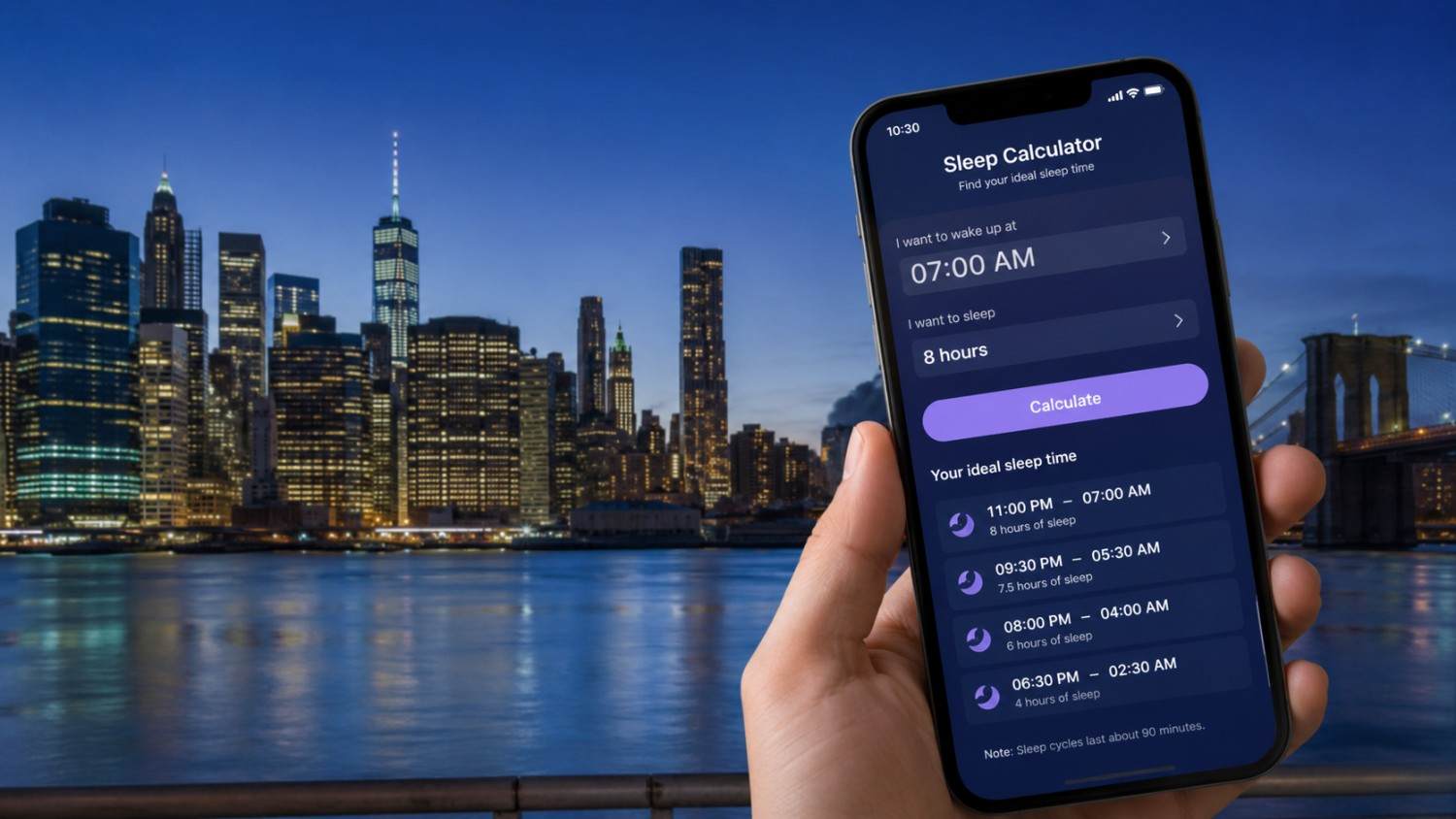
Sleep Calculator New York
Find your ideal bedtime and wake time based on sleep cycles, age, and New York-specific factors like noise, light pollution, and shift work schedules.
Sleep Cycle Results
—What This Means For You
—
What Exactly Is the Sleep Calculator New York?
This calculator determines your ideal bedtime or wake time by working backward or forward through complete 90-minute sleep cycles, then adjusting the result based on your age, your specific New York neighborhood, your work schedule, your sleep environment, and the real-world factors that prevent New Yorkers from getting the sleep they need. It does not just give you a generic “go to bed at 10:30 PM” answer — it accounts for the reality that sleeping in a fourth-floor walk-up on the Lower East Side with bars below and no air conditioning is fundamentally different from sleeping in a quiet Westchester suburb.
Human sleep operates in approximately 90-minute cycles, each progressing through light sleep, deep sleep, and REM sleep. Waking up at the end of a complete cycle — when you are in light sleep — feels dramatically better than waking up in the middle of deep sleep or REM, even if the total sleep duration is slightly shorter. This is the scientific foundation of sleep cycle calculators, and it is the reason why someone who sleeps for 7.5 hours (five complete cycles) can feel more rested than someone who sleeps for 8.5 hours (five cycles plus half a cycle interrupted mid-deep-sleep).
Where this calculator goes further than standard sleep tools is in its New York-specific adjustments. The city’s noise environment alone can reduce effective sleep quality by 15-30 minutes per night — not because you wake up fully, but because ambient noise (subway rumble, sirens, traffic, neighboring apartments, bar noise on weekends) pulls you into lighter sleep stages and reduces the proportion of deep and REM sleep you get. Light pollution is another factor: New York is one of the brightest cities on Earth, and ambient light entering through windows — even with your eyes closed — suppresses melatonin production and shifts your circadian rhythm. The calculator quantifies these penalties and builds them into your recommended schedule so you can compensate by going to bed earlier rather than wondering why you still feel tired after eight hours.
Why Sleep Calculation Matters More in New York Than Almost Anywhere Else
New Yorkers sleep less than residents of virtually any other major American city. According to data from the Centers for Disease Control and Prevention, New York City consistently ranks among the bottom five metropolitan areas for sufficient sleep, with roughly 40-45% of adults reporting that they get fewer than seven hours per night on average. The national average is about 35%. This is not because New Yorkers are fundamentally different from other Americans — it is because the city’s environment, economics, and culture create a perfect storm of sleep disruption that most people underestimate.
Wake Up Refreshed, Not Groggy
By aligning your alarm with the end of a sleep cycle, you avoid sleep inertia — that heavy, disoriented feeling that makes hitting snooze irresistible and can persist for 30-60 minutes.
Compensate for NYC Noise
Subway noise, sirens, and street traffic reduce your effective sleep quality. This calculator adds time to your target so you actually get the sleep you need despite the environment.
Shift Worker Support
Healthcare workers, hospitality staff, and first responders in New York often sleep during the day. This calculator adjusts cycle timing for daytime sleep, which is naturally harder due to circadian disruption.
Borough-Level Precision
Sleep conditions in Staten Island are not the same as in the East Village. Location-specific noise and light pollution estimates make the recommendation relevant to your actual apartment, not a generic average.
The economic dimension is also significant. Sleep deprivation costs the U.S. economy an estimated $411 billion annually in lost productivity, and New York — with its concentration of high-skill, high-stress jobs in finance, law, media, technology, and healthcare — bears a disproportionate share of that cost. A investment banker on Wall Street who is sleeping five hours a night is making materially worse decisions than one who sleeps seven. A surgeon at NYU Langone who is chronically sleep-deprived has measurably slower reaction times and reduced judgment accuracy. A software engineer at a Manhattan startup writing code on six hours of sleep produces more bugs and less creative solutions. These are not hypothetical — they are well-documented in sleep research, and the dollar impact on careers in New York’s high-compensation industries is enormous.
There is also a safety dimension that is particularly relevant in New York. Drowsy driving causes an estimated 100,000 crashes and 1,500 fatalities annually in the United States. New Yorkers who commute — whether driving from Long Island, Westchester, or New Jersey, or even navigating the city’s streets on foot or bicycle — are putting themselves and others at risk when sleep-deprived. The MTA has documented fatigue-related safety incidents among its operators. Using this calculator to get even 30-60 minutes more effective sleep per night has tangible safety benefits that go far beyond feeling better in the morning.
How to Use This Sleep Calculator (Takes 15 Seconds)
Choose Your Mode
Select whether you need to wake up at a specific time, plan to go to bed at a specific time, are going to sleep right now, or want to calculate a nap.
Set Date and Time
Enter the date and your target time. The date matters for shift workers and anyone calculating sleep across midnight boundaries or adjusting for daylight saving time.
Describe Your Situation
Select your age, location, work schedule, noise level, light exposure, caffeine intake, and how quickly you typically fall asleep. Each factor adjusts the calculation.
Review Your Schedule
See optimal cycle-based times, your environment penalty, caffeine impact, and an adjusted total sleep recommendation — plus a quality score and actionable tips.
Sleep Needs and Realities by Age Group and New York Location
The table below shows recommended sleep durations alongside estimated actual average sleep for New Yorkers in each group — highlighting the gap between what people need and what the city’s environment allows them to get.
| Age Group | Recommended | NYC Average | Sleep Debt / Night | Primary NYC Disruptor |
|---|---|---|---|---|
| Child (6–12) | 9–12 hours | 8.5–10 hours | 0.5–2 hours | Noise, screen time, homework load |
| Teenager (13–17) | 8–10 hours | 6–7.5 hours | 1.5–3 hours | School start times, phone use, circadian shift |
| Young Adult (18–25) | 7–9 hours | 5.5–7 hours | 1–3 hours | Late-night culture, work hours, roommates |
| Adult (26–64) | 7–9 hours | 6–7.5 hours | 0.5–2.5 hours | Work stress, commute time, family duties |
| Senior (65+) | 7–8 hours | 5.5–7 hours | 0.5–2 hours | Health conditions, fragmented sleep, early waking |
These NYC average estimates are derived from CDC Behavioral Risk Factor Surveillance System data, NYU School of Medicine sleep studies focused on urban populations, and the Sleep Foundation’s metropolitan-area analysis. The “sleep debt” column represents the average gap between recommended and actual sleep — a debt that accumulates over time and can only be repaid through additional sleep, not through caffeine, willpower, or adaptation. Research consistently shows that people who believe they have “adapted” to sleeping less are actually operating at reduced cognitive capacity without being aware of it.
How New York’s Unique Environment Destroys Your Sleep — And What to Do About It
Sleep research has historically been conducted in controlled laboratory environments that bear little resemblance to a typical New York City apartment. Understanding the specific mechanisms through which New York disrupts sleep helps you make targeted interventions rather than generic “sleep hygiene” advice that was designed for people in quiet suburban homes.
- Subway vibration and noise: The New York City subway system operates 24 hours a day, and roughly 3.5 million people live within 500 feet of a subway line. The low-frequency vibration from trains passing beneath buildings travels through foundations and walls, and research from NYU’s Department of Otolaryngology has shown that even vibrations below the threshold of conscious awareness can fragment sleep architecture — reducing deep sleep by 10-20% in exposed individuals. Above-ground subway segments (the 7 train in Queens, the elevated portions of the 1, 2, 4, 5, and 6 lines in Manhattan and the Bronx, the L train in Brooklyn) produce both ground-borne vibration and airborne noise that is measurably worse than underground segments. If your bedroom is above or adjacent to an elevated line, the sleep disruption is significant and persistent — it does not diminish with habituation the way many people assume.
- Siren and emergency vehicle noise: New York City has the busiest emergency medical system in the United States, with FDNY and EMS responding to roughly 5,000 calls per day. Each response involves sirens, and the sound propagation through Manhattan’s canyon-like street grid means that siren noise reaches far above street level. Studies have found that siren noise events in NYC average 4-8 per night in most residential areas, and each event can cause a measurable cortical arousal — a brief awakening that you may not remember but that disrupts your sleep cycle. Over a night, these micro-arousals can reduce effective sleep quality by the equivalent of 30-60 minutes of lost sleep.
- Light pollution and melatonin suppression: New York City produces more light pollution than almost any other city in the world. A 2016 study published in Science Advances found that Manhattan’s sky glow is among the brightest on the planet. Even with your eyes closed, ambient light entering through windows can suppress melatonin production by 20-50% depending on the brightness level and wavelength. Streetlights, neon signs, building facade lighting, and the glow from neighboring apartments all contribute. The impact is worst in neighborhoods with high-density commercial activity — Times Square, the Financial District, SoHo, Williamsburg’s main drags — but it affects every borough to some degree. Blackout curtains are the single most effective intervention, yet many New York apartments have ill-fitting window frames, air conditioners that let light through gaps, or landlords who prohibit curtain rod installation.
- Shift work and circadian disruption: New York’s 24-hour economy means that hundreds of thousands of residents work non-traditional shifts. Healthcare workers at the city’s 60+ hospitals, restaurant and bar staff, hotel employees, transit workers, security personnel, media professionals, and emergency responders all face the fundamental biological challenge of sleeping during daylight hours when their circadian system is promoting wakefulness. Research from Columbia University’s Sleep Disorders Center has shown that shift workers in New York get an average of 1.5-2 hours less sleep per day than day workers, with significantly higher rates of insomnia, sleep apnea, and excessive daytime sleepiness. The sleep cycle calculations for shift workers need to account for the fact that daytime sleep is typically shorter, more fragmented, and contains less deep sleep than nighttime sleep at the same duration.
- Summer heat without air conditioning: Core body temperature needs to drop by about 2-3 degrees Fahrenheit to initiate and maintain sleep. In New York summers — where overnight temperatures in apartments without AC can remain above 80 degrees for weeks — this thermoregulatory challenge prevents many residents from achieving adequate deep sleep. Heat-related sleep disruption disproportionately affects lower-income New Yorkers who are less likely to have air conditioning, residents of top-floor apartments in older buildings without adequate ventilation, and anyone whose building restricts window AC units. Even with air conditioning, the noise from window units can itself be a sleep disruptor — a cruel trade-off that many New Yorkers face every summer.
- The commute steals sleep directly: The average one-way commute in the New York metro area is approximately 38 minutes — among the longest in the country. For many residents, especially those commuting from Long Island, Westchester, New Jersey, or the outer parts of Queens and Brooklyn, one-way commutes of 60-90 minutes are common. A 90-minute commute each way means three hours per day devoted to transportation. For someone who needs to leave home at 6:30 AM to reach a 8:30 AM start in Manhattan, the only way to get eight hours of sleep is to be asleep by 10:00 PM — which, in New York’s late-night culture, means sacrificing virtually all evening activity. Many New Yorkers implicitly choose to sleep less rather than give up their limited personal time, creating a structural sleep deficit that no amount of sleep hygiene advice can fully overcome without addressing the commute itself.
- Roommate and partner disruption: New York’s high housing costs mean that a large proportion of residents share bedrooms or apartments. Roommates on different schedules, partners who snore, pets on the bed, and the simple reality of sharing a thin-walled apartment with other people all create sleep disruption that is largely outside your control. A 2023 survey by StreetEasy found that 28% of NYC renters reported that their roommate’s behavior negatively affected their sleep. For couples where one partner is a light sleeper and the other snores, moves frequently, or keeps different hours, the sleep cost can be 1-2 hours per night of effective sleep lost.
Sleep Optimization Approaches — What Actually Works for New Yorkers
Generic sleep advice often fails in New York because it assumes conditions that do not exist here. Here is an honest assessment of what works, what partially works, and what is largely wishful thinking for NYC residents.
- Blackout Curtains — Pros: The single most effective intervention for New York’s light pollution problem. Quality blackout curtains can reduce ambient light in a bedroom to near-zero levels, restoring normal melatonin production. Cost is low ($30-$80 for most windows). Installation is simple. Benefits are immediate and significant — research shows improved sleep onset latency, increased deep sleep duration, and better next-day alertness. Cons: Many NYC apartments have non-standard window sizes that require custom curtains. Some landlords prohibit drilling for curtain rods. Air conditioners in windows create light gaps. If you have a roommate who turns on lights in a shared space, you also need to address the light under your door. Despite these limitations, this should be every New Yorker’s first sleep investment.
- White Noise Machines — Pros: Effective at masking the unpredictable noise events (sirens, horns, shouting) that cause the most sleep disruption by creating a consistent auditory baseline. Can be particularly helpful for people living near elevated subway lines, busy intersections, or bars. Inexpensive ($20-$50 for a basic machine, $0 if you use a phone app with a speaker). Cons: Does not address low-frequency vibration from subways (white noise covers airborne sound but not structure-borne vibration). Some people find white noise itself disruptive, especially at the volumes needed to mask NYC noise. Phone-based solutions require the phone to be unlocked and emitting light, which creates its own sleep disruption. Dedicated machines are better but take up space in already-small NYC apartments.
- Sleep Earplugs — Pros: Directly reduces noise reaching your eardrums. High-quality foam or silicone earplugs (3M, Mack’s, Loop) cost $0.50-$2.00 per pair and can reduce noise by 20-33 dB — enough to transform a noisy NYC night into something approaching quiet. Particularly effective for siren noise and neighbor noise. Cons: Many people find them physically uncomfortable and cannot fall asleep with something in their ear canals. They do not block all noise — especially low-frequency sounds like subway vibration. Improper insertion (extremely common) reduces effectiveness dramatically. Some people report ear pain or infections with prolonged use. They also block important sounds like smoke alarms, which is a safety consideration in apartment buildings.
- Caffeine Management — Pros: Caffeine has a half-life of approximately 5-6 hours, meaning that a 2 PM coffee still has roughly 25% of its active caffeine in your system at 8 PM — enough to measurably delay sleep onset and reduce deep sleep. For many New Yorkers who drink coffee throughout the afternoon, simply cutting off caffeine at noon or switching to decaf after 1 PM can improve sleep onset latency by 15-30 minutes without any other changes. Cost: zero. Cons: New York’s work culture runs on caffeine, and cutting back requires genuine effort. People who are chronically sleep-deprived feel more dependent on caffeine, creating a vicious cycle where poor sleep drives caffeine consumption, which drives poor sleep. Withdrawal symptoms (headache, fatigue, irritability) can last 3-7 days. The effect is modest compared to environmental interventions — maybe 15-30 minutes of improved sleep, not the 1-2 hours that environmental fixes can provide.
- Screen/Device Curfews — Pros: Blue light from phones, tablets, and computers suppresses melatonin production and delays sleep onset by an average of 10-30 minutes. Setting a firm “screens off” rule 60 minutes before bed is free and has measurable benefits. Night mode / blue light filter settings help somewhat but do not fully eliminate the effect, because the cognitive stimulation of content is itself a sleep disruptor independent of light. Cons: For many New Yorkers, the hour before bed is the only personal time they have — the time after work, after the commute, after household responsibilities, when they finally get to scroll, watch, or read on their devices. Asking someone who has had 30 minutes of free time all day to spend that last hour staring at the ceiling instead of their phone is asking for a behavior change that most people cannot sustain. The advice is scientifically correct and practically unrealistic for much of New York’s workforce.
- Melatonin Supplements — Pros: Can help shift workers initiate daytime sleep by providing the circadian signal that the environment is not providing. Low dose (0.3-1 mg) taken 60-90 minutes before desired sleep onset has shown effectiveness in research. Inexpensive and available over the counter. Cons: Melatonin is not a sleep aid in the traditional sense — it is a circadian rhythm signal, and its effectiveness depends heavily on timing. Taking it at the wrong time can actually shift your rhythm in the wrong direction. Many commercial supplements contain far higher doses (5-10 mg) than research supports, and high-dose melatonin can cause grogginess, vivid dreams, and next-day fatigue. The supplement industry is poorly regulated, and actual melatonin content in pills often differs significantly from labeled amounts. For night-time sleepers in New York, melatonin is usually unnecessary — the problem is environmental disruption, not circadian misalignment. For shift workers, it can be helpful but should be used under medical guidance.
What This Calculator Cannot Do — And When to Seek Professional Help
This calculator provides scheduling recommendations based on sleep cycle science and New York-specific environmental adjustments. It is a planning tool, not a medical device, and there are important boundaries to what it can tell you.
- It cannot diagnose sleep disorders: If you consistently feel unrefreshed after adequate time in bed, snore loudly, wake up gasping, experience sudden muscle weakness during the day, or have an irresistible urge to move your legs at night, you may have a sleep disorder such as sleep apnea, narcolepsy, or restless legs syndrome. These conditions require diagnosis by a sleep medicine physician (NYU Langone, Mount Sinai, Weill Cornell, and Columbia all have excellent sleep medicine divisions) and cannot be addressed by adjusting your bedtime. This calculator cannot and does not attempt to diagnose these conditions.
- The 90-minute cycle length is an average, not exact: Sleep cycles vary between individuals and even between nights for the same individual. First-cycle length is often shorter (70-80 minutes) and later cycles longer (100-120 minutes). The calculator uses 90 minutes as a standard estimate, which is accurate enough for scheduling purposes but will not be perfectly precise for any specific individual. If you track your sleep with a wearable device, you can refine the cycle length for your personal biology and adjust accordingly.
- Environmental adjustments are estimates: The noise and light penalties applied by this calculator are based on research data averaged across populations. Your actual sleep disruption depends on the specific noise sources near your apartment, your floor level, your building’s construction quality, your personal noise sensitivity (which varies enormously between individuals), your window orientation, and many other factors. The calculator gives you a reasonable adjustment — your actual experience may differ by plus or minus 10-15 minutes in either direction.
- It does not account for sleep disorders that alter cycle structure: Conditions like sleep apnea fragment sleep cycles, meaning that even if you spend nine hours in bed, you may get far fewer complete cycles than the calculator predicts. Alcohol consumption (extremely common in New York’s social and dining culture) also dramatically alters sleep architecture — it may help you fall asleep faster but suppresses REM sleep and fragments later cycles. The calculator’s cycle-based math assumes normal, healthy sleep architecture.
- Daylight saving time transitions are not automatically calculated: New York observes daylight saving time, and the spring-forward transition in particular can disrupt sleep for 3-7 days as your circadian rhythm adjusts. If your calculation falls near a DST transition date, you should manually adjust by one hour. The calculator uses the time you enter without DST correction — it is your responsibility to account for the clock change.
What Happens With Your Information
Nothing — your sleep mode, date, time, age, location, work schedule, noise level, light exposure, caffeine intake, and fall-asleep speed are processed entirely in your browser. No data is sent to any server. No information about your sleep habits, location, or daily schedule is stored, logged, or transmitted. No cookies track your calculation. Sleep data is personal health information, and a scheduling calculator has no legitimate reason to transmit it. Close this tab and your data ceases to exist on your device.
Frequently Asked Questions
Sleep cycles are the repeated patterns your brain goes through during sleep, each lasting approximately 90 minutes. Each cycle progresses through Stage 1 (lightest), Stage 2 (light), Stage 3 (deep / slow-wave), and REM (rapid eye movement) sleep. Deep sleep is critical for physical recovery and immune function, while REM sleep is essential for memory consolidation, emotional processing, and cognitive performance. Waking up at the end of a complete cycle — during light sleep — feels natural and refreshing. Waking up in the middle of deep sleep or REM feels jarring and produces “sleep inertia,” a state of grogginess and impaired cognitive function that can last 30-60 minutes. By timing your alarm to align with cycle endings, you can wake up feeling more rested even with slightly less total sleep.
The reasons are layered. Structurally, New York has longer average commutes than most cities, which directly reduces available sleep time. Culturally, New York’s social and professional norms encourage late nights — dinner at 9 PM, drinks after work, networking events that start at 7 PM and run late. Environmentally, noise and light pollution are measurably worse than in other cities, reducing sleep quality even when time in bed is adequate. Economically, many residents work multiple jobs or side gigs to afford the city’s cost of living, further compressing available sleep time. Demographically, New York has large populations of young adults (18-30) and shift workers, both of whom are groups with inherently lower average sleep. These factors compound rather than cancel out — the New Yorker who has a long commute, a noisy apartment, a late-night social obligation, and financial pressure to work extra hours faces a sleep challenge that is qualitatively different from someone in a quieter, lower-cost city.
The noise penalty is an estimate based on aggregate data — 311 noise complaint density, subway proximity data, traffic volume studies, and ambient noise level measurements from NYC’s Department of Environmental Protection. It represents the average experience for your borough, not the specific experience at your address. A quiet side street in Brooklyn Heights will have a much lower actual penalty than the calculator’s Brooklyn average, while an apartment directly above the Atlantic Avenue Barclays Center subway station will have a much higher one. Treat the penalty as a starting estimate and adjust based on your personal experience. If you consistently wake up feeling like you got less sleep than the calculator predicted, your actual penalty is likely higher than the estimate.
Partially, but not fully. Research shows that weekend “recovery sleep” can partially restore cognitive function and reduce sleepiness, but it does not fully eliminate the deficits accumulated during the week. More importantly, sleeping in on weekends (a common New York pattern of waking at 6 AM on weekdays and 10 AM on weekends) creates “social jet lag” — a mismatch between your circadian rhythm and your actual sleep schedule that is similar to crossing two time zones every weekend. This social jet lag makes Monday mornings especially difficult and can contribute to metabolic, cardiovascular, and mood problems over time. The more consistent your wake time is across all seven days, the better your sleep quality will be — even if it means going to bed earlier on weekends rather than sleeping later.
For night shift workers (sleeping during the day), the calculator applies an additional 30-45 minute adjustment because daytime sleep is inherently less efficient: your circadian system is promoting wakefulness, ambient temperature is higher (reducing the natural temperature drop that facilitates sleep), and daytime noise in New York is significantly louder than nighttime noise. The cycle math remains the same (90-minute cycles), but the “fall asleep” adjustment is larger and the overall sleep quality score is lower, reflecting the genuine biological difficulty of sleeping during daylight hours. For rotating shift workers, the calculator provides a snapshot for the selected schedule — in practice, rotating workers should recalculate each time their shift changes and should expect lower sleep quality during transition days.
Not necessarily. Needing an alarm to wake at a specific time is normal and does not by itself indicate insufficient sleep — most people need an alarm to coordinate their wake time with work schedules regardless of how much sleep they have had. What does indicate insufficient sleep is: needing multiple alarms or snoozing repeatedly, feeling groggy for more than 15-20 minutes after waking, feeling the urge to nap in the afternoon, relying on caffeine to function, or sleeping dramatically more on weekends than weekdays. If you wake to a single alarm feeling reasonably alert within a few minutes, your sleep duration is likely adequate regardless of whether you would have eventually woken on your own.
Alcohol is a sedative, so it helps you fall asleep faster — which is why many New Yorkers believe a nightcap helps them sleep. But the effect is deceptive. Alcohol suppresses REM sleep in the first half of the night and causes sleep fragmentation and rebound wakefulness in the second half. A drink or two may have minimal impact on overall sleep quality for most people, but three or more drinks — which is common in New York’s dining and social culture — measurably reduces sleep quality even if you do not consciously wake up. The effect is worse for people with even mild sleep apnea, because alcohol relaxes airway muscles and increases apnea events. If you are tracking your sleep and notice that nights after drinking leave you feeling less rested despite the same time in bed, alcohol is likely the explanation.
You should consider consulting a sleep medicine specialist if: you consistently feel unrefreshed despite spending adequate time in bed (7-9 hours), you snore loudly and have been told you stop breathing during sleep (possible sleep apnea), you experience sudden uncontrollable sleep attacks during the day (possible narcolepsy), you have an uncomfortable urge to move your legs at night that prevents sleep (possible restless legs syndrome), you have chronic insomnia (difficulty falling or staying asleep at least three nights per week for three months) that does not respond to sleep hygiene improvements, or your sleep problems are affecting your work performance, relationships, or mood. New York has several world-class sleep medicine centers: NYU Langone Sleep Disorders Center, Mount Sinai Sleep Medicine Program, Weill Cornell Center for Sleep Medicine, and Columbia Sleep Disorders Center all accept patients and work with most insurance plans. A sleep study (polysomnography) can diagnose conditions that no calculator can detect.
New York observes daylight saving time from the second Sunday in March to the first Sunday in November. The spring-forward transition (losing one hour) is significantly more disruptive than the fall-back transition (gaining one hour). Research shows that in the week following spring-forward, there is a measurable increase in heart attacks, traffic accidents, and workplace injuries — attributed to the combined effects of losing one hour of sleep and circadian disruption. For New Yorkers who are already sleep-deprived, this transition can push them below a functional threshold. The best strategy is to shift your bedtime 15 minutes earlier each night for the four nights before the transition, so your body is already adjusted when the clock changes. For the fall-back transition, resist the urge to stay up an hour later — use the extra hour for additional sleep instead.
No. Your sleep mode, date, time, age, location, work schedule, noise level, light exposure, caffeine intake, and fall-asleep speed are processed entirely in your browser. No server receives this data, no history is stored, no cookies are created. Close the tab and it is completely gone.