
By Junaidul Islam
Last Updated: October 8, 2026
Planning for retirement in New York can be more complicated than simply asking, “How much will my pension be?”
Your retirement income may come from several different places, including a New York pension, Social Security, a 401(k), 403(b), 457(b), IRA, Roth IRA, personal savings, or other investments. Your retirement age can also change the amount you receive, while taxes, inflation and healthcare costs can affect how far that income will actually go.
That is why a useful New York Retirement Calculator should look at more than one number.
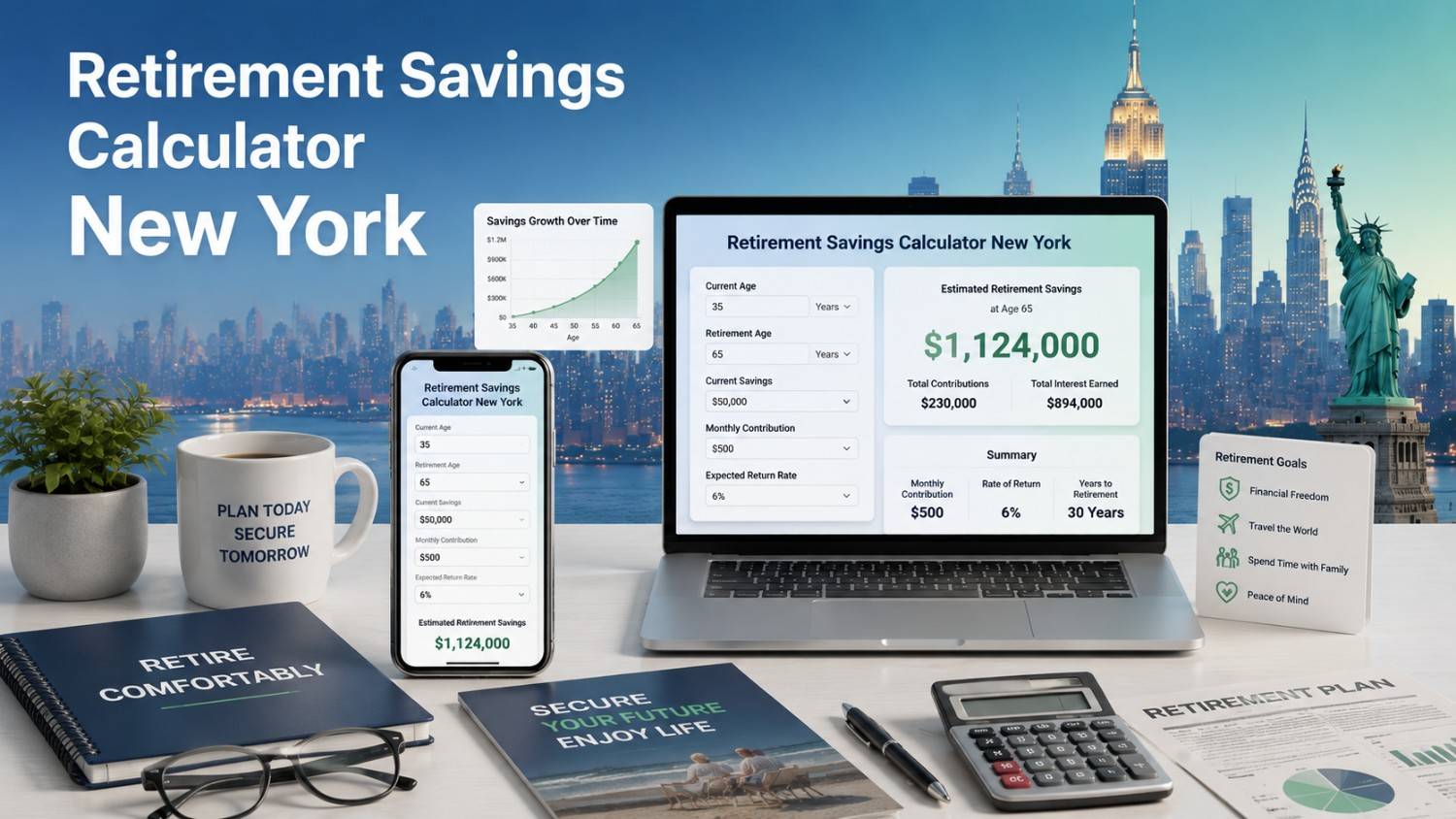
The calculator on this page is designed to help you build a practical estimate of your potential retirement income and compare different retirement scenarios. It can help you understand what may happen if you retire earlier or later, add more years of service, increase your savings, or change your expected Social Security benefit.
Important: This calculator provides an estimate for planning purposes. It is not an official pension estimate and should not replace an estimate from your retirement system, Social Security Administration, tax professional or financial adviser.
New York Retirement Calculator
Estimate your potential New York pension, Social Security, retirement savings income and inflation-adjusted retirement income.
1. Personal & Retirement Information
2. Social Security
3. Retirement Savings
4. Retirement Expenses & Inflation
Retirement Age Comparison
| Retirement Age | Estimated Annual Pension | Monthly Pension | Estimated Total Monthly Income |
|---|
Planning Summary
What Does a New York Retirement Calculator Do?
A New York Retirement Calculator is a planning tool that estimates how much income you may have available after you stop working.
For a New York employee, the calculation can be especially important because your pension may depend on factors such as:
- Your age
- Your retirement age
- Your retirement system
- Your tier
- Years of credited service
- Final Average Earnings or Final Average Salary
- Your retirement plan
- Whether you retire before your plan’s unreduced retirement age
- Survivor or beneficiary options
- Additional service credit
- Other retirement savings
Your total retirement income may then include Social Security and money from retirement accounts.
The goal is not to predict a guaranteed future payment. The goal is to give you a useful planning estimate so you can compare different choices before making a retirement decision.
Why New York Retirement Planning Is Different
New York has several public retirement systems and pension plans. A New York State or local government employee may not have the same retirement rules as a private-sector employee, teacher, police officer, firefighter or another public employee.
For example, NYSLRS includes the Employees’ Retirement System (ERS) and Police and Fire Retirement System (PFRS). Your tier can affect eligibility, the benefit formula, service credit rules, contributions and other retirement provisions.
That means entering a salary and age into a generic retirement calculator may not provide a useful New York-specific estimate.
A better approach is to identify your retirement system and understand which rules apply to you.
What Is NYSLRS?
The New York State and Local Retirement System, commonly called NYSLRS, provides retirement benefits for eligible public employees and public employers across New York.
NYSLRS includes:
- Employees’ Retirement System (ERS)
- Police and Fire Retirement System (PFRS)
Members are assigned to a tier based largely on when they joined the system.
For ERS, the major membership periods include Tier 4, Tier 5 and Tier 6. PFRS has its own tier structure and special plans.
Your tier matters because two employees with the same salary and years of service can have different pension calculations.
New York Retirement Tiers Explained
Tier 4
Tier 4 generally applies to many ERS members who joined during the period beginning September 1, 1983 and ending December 31, 2009.
Tier 4 members can have different retirement outcomes depending on service credit, age and plan.
For regular ERS members, retiring at age 62 generally represents the full-benefit age, while certain members with sufficient service may be able to retire earlier without an age-based reduction.
Tier 5
Tier 5 generally applies to ERS members who joined from January 1, 2010 through March 31, 2012.
Tier 5 has different service and benefit rules from Tier 4.
A Tier 5 member may be eligible for a service retirement beginning at age 55 with the required service credit, but retiring before the full-benefit age can result in a permanent reduction.
Tier 6
Tier 6 generally applies to ERS members who joined April 1, 2012 or later.
Tier 6 is especially important when using a current New York retirement calculator because its rules have changed in recent years.
One important update is the improvement to Final Average Earnings rules for eligible Tier 6 members who retire after the applicable 2024 dates. The current rules can use the highest three consecutive years rather than the previous five-year approach, subject to applicable limitations.
Tier 6 members should also pay attention to current contribution rules because New York’s 2026-27 budget changed certain Tier 6 contribution rates and temporarily changed how overtime is treated for contribution-rate calculations.
Because retirement laws can change, always verify your personal information with NYSLRS.
What Is Final Average Earnings?
One of the most important numbers in a New York pension calculation is your Final Average Earnings, often called FAE.
In simple terms, FAE is an average of eligible earnings used by your retirement plan when determining your pension.
It is not necessarily the same thing as your current annual salary.
Depending on your tier and plan, certain types of compensation may be included or excluded, and statutory limits may apply.
Eligible compensation can include certain forms of:
- Regular salary
- Overtime, subject to applicable limits
- Holiday pay
- Longevity payments
- Certain retroactive payments
Other payments may not qualify.
This is why entering your current salary into a calculator and assuming it is your exact FAE can produce a misleading result.
For a planning estimate, you should use the best FAE figure available from your retirement records.
How Years of Service Affect Your Pension
Years of credited service can have a major effect on a pension.
Consider two employees with the same Final Average Earnings:
Employee A: 15 years of service
Employee B: 25 years of service
The second employee may receive a substantially larger pension because the benefit formula generally increases with additional credited service.
Service credit can also affect whether an employee qualifies for certain retirement benefits or reductions.
If you are considering purchasing additional service credit, it is worth comparing the estimated pension with and without the additional credit before making a decision.
Do not assume that every type of previous employment automatically counts as retirement service. Eligibility and purchase rules depend on the retirement system and circumstances.
How Retirement Age Changes Your Pension
Retirement age is one of the biggest variables in retirement planning.
Retiring earlier can mean:
- Fewer years of service
- Lower final earnings
- A larger age-based reduction
- More years that your savings must support you
Working longer can potentially mean:
- More service credit
- Higher earnings
- A larger pension
- More time to contribute to retirement accounts
- A larger Social Security benefit if you delay claiming it
For example, someone considering retirement at 55 should not compare only the monthly pension.
They should compare:
Retire at 55
versus
Retire at 60
versus
Retire at 62
versus
Retire at 63
versus
Retire at 65
The best decision depends on the person’s retirement system, finances, health, goals and expected longevity.
Early Retirement Can Permanently Reduce Your Pension
An important mistake is assuming that an early retirement reduction disappears when you reach the normal retirement age.
For certain NYSLRS plans, an age-based reduction can be permanent.
For example, regular ERS Tier 3 and Tier 4 members who retire before age 62 with fewer than 30 years of service can face reductions based on their retirement age.
Tier 5 and Tier 6 have their own reduction schedules.
This is one reason a good calculator should show the estimated reduction rather than simply displaying a pension amount.
Your Pension Is Only Part of Your Retirement Income
A pension may be your largest source of retirement income, but it does not necessarily represent your complete retirement picture.
You may also receive:
Social Security
Social Security benefits depend on your earnings history and the age at which you claim benefits.
401(k)
Employer-sponsored retirement savings can supplement your pension.
403(b)
Teachers and employees of certain nonprofit or educational organizations may have a 403(b).
457(b)
Many government employees have access to a governmental 457(b) deferred compensation plan.
IRA
Traditional and Roth IRAs can provide another source of retirement income.
Personal Savings
Cash savings and taxable investment accounts can also contribute to your retirement budget.
A retirement calculator becomes much more useful when these income sources are considered together.
Social Security and New York Retirement
Social Security is an important part of retirement planning for many New Yorkers.
The earliest age for retirement benefits is generally 62.
However, claiming at 62 does not provide the same monthly benefit as claiming at Full Retirement Age or delaying benefits.
For people reaching age 62 in 2026, the Social Security Full Retirement Age is 67.
If you delay retirement benefits beyond Full Retirement Age, your monthly retirement benefit can increase until age 70.
Your actual benefit depends heavily on your earnings record.
Social Security uses your covered earnings history when calculating retirement benefits, so a person with a long history of higher earnings can have a very different benefit from someone with lower or fewer years of earnings.
2026 Social Security Numbers New Yorkers Should Know
For 2026, Social Security benefits received a 2.8% cost-of-living adjustment.
The maximum taxable earnings for Social Security increased to $184,500.
For workers who are below Full Retirement Age for the entire year, the 2026 retirement earnings test limit is $24,480.
For someone reaching Full Retirement Age during 2026, the higher earnings limit is $65,160 for earnings before the month Full Retirement Age is reached.
These numbers matter if you plan to work while collecting Social Security.
They can change from year to year, so an old retirement calculator may display outdated information.
Should You Retire at 62 or Wait Until 67?
There is no universal answer.
Suppose your estimated Social Security benefit at age 62 is lower than your benefit at Full Retirement Age.
You could start receiving money earlier, but you would generally receive a smaller monthly amount.
Waiting can produce a larger monthly benefit, but you must fund your living expenses without that larger Social Security payment during the waiting period.
The right question is not simply:
“Which age gives me the biggest monthly check?”
A better question is:
“Which retirement age produces the best overall plan for my expected income, expenses, health, savings and longevity?”
New York Retirement Taxes
Taxes are another area where generic retirement calculators can be misleading.
New York does not treat every retirement income source in exactly the same way.
For example, qualifying NYSLRS pensions are not subject to New York State or local income tax, although they can generally be subject to federal income tax.
New York also provides important tax treatment for Social Security benefits.
Certain other pension and annuity income can qualify for a New York exclusion of up to $20,000 per eligible taxpayer age 59½ or older, subject to the applicable rules.
That means a retiree’s federal taxable income and New York taxable income can be very different.
Your actual tax situation may also depend on:
- Filing status
- Other income
- Retirement account withdrawals
- Investment income
- Deductions
- Credits
- Residency
- New York City residency
- Other state and federal tax rules
Therefore, a retirement calculator should not promise an exact after-tax amount unless it is designed as a full tax-planning system.
New York City Retirement Is Not the Same as Upstate Retirement
The amount you need to retire depends partly on where you live.
A retiree in New York City may have very different housing and transportation costs from someone retiring in Buffalo, Rochester, Syracuse, Albany or another upstate community.
Your retirement budget should consider:
- Housing
- Mortgage or rent
- Property taxes
- Utilities
- Food
- Transportation
- Healthcare
- Insurance
- Travel
- Family support
- Debt
- Entertainment
- Emergency expenses
A $6,000 monthly retirement income may feel very different depending on where and how you live.
Inflation Can Change Your Retirement Lifestyle
Inflation is one of the easiest retirement risks to underestimate.
Imagine you need $5,000 per month today.
If prices rise over time, $5,000 in the future will not have the same purchasing power as $5,000 today.
That is why retirement planning should look at both:
Future dollars
and
Today’s purchasing power
A useful retirement calculator should allow you to test different inflation assumptions instead of assuming that today’s expenses will remain unchanged forever.
Retirement Savings Matter Even With a Pension
A pension can provide dependable lifetime income, but additional savings can give you more flexibility.
For example, retirement savings can help pay for:
- Home repairs
- Medical expenses
- Travel
- Family support
- Unexpected costs
- Large one-time purchases
- Income gaps before Social Security
- Long-term care
If you have a 401(k), 403(b), 457(b), IRA or other retirement account, include it in your retirement planning.
A pension-only calculation may make your retirement look stronger or weaker than it actually is.
What Is a Survivor Benefit?
A survivor benefit is a pension payment arrangement that can continue payments to an eligible beneficiary after your death.
Choosing a survivor option can reduce your own monthly pension compared with a maximum-payment option.
That creates an important tradeoff.
You should compare:
Higher monthly payment for you
against
Potential ongoing income for your spouse or beneficiary
The right choice depends on your household’s financial situation.
Do not choose a survivor option solely because it produces the largest number on a calculator. Consider your spouse’s income, Social Security, savings, insurance and other resources.
What About Unused Sick Leave and Vacation?
Unused leave can be complicated.
Not every type of unused leave is automatically added to your pension calculation.
Some retirement plans allow certain unused sick leave to affect service credit or other retirement calculations, while other forms of unused leave may not be included in Final Average Earnings.
This is why you should not simply add the dollar value of unused vacation or sick leave to your expected pension.
Check your retirement plan’s specific rules before relying on the amount.
Additional Service Credit Can Matter
Some NYSLRS members may be eligible to purchase or receive credit for certain previous public employment, military service or other qualifying service.
Additional service credit can increase a pension in some circumstances.
But buying service credit is not automatically a good financial decision.
Before paying for additional credit, compare:
- Cost of purchasing the credit
- Increase in estimated pension
- Expected years of retirement
- Break-even period
- Other investment opportunities
A pension estimate with and without the additional service credit can help you understand the potential impact.
A Better Way to Compare Retirement Ages
Instead of calculating only one retirement date, run several scenarios.
For example:
| Retirement Age | Pension | Social Security | Savings Income | Total |
|---|---|---|---|---|
| 55 | Estimate | Estimate | Estimate | Estimate |
| 60 | Estimate | Estimate | Estimate | Estimate |
| 62 | Estimate | Estimate | Estimate | Estimate |
| 63 | Estimate | Estimate | Estimate | Estimate |
| 65 | Estimate | Estimate | Estimate | Estimate |
| 67 | Estimate | Estimate | Estimate | Estimate |
This makes the decision much easier to understand.
The highest monthly income is not necessarily the best retirement age.
What Is a Retirement Income Gap?
Your retirement income gap is the difference between the money you expect to receive and the money you expect to spend.
For example:
Estimated retirement income: $7,000/month
Estimated retirement expenses: $7,600/month
Monthly gap: $600
That means you may need another source of approximately $600 per month.
The gap could potentially be addressed through:
- Working longer
- Increasing retirement contributions
- Delaying Social Security
- Reducing expenses
- Saving more before retirement
- Using another retirement income source
The earlier you identify a potential gap, the more options you have.
How to Improve Your Retirement Estimate
If your estimated retirement income is lower than you expected, do not panic.
Try changing one variable at a time.
Scenario 1: Work two more years
Additional service and earnings may increase your pension.
Scenario 2: Increase retirement contributions
Additional savings may create a larger retirement balance.
Scenario 3: Delay Social Security
Waiting longer can increase the monthly benefit.
Scenario 4: Reduce retirement expenses
Lower housing or debt costs can reduce the income you need.
Scenario 5: Compare different retirement ages
The best answer may be somewhere between your earliest and latest planned retirement dates.
How Accurate Is a New York Retirement Calculator?
A calculator can provide a useful planning estimate, but it cannot guarantee your actual pension.
The accuracy depends on the information entered.
For example, the estimate can change if:
- Your salary changes
- Your service credit changes
- Your retirement date changes
- Your retirement tier or plan is entered incorrectly
- Your FAE is different from the estimate
- You qualify for a special retirement plan
- You have additional service credit
- You have a pension loan
- Retirement laws change
- Social Security rules change
- Investment returns differ from assumptions
For an official NYSLRS pension estimate, use your Retirement Online account or request an estimate from NYSLRS when appropriate.
For Social Security, use your personal Social Security earnings record and official SSA estimate.
Why Our New York Retirement Calculator Uses Scenarios
Retirement planning is not about finding one magical number.
It is about understanding what changes when you make different decisions.
That’s why this calculator is designed around scenarios.
You can change:
- Retirement age
- Years of service
- Final Average Earnings
- Tier
- Social Security estimate
- Retirement savings
- Monthly contributions
- Expected investment return
- Inflation
- Retirement expenses
Then compare the results.
This can help you see which assumptions have the biggest effect on your retirement plan.
New York Retirement Calculator: What You Should Enter
For a better estimate, gather the following information before using the calculator:
Personal information
- Current age
- Planned retirement age
Pension information
- Retirement system
- Tier
- Years of service
- Final Average Earnings
- Expected additional service
Social Security
- Estimated monthly Social Security benefit
- Planned Social Security claiming age
Retirement savings
- Current 401(k), 403(b) or 457(b) balance
- IRA balance
- Monthly contribution
- Expected annual return
Retirement budget
- Expected monthly expenses
- Housing costs
- Healthcare costs
- Other recurring expenses
The more accurate your inputs, the more useful your planning estimate will be.
Frequently Asked Questions
What is the New York Retirement Calculator?
It is a planning tool that estimates potential retirement income using information such as age, retirement age, pension factors, Social Security and retirement savings.
Is this an official NYSLRS calculator?
No. It is an independent planning tool. Your official NYSLRS estimate should come from NYSLRS and your Retirement Online information.
What is the best age to retire in New York?
There is no single best age. Your pension rules, Social Security strategy, savings, expenses, health and personal goals all matter.
Can I retire at 55 in New York?
Some retirement plans allow retirement at 55, but eligibility and reductions depend on your retirement system, tier, plan and service credit.
Does retiring earlier reduce a New York pension?
It can. Many retirement plans apply an age-based reduction when a member retires before the applicable full-benefit age.
Is a New York pension taxable?
It depends on the pension. Qualifying NYSLRS pensions are generally subject to federal income tax but are not subject to New York State or local income tax. Other retirement income can have different rules.
Is Social Security taxable in New York?
New York generally allows Social Security benefits to be excluded from New York adjusted gross income when they are included in federal adjusted gross income, subject to applicable rules.
How much money do I need to retire in New York?
There is no universal number. Your required retirement income depends on housing, healthcare, taxes, debt, lifestyle and location.
Should I include my 401(k) in retirement planning?
Yes. If your 401(k) is part of your retirement income strategy, including it can give you a more realistic picture than looking only at your pension.
Does inflation matter after retirement?
Yes. Inflation can reduce purchasing power over time, so retirement planning should consider both future dollars and today’s purchasing power.
Can I use this calculator for NYCERS or NYSTRS?
You should be careful. NYCERS and NYSTRS have their own pension rules. A general NYSLRS-based estimate should not be treated as an official estimate for another retirement system.
Why is my calculator result different from my official pension estimate?
Different assumptions can produce different results. Your official retirement system may have access to your actual service record, eligible earnings, plan details and other information that an independent calculator does not have.
Final Thoughts
Retirement planning in New York is more than calculating a pension.
Your real retirement picture may include a pension, Social Security, retirement savings, investment income and other resources. At the same time, taxes, inflation, healthcare and living costs can determine how comfortable that income actually feels.
The best approach is to test multiple scenarios instead of relying on one retirement age or one estimated number.
Start with your current information, run the calculation, then compare different retirement ages and savings assumptions.
And before making an irreversible retirement decision, verify the result with your actual retirement system.
The purpose of this calculator is to help you ask better questions, compare realistic scenarios and prepare for a more informed retirement decision.
Important Disclaimer
This calculator and article are provided for general educational and planning purposes only. They are not legal, tax, investment or financial advice and are not an official estimate from NYSLRS, NYCERS, NYSTRS, the Social Security Administration, the IRS or the State of New York. Pension formulas and tax rules can vary by retirement system, tier, plan, service history and individual circumstances. Laws and contribution rules can also change. Always verify important retirement decisions with your retirement system and qualified professional advisers.
Information Sources
The information used for this guide should be checked against the latest publications from:
- New York State and Local Retirement System (NYSLRS)
- New York State Comptroller
- New York State Teachers’ Retirement System (NYSTRS)
- Social Security Administration (SSA)
- New York State Department of Taxation and Finance
- Internal Revenue Service (IRS)
Written by Junaidul Islam for NewYorkCalculator.com