
Author: Junaidul Islam
Last reviewed: October 9, 2026
An out-of-network doctor bill in New York can be difficult to understand. Your doctor may charge $800 for an office visit, but your insurance company may recognize a much lower amount. Depending on your health plan, deductible, coinsurance, and legal protections, the amount you ultimately owe could be very different from the original bill.
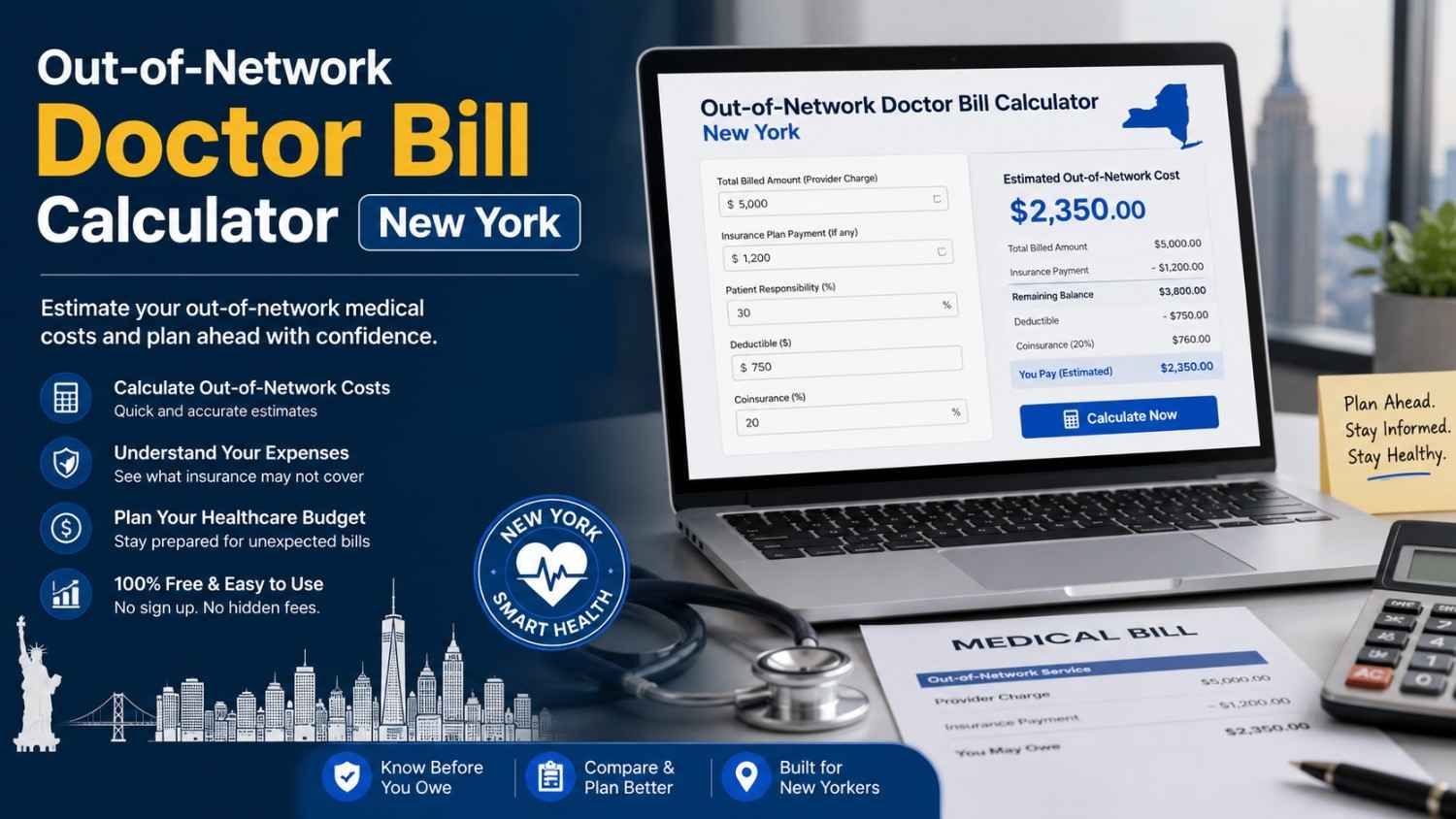
The Out-of-Network Doctor Bill Calculator New York helps you estimate your potential medical expenses using your provider’s billed charge, your plan’s allowed amount, your remaining deductible, and your coinsurance. It also helps you understand how a possible balance bill can affect your total cost.
Use the calculator below as a starting point, then compare your estimate with your insurance company’s Explanation of Benefits (EOB) and the provider’s final bill.
Important: This calculator provides an educational estimate, not a guaranteed insurance payment or a legal determination. New York and federal surprise-billing protections may limit what you owe in qualifying situations.
Out-of-Network Doctor Bill Calculator
Estimate your potential doctor bill in New York using your insurance plan details.
Your Estimated Cost Breakdown
Illustrative estimate based on the information entered.
| Provider’s billed charge | |
|---|---|
| Plan’s allowed amount | |
| Deductible applied in this estimate | |
| Coinsurance estimate | |
| Copay entered | |
| Cost sharing before maximum adjustment | |
| Estimated cost sharing after maximum adjustment | |
| Potential balance bill included |
This tool is for educational purposes only. It does not verify insurance eligibility, determine legal protection, process a claim, or guarantee the amount owed. Your plan’s contract, EOB, provider billing rules, and applicable New York and federal laws control.
Enter the amounts shown on your medical bill and insurance documents. If you do not know your plan’s allowed amount or remaining out-of-network deductible, contact your insurer before relying on the estimate.
What Is an Out-of-Network Doctor Bill?
An out-of-network doctor is a healthcare provider who does not participate in your health insurance plan’s provider network for the service you receive. The provider generally has not agreed to the same negotiated rates as an in-network doctor.
An out-of-network provider may charge more than your insurance company recognizes as the allowed amount. Depending on your policy and the circumstances of your care, you may have higher cost-sharing responsibilities or face a bill for the difference between the provider’s charge and the allowed amount.
However, an out-of-network provider cannot automatically charge you the full difference in every situation. New York law and the federal No Surprises Act protect patients from certain unexpected out-of-network bills.
Before paying a large bill, determine whether the service was covered, whether the provider was actually out of network for that service, and whether surprise-billing protections apply.
How to Use the Out-of-Network Doctor Bill Calculator
You will get a more useful estimate when you have your provider’s bill and your insurance plan information available.
1. Enter the provider’s billed charge
This is the amount the doctor or medical practice initially charged for the service. For example, enter $1,200 if the bill lists a charge of $1,200.
The billed charge is not necessarily the amount your insurance plan will recognize or the amount you must legally pay.
2. Enter your plan’s allowed amount
The allowed amount is the amount your insurance plan recognizes for the service under its applicable rules. It may be substantially lower than the provider’s billed charge.
For example, a provider might charge $1,200 while your plan recognizes $700. The difference is $500, but that difference is not automatically a valid patient balance. Whether the provider may bill you for it depends on your plan and applicable protections.
If you cannot find the allowed amount, ask your insurer for the out-of-network allowed amount or reimbursement calculation for the specific service.
3. Enter your remaining out-of-network deductible
A deductible is the amount you generally must pay for eligible covered services before your plan begins paying according to its benefits.
Some plans have separate in-network and out-of-network deductibles. Use the deductible that applies to the service being estimated, not simply the deductible displayed most prominently on your insurance card.
The deductible amount remaining matters more than the original annual deductible when estimating a particular bill.
4. Enter your coinsurance percentage
Coinsurance is the percentage of eligible costs you pay after the applicable deductible is satisfied.
For example, if your plan requires 30% coinsurance, you may owe 30% of the applicable post-deductible allowed amount. Your insurer’s share is generally the remaining covered portion, subject to the plan’s terms.
Coinsurance is different from a copay, which is a fixed amount for a covered service.
5. Add your copay and remaining out-of-pocket maximum
Enter any applicable copay and the remaining out-of-pocket maximum for the relevant plan benefit.
Do not assume your in-network and out-of-network maximums are interchangeable. Some plans maintain separate limits, and some out-of-network expenses or balance bills may not count toward a plan’s out-of-pocket maximum.
The calculator uses these values to produce a simplified estimate. Your insurer’s actual claim processing may differ because of benefit exclusions, claim adjustments, multiple service lines, or other plan-specific rules.
Billed Charge vs. Allowed Amount: Why the Difference Matters
Understanding these two amounts is essential to interpreting an out-of-network bill.
Consider this illustrative example:
- Provider’s billed charge: $1,200
- Insurance plan’s allowed amount: $700
- Difference: $500
The $500 difference is sometimes called the potential balance-billing amount. It does not necessarily mean that the patient owes $500.
If balance billing is legally permitted and the plan’s terms leave that difference to the patient, it may increase the total cost. If the service qualifies for surprise-billing protection, the provider generally cannot simply transfer that protected difference to the patient.
The insurer’s Explanation of Benefits should help you identify the recognized amount, the deductible applied, the plan’s payment, and the stated patient responsibility. An EOB is generally not itself a bill.
How Deductibles and Coinsurance Affect Your Bill
Assume a plan recognizes $700 for a covered out-of-network service. You have $200 remaining on the applicable deductible and 30% coinsurance after the deductible.
For a simplified example:
| Calculation | Amount |
|---|---|
| Allowed amount | $700 |
| Deductible applied | $200 |
| Remaining allowed amount | $500 |
| 30% coinsurance on $500 | $150 |
| Estimated plan cost-sharing responsibility | $350 |
In this simplified example, your cost-sharing responsibility is $350 before any applicable copay, maximum-limit adjustment, or other plan provision.
The insurer’s estimated payment on the recognized amount would be $350 if the service is covered and no other adjustments apply.
If a separate balance bill is legally permitted, that amount could add to your total. If balance billing is prohibited, the protected difference should not simply be added to your patient responsibility.
This example is intended to explain the calculation, not to predict a specific insurer’s claim.
New York Surprise Medical Bill Protections
New York has state-level surprise-billing protections, and the federal No Surprises Act provides additional safeguards in qualifying situations.
According to the New York Department of Financial Services (DFS), protections can apply when an out-of-network provider treats a patient at an in-network hospital or ambulatory surgical center under qualifying circumstances. Certain referrals from participating doctors may also qualify.
For eligible surprise bills, patients generally pay the applicable in-network cost-sharing rather than the full out-of-network balance.
When might protection apply?
Depending on the applicable law and plan, qualifying circumstances may include:
- Emergency services received from an out-of-network provider.
- Certain out-of-network services delivered at an in-network hospital, hospital outpatient department, or ambulatory surgical center.
- Certain out-of-network services received through a referral from an in-network doctor.
- Specific ancillary services, such as anesthesia, radiology, pathology, or laboratory services, that qualify under the relevant rules.
These examples are not a complete eligibility test. The details of the service, facility, insurance coverage, notice, consent, and applicable law matter.
When might protection not apply?
If you knowingly choose an out-of-network doctor for a service that is not protected, your plan may apply higher out-of-network cost-sharing, and the provider may be allowed to bill you for amounts above the plan’s allowed amount.
Some non-emergency situations have notice-and-consent rules. However, signing a consent form does not waive every protection in every situation. Certain ancillary services remain protected under applicable rules.
Read the New York Attorney General’s surprise-billing guidance and ask your insurer to explain how the rules apply to your specific claim.
New York Fully Insured vs. Self-Funded Health Plans
The type of health plan can affect which protections and complaint procedures apply.
Fully insured plans: New York insurance law may provide state-level protections, including qualifying surprise-billing protections. Your insurance identification card and plan documents can help you identify your coverage type.
Self-funded employer plans: Your employer generally pays covered claims from its own funds, although an insurance company may administer the plan. Federal protections may apply even when the plan is not subject to the same state insurance requirements as a fully insured plan.
Do not assume that every employer plan follows identical rules. Check your plan documents and ask the benefits administrator whether the plan is self-funded and which surprise-billing protections apply.
Medicare, Medicaid, and certain other public coverage programs have their own billing rules. The calculator’s commercial-plan assumptions should not be treated as a substitute for those program-specific rules.
How to Check Whether Your Doctor Bill Is Correct
If your bill looks unusually high, review it before paying the amount in full.
- Compare the bill with your EOB. Confirm the provider, date of service, procedure description, billed charge, allowed amount, insurer payment, and patient responsibility.
- Check the provider’s network status. Ask your insurer whether the doctor and facility were in network for the specific service and date. Network status can differ by plan and provider location.
- Verify your deductible and coinsurance. Confirm which deductible applies, how much remains, and whether the service is subject to a separate out-of-network benefit.
- Ask about surprise-billing protections. Explain whether the care was emergency treatment, provided at an in-network facility, or arranged through an in-network referral. Ask the insurer to review eligibility.
- Request an itemized bill. Compare individual service lines with the EOB and ask the billing office to explain duplicate, unfamiliar, or inconsistent charges.
- Appeal a potentially incorrect insurance decision. Follow the deadline and instructions in your denial notice and plan documents. If necessary, ask whether an independent external review or regulatory complaint is available.
Keep copies of your bill, EOB, referral, consent forms, claim correspondence, and notes from calls.
What If You Do Not Have Insurance or Choose Self-Pay?
The federal No Surprises Act includes a separate process for uninsured or self-pay patients.
In many non-emergency circumstances, providers must give patients a Good Faith Estimate of expected charges when the patient requests one or schedules care sufficiently in advance.
If an eligible provider’s bill is at least $400 more than that provider’s Good Faith Estimate, the patient may qualify for the federal Patient-Provider Dispute Resolution process.
According to CMS’s official dispute guidance, important conditions include:
- You did not have insurance or chose not to use it, and told the provider in advance.
- You have the applicable Good Faith Estimate.
- The initial bill is within the 120-calendar-day filing window.
- The relevant provider’s bill is at least $400 higher than that provider’s estimate.
The current CMS guidance describes a $25 non-refundable administrative fee to start the process. If the dispute is decided in your favor, that fee is deducted from the amount you owe the provider.
This is a separate process from an insured patient’s appeal of an out-of-network insurance claim. A patient who used insurance generally does not qualify for this particular self-pay dispute process, although other complaint and appeal options may be available.
For details, review the CMS medical bill rights page.
How to Challenge a Potentially Improper Surprise Bill in New York
If you believe a bill violates your protections, take action promptly.
Start with your insurer
Ask the insurer to review the claim under New York’s surprise-billing rules and the federal No Surprises Act. Request a written explanation of the applicable cost-sharing and any denial.
Contact the provider’s billing department
Tell the provider that you are reviewing the bill and believe surprise-billing protections may apply. Request an itemized bill and ask whether collection activity can be paused while the claim or dispute is reviewed. Do not assume a request automatically stops payment deadlines or collections.
Contact the appropriate government agency
The New York Attorney General’s Health Care Bureau can help consumers with health insurance problems, including potentially improper out-of-network charges.
- New York Attorney General Health Care Helpline: 1-800-428-9071
- New York Attorney General health care guidance
- New York DFS surprise medical bill information
- Federal No Surprises Help Desk: 1-800-985-3059
- CMS medical bill rights and help
The correct complaint route depends on your insurance, the type of bill, and the circumstances of care. Contact the agency that handles your particular situation.
Practical Ways to Reduce Future Out-of-Network Costs
You cannot always avoid out-of-network care, but a few steps can reduce uncertainty.
- Confirm both the doctor and the facility are in network before a scheduled appointment.
- Ask your insurer for a written estimate of your expected out-of-network benefits.
- Ask the provider for an itemized estimate before a non-emergency service.
- Check whether a referral or prior authorization is required.
- Save your EOBs and track your remaining deductible and out-of-pocket maximum.
- Ask about a payment plan or financial assistance if a bill is difficult to afford.
- Before paying a disputed amount, verify your deadlines and the available appeal or complaint options.
A lower quoted price is not always the lowest final cost. The service’s coverage status, allowed amount, deductible, coinsurance, and any applicable legal protections can all affect what you pay.
Frequently Asked Questions
1. How much does an out-of-network doctor visit cost in New York?
There is no single statewide price. The final amount depends on the provider’s charge, your plan’s allowed amount, the service, your remaining deductible, coinsurance, and whether balance billing is permitted. Use the calculator for an estimate and confirm the details with your insurer.
2. Can an out-of-network doctor bill me for the difference?
Sometimes, but not always. If applicable law protects the service as a surprise bill, the provider generally cannot bill you beyond the permitted in-network cost-sharing. For other services, the plan and applicable billing rules determine whether a balance bill is allowed.
3. Does the No Surprises Act cover every out-of-network doctor visit?
No. It covers specified situations, including qualifying emergency care, certain non-emergency services at in-network facilities, and air ambulance services. It does not automatically make every voluntarily selected out-of-network visit an in-network service.
4. Does my out-of-pocket maximum limit every medical bill?
No. Plan rules determine which expenses count toward a particular maximum. Permitted balance bills, excluded services, and other expenses may not count toward the same limit. Review your plan documents before relying on an out-of-pocket maximum.
5. What if my insurance company denied the claim?
Read the Explanation of Benefits and denial notice. Ask the insurer for the reason, check the appeal deadline, and submit supporting documents. If you believe surprise-billing protections apply, specifically request a review under the relevant state and federal rules.
6. Can I dispute a medical bill without insurance?
In qualifying cases, yes. If you were uninsured or chose not to use insurance, you may have the right to request a Good Faith Estimate and use the federal dispute process when the same provider’s bill is at least $400 higher than the estimate. Specific eligibility requirements and deadlines apply.
7. Where can New York residents get help with an unexpected medical bill?
Start with your insurer and the provider’s billing office. You can also consult the New York Attorney General’s Health Care Bureau at 1-800-428-9071, New York DFS, or the federal No Surprises Help Desk at 1-800-985-3059, depending on your situation.
Final Thoughts
An out-of-network doctor bill should be reviewed carefully rather than judged only by its total. The provider’s billed charge, your plan’s allowed amount, your deductible, coinsurance, and the circumstances of your care all affect the result.
Use the Out-of-Network Doctor Bill Calculator New York to estimate your potential cost, then verify the result against your EOB and plan documents. If the service may qualify for surprise-billing protection, ask your insurer and the appropriate New York or federal agency to review the bill before assuming that you owe the full balance.
About the Author: Junaidul Islam writes practical online guides and calculators designed to help readers understand costs and make more informed decisions. This article is educational and is not a substitute for an insurer’s claim determination, legal advice, or individualized financial guidance.
Sources and further reading