
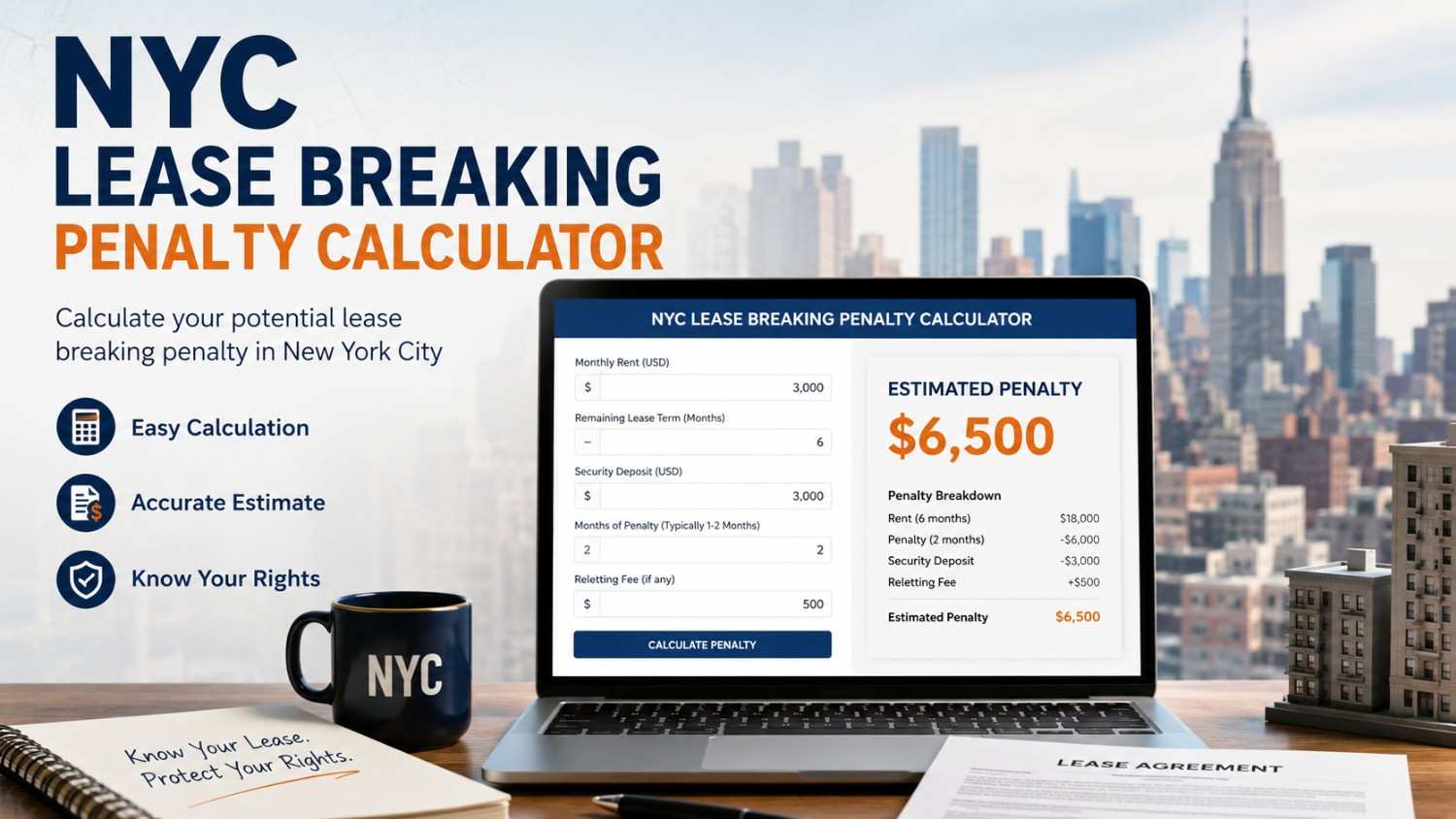
NYC Move-Out / Breaking Lease Penalty Calculator
Estimate your legal liability for breaking a lease in New York City — based on lease type, NYC mitigation laws, and valid legal exemptions.
Your Estimated Lease Breaking Liability
—What This Means For You
—
Important Legal Disclaimer
This calculator provides estimates based on New York State and NYC landlord-tenant law. It is NOT legal advice. Lease terms, specific building rules, and court interpretations can affect your actual liability. For legal advice regarding your specific situation, contact the NYC Rent Helpline at 311, Housing Court Answers at 212-962-4795, or a tenant rights attorney.
What Exactly Is the NYC Lease Breaking Penalty Calculator?
This calculator estimates how much money you might legally owe if you break your lease early in New York City. Unlike most states, where breaking a lease typically means owing a fixed penalty (like two months’ rent) regardless of what happens next, New York law imposes a “duty to mitigate” on landlords for unregulated apartments. This means your landlord cannot simply sit back and collect the full remaining lease balance — they must make reasonable efforts to re-rent the apartment, and you only owe rent for the period it actually sits vacant. This calculator applies this rule, along with the specific protections for rent-stabilized and rent-controlled tenants, to give you a realistic estimate of your financial exposure.
The calculator also accounts for legal exemptions that allow you to break a lease with zero penalty under specific circumstances. Active military members, victims of domestic violence, tenants in uninhabitable conditions, and tenants whose landlords have breached the lease all have statutory or common-law rights to terminate their lease early without liability. Many New York tenants don’t realize they qualify for these exemptions and pay thousands of dollars in penalties they didn’t legally owe. The calculator flags these exemptions immediately when you select the applicable reason.
What makes this calculator specifically necessary for New York is the city’s unique regulatory environment. The majority of NYC rental apartments are either rent-stabilized or subject to regulations that don’t exist in most of the country. A rent-stabilized tenant who breaks their lease is treated differently than a market-rate tenant — they can be sued for actual damages (vacancy loss), but they cannot be charged a punitive penalty clause, and they retain the right to future lease renewals in the building if they return. A rent-controlled tenant faces even more specific rules. And for the new “Good Cause Eviction” protections that have been expanding in NYC, the calculus changes again. Generic lease-breaking calculators from other states assume a simple “penalty equals X months’ rent” formula that is often legally unenforceable in New York.
Why Understanding Your Legal Liability Matters Before You Move Out
Breaking a lease in New York City is one of the most stressful experiences a renter can face, and the financial stakes are high. In a city where the median rent exceeds $3,500 per month, even a few months of liability can mean $7,000-$15,000 in potential costs. But the actual amount you owe is often much less than what your landlord initially demands — and in some cases, it’s zero. Understanding the law before you move out allows you to make informed decisions, negotiate effectively, and avoid being intimidated into paying more than you legally owe.
Know Your True Liability
Your landlord may demand the full remaining lease balance ($28,000 for 8 months). This calculator shows why NY law likely limits you to far less.
Check for Legal Exemptions
Military service, domestic violence, and uninhabitable conditions are automatic get-out-of-lease-free cards in NY. The calculator flags these immediately.
Challenge Unenforceable Clauses
Many NYC leases have penalty clauses that NY courts refuse to enforce. Knowing this gives you leverage in negotiations with your landlord.
Factor in Security Deposits
Your security deposit is applied to whatever you owe. The calculator shows your actual out-of-pocket cost after the deposit is credited.
The landlord’s duty to mitigate is the single most important concept for NYC market-rate tenants to understand. In many states, a lease clause saying “tenant owes 3 months’ rent upon early termination” is fully enforceable — the landlord doesn’t have to lift a finger to re-rent the apartment. In New York, the law is clear: even if you signed a lease with such a clause, the landlord must still make reasonable efforts to re-rent. If they don’t, a Housing Court judge will not enforce the penalty clause beyond the landlord’s actual damages. This doesn’t mean the clause is meaningless — it can serve as evidence of the parties’ estimate of damages — but it’s not an automatic entitlement for the landlord. The calculator uses the actual damages (vacancy period × rent) as the primary estimate and flags the lease clause as a secondary reference point.
For rent-stabilized tenants, the situation is different in a subtle but important way. Stabilized tenants cannot be charged a penalty clause at all — the only damages a landlord can recover are the actual rent lost during the vacancy period before a new tenant moves in. But there’s a catch: if you break a stabilized lease, you may lose your right to a renewal lease for that apartment. If you change your mind and want to move back, or if the landlord finds a new tenant quickly and you want to stay, your original lease rights may be extinguished. This is a non-financial cost that the calculator notes but can’t quantify.
How to Use This Calculator (Takes 20 Seconds)
Enter Lease Details
Input your monthly rent, months remaining, lease type (market rate, stabilized, or controlled), and security deposit amount.
Select Your Reason
Choose why you’re breaking the lease. If you select a legal exemption (military, DV, uninhabitable, landlord breach), the calculator will flag it.
Enter Re-Renting Status
Has the landlord found a new tenant? If yes, enter how many months the apartment was vacant. This determines your actual damages.
Calculate and Review
See your estimated liability, how your security deposit offsets it, and what the law says versus what your lease claims.
How NYC Lease Breaking Laws Actually Work
New York does not have a specific “lease breaking” statute. Instead, the rules come from a combination of common law (court decisions), the Real Property Law, the Rent Stabilization Code, and various tenant protection statutes. Here’s how the different layers of law interact.
- Market-rate apartments (unregulated): These are governed primarily by common law. When you sign a lease, you’re legally obligated to pay rent for the full term. If you break the lease, you’ve technically breached the contract. However, New York courts impose a “duty to mitigate” on the landlord — meaning the landlord must take reasonable steps to re-rent the apartment (listing it at a fair market price, showing it to prospective tenants, not unreasonably rejecting qualified applicants). You’re liable for the landlord’s actual damages: rent for the period the apartment sits vacant, plus any reasonable costs of re-renting (advertising, broker fees if the landlord uses one). You are NOT liable for the full remaining lease balance if the landlord could have re-rented but didn’t try.
- Rent-stabilized apartments: The rules are similar to market-rate for damages (actual vacancy loss only, no penalty clauses), but there are additional protections. A stabilized tenant who breaks their lease cannot be evicted through a “holdover” proceeding for the full remaining lease term — the landlord’s remedy is limited to damages (money). Additionally, the landlord must offer the vacant apartment to the next person on the waiting list (if the building has one), which may actually speed up re-renting and reduce your liability. However, breaking a stabilized lease means you give up your right to a renewal lease — if you change your mind, you can’t undo it.
- Rent-controlled apartments: Rent control is the most restrictive regime, and tenants who break rent-controlled leases face the same actual-damages standard. However, rent-controlled tenants have extraordinarily strong protections, and landlords are highly motivated to re-rent quickly because the rent for a new tenant will be significantly higher (rent control apartments reset to market rate upon vacancy in most cases). This means the landlord’s damages may be minimal because they have a strong financial incentive to fill the vacancy immediately.
- The “liquidated damages” clause issue: Many NYC leases contain a clause stating that if the tenant breaks the lease, they owe a specific amount (typically 1-3 months’ rent) as “liquidated damages.” In New York, these clauses are treated as a non-binding estimate of damages, not an automatic penalty. A court will look at the clause as evidence of what the parties expected the damages to be, but will still require the landlord to prove actual damages and mitigate. If the landlord’s actual damages are LESS than the liquidated damages amount, you only owe the actual damages. If the actual damages are MORE, the landlord can recover the higher amount (up to the actual damages). A clause that functions as a pure penalty (designed to punish rather than compensate) is unenforceable under NY law.
- Good Cause Eviction protections: Depending on the specific building type and location within NYC (and evolving regulations), some tenants may have additional protections under “Good Cause” eviction laws, which require landlords to provide a specific reason for non-renewal and may limit the penalties for early lease termination. These rules are complex and evolving, so the calculator provides general estimates and recommends consulting a legal expert for Good Cause-specific situations.
When You Can Break a Lease in NYC With Zero Penalty
There are several situations where New York law allows you to break your lease without owing any rent, penalties, or damages. If any of these apply to you, your financial liability is zero — but you still need to follow the proper procedures (like giving written notice and providing documentation) to protect yourself.
- Active military service (Servicemembers Civil Relief Act — SCRA): If you are an active-duty member of the Armed Forces and you receive orders for a permanent change of station (PCS) or a deployment lasting 90+ days, you can terminate your lease with 30 days’ written notice. Your liability ends 30 days after the next rent payment is due following your notice. You must provide a copy of your military orders to your landlord. The SCRA is a federal law that overrides any state or local lease provisions — your landlord cannot refuse, charge a penalty, or report negative credit information for an SCRA termination. This applies to all lease types (market rate, stabilized, and controlled).
- Domestic violence (NY Real Property Law § 227-c): If you or a member of your household is a victim of domestic violence and you have obtained an order of protection or a court finding of domestic violence, you can terminate your lease with 30 days’ written notice. You must provide a copy of the order of protection or court finding to your landlord. The landlord cannot charge a penalty, withhold your security deposit for this reason, or disclose the domestic violence to future landlords. This applies to all lease types.
- Uninhabitable conditions (Warranty of Habitability): Every NYC lease contains an implied warranty of habitability — the legal guarantee that the apartment is fit to live in. If the apartment has serious conditions that make it unsafe or unlivable — no heat in winter (below 68°F when it’s under 55°F outside, per NYC Housing Maintenance Code), no hot water, severe mold, pest infestations, lead paint hazards, structural damage, lack of working locks on exterior doors, or any condition that violates the NYC Housing Maintenance Code — you may be able to break your lease without penalty. The process is: document the conditions (photos, 311 complaints, HPD violations), notify the landlord in writing, give them a reasonable time to fix it (typically 30 days for non-emergency conditions, shorter for emergencies), and if they fail to fix it, you can move out and argue that the landlord’s breach of the warranty of habitability relieves you of further rent obligations. This is more complex than the SCRA or DV exemptions and may require a court proceeding if the landlord disputes it.
- Landlord breach of quiet enjoyment or lease terms: If your landlord repeatedly enters your apartment without proper notice (24 hours’ notice is required except in emergencies), fails to make repairs they’re legally obligated to make, harasses you to move out, or otherwise materially breaches the lease, you may have grounds to terminate. Like the uninhabitable conditions defense, this requires documentation and may involve a legal proceeding. It’s not as clean-cut as the SCRA or DV exemptions, but it’s a valid legal argument that NYC Housing Court judges take seriously.
- Constructive eviction: This is a legal doctrine that applies when the landlord’s actions (or failure to act) make the apartment effectively unlivable, even if the physical condition doesn’t rise to the level of a Housing Maintenance Code violation. For example, if the landlord is doing construction in the building that creates deafening noise, dust, and lack of water access for months, a court might find that you were “constructively evicted” and relieve you of rent obligations from the point you moved out. This is a fact-specific determination that requires court intervention.
How Security Deposits Work When You Break a Lease in NYC
Your security deposit is not an additional penalty — it’s a prepayment that gets applied to whatever you owe when you move out. Understanding how it interacts with your lease-breaking liability is important for calculating your true out-of-pocket cost.
- Deposit as a credit, not a bonus: If you owe $5,000 in damages for breaking your lease and your security deposit is $3,500, you owe $1,500 out of pocket — the landlord keeps the deposit and you pay the difference. If you owe $2,000 and your deposit is $3,500, the landlord must return $1,500 to you within the legally required timeframe.
- NYC’s 14-day return rule: In New York City, for leases in buildings with 6 or more units, the landlord must return your security deposit (or a detailed itemization of deductions) within 14 days of you vacating the apartment. For buildings with fewer than 6 units, the rule is “a reasonable time.” If the landlord fails to return the deposit or provide an itemization within 14 days (in applicable buildings), they may forfeit the right to deduct anything — meaning they owe you the full deposit back, regardless of what you might owe for breaking the lease. This is a powerful tool for tenants, but it requires careful timing and documentation.
- Deposit cannot be used for normal wear and tear: The landlord can deduct from your deposit for damage beyond normal wear and tear (broken windows, holes in walls, damaged appliances, excessive staining on carpets) and for unpaid rent (including lease-breaking damages). They CANNOT deduct for painting, normal carpet wear, or other routine maintenance that is the landlord’s responsibility. If the landlord makes improper deductions, you can sue in Small Claims Court (up to $10,000) to recover the deposit.
- First month / last month rent confusion: Many NYC landlords collect “first month’s rent, last month’s rent, and one month security” at lease signing. “Last month’s rent” is NOT the same as a security deposit — it’s prepayment for the final month of the lease. If you break your lease before the last month, the landlord is entitled to apply that prepayment to the rent you owe for the vacancy period. The calculator treats the security deposit separately — do NOT include “last month’s rent” in the deposit field, as it’s already been applied to rent.
What This Calculator Can’t Do — And How To Fill Those Gaps
- It’s not legal advice: This calculator provides estimates based on general principles of NY landlord-tenant law. Every situation is unique, and the specific terms of your lease, the behavior of your landlord, and the specific facts of your case can all affect your actual liability. If the stakes are high (many months of rent remaining), consult a tenant rights attorney before making any decisions.
- It can’t predict court outcomes: If your case ends up in Housing Court, a judge has broad discretion in determining damages. The calculator provides an estimate based on the most common outcomes, but a judge could award more or less depending on the evidence presented.
- It doesn’t handle subletting or assignment: In New York, you may be able to sublet your apartment (with the landlord’s consent, which cannot be unreasonably withheld for most unregulated leases) instead of breaking the lease entirely. Subletting means you remain on the lease and the subtenant pays you rent, which you use to pay the landlord. This is often a cheaper alternative to breaking the lease, but it has its own risks and complexities that the calculator doesn’t model.
- It doesn’t calculate relocation or moving costs: The calculator only estimates your liability to your landlord. It doesn’t include the cost of hiring movers, renting a new apartment, paying a new security deposit, or other move-out expenses — all of which are real costs that factor into the decision of whether to break your lease.
- Good Cause Eviction nuances: As NYC implements and expands Good Cause Eviction protections, the rules for lease breaking may change. The calculator provides general estimates and may not reflect the very latest regulatory developments for every building type.
- It assumes NYC jurisdiction: If your apartment is in Yonkers, Mount Vernon, or other New York State cities outside NYC, different rules may apply. NYC has tenant protections that go beyond state law, and this calculator is specifically calibrated for NYC apartments.
What Happens With Your Information
Nothing — your rent amount, lease details, reason for moving, and all other inputs are processed entirely in your browser. No data is sent to any server. No rent, lease, or personal housing information is stored, logged, or transmitted. No cookies, no tracking. Close the tab and it’s completely gone.
Frequently Asked Questions
In most cases, no — at least not legally. In New York, landlords of unregulated apartments have a duty to mitigate damages by making reasonable efforts to re-rent. If they refuse to try to re-rent and sue you for the full balance, a Housing Court judge will reduce the judgment to the actual damages (the rent lost during the vacancy period that could have been avoided with reasonable effort). However, if the landlord CAN prove they made reasonable efforts and the apartment simply didn’t rent — perhaps because it’s overpriced, in poor condition, or in a slow market — they may be entitled to rent for the full period it was vacant. The key is that they must TRY. If they don’t try, they can’t collect.
It depends on what the court determines. In New York, liquidated damages clauses in residential leases are treated as a non-binding estimate of the landlord’s expected damages — not as an automatic penalty. If the landlord re-rents the apartment in 1 month, a court will likely only hold you liable for 1 month’s rent, regardless of what the lease clause says. If the apartment sits vacant for 4 months through no fault of the landlord (they listed it, showed it, didn’t unreasonably reject tenants), the landlord might be awarded 4 months’ rent — MORE than the 2-month clause. The clause is essentially a starting point for negotiation or evidence, not a fixed cap or floor. Many NYC tenants don’t know this and pay the clause amount without question, even when they don’t owe it.
If the landlord re-rents at a higher rent than you were paying, they cannot charge you for the difference — in fact, the higher rent reduces their damages. For example, if you paid $3,000/month and the landlord re-rents to someone for $3,500/month, the landlord is arguably better off, and your liability for the vacancy period may be reduced or eliminated (since the landlord suffered no economic loss). However, if the landlord re-rents at a LOWER rent (e.g., $2,500/month), some courts may hold you liable for the difference between your rent and the new rent for the remaining lease term — though this is less common and depends on the specific judge and circumstances.
For unregulated (market-rate) leases, New York Real Property Law § 226-B gives you the right to sublet, and the landlord cannot unreasonably withhold consent. You must send a written request to the landlord by certified mail, return receipt requested, at least 30 days before the intended sublet date, including information about the proposed subtenant, the term of the sublet, and your reason for subletting. The landlord has 10 days to ask for additional information and 30 days total to respond. If they don’t respond within 30 days, consent is deemed given. For rent-stabilized apartments, the landlord CAN reasonably withhold consent for a sublet, but they must have a legitimate reason. Subletting is often a better financial option than breaking the lease because you remain responsible for rent (so no penalty issue) and the subtenant pays you, which you use to pay the landlord.
If you move out, stop paying rent, and don’t communicate with your landlord, the landlord will eventually file a proceeding in NYC Housing Court for rent arrears. You’ll receive a notice (a “Notice of Petition”) and have the opportunity to appear in court and argue your case — for example, that the landlord failed to mitigate, that the apartment had conditions that justified your departure, or that the damages claimed are excessive. If you don’t appear in court, the landlord gets a default judgment for whatever they’re asking for. Appearing in court and presenting your evidence (documentation that you gave notice, photos of conditions, evidence that the landlord listed the apartment) is the best way to limit your liability. Ignoring the problem does not make it go away — it makes it worse, because you lose the opportunity to present your defense.
Yes, potentially. If you break a rent-stabilized lease and vacate the apartment, the landlord can refuse to offer you a future renewal lease for that specific apartment. You don’t lose your rent-stabilized rights in general — if you move into a different stabilized apartment later, you have full rights there. But you may lose the right to return to the specific apartment you broke the lease on. If there’s any chance you might want to return (e.g., you’re temporarily relocating for a job that might bring you back to NYC), subletting is a much safer option than breaking the lease, because subletting preserves your lease rights. Once you surrender the apartment and the landlord re-rents it to someone else, your connection to that specific unit is severed.
If you’re breaking your lease early, there’s no specific statutory notice period for the break itself — but giving at least 30 days’ written notice is strongly recommended because it helps establish that you acted reasonably and gave the landlord time to mitigate. For month-to-month tenancies (which is what you become if your lease expires and you stay without signing a new one), NYC requires 30 days’ written notice. For a fixed-term lease that you’re breaking early, giving 30 days’ notice is the standard practice and the minimum that courts expect before they’ll consider your mitigation arguments favorably. Less notice can be used against you as evidence that you didn’t act reasonably, potentially increasing your liability.
If you owe money for breaking your lease and don’t pay it — and the landlord obtains a court judgment against you — that judgment can appear on your credit report and significantly damage your credit score. If you negotiate a settlement with the landlord and pay it, or if the landlord doesn’t pursue a court judgment, it’s less likely to appear on your credit report (though some landlords report to tenant screening databases regardless of whether there’s a judgment). The best way to protect your credit is to communicate with your landlord, try to negotiate a reasonable settlement based on actual damages, get any agreement in writing, and pay whatever you agree to pay. If you dispute the landlord’s claims, appearing in Housing Court to present your defense is better than ignoring the situation and letting a default judgment hit your credit.