
Finding an affordable apartment in New York City can be challenging, especially when a housing lottery attracts far more applicants than there are apartments available. If you have applied through NYC Housing Connect, you may have wondered whether your chances are 1 in 100, 1 in 1,000, or even lower.
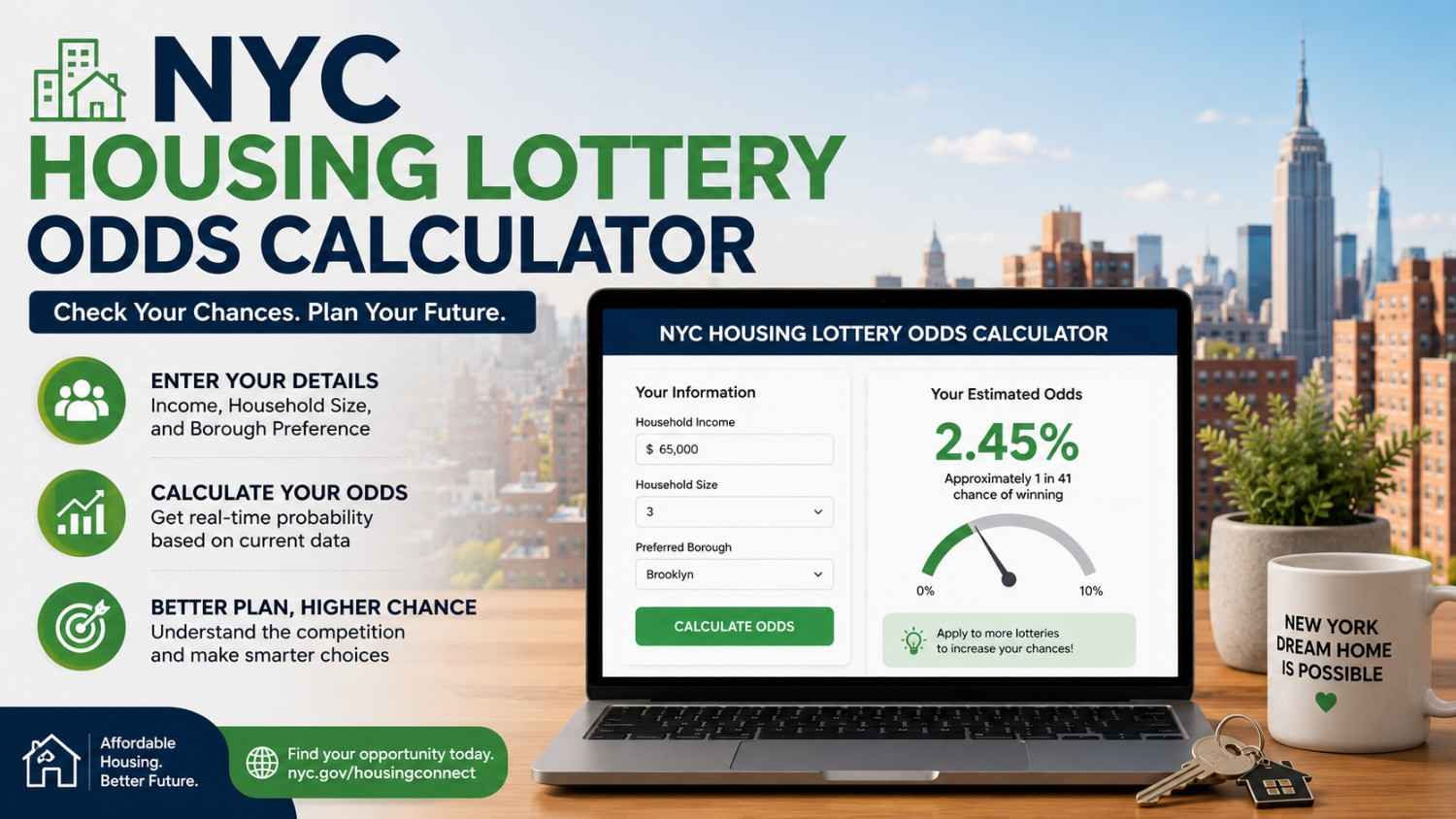
An NYC Housing Lottery Odds Calculator can help you understand the relationship between the number of available apartments and the number of applications. It can also help you compare different scenarios when the actual applicant count is unknown.
However, there is an important distinction: a simple calculation is not the same as your official probability of being selected. NYC Housing Connect lotteries involve eligibility requirements, application ordering, preferences, and apartment-specific selection rules. Without complete information about a particular lottery, no independent calculator can reliably predict your personal outcome.
Use the calculator below to explore an illustrative estimate, understand the assumptions behind it, and learn what you can do to prepare a stronger, complete application.
NYC Housing Lottery Odds Calculator
Explore apartment-to-application ratios and compare hypothetical lottery scenarios.
Enter figures for one housing lottery. Use a verified application count when available; otherwise, treat your number as a hypothetical estimate.
Your illustrative results
How the ratio changes
These scenarios hold the apartment count constant and change only the assumed number of applications.
| Assumed applications | Apartment count | Illustrative ratio |
|---|
Important: This calculator provides an illustrative estimate, not an official Housing Connect result or a guarantee of receiving an apartment.
What Are the Odds of Winning the NYC Housing Lottery?
There is no single percentage that accurately describes every NYC housing lottery. The number of available apartments, the number of applications, the eligible applicant pool, and the selection rules can differ from one development to another.
Consider a simplified example:
- Available apartments: 10
- Total applications: 1,000
- Assumption: Every application has the same chance of being selected for one of those apartments.
The basic ratio is:
10 ÷ 1,000 × 100 = 1%
That is a simple units-to-applications ratio of 1%. It is useful for understanding the scale of competition, but it should not automatically be treated as your actual chance of receiving an apartment.
Why? The 1,000 applications may not all be eligible for the same units. Some apartments may have specific income ranges, occupancy requirements, or preference categories. A marketing agent must also review whether an applicant qualifies for the apartment being offered.
For that reason, think of the ratio as a starting point for understanding competition—not a personalized prediction.
How Does the NYC Housing Lottery Odds Calculator Work?
The calculator uses the number of available apartments and an estimated or known number of applications to illustrate how competition changes.
Step 1: Enter the number of apartments
Use the number of apartments relevant to the lottery you are evaluating. Check the official listing carefully because a building may advertise multiple apartment sizes and income bands.
Do not assume every advertised unit is available to every household.
Step 2: Enter the application count
Use the actual application count only if it has been reliably published or provided for that specific lottery. Otherwise, enter a clearly labeled estimate.
Do not confuse the number of applications with the number of eligible applicants. Those figures can be different.
Step 3: Review the estimated ratio
The basic calculation is:
Illustrative competition ratio = Available apartments ÷ Applications × 100
For example, 20 apartments and 5,000 applications produce a ratio of 0.4%.
This does not mean that every applicant has precisely a 0.4% personal chance. It assumes a simplified situation in which applications are treated equally, an assumption that may not reflect the real selection process.
Step 4: Compare scenarios carefully
If the true application count is unavailable, try different hypothetical counts. For example, compare 1,000, 5,000, and 10,000 applications for the same number of apartments.
The results will show how competition changes under those assumptions. They will not reveal how many people actually applied.
Example: How Apartment Counts Affect the Competition Ratio
The table below uses hypothetical figures to demonstrate the basic calculation.
| Available apartments | Applications | Illustrative ratio |
|---|---|---|
| 5 | 1,000 | 0.50% |
| 10 | 2,000 | 0.50% |
| 20 | 5,000 | 0.40% |
| 25 | 10,000 | 0.25% |
| 50 | 10,000 | 0.50% |
| 100 | 20,000 | 0.50% |
These examples are mathematical illustrations, not reported results from actual NYC lotteries.
Notice that adding apartments does not necessarily make a lottery less competitive. If the number of applications grows at the same rate, the ratio may remain unchanged. If applications increase faster than the apartment supply, the ratio can decrease.
This is why the number of units alone cannot tell you whether a particular lottery offers better prospects.
Why Your Actual NYC Housing Lottery Chances May Be Different
1. Income and household-size eligibility
NYC affordable housing opportunities have income and household-size requirements. The applicable rules depend on the particular apartment and its published eligibility criteria.
Area Median Income, commonly called AMI, is used to establish income limits for many affordable housing programs. A household that meets one apartment’s income range may not qualify for another apartment in the same building.
The NYC Department of Housing Preservation and Development (HPD) provides official application guidance and income-eligibility resources.
Before applying, review the income range, household-size limits, rent, occupancy criteria, and any additional requirements shown in the individual listing.
Official resource: NYC Housing Connect Application Guides.
2. NYC residency and other preferences
Some Housing Connect listings provide preferences for specified applicants or groups. Depending on the development, these may include NYC residents, residents of a designated community board, municipal employees, or other eligible categories.
The applicable preferences and their percentages are not necessarily the same across all developments.
For example, an official Housing Connect listing may specify a preference for residents of a particular Brooklyn community board and a separate set-aside for applicants with disabilities. These categories can affect how applications are considered for particular apartments.
You should therefore review the individual lottery advertisement instead of applying a single preference percentage to every building.
3. Disability-related set-asides
Some developments reserve a percentage of apartments for applicants with qualifying disabilities, such as mobility or vision and hearing disabilities. The applicable categories and percentages depend on the specific listing and program rules.
A set-aside is not a general bonus that every applicant can add to their odds. It identifies apartments or selection categories governed by specific eligibility rules.
Read the listing carefully and follow its instructions if you believe you qualify for a particular category.
4. Application log numbers
After the application deadline, applications enter a lottery process that assigns log numbers and determines the order in which applications are considered.
A lower log number can mean an application is reviewed earlier. However, being reviewed earlier does not guarantee an apartment. The household must still meet the applicable eligibility and selection requirements.
A high log number may reduce the likelihood of being reached during a particular review process, but the precise outcome depends on the development and how far the review proceeds.
Do not confuse a log number with a percentage chance. They describe different things.
5. Apartment size and occupancy rules
A studio, one-bedroom, and two-bedroom apartment may have different income ranges, rents, and occupancy requirements.
In a July 9, 2025 announcement, NYC HPD explained that Housing Connect had added a feature allowing applicants to indicate preferred apartment sizes in their profiles. If a preference is selected, applicants may not be contacted for a lottery offering a different size. If the field is left blank, the system defaults to interest in all sizes.
This is a practical detail worth checking before applying: your household profile should reflect the apartment sizes you genuinely want and may qualify for.
Official update: NYC HPD’s Housing Lottery Application Update.
Does Applying Earlier Improve Your Odds?
Submitting an application earlier does not, by itself, provide a better lottery position. The important deadline is the application deadline stated in the listing.
According to the NYC Housing Connect guide, applications received by the deadline are processed through the lottery process. Online and properly submitted paper applications are treated under the applicable process; sending duplicate applications can lead to disqualification.
A practical approach is to apply well before the deadline so you have time to check your information, correct mistakes where permitted, and confirm that your submission has been completed.
Official guide: NYC Housing Connect Guidebook.
Does Applying to Multiple NYC Housing Lotteries Help?
Applying to multiple lotteries that fit your household can create more opportunities to be considered. However, the effect on your overall chances cannot be calculated accurately by simply adding the individual percentages.
For instance, suppose a simplified model assigns a 1% chance to each of three independent opportunities. Under that mathematical assumption, the combined probability of at least one success would be:
1 − (1 − 0.01)³ ≈ 2.97%
This is a hypothetical probability model, not an estimate of a real person’s Housing Connect results. Actual lottery outcomes may not be independent, the applicant may not qualify for every apartment, and selection procedures can differ between developments.
The practical takeaway is to consider multiple suitable opportunities rather than relying on one application, while ensuring that every application is accurate and submitted according to its own rules.
Important: Submit only one application per lottery unless the official instructions explicitly state otherwise. Housing Connect listings warn that duplicate applications—including submitting both online and by mail for the same lottery—may result in disqualification.
How to Improve Your Housing Lottery Application Preparation
You cannot guarantee selection, but you can reduce avoidable mistakes.
Check your eligibility before applying
Review the minimum and maximum household income, household size, rent, occupancy criteria, asset limits where applicable, and any additional requirements in the official listing.
Do not assume that eligibility for one building means eligibility for another.
Keep your Housing Connect profile current
Check household members, income information, contact details, and apartment-size preferences. Use the official instructions to update your profile when necessary.
Prepare documents in advance
Depending on the lottery, the marketing agent may request proof of identity, income, household composition, employment, assets, or other documents.
Gather the documents relevant to your circumstances and follow the specific instructions provided. Do not send sensitive documents to unofficial third-party calculators.
Apply before the deadline
Allow enough time to review your application. Follow the submission method described in the listing and retain any confirmation or reference information available to you.
Monitor your application
Keep your contact details current and check Housing Connect for updates. Respond to legitimate requests for additional documentation within the stated deadline.
Avoid duplicate applications
Check the listing’s rules before submitting anything. If you have already applied online, do not submit another application by mail for the same lottery unless the official instructions tell you to do so.
What to Do When Your Lottery Odds Are Unknown
In many cases, the exact number of applications is not readily available. That does not make a calculator useless, but it does limit what the result can tell you.
Use the following approach:
- Confirm the number of apartments advertised in the specific listing.
- Check whether those apartments match your household size and income range.
- Look for published applicant-count data, if available.
- If no verified count exists, compare several clearly labeled hypothetical scenarios.
- Review the listing’s preferences, set-asides, and additional selection criteria.
- Treat the result as a planning aid, not an official forecast.
Do not substitute the number of building units for the number of units available in your particular eligibility category. A building may have many apartments overall but only a subset relevant to your household.
Official Resources for NYC Housing Lottery Applicants
Use these resources to verify information before making an application decision.
- NYC Housing Connect: Browse housing opportunities and manage applications.
- NYC HPD Application Guides: Learn how to apply and prepare documents.
- NYC Housing Connect Information: Read the city’s official program overview.
- 2025 Unit-Size Preference Update: Review HPD’s announcement.
Official listings should take priority over third-party calculators when confirming application deadlines, eligibility, required documents, and selection rules.
Frequently Asked Questions
What are the odds of winning the NYC Housing Lottery?
There is no universal percentage. The outcome depends on the particular development, eligible applicant pool, available apartments, preferences, set-asides, and selection process. A simple calculator can illustrate competition but cannot guarantee your personal probability.
Is the NYC Housing Lottery Odds Calculator official?
No. The calculator on this website is an independent educational tool. It is not operated by NYC HPD or Housing Connect and does not access private applicant records or official lottery results.
Can I calculate my exact odds if I know the number of apartments?
Not from apartment count alone. You would also need reliable information about the relevant applicant pool and applicable selection rules. Even then, a simplified formula may not reproduce the official process.
Does a low log number guarantee an apartment?
No. A low log number may mean your application is considered earlier, but you must still satisfy the apartment’s eligibility and selection requirements. It is not a guarantee of approval.
Does applying early increase my chance of winning?
Submitting earlier does not automatically improve your lottery position. Submit a complete application before the deadline and follow the instructions for the specific development.
Should I apply to multiple lotteries?
You can consider multiple lotteries for which your household qualifies. Each application is a separate opportunity, but combined odds depend on assumptions that a simple calculator cannot fully verify. Follow the instructions for each listing and avoid duplicate applications within the same lottery.
Why do different apartments in one building have different income limits?
Affordable apartments can be assigned to different AMI bands, household sizes, rents, and program requirements. Always check the income and occupancy criteria for the exact apartment category you want.
Where can I check current NYC Housing Lottery listings?
Use the official NYC Housing Connect portal to browse opportunities, review eligibility requirements, and manage your application.
Final Thoughts
The NYC Housing Lottery can be difficult to navigate, and a clear estimate can help you understand the scale of competition. The most useful approach is to combine a transparent calculator with accurate information about eligibility, apartment availability, preferences, and application requirements.
Use the NYC Housing Lottery Odds Calculator to explore hypothetical scenarios, then confirm all important details through official Housing Connect listings. No third-party tool can guarantee selection, but careful preparation can help you avoid preventable application mistakes.
About the author: Junaidul Islam writes practical online guides and calculator-focused resources for NewYorkCalculator.com. Readers should use the linked official NYC resources to verify current housing program requirements before applying.
Information checked October 14, 2026. Housing program requirements and application features can change; verify the latest instructions on official NYC websites.