
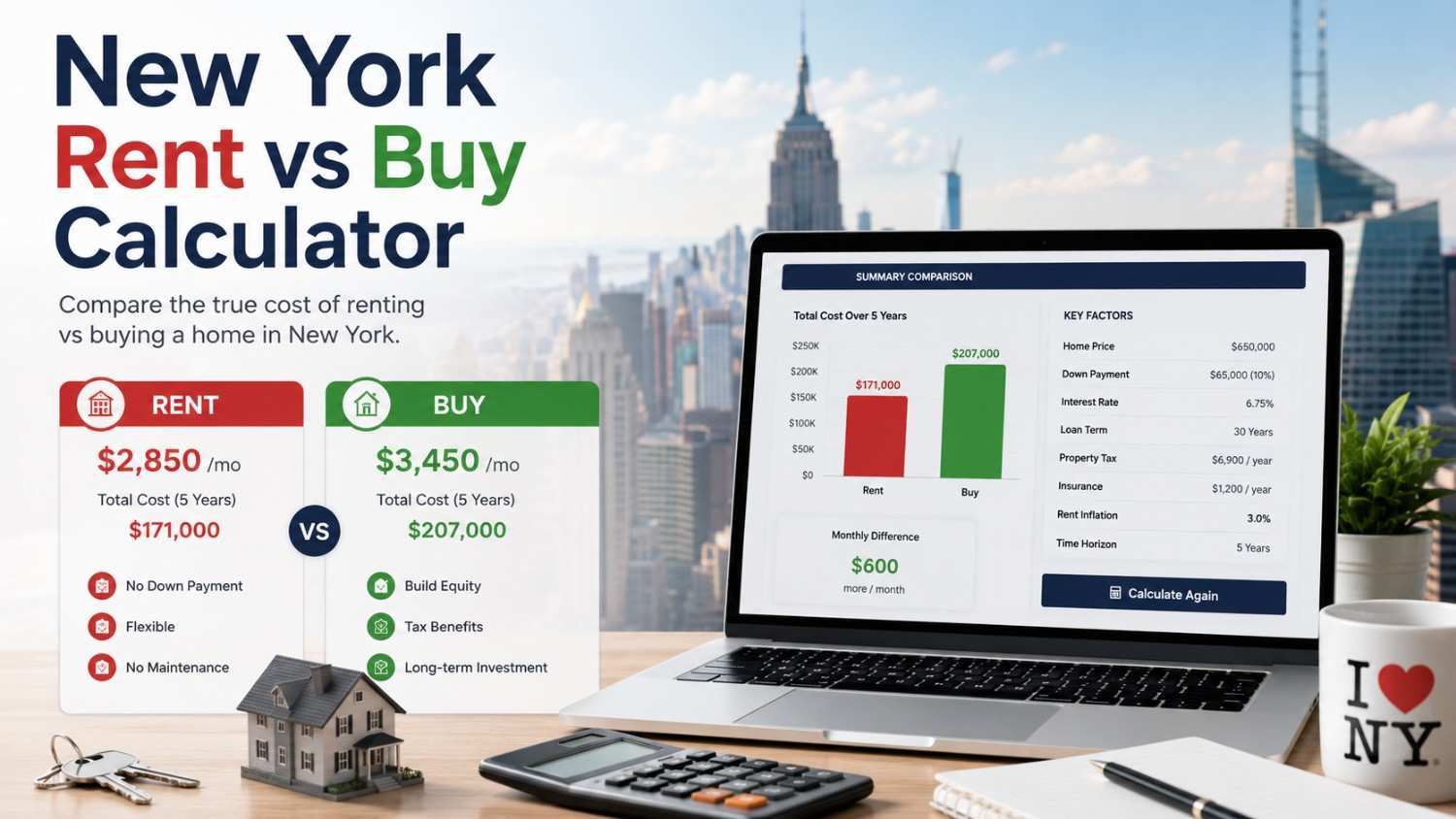
Deciding whether to rent or buy a home in New York is about much more than comparing your monthly rent with a mortgage payment. A home purchase can involve a down payment, mortgage interest, property taxes, insurance, building maintenance, closing costs, and substantial expenses when you eventually sell. Renting has its own financial considerations, including rent increases, renter’s insurance, moving expenses, and the opportunity to invest money that would otherwise go toward buying a property.
The right decision also depends on where you live. Buying a co-op in Manhattan is financially different from purchasing a condominium in Brooklyn, a single-family home in Queens, or a property in Buffalo or Albany.
Our New York Rent vs Buy Calculator helps you compare these costs using your own financial assumptions. You can estimate mortgage payments, ongoing ownership expenses, rental costs, home appreciation, investment returns, and the potential break-even point.
Instead of relying on a generic national estimate, you can adjust the numbers to reflect your property, neighborhood, expected holding period, and financial priorities.
New York Rent vs Buy Calculator
Use the calculator below to compare the estimated financial outcomes of renting and buying. Enter your expected purchase price, monthly rent, down payment, mortgage rate, property expenses, and the number of years you expect to stay.
New York Rent vs Buy Calculator
Compare the estimated financial cost of renting and buying a home in New York. Explore mortgage payments, ownership expenses, investment returns and your potential break-even year.
Your Financial Comparison
Estimated Financial Position
The comparison includes estimated net sale proceeds and investment balances. It is not a measure of monthly affordability or a guaranteed future result.
Year-by-Year Comparison
| Year | Home Value | Mortgage Balance | Net Sale Proceeds | Buyer’s Position | Renter’s Position |
|---|
Break-even is the first modeled year in which the buyer’s estimated net position equals or exceeds the renter’s. It is based on annual checkpoints.
Estimates only. The calculation does not automatically verify taxes, tax deductions, insurance quotes, market values, or investment returns. Co-op and condo rules vary by building. Confirm all figures with qualified professionals.
The calculator provides an estimate based on the information you enter. Actual results can change with mortgage terms, tax treatment, building expenses, market conditions, and future investment performance.
Is It Better to Rent or Buy in New York in 2026?
There is no single answer that applies to every New York household.
Renting may make more financial sense if you expect to move within a few years, have limited savings, or can rent a comparable property for substantially less than the total cost of owning. It can also be attractive when you want flexibility or live in a rent-stabilized apartment.
Buying may become more attractive if you plan to remain in the same property for a long time, have enough money for the down payment and closing expenses, and can comfortably manage the ongoing costs of ownership.
New York’s housing market makes this comparison particularly complicated because the state includes several very different markets.
For example:
- Manhattan and Brooklyn have significant co-op and condominium markets.
- Queens offers a mixture of apartments, co-ops, condos, and single-family houses.
- The Bronx and Staten Island have different property types and ownership costs.
- Long Island has its own local property-tax considerations.
- Buffalo, Rochester, Syracuse, and Albany generally have different purchase-price and rental relationships from New York City.
A calculator that uses one national average cannot accurately represent every one of these situations.
The best approach is to compare the cost of renting with the full financial cost of owning a comparable property in your actual location.
1. Monthly Rent vs. Total Homeownership Cost
One of the most common mistakes prospective buyers make is comparing rent with only the principal and interest portion of a mortgage.
A mortgage payment is not the complete cost of owning a home.
Depending on the property, a homeowner may also need to pay:
- Property taxes
- Homeowners or condominium insurance
- Co-op maintenance or condominium common charges
- Repairs and routine maintenance
- Mortgage insurance, when applicable
- Special assessments
- Utilities and other property-related expenses
Consider a hypothetical example.
Suppose you are currently paying $3,000 per month in rent and are considering purchasing a property. Your estimated monthly mortgage payment is $3,400.
At first glance, buying appears to cost only $400 more each month.
However, suppose you also need to pay $650 in monthly property-related charges, $150 for insurance, and $200 for maintenance.
Your estimated monthly ownership cash outflow becomes $4,400.
That is $1,400 more than your current rent.
This example is illustrative, not a statement about typical New York housing costs. Your actual figures may be very different.
It is also important to understand that the entire mortgage payment is not an economic expense. Principal payments reduce your outstanding loan balance and increase your ownership equity. Interest, taxes, insurance, maintenance, and transaction expenses are different because they generally do not become home equity.
A useful rent-versus-buy comparison must account for both cash flow and the equity you may receive when selling the property.
2. Understanding New York Home Purchase Closing Costs
New York buyers should pay particular attention to closing costs because some expenses are specific to the state or New York City.
The amount depends on the purchase price, property type, financing structure, location, and transaction terms.
New York State Real Estate Transfer Tax
New York State generally imposes a real estate transfer tax of $2 for every $500, or fractional part of $500, of consideration.
An additional mansion tax generally applies to residential property transfers with a purchase price of $1 million or more. The basic mansion tax rate is 1%, although higher-value NYC transactions can involve additional local taxes.
The New York State Department of Taxation and Finance provides the applicable rules and details.
Official resource: https://www.tax.ny.gov/bus/transfer/rptidx.htm
NYC Mortgage Recording Tax
A financed property purchase in New York City may involve a mortgage recording tax.
The amount depends on the mortgage amount, property classification, applicable state and local rates, and any available exemptions or credits.
This is an important expense because two properties with the same purchase price may have different financing-related closing costs.
For example, a co-op purchase generally has a different mortgage recording tax treatment from a conventional condo or house purchase.
Do not automatically apply the same recording-tax percentage to every property.
NYC Mansion Tax
The mansion tax is another expense buyers should consider before making an offer.
The New York State mansion tax generally starts at a residential purchase price of $1 million.
For certain NYC transactions, additional local transfer taxes may also apply at higher price levels.
A property listed just below a tax threshold may have a noticeably different transaction cost from a property priced just above it.
Buyers should calculate the complete transaction rather than looking only at the advertised purchase price.
Attorney, Title, Bank, and Building Fees
A New York real estate transaction can also involve:
- Buyer’s attorney fees
- Title insurance, where applicable
- Bank and mortgage origination charges
- Appraisal and inspection expenses
- Co-op application and processing fees
- Building move-in or administrative charges
- Working capital contributions for certain buildings
New-development purchases may involve additional sponsor-related expenses.
Ask your real estate attorney and lender for an itemized estimate before deciding how much cash you need.
3. Co-op vs. Condo vs. Single-Family Home: Why Property Type Matters
New York is unusual because buying an apartment does not always mean purchasing real property in the same way as buying a conventional house.
Buying a Co-op in NYC
When you purchase a co-op, you generally purchase shares in a cooperative corporation together with a proprietary lease giving you the right to occupy an apartment.
Co-op boards often review buyers’ financial information and may have specific requirements involving:
- Minimum down payment
- Post-closing liquidity
- Debt-to-income ratio
- Financial statements
- Board application and interview
- Restrictions on subletting
- Building-specific ownership rules
Monthly co-op maintenance commonly includes the building’s property tax allocation and may include expenses related to an underlying building mortgage.
That means you should avoid entering the same property tax expense twice when calculating co-op ownership costs.
Some co-op maintenance payments may also contain tax-deductible components, depending on the building, shareholder, and applicable tax rules.
Ask the building or your tax professional for the correct information.
Buying a Condominium
A condo owner generally owns an individual unit and shares ownership of common areas through the condominium structure.
Condo owners commonly pay:
- Monthly common charges
- Individual property taxes
- Unit insurance
- Repairs inside the apartment
- Possible special assessments
Condo purchases financed with a mortgage can also involve mortgage recording tax and title insurance expenses.
Some condos may have temporary tax abatements or other property-specific tax arrangements. Always check the current tax bill and the remaining term of any applicable benefit.
Buying a Single-Family Home
A detached or single-family house creates a different cost structure.
The owner is generally responsible for the property’s maintenance, roof, heating system, plumbing, exterior repairs, landscaping, and other expenses.
For houses outside NYC, county, town, village, and school-district taxes may all influence the total property-tax burden.
A buyer should request the actual tax information rather than relying exclusively on a percentage of the asking price.
4. NYC Property Taxes: Why Your Purchase Price Is Not Enough
Property taxes can make a significant difference when comparing renting and buying.
New York City has four property tax classes, and the applicable tax rate depends on the property’s classification.
For tax year 2026, NYC Department of Finance publishes the following rates:
| Tax class | 2026 rate |
|---|---|
| Class 1 | 19.843% |
| Class 2 | 12.439% |
| Class 3 | 11.108% |
| Class 4 | 10.848% |
These percentages apply within NYC’s property-tax assessment system. They are not direct percentages of the home’s market purchase price.
The assessed value, applicable assessment limitations, exemptions, and property classification matter.
For instance, a one-family home and a larger residential condominium building may fall under different tax classes.
Official resource: https://www.nyc.gov/site/finance/taxes/property-tax-rates.page
What About Property Tax Abatements?
Some NYC properties may qualify for tax exemptions or abatements.
A buyer should investigate:
- Whether the property currently receives a tax benefit.
- When that benefit expires.
- What the estimated tax bill will be afterward.
- Whether the benefit transfers to the new owner.
- Whether future assessment changes could affect the bill.
A low current tax bill should not automatically be treated as a permanent ownership expense.
This is particularly important when comparing a newly developed condominium with an older property.
5. Rent Stabilization Can Change the Renting Decision
New York City has rent-regulated apartments, including rent-stabilized housing.
If you live in a rent-stabilized apartment, your future rent increases may be governed by NYC Rent Guidelines Board orders rather than ordinary market conditions.
The 2026–27 guidelines adopted on June 25, 2026, set a 0% guideline increase for one-year and two-year rent-stabilized apartment leases commencing between October 1, 2026, and September 30, 2027.
This does not mean every NYC renter receives a 0% rent increase.
Market-rate apartments are not automatically covered by these guidelines. Other lawful adjustments and apartment-specific circumstances may also matter.
Official resource: https://rentguidelinesboard.cityofnewyork.us/adopted-summary-of-guidelines-2026-27/
Before leaving a rent-stabilized apartment to purchase a home, carefully compare the value of your current rental arrangement with the full ownership cost.
For some households, remaining in a regulated apartment and investing the money saved on a down payment may be a financially reasonable strategy.
6. How Mortgage Interest Rates Affect Your Rent vs. Buy Decision
Your mortgage rate can significantly change the financial outcome.
A higher interest rate generally increases monthly principal and interest payments, reducing the amount of money available for other expenses.
Consider two hypothetical buyers purchasing the same property with identical down payments and loan terms.
One buyer receives a lower mortgage rate, while the other receives a higher rate.
The second buyer may pay substantially more interest over the life of the loan, even though both purchased the same home.
Before using the calculator, consider obtaining an actual mortgage estimate.
Pay attention to:
- Fixed versus adjustable interest rates
- Loan term
- Annual percentage rate (APR)
- Points and lender fees
- Private mortgage insurance
- Prepayment provisions
- Refinancing costs
A lower advertised interest rate is not always the cheapest mortgage after fees and other financing expenses.
7. Down Payment: How Much Cash Do You Really Need?
The down payment is only one part of the cash required to buy a property.
You may also need money for:
- Closing expenses
- Mortgage-related fees
- Inspection and appraisal
- Moving expenses
- Initial repairs
- Building deposits
- Emergency savings
Co-op buildings may have their own down-payment and post-closing liquidity requirements.
Some lenders offer programs with smaller down payments, but a lower down payment may result in higher monthly payments or mortgage insurance expenses.
Do not use every dollar of your savings to purchase a home.
A financially comfortable buyer should consider keeping an emergency reserve for unexpected repairs, job changes, medical expenses, and other household needs.
8. Rent Growth vs. Home Price Appreciation
Two assumptions can have a major influence on a long-term rent-versus-buy calculation:
Annual rent growth: How quickly your rent increases over time.
Home appreciation: How much the property’s market value changes.
These assumptions should be treated as scenarios, not guaranteed future outcomes.
For example, you could compare three hypothetical situations:
| Scenario | Annual rent growth | Home price change |
|---|---|---|
| Conservative | 1% | 0% |
| Moderate | 3% | 3% |
| Higher-growth scenario | 5% | 5% |
These are example assumptions, not forecasts for New York.
Real estate prices can decline as well as increase. Rent growth can also vary by neighborhood, building, apartment type, and rental regulation.
A better decision involves testing multiple assumptions rather than choosing whichever numbers make buying look more attractive.
9. What Is the Break-Even Point When Buying a Home?
The break-even point is the estimated period when buying becomes financially competitive with renting under your chosen assumptions.
It is particularly important in NYC because buying and selling can involve substantial transaction costs.
Suppose you purchase a condominium and sell it after only three years.
Even if the property’s value increases, you may still face:
- Remaining mortgage balance
- Seller’s real estate brokerage expenses
- New York State transfer tax
- NYC transfer tax, when applicable
- Attorney expenses
- Co-op flip tax, where applicable
- Other building or transaction expenses
These expenses can reduce the money you receive from the sale.
A buyer who expects to move after a short period should examine the break-even calculation carefully.
There is no universal rule that buying becomes better after five, seven, or ten years. The actual period depends on purchase price, rent, interest rate, appreciation, ownership costs, closing expenses, and investment assumptions.
10. The Hidden Cost of Selling a New York Property
Many rent-versus-buy comparisons concentrate on purchase expenses and overlook the cost of leaving the property.
However, selling expenses are essential when estimating long-term ownership value.
Depending on the property and transaction, a seller may pay:
- Real estate broker compensation
- New York State transfer tax
- NYC transfer tax
- Attorney fees
- Mortgage payoff and discharge expenses
- Co-op flip tax
- Building transfer and administrative charges
Broker compensation is negotiable and should be entered as an assumption rather than treated as a fixed legal rate.
The seller’s final proceeds are not simply the home’s market value minus the original mortgage amount.
A more useful calculation is:
Estimated Net Sale Proceeds = Sale Price − Remaining Mortgage − Selling Expenses
This is the amount that can be compared with the renter’s investment balance.
11. Should You Rent and Invest the Down Payment Instead?
This is one of the most important questions in a proper rent-versus-buy analysis.
When you rent instead of buying, you may retain a substantial amount of money that would otherwise go toward:
- Down payment
- Buyer closing costs
- Mortgage-related expenses
- Other initial ownership costs
That money could potentially be invested.
Renting may also leave you with a monthly cash-flow advantage if rent is substantially lower than the total cost of owning a comparable property.
However, investment returns are uncertain. Stocks, bonds, savings accounts, and other investments have different levels of risk, liquidity, and tax treatment.
A fair comparison should give both households the same starting financial resources.
For example:
The renter’s strategy
Invest the cash that would have been used for the down payment and closing costs. Continue investing any monthly amount saved compared with owning.
The buyer’s strategy
Build home equity through mortgage principal payments and potential property appreciation. If the buyer’s monthly housing expenses are lower than rent, invest the monthly difference.
This comparison is more meaningful than simply comparing total rent with total mortgage payments.
The calculator uses an investment-return assumption to estimate these alternative financial outcomes. It should not be interpreted as a guaranteed investment result.
12. What Happens If You Sell Your Home Earlier Than Expected?
Life does not always follow a 10-year financial plan.
You might need to relocate because of a new job, family circumstances, retirement, or changes in your financial situation.
Selling earlier than expected can make buying less attractive because transaction costs are concentrated over a shorter ownership period.
Consider testing different holding periods in the calculator:
- 3 years
- 5 years
- 7 years
- 10 years
- 15 years
- 20 years
Compare the estimated net sale proceeds and the renter’s investment portfolio for each period.
This helps you understand how sensitive your decision is to the amount of time you actually remain in the property.
13. When Renting Makes More Sense in New York
Renting may be a reasonable financial choice when:
- You expect to relocate within a few years.
- Your comparable monthly rent is substantially lower than ownership expenses.
- You do not have enough savings for a comfortable down payment and emergency reserve.
- Your mortgage quote is significantly more expensive than expected.
- You live in a favorable rent-stabilized apartment.
- You prefer flexibility.
- You can consistently invest the money you save.
Renting is not automatically a financial mistake.
You are paying for housing and flexibility while avoiding certain ownership responsibilities.
The important question is whether the total value of renting, including the potential investment of saved cash, compares favorably with buying.
14. When Buying Makes More Sense in New York
Buying may be attractive when:
- You expect to remain in the property for a long period.
- Your income and savings support the complete cost of ownership.
- You have a reasonable mortgage offer.
- You can afford the property taxes, insurance, maintenance, and building expenses.
- You understand the building’s financial condition.
- You have considered future selling expenses.
- The purchase price makes sense relative to comparable rental properties.
Homeownership can also provide benefits that are difficult to represent in a calculator, including housing stability, control over your living space, and the ability to make certain improvements.
A financial comparison should support your decision, not replace your personal priorities.
15. Special Assessments, Building Reserves, and Co-op Financial Health
A property’s advertised monthly charges do not necessarily reveal its complete future cost.
Condo and co-op owners may face special assessments when a building needs major repairs or improvements.
Examples include:
- Roof replacement
- Elevator modernization
- Plumbing upgrades
- Facade repairs
- Heating and cooling system replacement
- Structural improvements
- Unexpected insurance-related expenses
Before purchasing, review the building’s financial statements, reserve funds, meeting minutes, planned capital projects, and recent assessment history where available.
For a co-op, also investigate the underlying building mortgage and any financial obligations that may affect monthly maintenance.
For a condo, review the association’s budget, reserve funding, insurance coverage, and outstanding litigation or major projects.
A property with lower monthly charges is not necessarily cheaper if it has significant deferred maintenance.
16. Tax Benefits of Homeownership: What Buyers Should Know
Homeownership can offer tax advantages, but they depend on individual circumstances.
Potentially relevant items include:
- Mortgage interest deductions
- State and local tax deductions
- Property tax treatment
- Eligible co-op maintenance deductions
- Capital gains exclusion when selling a qualifying primary residence
Not every homeowner receives the same benefit.
Mortgage interest and property taxes may only provide an incremental benefit when itemized deductions exceed the applicable standard deduction. Eligibility, deduction limits, income, filing status, and current tax law all matter.
The federal home-sale capital gains exclusion may allow qualifying homeowners to exclude up to $250,000 of gain, or up to $500,000 for certain married couples filing jointly, subject to ownership, use, and other requirements.
Do not assume the entire gain on a future property sale will automatically be tax-free.
Consult a qualified tax professional before including tax savings in your personal financial plan.
17. How to Use the New York Rent vs Buy Calculator
Follow these steps to get a useful estimate.
Step 1: Enter your location and property details.
Identify the New York area and property you are considering. Use a comparable property rather than comparing a small rental apartment with a much larger house.
Step 2: Enter the purchase price and down payment.
Use the actual asking price or a realistic purchase estimate. Enter the down payment as a percentage.
Step 3: Add your mortgage information.
Enter the mortgage interest rate and loan term from your lender’s estimate.
Step 4: Enter ownership expenses.
Add property taxes, maintenance or common charges, insurance, and estimated repair expenses.
For co-ops, be careful not to count property taxes separately if they are already included in maintenance.
Step 5: Enter your current monthly rent.
Use the rent for a comparable apartment or house in the same general location.
Step 6: Choose future assumptions.
Estimate annual rent growth, home appreciation, ownership expense increases, and investment returns.
Step 7: Select your holding period.
Compare several periods instead of relying on one estimate.
Step 8: Review the results.
Look at monthly cash flow, initial cash requirements, projected property value, remaining mortgage, estimated selling expenses, and the renter’s investment balance.
Change one assumption at a time to understand what actually drives the result.
18. Important Limitations of a Rent vs Buy Calculator
No calculator can predict the future housing market with certainty.
The result depends on the quality of the information entered.
Some costs may also be difficult to estimate before a purchase, including unexpected repairs, special assessments, insurance changes, and future property-tax adjustments.
A calculator may not fully represent:
- Emotional value of homeownership
- Personal preference for flexibility
- The convenience of a particular neighborhood
- Future job changes
- Family needs
- Unplanned relocation
- Investment volatility
- Every available tax exemption or deduction
The calculator should be used as a financial planning tool, not as a mortgage approval, tax calculation, legal opinion, or investment recommendation.
Frequently Asked Questions
1. Is it cheaper to rent or buy in New York in 2026?
It depends on the location, purchase price, rent, mortgage rate, property taxes, and how long you expect to stay. Renting may be less expensive in some NYC neighborhoods, while buying may be more attractive in certain Upstate markets. Compare your own numbers before deciding.
2. How long should I stay in a New York home before buying becomes worthwhile?
There is no universal break-even period. NYC closing expenses, property appreciation, mortgage interest, rent growth, and selling costs can make the required holding period different for every property.
3. Does the NYC mansion tax apply to every home purchase?
No. The New York State mansion tax generally applies to residential conveyances with consideration of $1 million or more. Additional NYC transfer taxes may apply to certain higher-value transactions.
4. Are co-ops cheaper than condos in NYC?
Some co-ops have lower purchase prices than comparable condos, but the total financial comparison depends on maintenance, building finances, down-payment requirements, taxes, financing, and resale restrictions.
5. Do NYC property taxes depend on the purchase price?
Not directly. NYC property taxes are based on the city’s assessment system, property classification, applicable tax rate, and relevant exemptions or limitations.
6. What is the difference between co-op maintenance and condo common charges?
Co-op maintenance commonly includes the shareholder’s allocated property taxes and may include an underlying building mortgage. Condo common charges generally cover shared building expenses, while unit owners typically receive separate property tax bills.
7. Can I use this calculator for Buffalo, Albany, or Rochester?
Yes. You can enter your local rent, property price, tax, insurance, and other ownership expenses. Make sure to use local figures rather than NYC-specific assumptions.
8. Should I include closing costs when comparing renting and buying?
Absolutely. Buyer closing expenses and future selling costs can have a significant effect on the financial result, especially if you expect to sell within a few years.
9. Is renting and investing the down payment a good strategy?
It can be a reasonable alternative when renting costs less than owning and the renter consistently invests the money saved. However, investment returns are uncertain and can be negative.
10. Does this calculator provide an exact financial recommendation?
No. It provides estimates based on user-entered assumptions. Actual costs depend on the property, mortgage, local taxes, transaction terms, and future financial conditions.
Final Thoughts: Make Your New York Housing Decision With Better Information
Choosing between renting and buying in New York should involve more than comparing two monthly payments.
The purchase price, mortgage interest, property taxes, maintenance, building expenses, closing costs, selling expenses, rent increases, and investment opportunities all influence the final result.
For some households, renting and investing the difference may create a stronger financial position. For others, buying a property and staying for many years may be a better fit.
The most useful decision is the one that matches your actual financial situation, location, and long-term plans.
Use the New York Rent vs Buy Calculator to test different scenarios, review the complete cost of ownership, and understand how your decision could affect your finances over time.
Author: Junaidul Islam
Last Updated: October 11, 2026
This article is provided for general educational purposes. Calculator results are estimates and are not financial, tax, mortgage, investment, or legal advice. Verify property-specific costs and current regulations with qualified professionals and official sources before making a real estate decision.