
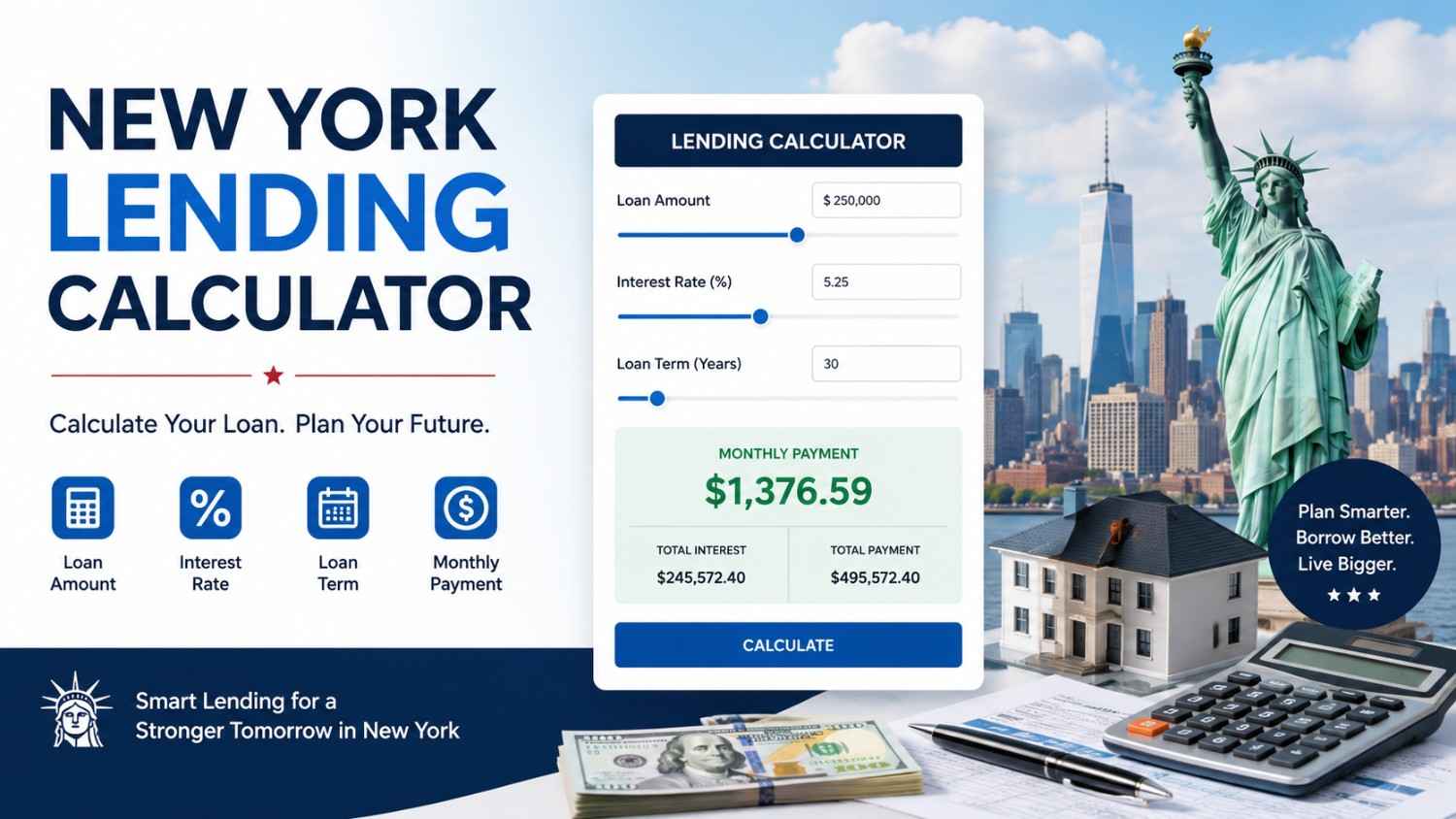
Planning to borrow money in New York? Before accepting a loan offer, it helps to understand more than the advertised interest rate. Your monthly payment, total interest, upfront fees, repayment period, and ability to manage the payment alongside everyday expenses can all affect the real cost of borrowing.
The New York Lending Calculator below is designed to help you estimate fixed-rate loan payments, compare repayment scenarios, and understand how fees and additional payments may change your borrowing costs. You can use it to explore personal loan scenarios and other fixed-payment borrowing examples before reviewing an actual lender’s offer.
Your result is an estimate, not a loan approval, a personalized offer, or a guarantee of the rate a lender will provide.
New York Lending Calculator
Estimate your monthly loan payment, interest, fees and payoff schedule.
Your Estimated Loan Results
Monthly Amortization Schedule
Each row estimates how your payment is divided between interest and principal. Scroll horizontally on smaller screens.
| Month | Payment | Interest | Principal | Remaining balance |
|---|---|---|---|---|
| Calculate a loan to display your schedule. | ||||
Educational estimate only, not a loan offer or approval. Assumes a fixed rate, monthly payments, an origination fee deducted from proceeds, and additional payments applied to principal. Actual APR, fees, payment dates, rounding, and payoff terms may differ. Verify all terms with your lender.
What Is a New York Lending Calculator?
A New York Lending Calculator is an online financial planning tool that estimates how much you may need to repay when borrowing money. By entering a loan amount, annual interest rate, repayment term, and applicable fees, you can estimate your monthly payment and the total cost of a loan.
For example, someone considering a $15,000 personal loan can use the calculator to compare a three-year repayment period with a five-year period. The longer term may reduce the required monthly payment, but it can increase the total interest paid.
This distinction matters when comparing offers. A payment that looks affordable today may cost more over the life of the loan.
The calculator is intended for planning and comparison. Actual terms depend on the lender, loan type, creditworthiness, underwriting criteria, applicable laws, and the disclosures in your loan agreement.
How to Use the New York Lending Calculator
Follow these steps to explore a borrowing scenario:
- Enter the loan amount. Use the amount you intend to borrow, not necessarily the amount you want to receive after fees.
- Enter the annual interest rate. Use the rate quoted in your lender’s offer, if available. If you are exploring options, try several clearly labeled hypothetical rates.
- Choose the loan term. Enter the repayment period in years or months, as supported by the calculator.
- Include applicable fees. Enter an origination fee or other eligible upfront charge when the calculator supports it. Check whether the fee is deducted from the proceeds or added to the amount financed.
- Review the estimated monthly payment. Consider whether it fits your actual budget after housing, utilities, transportation, insurance, food, and existing debt payments.
- Compare different scenarios. Change the interest rate or term and review the difference in monthly payments and total interest.
- Check the assumptions. Confirm that the calculator’s fixed-rate and fee assumptions resemble the terms you are evaluating.
For the most useful comparison, use the same loan amount and the same assumptions for each scenario. Otherwise, the results may not be directly comparable.
How Much Will a Loan Cost in New York?
The cost depends on the principal, interest rate, repayment period, fees, and loan structure. The following example illustrates a standard fixed-rate installment loan.
Suppose you borrow $15,000 at a hypothetical 10% annual interest rate and repay it through 36 equal monthly payments. Assume there are no fees, no additional payments, and no changes to the rate.
Under a standard monthly amortization calculation, the estimated payment is approximately $484.01 per month.
| Loan detail | Illustrative estimate |
|---|---|
| Amount borrowed | $15,000 |
| Annual interest rate | 10% |
| Repayment term | 36 months |
| Monthly payment | About $484.01 |
| Total of payments | About $17,424 |
| Total interest | About $2,424 |
| Fees | $0 assumed |
These are illustrative figures, not a current market-rate quote. Actual payment amounts may differ because of rounding, lender-specific calculations, payment dates, fees, and contract terms.
Why does the repayment term matter?
Consider the same $15,000 loan at the same hypothetical 10% annual rate.
A shorter term generally means a higher monthly payment but less time for interest to accumulate. A longer term generally means a lower monthly payment but potentially a higher total borrowing cost.
That is why you should review both the monthly payment and the total amount repaid. Neither number tells the complete story by itself.
Interest Rate vs. APR: What Borrowers Should Know
The interest rate is the rate used to calculate interest on the outstanding loan balance. Annual percentage rate, or APR, is a broader borrowing-cost measure that can incorporate certain fees and charges under applicable disclosure rules.
An offer with a lower stated interest rate is not necessarily the less expensive option. For example, a loan with substantial upfront fees may have a higher APR than another loan with a slightly higher interest rate and fewer fees.
When comparing offers:
- Review the interest rate and APR separately.
- Check the origination fee and any other mandatory charges.
- Confirm whether the advertised rate is fixed or variable.
- Review the payment amount and total of payments.
- Read the lender’s required disclosures before signing.
For personal installment loans, the Consumer Financial Protection Bureau explains that fees can include origination, documentation, and late fees, among other charges. Some insurance products may be optional. Review the actual loan disclosure to determine which costs apply to your offer.
Official resource: https://www.consumerfinance.gov/ask-cfpb/do-personal-installment-loans-have-fees-en-2120/
A calculator can estimate costs using the information you provide, but it should not be treated as a substitute for the lender’s formal APR disclosure.
How Loan Fees Affect the Money You Receive
Fees can change the economics of a loan in more than one way.
Imagine a lender approves a $10,000 loan and deducts a hypothetical 3% origination fee from the proceeds. If the fee is calculated on the full principal, the fee would be $300 and you would receive $9,700 before any other deductions.
However, you might still owe payments based on the full $10,000 principal if that is how the loan agreement is structured.
This is an important distinction: the amount you receive can be lower than the amount you must repay.
Before accepting an offer, ask:
- Is the origination fee deducted from the proceeds or added to the loan balance?
- Are any fees financed?
- Are there charges for late payments?
- Does the agreement include optional products?
- Is there a prepayment penalty or another early-payoff condition?
- Will the lender provide a complete written disclosure of costs?
The correct calculation depends on how the fees are charged. Do not assume every fee should simply be added to the principal.
Compare Two Loan Offers Before You Borrow
Suppose two lenders offer the same principal and repayment term but different interest rates or fees. Comparing only the monthly payments can conceal meaningful differences.
A useful comparison should include:
Monthly payment: How much must you pay on schedule?
Total interest: How much interest is expected over the repayment period?
Upfront fees: How much money will you pay or lose from the proceeds before receiving the funds?
Total repayment: What is the expected total of scheduled payments, including any financed charges reflected in the payment calculation?
Net proceeds: How much money will actually reach your bank account?
Flexibility: Does the agreement allow extra principal payments, and are there restrictions or penalties?
If two offers are close in monthly payment, the fee structure and total repayment may help you understand which one better fits your needs. Compare the same loan amount, term, and fee assumptions wherever possible.
Can Extra Monthly Payments Reduce Loan Interest?
Making additional payments toward principal can reduce the outstanding balance more quickly. On a typical amortizing fixed-rate loan, a lower balance means less interest accrues in future periods.
For example, if your scheduled payment is $400 and you voluntarily pay an additional $50 toward principal each month, the extra amount may help you repay the loan earlier.
The exact savings depend on the remaining balance, interest rate, payment timing, and the lender’s rules for applying additional payments.
Before making extra payments, confirm that:
- The lender applies the additional amount to principal.
- The contract permits the payment without a penalty.
- You will not incur a fee for changing your payment schedule.
- You still have enough savings for emergencies and essential expenses.
A loan calculator can model an extra-payment scenario, but the estimate may differ from the lender’s payoff quote.
How to Estimate Whether a Loan Fits Your Budget
A monthly payment can be mathematically affordable while still making your budget uncomfortable. Your decision should account for all regular expenses, not just the loan itself.
Start with your monthly take-home income. Subtract essential living expenses, existing debt payments, insurance, transportation, utilities, and regular savings contributions. Then consider the proposed loan payment.
For a simple planning example, if your take-home income is $4,500 per month and your essential expenses and existing obligations total $3,700, you have $800 remaining before accounting for irregular expenses and additional savings needs.
A proposed $500 payment would leave $300 under those assumptions. That may or may not be comfortable depending on your circumstances.
This is a personal budgeting illustration, not a lending eligibility rule. Lenders may use different income, credit, debt-to-income, collateral, and underwriting criteria.
For mortgage borrowers, housing costs deserve special attention because property taxes, homeowners insurance, mortgage insurance, maintenance, and other costs may sit outside a simple principal-and-interest payment.
New York Lending Rules and Consumer Protection
Borrowers in New York should consider state-specific consumer protections when researching loans. Not every lending product is governed by the same rules, and the details can depend on the lender and type of credit.
Payday loans are illegal in New York
The New York State Department of Financial Services states that payday lending is illegal in New York State, including lending offered in person, by telephone, or over the internet. The state also warns that collecting on an illegal payday loan can violate New York law.
Be cautious if a website offers a short-term payday loan to a New York resident, promises guaranteed approval, or demands payment in advance.
Official guidance: https://www.dfs.ny.gov/consumers/banking_money/avoiding_predatory_loans_and_loan_scams
Check whether a lender is properly authorized
The New York State Department of Financial Services publishes information about licensed lenders and applicable licensing requirements. The precise requirements depend on the activity, loan amount, lender type, and legal exemptions that may apply.
You can begin your research through the official DFS licensed-lender resource:
Do not assume that every lender is subject to the same state licensing requirement. Banks, credit unions, nonbank lenders, brokers, and other providers may operate under different legal frameworks.
Avoid advance-fee loan scams
The New York Attorney General warns consumers about offers that promise a loan in exchange for an advance fee. Be suspicious of claims that approval is guaranteed regardless of your credit history, and do not send money simply to secure a promised loan.
Before sharing sensitive financial information, independently verify the company, review the loan agreement, and make sure you understand all charges.
Official resource: https://ag.ny.gov/resources/individuals/credit-debt-lending/loans-mortgages
These links are provided for general consumer education. They are not a legal opinion about a particular loan. Rules can change, and a borrower’s rights depend on the facts and applicable law.
What Types of Loans Can You Evaluate?
The calculator is most useful when its assumptions match the loan you are considering.
Personal loans
Personal loans are often repaid through scheduled installments. A fixed-rate payment calculator can help estimate monthly payments and total interest when the principal, rate, and term are known.
Auto loans
Auto loans may include a down payment, trade-in value, taxes, dealer fees, and other charges. A basic loan calculator may not include all vehicle purchase costs, so account for them separately when necessary.
Student loans
Student loans can have different repayment options, grace periods, subsidies, and federal or private loan terms. A standard fixed-payment calculator does not necessarily reproduce an income-driven or other specialized repayment plan.
Business loans
Business financing can include fixed installments, variable rates, balloon payments, or other structures. Use a standard amortization calculator only when its assumptions reasonably match the contract.
Mortgages
Mortgage payments may include principal and interest as well as property taxes, homeowners insurance, mortgage insurance, and other expenses. A personal-loan calculator alone should not be treated as a complete mortgage affordability calculator.
For every loan type, the actual agreement takes precedence over an illustrative online estimate.
How a Fixed-Rate Loan Payment Is Calculated
For a conventional fixed-rate loan with equal monthly payments, the scheduled payment can be calculated using the standard amortization formula:
Monthly payment = P × r ÷ [1 − (1 + r)⁻ⁿ]
Where:
- P is the amount financed.
- r is the monthly interest rate, usually the annual nominal rate divided by 12 for this calculation.
- n is the number of monthly payments.
If the annual rate is 10%, the monthly rate used in this standard example is 0.10 ÷ 12. A 36-month term means there are 36 scheduled payments.
This formula assumes a fixed rate, regular monthly periods, and a fully amortizing loan with no additional fees included in the financed principal. Real contracts may use different conventions or payment timing.
Total scheduled payments are generally the monthly payment multiplied by the number of payments. Estimated interest for a simple fixed-payment example is the total scheduled payments minus the principal financed, subject to rounding and any charges included in the loan balance.
Limitations of an Online Lending Calculator
A calculator is useful for comparing scenarios, but it cannot predict every detail of a real loan.
Results may not include:
- Lender-specific underwriting or approval criteria.
- Taxes, insurance, collateral costs, or other expenses unless entered separately.
- Variable-rate changes.
- Irregular payment dates or daily-interest calculations.
- Balloon payments or specialized repayment arrangements.
- All legal, closing, servicing, or third-party fees.
- The exact APR required in a lender’s formal disclosure.
The tool should be used for estimates and educational planning. Always compare the output with the loan estimate, Truth in Lending disclosure, repayment schedule, or other applicable documents provided by the lender.
Frequently Asked Questions
Is a New York Lending Calculator free to use?
A calculator on this website can be offered free of charge. Review the page’s privacy policy and terms to understand how the website handles information. Do not enter Social Security numbers, bank passwords, or other sensitive identifiers into an ordinary calculator.
Does the calculator tell me whether a lender will approve me?
No. It estimates payments using the values entered. Approval depends on the lender’s underwriting process, income and credit information, loan purpose, and other relevant factors.
What interest rate should I enter?
Enter the rate shown in a real offer if you have one. If you are planning ahead, test hypothetical rates to understand how the payment changes. Do not interpret an example rate as a current market quote or a guaranteed offer.
Is APR the same as the interest rate?
No. The interest rate is used to calculate interest, while APR is a broader measure of borrowing cost that can include certain fees under applicable rules. Compare both figures and review the lender’s disclosures.
Can I use this calculator for a mortgage?
You can estimate a standard fixed-rate loan payment if the calculator’s assumptions match your mortgage. However, a complete mortgage estimate may need property taxes, homeowners insurance, mortgage insurance, closing costs, and other housing expenses.
Are payday loans legal in New York?
The New York State Department of Financial Services states that payday lending is illegal in New York State. Review the official guidance before considering a short-term loan advertised to New York residents.
Will making extra payments save interest?
Extra principal payments can reduce interest on many amortizing loans because the outstanding balance falls sooner. Savings depend on the contract, timing, and how the lender applies extra payments. Check for applicable fees or restrictions first.
Why is my lender’s payment different from the calculator result?
The lender may use different rounding, payment dates, fees, interest conventions, financed charges, or loan terms. Compare the assumptions carefully and rely on the formal loan documents for the contractual payment.
What should I check before accepting a loan?
Review the APR, interest rate, total repayment, upfront fees, late fees, prepayment terms, variable-rate conditions, and the lender’s authorization where applicable. Make sure the payment fits your budget and that you have read the full agreement.
Final Thoughts
A loan should be evaluated by its full cost, not just the advertised monthly payment or interest rate. A New York Lending Calculator can help you estimate repayments, explore different terms, understand fees, and prepare better questions before speaking with a lender.
Use the calculator to compare realistic scenarios, verify the details against official loan disclosures, and consult New York’s consumer protection resources when necessary. A careful comparison can help you make a more informed borrowing decision without assuming that an online estimate guarantees approval or the final terms of a loan.
Author: Junaidul Islam
Editorial note: This article provides general educational information and illustrative calculations, not individualized financial, legal, tax, or lending advice. Verify current requirements and actual loan terms with the appropriate official source or qualified professional.