
By Junaidul Islam If your New York electricity bill seems higher than expected, the first question is usually simple: how much electricity did I use, and what am I actually paying for it?
Your total bill depends on more than the number of kilowatt-hours you consume. The electricity supply rate, delivery charges, fixed fees, adjustments, and applicable taxes or credits can all affect the final amount. Your utility, rate plan, home equipment, and seasonal habits also matter.
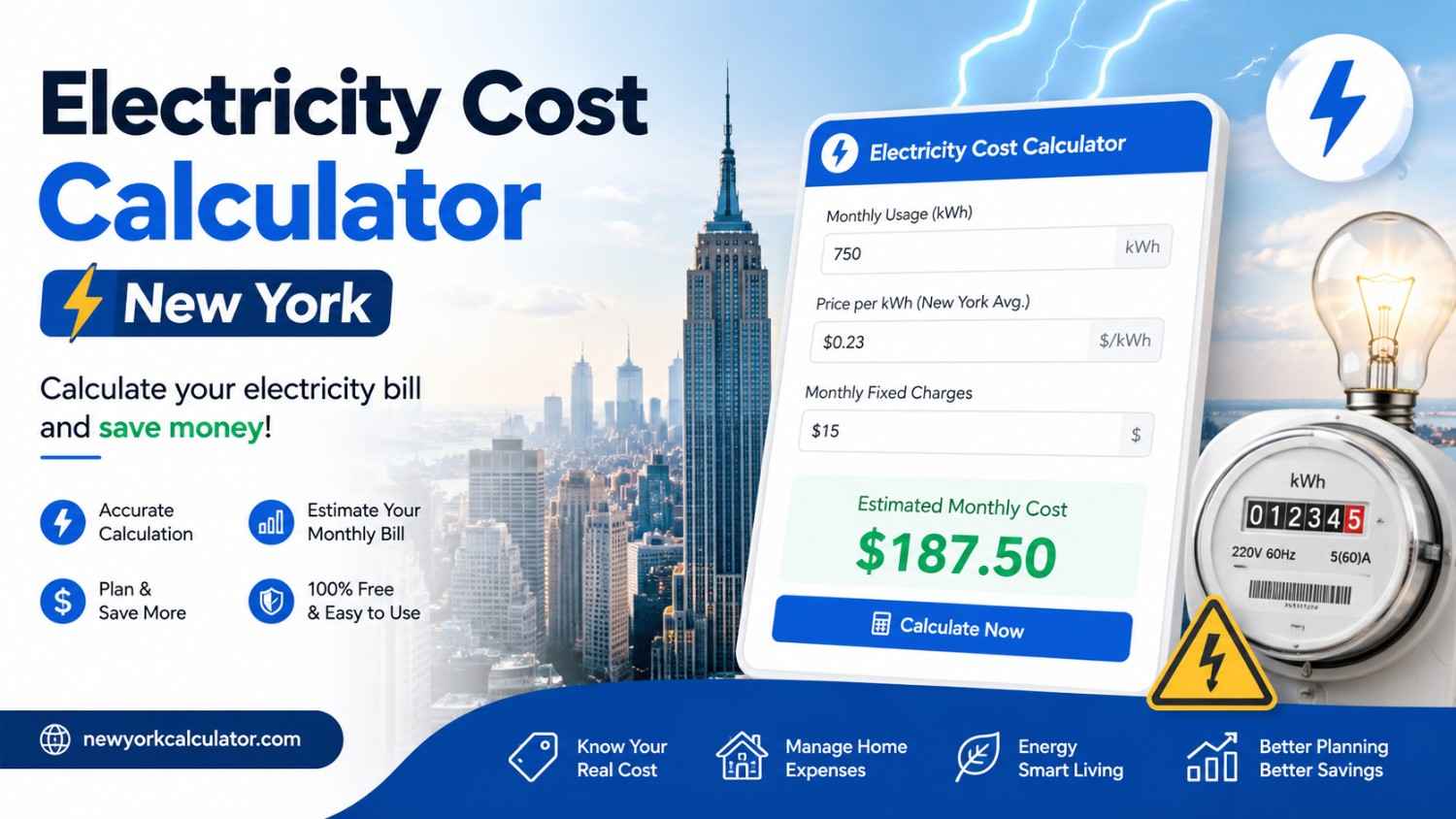
The Electricity Cost Calculator New York below helps you estimate household electricity costs, calculate the running cost of individual appliances, compare different usage levels, and understand how a change in electricity consumption could affect your budget.
You can enter the figures from your own bill instead of relying on a statewide average. That distinction is important because an average price is useful for planning, but it is not necessarily the rate your utility charges you today.
New York Electricity Cost Calculator
Estimate your household bill, appliance energy costs, and potential savings.
Estimate your monthly electricity bill
Find this number on your utility bill.
Default benchmark: $0.299/kWh, New York residential average for July 2026. Your rate may differ.
Enter only charges not included in your selected rate.
Optional planning assumption, not an official statewide tax rate.
Estimated monthly total
Calculate appliance electricity costs
Enter each device’s power rating and typical use. Add several appliances to estimate their combined monthly energy cost.
Combined monthly appliance energy cost
Appliance estimates assume constant rated power during entered operating hours. Devices that cycle on and off may use less electricity.
Compare electricity usage and potential savings
Estimated monthly energy-cost reduction
Positive savings require lower usage. If usage increases, the result will show an added cost instead.
Estimates are for planning only, not a utility quote. The default rate is a statewide benchmark, not a live utility tariff. The calculator does not fetch live rates or reproduce every utility’s billing rules. Check your actual bill and current utility tariff before making financial decisions. Official data: EIA and NYSERDA.
Use the calculator to estimate a monthly electricity bill or work out how much a particular appliance costs to operate. For the closest estimate, use your recent bill and avoid entering a charge twice.
How Much Does Electricity Cost in New York?
Electricity prices change over time, so the month and source behind a quoted rate matter.
The U.S. Energy Information Administration (EIA) reported an average residential electricity price of 29.90 cents per kilowatt-hour in New York for July 2026, compared with 26.22 cents in July 2025. These are statewide averages, not guaranteed rates for individual customers.
Source: EIA — Average Price of Electricity by State.
This figure is useful as a starting point, but it needs careful interpretation. NYSERDA explains that its statewide average residential price represents the total electricity bill divided by the electricity used. The calculation can therefore reflect fixed costs, variable charges, taxes, surcharges, late fees, and bill credits—not just the supply rate per kWh.
Source: NYSERDA — Monthly Average Retail Price of Electricity, Residential.
For example, multiplying 600 kWh by $0.299 gives an estimated energy cost of $179.40. That is a useful calculation, but it should not automatically be treated as the exact amount due on a utility bill. Whether the result resembles your actual bill depends on what the selected rate already includes.
Practical tip: If you have a recent bill, start with the usage shown on it and inspect the supply and delivery sections. A rate calculated from your own bill may be more useful for your household than a statewide benchmark.
How to Calculate Your Electricity Cost
Electricity consumption is measured in kilowatt-hours, usually written as kWh. One kilowatt-hour represents using one kilowatt of power for one hour.
For an appliance with a known wattage, the basic calculation is:
Energy used (kWh) = Watts ÷ 1,000 × Hours of use
To estimate the energy charge:
Energy cost = Energy used (kWh) × Electricity rate ($/kWh)
For an entire household, use the total monthly kWh from your meter or utility bill. Then apply the appropriate rate and account for any additional charges that are not already included.
Example: A household using 600 kWh per month
Suppose a household uses 600 kWh during a billing period and uses an illustrative electricity price of $0.299 per kWh.
| Calculation | Amount |
|---|---|
| Monthly consumption | 600 kWh |
| Illustrative rate | $0.299/kWh |
| Usage-based cost | $179.40 |
| Annualized usage-based cost | $2,152.80 |
These figures are calculations, not a claim that every New York household using 600 kWh will receive a $179.40 bill. The annual figure simply multiplies the monthly estimate by 12 and assumes the same consumption and rate throughout the year.
Your actual monthly usage and total bill may vary.
Why Your New York Electricity Bill Has More Than One Charge
One of the most useful things you can do before estimating your bill is learn how to read the charges on it.
1. Electricity supply charges
Supply charges cover the electricity itself. Depending on your arrangement, your utility may supply the electricity, or you may have a separate energy supplier.
Supply pricing can vary by plan and billing period. If you have a variable-rate arrangement, the amount you pay per kWh may change.
2. Electricity delivery charges
Delivery charges pay for delivering electricity to your home through the electric distribution system. They can cover infrastructure, maintenance, metering, and related utility services.
For example, NYSEG explains the difference between supply and delivery on its Understanding Your Bill page.
Delivery charges do not necessarily disappear when you choose a different electricity supplier. Review your utility's current tariff and bill details before assuming that a supplier change will reduce the entire bill.
3. Fixed monthly charges
Some bills include customer or service charges that do not vary directly with the number of kWh consumed. This is one reason that cutting electricity usage does not always reduce the total bill in direct proportion to the reduction in consumption.
4. Taxes, surcharges, adjustments, and credits
Other items can affect the final amount due. Their applicability and calculation depend on your account, utility, location, and billing arrangements.
Do not apply a generic tax percentage as though it were an official rate for every New York customer. If you need a closer estimate, check the actual line items on your bill and the rules that apply to your service address.
Avoid double counting: If the rate you enter already represents your total bill divided by your kWh usage, adding all supply and delivery charges again can overestimate the cost.
How Much Does It Cost to Run an Appliance?
An appliance's running cost depends on its power consumption, operating time, and electricity rate. The wattage printed on a label is useful, but it does not always tell you how much electricity a device consumes during an entire day.
Consider a 1,500-watt space heater operated for four hours a day over 30 days.
- Convert watts to kilowatts: 1,500 ÷ 1,000 = 1.5 kW.
- Calculate daily energy: 1.5 × 4 = 6 kWh.
- Calculate monthly energy: 6 × 30 = 180 kWh.
- At an illustrative rate of $0.299/kWh, the energy cost is 180 × $0.299 = $53.82 per month.
This assumes the heater draws its full rated power for all four hours. A thermostat-controlled heater may cycle on and off, so actual consumption can be lower.
Common appliances worth checking
| Appliance | What affects its electricity cost? |
|---|---|
| Window or central air conditioner | Cooling demand, unit efficiency, thermostat setting, and operating hours |
| Electric space heater | Wattage, room conditions, and daily operating time |
| Refrigerator or freezer | Energy efficiency, age, temperature settings, and how often the door is opened |
| Clothes dryer | Number of loads, cycle length, and dryer type |
| Dishwasher | Cycle selection, heated drying, and frequency of use |
| Gaming computer or workstation | Actual power draw, workload, monitor use, and hours operated |
| Electric water heater | Water temperature, hot-water demand, and equipment efficiency |
| Electric vehicle charger | Charging energy, charging frequency, and the applicable electricity rate |
These examples are starting points, not universal appliance-cost figures. If you want a realistic estimate, use measured energy consumption when available. A device's maximum rated wattage can overstate or understate its typical consumption.
Estimate the Cost of Multiple Appliances
Household electricity use is the sum of many small and large loads. Instead of guessing which device is responsible for a high bill, calculate each appliance separately and add the results.
For every appliance, record:
- Its power rating or measured energy consumption.
- Average hours of use per day.
- Number of days used during the month.
- Your selected electricity rate.
Then add the estimated kWh from all appliances. Compare that total with the consumption shown on your electricity bill.
The two figures may not match exactly. Some equipment cycles automatically, and your household also uses electricity for devices that are easy to overlook, such as lighting, routers, standby electronics, ventilation, pumps, and other permanently connected equipment.
For appliances that report energy directly in kWh, use the measured kWh rather than estimating consumption from watts and hours. This is especially helpful for equipment whose power draw changes throughout a cycle.
Why Electricity Costs Differ Across New York
New York is not one uniform electricity-pricing area. The utility serving your property, the applicable rate schedule, and your supply arrangement can affect the bill.
A household in New York City may have a different bill structure from a household served by a utility elsewhere in the state. Even two homes with similar monthly consumption can pay different amounts because their rates and charges are not identical.
When comparing electricity costs, check these details:
- Your utility: Confirm which company delivers electricity to your address.
- Your supply arrangement: Determine whether you use the utility's supply service or a separate energy supplier.
- Your rate plan: Check whether your price is fixed, variable, or subject to time-based pricing.
- Your billing period: Compare the same number of days whenever possible.
- Your actual consumption: Use kWh, not just the total dollar amount.
- Your additional charges: Check fixed fees, adjustments, taxes, and credits.
If you are comparing supplier offers, read the complete contract, including introductory pricing, variable-rate terms, cancellation fees, and other conditions. A low advertised supply rate does not necessarily mean the lowest total household bill.
Why Your Electricity Bill Changes Between Summer and Winter
Seasonal changes can make electricity budgeting difficult. The reason is not simply that one season always costs more than another; it depends on how your home is heated, cooled, and occupied.
During warm weather, air conditioning and dehumidification can increase electricity use. During colder months, electric resistance heating, electric water heating, and longer periods indoors may increase consumption.
However, a home heated primarily with natural gas or another fuel may have a different electricity pattern from a home that relies on electric heating.
A useful way to plan is to compare your actual bills from similar seasons. Look at both the kWh consumed and the total amount charged. If the dollar amount rises but usage remains similar, the difference may relate to pricing or other bill components rather than electricity consumption alone.
For a future estimate, create separate scenarios for summer, winter, and a typical month. Use your own historical consumption wherever possible instead of assuming that every month will be identical.
How to Estimate Next Month's Electricity Bill
If you do not yet have a complete billing period, use a simple forecast.
Estimated bill = Estimated kWh × Selected rate + Other applicable charges
For example, suppose your home normally uses 550 kWh per month. If you expect an additional 100 kWh because of increased air-conditioning use, your projected usage becomes 650 kWh.
At an illustrative rate of $0.299/kWh, the usage-based component would increase from $164.45 to $194.35—a difference of $29.90 before considering other charges.
This example shows the financial effect of additional usage under a fixed-rate assumption. It does not predict the weather, your actual appliance consumption, or changes in your utility's prices.
For better planning, prepare a low-use scenario, a typical-use scenario, and a high-use scenario. This gives you a reasonable range rather than one number that may be misleadingly precise.
How to Lower Your Electricity Costs Without Guessing
The best first step is to identify where your electricity is going. A few practical checks can help you make informed decisions.
Review high-use equipment. Air conditioning, electric heating, water heating, and clothes drying can account for substantial consumption in some homes. Measure or estimate their energy use before deciding where to focus.
Check thermostat settings. Avoid heating or cooling an empty home unnecessarily, while keeping indoor conditions safe and comfortable.
Use efficient settings and equipment. Energy-saving modes, appropriate temperature settings, and efficient appliances can reduce consumption depending on the device and how it is used.
Reduce avoidable operating time. If a device can safely perform its function for fewer hours, calculate the difference before and after changing the schedule.
Check your bill's rate and charges. A higher bill is not always caused by wasteful electricity use. Review usage, supply pricing, delivery charges, and other line items separately.
Explore available assistance. Eligible New York households may qualify for energy assistance or efficiency programs. Check the official NYSERDA website and relevant state or local programs for current eligibility requirements.
Calculate potential savings before changing your habits
Suppose you reduce an appliance's consumption by 60 kWh each month. At an illustrative rate of $0.299/kWh, the usage-based saving would be $17.94 per month, or $215.28 over 12 months if the reduction continued.
This calculation does not mean your entire bill will fall by the same percentage. Fixed charges may remain, and the actual saving depends on the rate and charges that apply to the reduced usage.
How Accurate Is an Electricity Cost Calculator?
An electricity cost calculator is only as accurate as its inputs and assumptions.
A calculator using your actual monthly kWh and an appropriate all-in cost per kWh can provide a useful estimate of the bill total for that period. However, it may be less accurate when your supply price changes, your bill includes unusual adjustments, or your next month's consumption differs from the last one.
An appliance calculator answers a different question. It estimates the energy cost of a device using its power draw and operating time. It does not automatically include every household charge on your utility bill.
For the most useful estimate:
- Use a recent bill from the utility serving your property.
- Check the exact billing period and kWh consumption.
- Identify which charges your selected rate already includes.
- Add only additional charges that are not already counted.
- Treat future estimates as scenarios rather than guaranteed totals.
If you are trying to explain a sudden increase, compare the current bill with the previous bill using both kWh and total charges. This is generally more informative than comparing dollar amounts alone.
Frequently Asked Questions
How much does 1,000 kWh cost in New York?
The cost depends on the rate used. At an illustrative rate of $0.299/kWh, 1,000 kWh would cost $299 for the usage-based component. Your actual total may differ because of the rate plan and other charges.
What is the difference between kW and kWh?
A kilowatt (kW) measures power, while a kilowatt-hour (kWh) measures energy used over time. A 1 kW device running for three hours uses 3 kWh, assuming it draws that power continuously.
Does the New York average electricity price equal my supply rate?
No. A statewide average price calculated from total bills and kWh can reflect more than the supply rate. Use your bill and the relevant official rate information to estimate your own costs.
Why is my electric bill high even when I use less electricity?
Your total bill can be affected by changes in rates, fixed charges, adjustments, billing-period length, and other items. Compare both kWh and the individual bill components to identify the likely cause.
Are delivery charges included in an electricity cost estimate?
That depends on the rate and method used. If you enter a total-bill average price per kWh, it may already reflect delivery and other charges. If you enter a supply-only rate, you may need to account for delivery and applicable fees separately.
Can I calculate the cost of a space heater or air conditioner?
Yes. Enter the appliance's wattage, daily operating hours, number of days, and electricity rate. Remember that the rated wattage may not equal actual average power consumption, particularly for equipment that cycles on and off.
Can I use this calculator for an apartment?
Yes. The same energy calculations apply, but use the electricity consumption and charges associated with your own account. If electricity is included in rent or billed through a building, your personal charges may be calculated differently.
How can I estimate an annual electricity bill?
Multiply a monthly estimate by 12 only when you are comfortable assuming that usage and rates remain the same. A more realistic annual forecast uses separate monthly or seasonal estimates based on your historical consumption.
Where can I find official New York electricity price information?
Start with the EIA's Electric Power Monthly and NYSERDA's residential electricity price data. Check the publication date and reporting month before using a figure in a calculation.
Final Thoughts
Understanding an electricity bill starts with separating energy use from the price charged for that energy. Once you know your monthly kWh, your rate, and the additional charges that apply to your account, it becomes easier to estimate costs and investigate unexpected changes.
Use the Electricity Cost Calculator New York to compare household usage, estimate appliance costs, and test different scenarios. For the most relevant result, use your own utility information instead of assuming that a statewide average represents every New York home.
Data note: Statewide price figures can change as new monthly data are released. The EIA and NYSERDA links above should be checked again when updating this article.
Author: Junaidul Islam