
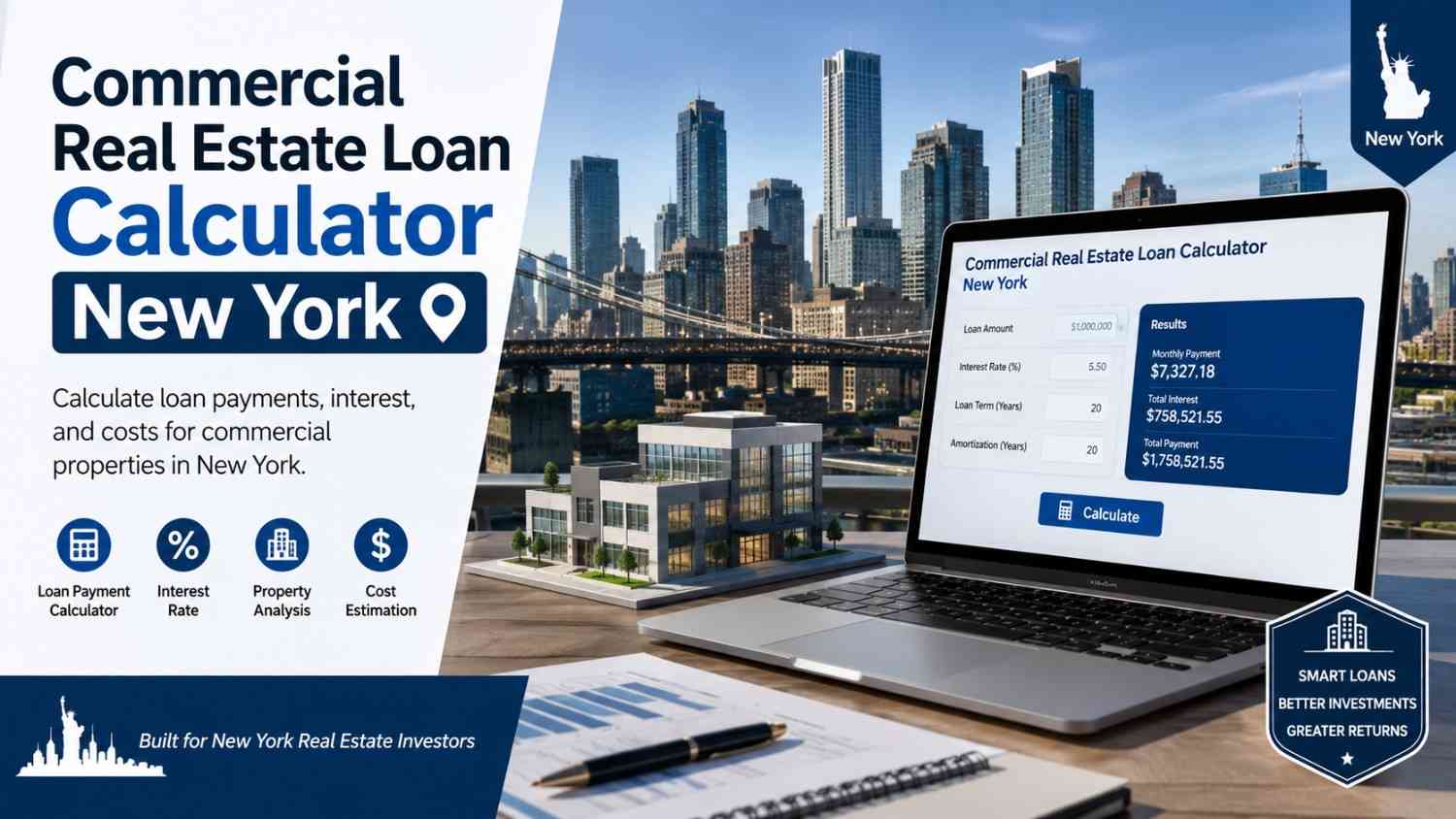
Buying or refinancing a commercial property in New York involves more than choosing an interest rate and calculating a monthly payment. A realistic financing estimate should account for the purchase price, down payment, loan structure, property income, lender requirements, upfront costs and the amount that may remain due when the loan matures.
Our Commercial Real Estate Loan Calculator New York helps property buyers, business owners, landlords and real estate investors estimate these costs using their own assumptions. You can explore monthly principal and interest payments, loan-to-value (LTV), debt-service coverage ratio (DSCR), debt yield, estimated cash required at closing and the potential balloon balance.
Whether you are evaluating an office building in Manhattan, a mixed-use property in Brooklyn, a retail investment in Queens or an industrial property elsewhere in New York State, use the calculator to understand how different financing assumptions affect your deal.
Important: The results are planning estimates, not a mortgage offer, lender approval or a substitute for a property-specific underwriting review.
Use the calculator below to estimate your commercial mortgage payments, upfront financing costs and key loan metrics. Enter actual figures when available. If you do not yet have a lender quote, use clearly identified assumptions and compare multiple scenarios.
Commercial Real Estate Loan Calculator
Estimate commercial mortgage payments, closing costs, loan sizing and balloon payments for New York property transactions.
Your Loan Estimate
Maximum Loan Comparison
| Constraint | Estimated limit | Method |
|---|---|---|
| LTV | $— | Property value × maximum LTV |
| DSCR | $— | NOI ÷ minimum DSCR ÷ annual debt constant |
| Debt yield | $— | NOI ÷ minimum debt yield |
Refinancing Scenario
Amortization Schedule
The table summarizes the first payment year and subsequent annual balances through the loan term. The balloon is separate from regular payments.
| Period | Scheduled debt service | Interest paid | Principal repaid | Ending balance |
|---|
For educational planning only. This is not a loan approval, lender quote, appraisal, legal or tax advice, or investment recommendation. Results exclude costs and loan features not entered here. Actual lender underwriting may use different definitions, payment conventions, constraints and requirements.
After calculating, review not only the monthly payment but also the cash you need to close, the property’s ability to cover debt service and the outstanding principal expected at maturity.
What Is a Commercial Real Estate Loan?
A commercial real estate (CRE) loan is financing used to purchase, refinance, improve or develop property for business or investment purposes. Depending on the transaction and loan program, eligible properties may include:
- Office buildings and professional spaces
- Retail stores and shopping centers
- Industrial buildings and warehouses
- Multifamily rental properties
- Mixed-use buildings with residential and commercial units
- Hotels, self-storage facilities and other income-producing assets
Some owner-occupied businesses may also qualify for specialized financing programs, including certain Small Business Administration (SBA) loans, subject to eligibility requirements.
Commercial mortgage underwriting differs from residential mortgage underwriting. Lenders may evaluate the property’s income, operating expenses, tenant quality, occupancy, market value, borrower financial strength, available equity and repayment strategy.
A commercial loan can have a five-, seven- or ten-year contractual term while using a much longer amortization schedule. This structure can produce a manageable monthly payment but leave a substantial balance due at maturity.
How to Calculate a Commercial Real Estate Loan Payment
For a conventional fixed-rate loan with fully amortizing monthly payments, the standard payment formula is:
Monthly payment = P × r × (1 + r)ⁿ ÷ [(1 + r)ⁿ − 1]
Where:
- P is the original loan principal.
- r is the monthly interest rate, calculated as the annual nominal rate divided by 12.
- n is the total number of monthly payments in the amortization period.
For example, assume you borrow $2,000,000 at a hypothetical fixed annual interest rate of 7% and amortize the loan over 25 years. The estimated monthly principal-and-interest payment is approximately $14,139.
This illustration excludes taxes, insurance, maintenance, reserves, lender fees and other property expenses. It is not a current market quote.
The amortization period matters because a longer schedule generally reduces the scheduled monthly payment but causes principal to be repaid more slowly. If the loan matures before it is fully amortized, the unpaid balance becomes due according to the loan documents.
Loan Term vs. Amortization: Why the Difference Matters
These terms are often confused, but they describe different parts of a commercial mortgage.
Loan term is the period until the loan matures or becomes due under its contractual terms.
Amortization period is the schedule used to calculate the principal-and-interest payment.
Consider a hypothetical $2 million loan with a 7% fixed rate, a 25-year amortization period and a 10-year maturity. Payments are calculated using the 25-year schedule, but the borrower may still owe a substantial principal balance after ten years.
That remaining balance is commonly called a balloon payment. Depending on the loan agreement, the borrower may need to refinance, sell the property or use other available funds to repay it.
A lower monthly payment does not necessarily mean the loan is less risky. Before accepting commercial financing, understand when the balance becomes due and how you intend to repay it.
How Much Down Payment Do You Need in New York?
There is no single down-payment requirement for every commercial property loan in New York.
The amount depends on the lender, property type, occupancy, cash flow, borrower financial strength, loan purpose, valuation and financing program. Some transactions may require a relatively modest equity contribution, while others require substantially more.
A useful starting point is the loan-to-value ratio:
LTV = Loan amount ÷ Property value × 100
Suppose a commercial property is valued at $3,000,000 and the lender is willing to consider a maximum LTV of 70%.
The LTV-based loan limit would be:
$3,000,000 × 70% = $2,100,000.
If the purchase price is also $3,000,000, the buyer would need at least $900,000 toward the purchase price under this simplified scenario, before closing costs and other expenses.
This does not mean a lender will approve a $2.1 million loan. The property’s income, debt coverage, debt yield and other underwriting conditions may reduce the available amount.
Understanding LTV, DSCR and Debt Yield
A commercial mortgage calculator is more useful when it explains the metrics lenders may use to assess a transaction.
Loan-to-Value Ratio (LTV)
LTV measures the loan amount relative to the property’s value.
Formula: Loan amount ÷ Property value.
A lower LTV generally means the borrower contributes more equity relative to the financed property value. Lenders may use the lower of purchase price and appraised value, depending on their underwriting policy.
Debt-Service Coverage Ratio (DSCR)
DSCR measures how much net operating income a property generates relative to its annual debt service.
Formula: Net operating income ÷ Annual debt service.
For example, if a property generates $300,000 in annual NOI and its annual principal-and-interest payments total $240,000, the DSCR is 1.25x.
That means the property generates $1.25 of NOI for every $1.00 of modeled annual debt service.
A lender may require a minimum DSCR, but the threshold varies by loan program, property type, lender policy and transaction risk. A ratio that appears acceptable in a calculator does not guarantee approval.
Debt Yield
Debt yield compares a property’s annual NOI with the loan principal.
Formula: Annual NOI ÷ Loan amount × 100.
If a property generates $300,000 in NOI and the loan is $3,000,000, the debt yield is 10%.
Unlike DSCR, debt yield does not directly depend on the interest rate or amortization period. It provides another view of the relationship between property income and the amount borrowed.
Why All Three Metrics Matter
A property may meet an LTV limit but fail a lender’s DSCR requirement because its income cannot support the proposed payments. Alternatively, it may meet DSCR but fail the lender’s debt-yield requirement.
For that reason, the maximum loan supported by these three tests is often determined by the smallest of the three independently calculated limits. Actual underwriting may include additional requirements, such as loan-to-cost, minimum loan amounts, reserves or borrower guarantees.
How Much Can You Borrow Against a New York Commercial Property?
The answer depends on both the property value and the income available to repay the loan.
A practical preliminary assessment involves three calculations:
- LTV limit: Property value multiplied by the maximum permitted LTV.
- DSCR limit: The loan amount whose modeled annual debt service does not exceed NOI divided by the required DSCR.
- Debt-yield limit: Annual NOI divided by the minimum required debt-yield percentage.
For a fixed-rate, fully amortizing loan, the DSCR-based maximum can be estimated using the annual debt-service factor generated by the selected rate and amortization period.
The calculator should compare all three limits and identify the lowest one. This helps explain why a property’s asking price alone cannot determine how much a lender will finance.
Use lender-specific thresholds whenever possible. Any default values in a calculator are assumptions for comparison, not universal commercial lending standards.
New York Commercial Mortgage Closing Costs
The amount needed to close a commercial property transaction is usually greater than the down payment alone.
Potential costs include:
- Lender origination fees and points
- Appraisal and property valuation expenses
- Legal fees and document preparation
- Title-related charges and applicable insurance
- Recording fees
- Mortgage recording tax, where applicable
- Environmental, engineering or property inspections
- Survey expenses, due diligence and other transaction charges
- Prepaid items, escrows and reserves required by the lender
Not every transaction includes every charge, and the amount can vary substantially.
New York Mortgage Recording Tax
New York State imposes mortgage recording tax on mortgages recorded against real property in the state. New York City and certain other local jurisdictions impose additional mortgage taxes. The applicable calculation depends on the property’s location, mortgage amount, transaction structure and any relevant exemptions or special rules.
For property in New York City’s five boroughs, the New York City Department of Finance directs users to ACRIS to calculate mortgage recording tax. Staten Island recording procedures differ from those used for Manhattan, Brooklyn, Queens and the Bronx.
Do not assume one flat percentage applies to every commercial mortgage. Confirm the applicable jurisdiction and current rules before relying on an estimate.
Official resources:
- New York State Department of Taxation and Finance: https://www.tax.ny.gov/pit/mortgage/mtgidx.htm
- NYC Department of Finance, property recording and mortgage recording tax: https://www.nyc.gov/site/finance/taxes/property-recording-property-related-documents.page
Estimate Cash Required at Closing
A simplified cash-to-close estimate is:
Cash required = Purchase price − Loan amount + Estimated upfront fees and closing costs
This calculation should be adjusted for any applicable credits, deposits, prorations, seller contributions, escrows and other transaction-specific items.
The estimate is only as complete as the expenses entered. Do not count a fee twice if it is already included in a combined closing-cost figure.
Interest-Only Commercial Loans
An interest-only loan allows the borrower to make payments that cover interest without reducing principal during the interest-only period, according to the loan terms.
For example, a $2,000,000 balance at a hypothetical 7% annual interest rate would produce an initial monthly interest-only payment of approximately $11,667, assuming a constant balance and a simple monthly rate calculation.
Once principal amortization begins, payments generally increase because the borrower must pay both interest and principal over the remaining repayment schedule.
Interest-only financing may be used in certain bridge, transitional or other commercial transactions, but availability and terms vary. A lower initial payment should not be interpreted as a lower total financing cost.
Balloon Payments and Commercial Loan Refinancing Risk
One of the most important outputs of a commercial real estate loan calculator is the estimated principal balance due at maturity.
A loan with a ten-year maturity and a 25-year amortization schedule does not ordinarily become fully repaid after ten years. The remaining principal must be addressed under the loan agreement.
Refinancing may be possible, but it is not guaranteed. Future loan rates, property value, NOI, occupancy, lender requirements and market conditions may be different from those at the original closing.
A practical stress test should ask:
- What happens if the refinance interest rate is higher?
- What happens if NOI falls because of vacancies or operating expenses?
- Could a lower appraisal reduce the amount available for refinancing?
- Would the remaining loan balance exceed the new lender’s LTV or DSCR limit?
- How much additional equity might be needed to close a refinancing shortfall?
A refinance estimate is a scenario, not a commitment. Before the maturity date, review the loan documents and discuss the repayment strategy with qualified financing and legal professionals.
Worked Example: Financing a $3 Million Commercial Property
Assume the following hypothetical transaction:
| Item | Assumption |
|---|---|
| Purchase price | $3,000,000 |
| Loan amount | $2,100,000 |
| Down payment | $900,000 |
| Fixed annual interest rate | 7% |
| Amortization period | 25 years |
| Loan maturity | 10 years |
| Annual NOI | $210,000 |
Using a standard monthly amortization formula, the estimated monthly principal-and-interest payment is approximately $14,846. Annual debt service is approximately $178,152, assuming twelve equal payments.
The approximate DSCR is:
$210,000 ÷ $178,152 = 1.18x.
The LTV is 70%, based on the assumed $3 million property value.
The debt yield is:
$210,000 ÷ $2,100,000 = 10%.
These figures describe three different underwriting tests. A lender might accept one metric but require a different result for another. The loan’s actual eligibility depends on the complete transaction and lender policy.
Because the loan matures after ten years while amortizing over 25 years, a substantial balance would remain due at maturity. That balance should be calculated from the full amortization schedule rather than estimated by subtracting ten years of payments from the original principal.
Closing costs are not included in this example, so the actual cash required would be higher than the down payment alone.
How to Use This Commercial Real Estate Loan Calculator
For a more useful estimate, follow these steps:
- Enter the property’s purchase price or the value you want to test.
- Enter the down payment or proposed loan amount.
- Add the expected interest rate and amortization period.
- Enter the contractual loan term to estimate the maturity balance.
- Add annual NOI to evaluate DSCR and debt yield.
- Enter the lender’s maximum LTV, minimum DSCR and minimum debt-yield assumptions.
- Add origination fees, closing costs and any separately estimated tax or recording charges.
- Calculate the results and compare different financing scenarios.
For a proposed loan, test more than one rate and NOI assumption. A scenario that works only under optimistic assumptions may carry substantial refinancing or cash-flow risk.
Common Mistakes When Estimating a Commercial Mortgage
Using the purchase price as the only underwriting measure. Property income and appraised value may constrain the loan even when the purchase price appears affordable.
Ignoring the balloon balance. A manageable monthly payment does not mean the loan will be fully repaid by maturity.
Confusing NOI with cash flow after debt service. NOI is generally calculated before mortgage principal and interest. Do not deduct mortgage payments twice when calculating DSCR.
Forgetting transaction expenses. Down payment, lender fees, recording taxes, legal expenses and required reserves can materially affect cash requirements.
Treating an estimated interest rate as a current quote. Commercial financing terms vary by lender, borrower, property and market conditions.
Assuming calculator results mean approval. The final decision belongs to the lender and depends on verification, underwriting and loan documentation.
Frequently Asked Questions
What is a commercial real estate loan calculator?
It is a financial tool that estimates commercial mortgage payments and related financing metrics using inputs such as loan amount, interest rate, amortization period and property income.
How much down payment is required for a commercial property in New York?
There is no universal requirement. The amount depends on the lender, property, borrower, loan program, valuation and underwriting conditions. Use a proposed LTV as a planning assumption, not a guaranteed loan offer.
What interest rate should I enter?
Use the rate stated in a lender quote or term sheet when available. If you do not have one, compare several hypothetical rates and clearly label them as assumptions. A calculator should not present an unverified assumption as a live market rate.
How do I calculate DSCR?
Divide annual net operating income by annual debt service. For consistent comparisons, use the lender’s definition of NOI and debt service, which may include specific treatment of reserves, amortization and other loan obligations.
What is a balloon payment on a commercial mortgage?
It is the remaining amount due at loan maturity when the scheduled payments have not fully repaid the principal. The amount depends on the loan balance, rate, amortization and payment history.
Does the calculator include New York mortgage recording tax?
Any tax estimate depends on the calculator’s inputs and assumptions. Verify the applicable jurisdiction, current tax rules and possible exemptions using official state or local resources before closing.
Can I use this calculator for an office building, retail property or multifamily investment?
You can use it for preliminary estimates across different commercial property types. However, lender requirements and the treatment of income, expenses and reserves may differ. Specialized financing programs may use additional underwriting rules.
Does a high DSCR guarantee commercial loan approval?
No. DSCR is only one part of underwriting. Lenders may also evaluate LTV, debt yield, borrower finances, property condition, tenant concentration, occupancy and other requirements.
Is a commercial mortgage payment the same as total property expenses?
No. A principal-and-interest estimate generally excludes property taxes, insurance, repairs, utilities, capital reserves, management expenses and other ownership costs unless they are separately entered or explicitly included.
How can I compare two commercial loan offers?
Compare the interest rate, monthly payment, amortization period, maturity date, balloon balance, fees, prepayment provisions, required reserves and other contractual conditions. A lower payment may not represent the lowest total cost or the lowest risk.
Methodology and Limitations
This calculator is intended for preliminary financial planning. Payment calculations use the stated loan assumptions and standard amortization mathematics. DSCR, LTV and debt yield are calculated from the inputs supplied by the user.
The tool does not verify property values, rental income, operating expenses, lender quotes, tax eligibility or legal requirements. Results may differ from a lender’s underwriting model, loan documents or final closing statement. Interest-only transitions, variable-rate adjustments, fees, escrows, prepayment penalties and other terms should be modeled separately unless the calculator explicitly includes them.
For current New York mortgage recording tax information, consult the New York State Department of Taxation and Finance and the relevant local recording authority. For complex transactions, obtain advice from qualified commercial real estate, tax and legal professionals.
About the Author
Junaidul Islam writes practical financial calculator guides designed to help users understand their assumptions, interpret estimates and ask better questions before making important financial decisions.
This guide is educational and is not a lending offer, legal opinion, tax opinion or individualized investment advice.
Last reviewed: October 10, 2026.