
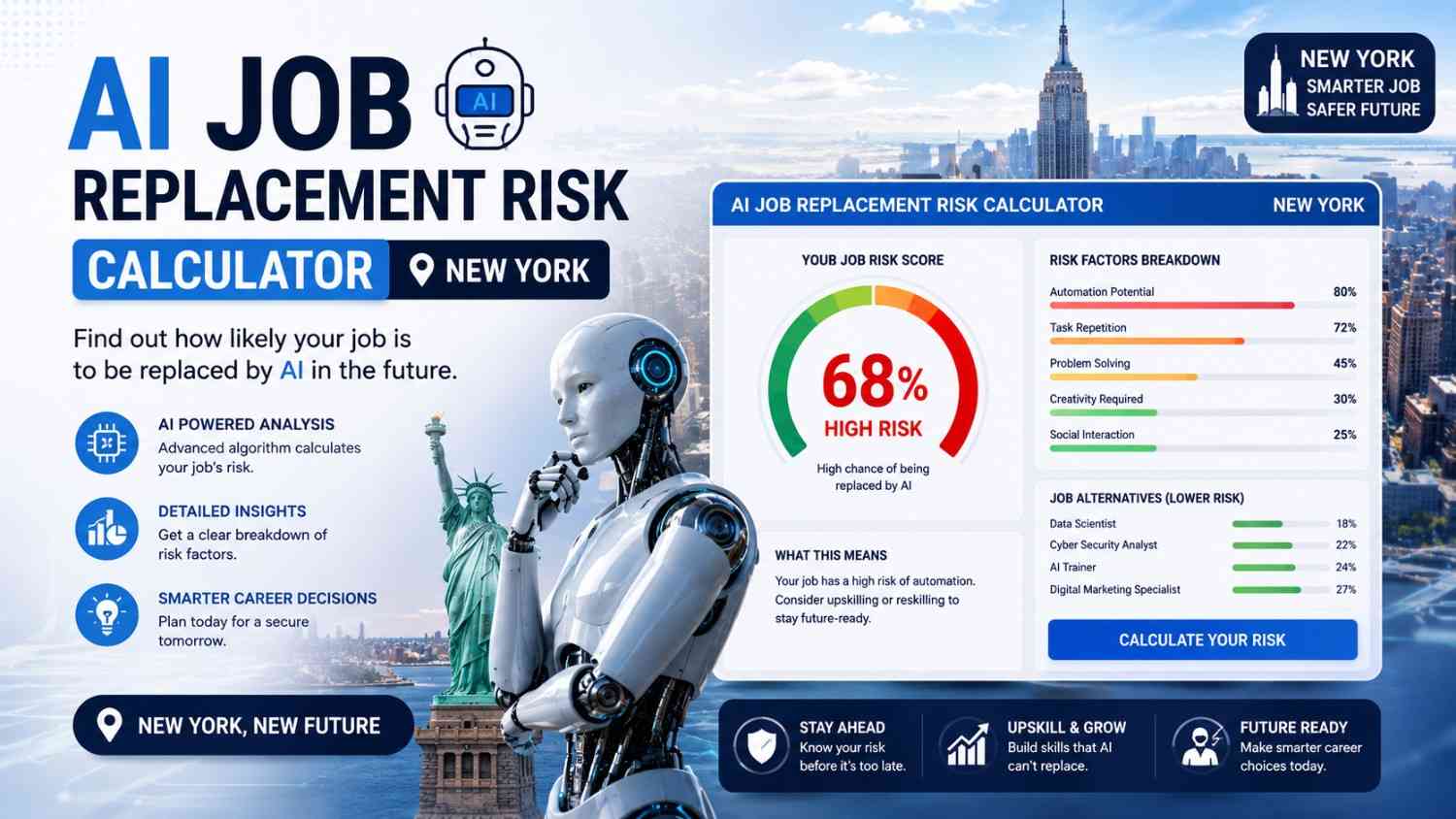
Artificial intelligence is changing the way people work, from preparing reports and answering customer questions to reviewing documents, analyzing data, and managing everyday business tasks. For people working in New York, the important question is not simply whether AI will replace jobs. It is which parts of their work may change, how quickly employers could adopt new technology, and what they can do to remain valuable in the labor market.
The AI Job Replacement Risk Calculator New York helps you explore these questions using your occupation, work responsibilities, experience level, and work location. Instead of treating every person with the same job title as equally exposed, this tool considers the nature of the work you actually perform.
Whether you work in Manhattan’s financial sector, provide customer support, manage a small business, work in healthcare, or perform hands-on work elsewhere in New York State, understanding your exposure to AI can help you make more informed career decisions.
Important: This calculator provides an educational estimate of potential task exposure to AI. It does not predict your individual probability of losing your job, and it cannot guarantee that any occupation is safe from future technological change.
[AUTHOR NOTE: Keep the calculator immediately below this introduction so visitors can use it without reading the entire article first.]
AI Job Replacement Risk Calculator New York
Use the calculator below to assess how your current responsibilities may be affected by AI. Select your occupation, choose your New York work location, and adjust the task sliders to reflect your actual workweek.
AI Job Replacement Risk Calculator
Explore how AI may affect your work in New York. Get an illustrative task-exposure score and practical career-planning suggestions.
Describe your actual work
Estimate how much each factor describes your workweek. These sliders are separate characteristics, not portions that must add up to 100%.
Your indicative results
Selected region:
Experience:
What influenced your result?
Suggested next steps
Official resources for further research
- BLS AI exposure categories
- BLS Occupational Outlook Handbook
- New York State labor-market statistics
- New York State AI skills and training resources
Your result should be interpreted as a starting point for career planning, not as a forecast of unemployment. Two people working in the same occupation can have very different levels of exposure because their responsibilities, employers, customers, and decision-making duties may differ.
What Is an AI Job Replacement Risk Calculator?
An AI job replacement risk calculator is a career-planning tool that estimates how much of a person's work may be affected by artificial intelligence and automation. Depending on its methodology, it may consider an occupation's routine tasks, digital workflows, need for human judgment, physical responsibilities, and interaction with customers or coworkers.
For example, an employee who spends much of the day entering information, formatting standard documents, and answering repetitive questions may have a different exposure profile from a colleague who negotiates with clients, handles unusual cases, supervises staff, and makes decisions that require accountability.
The distinction matters because AI can change a job without eliminating it. A company may use AI to help employees finish routine work faster, allowing them to spend more time on complex responsibilities. In other situations, automation may reduce the number of workers needed for particular tasks.
The calculator therefore focuses on task exposure and work characteristics rather than claiming to know exactly which individual jobs will disappear.
How AI May Affect Jobs in New York
New York has a diverse economy that includes finance, professional services, healthcare, retail, hospitality, construction, transportation, education, and technology. AI will not affect all these industries in the same way.
New York City also has a substantial concentration of office-based and professional work. AI systems capable of processing text, analyzing information, and generating digital content may be particularly relevant to certain administrative, analytical, and customer-service responsibilities.
A March 2025 report from the New York City Economic Development Corporation examined generative AI's potential impact on the city's occupations. Using its own task-based methodology and 2023 employment baseline, the report estimated that approximately 21% to 49% of NYC jobs could be augmented by generative AI. It also estimated that around 5% of jobs could face displacement risk over the following decade under its assumptions.
These were research estimates, not observed job losses or guarantees about what will happen. The report distinguished between jobs that AI could help workers perform and occupations that could face reduced demand. Read the NYCEDC report.
This distinction is especially important when interpreting a personal calculator result. A high level of exposure may mean that AI could assist with a substantial portion of your responsibilities. It does not automatically mean that your employer will eliminate your position.
In May 2026, the New York City Comptroller also published an analysis of AI's potential implications for the city's economy, employment, wages, and public finances. Its scenario-based approach illustrates why career planning should account for uncertainty rather than rely on one definitive prediction. Read the Comptroller's 2026 analysis.
What Is the Difference Between AI Exposure and Job Replacement Risk?
These terms are related, but they do not mean the same thing.
AI exposure describes how much of an occupation's work could be assisted by or performed using AI technology.
Automation susceptibility describes how suitable particular tasks may be for automation, considering factors such as repeatability, digital inputs, and predictable outputs.
Job displacement occurs when an employer or the wider labor market reduces the need for workers in a role. AI may contribute to that change, but so can business conditions, consumer demand, outsourcing, and other technologies.
Employment outlook concerns how employment in an occupation may grow or decline over time. This depends on more than AI alone.
The U.S. Bureau of Labor Statistics introduced AI exposure categories alongside its 2025–2035 employment projections in August 2026. Its categories use multiple external measures of theoretical AI exposure and observed AI-related activity. The BLS explicitly cautions that exposure is not a forecast of job loss, wage changes, productivity gains, or future employment decline.
You can review the official BLS AI exposure categories and the 2025–2035 employment projections release.
For that reason, a responsible AI risk calculator should explain what its score measures. It should not turn a task-exposure estimate into an unsupported claim such as “you have an 85% chance of losing your job.”
Which Types of Work May Have Greater AI Exposure?
AI exposure generally depends more on work activities than on an occupation's name alone. The following examples illustrate possible patterns, not definitive rankings of New York occupations.
1. Administrative and Office Support
Administrative work can include scheduling, preparing routine documents, organizing information, entering data, and responding to standard requests. Some of these tasks can be assisted by current AI tools and conventional automation.
However, administrative professionals may also coordinate people, resolve unusual problems, protect confidential information, and make judgment calls. Those responsibilities should be considered separately from repetitive tasks.
What you can do: Develop spreadsheet and data skills, learn to check AI-generated information, improve workflow coordination, and become familiar with the software used in your industry.
2. Customer Service and Call Centers
AI-powered chat systems and automated response tools can handle some common questions, retrieve information, and prepare standard responses. The level of impact depends on the complexity of customer requests and how an employer deploys these systems.
Complaints, sensitive conversations, unusual cases, and decisions requiring human authorization may still require employee involvement.
What you can do: Build skills in complaint resolution, customer retention, complex case handling, communication, and the responsible use of AI support tools.
3. Finance, Accounting, and Insurance
Financial and insurance professionals may use AI for document review, data classification, drafting, research, and preliminary analysis. These capabilities can change how routine work is performed.
Professional judgment, regulatory requirements, risk assessment, client relationships, and accountability remain important considerations. The actual effect varies by role and employer.
What you can do: Strengthen financial analysis, data interpretation, regulatory knowledge, internal controls, and the ability to verify automated outputs.
4. Marketing, Writing, and Digital Content
Generative AI can help produce first drafts, summarize research, suggest headlines, and create variations of marketing material. This can change the time needed for certain production tasks.
Original reporting, subject-matter expertise, editorial judgment, brand strategy, fact-checking, and audience understanding are different responsibilities that should not be reduced to text generation alone.
What you can do: Improve research, editing, analytics, audience strategy, original reporting, and the ability to demonstrate the results of your work.
5. Software and Information Technology
AI coding assistants can help developers write, explain, and test code. They may also help with documentation and debugging. These tools can change the mix of tasks within software and IT roles.
System design, security, architecture, production reliability, integration, and responsibility for technical decisions require broader context than generating code alone.
What you can do: Learn to review AI-generated code, test for errors and security issues, understand system architecture, and strengthen problem-solving skills.
6. Healthcare and Patient-Facing Work
Some healthcare tasks involving documentation, scheduling, information retrieval, and administrative processing may be supported by AI.
Healthcare also involves physical care, patient communication, clinical judgment, privacy obligations, and professional accountability. Exposure to AI-assisted tasks should not be confused with the likelihood that an entire healthcare role will be automated.
What you can do: Follow the technology and training requirements relevant to your profession, maintain appropriate qualifications, and learn how to verify AI-assisted documentation and information.
7. Retail, Hospitality, and Food Service
Retail and hospitality employers may use AI for inventory forecasting, customer communications, scheduling, marketing, and demand planning. Other automation systems can affect checkout and ordering tasks.
Physical service, guest assistance, exception handling, safety, and the ability to respond to changing conditions can influence how much of a role is suitable for automation.
What you can do: Develop customer-service, supervisory, inventory, operational, and digital-system skills.
8. Construction, Maintenance, and Skilled Trades
Many construction and maintenance responsibilities take place in changing physical environments. Work can involve inspecting a site, handling tools, coordinating other trades, diagnosing unexpected problems, and following safety requirements.
AI may still assist with estimating, scheduling, design documents, project administration, and inspection support. Physical work should not be assumed to be completely unaffected by technological change.
What you can do: Strengthen technical qualifications, safety knowledge, digital estimating, project coordination, equipment knowledge, and the ability to work with new systems.
Does Your New York Location Matter?
Your location can influence which employers, industries, training opportunities, and jobs are available to you. It does not, by itself, establish how likely your individual job is to be replaced by AI.
New York City has a different occupational mix from many smaller cities and rural communities across the state. Finance, professional services, media, healthcare, retail, tourism, manufacturing, logistics, and construction also have different task requirements.
When using this calculator, choose your actual work location rather than assuming that the statewide experience applies equally to every city.
For local employment information, the New York State Department of Labor publishes regional labor-market statistics and industry profiles. Its regional labor statistics portal is a useful starting point for understanding employment conditions beyond New York City.
The state also publishes research on AI-related skills and hiring demand. Its Artificial Intelligence Skills in New York State report identifies AI-related occupations and skills using job-posting and labor-market information. Such data can help inform career planning, although it should not be treated as a direct measure of an individual worker's replacement risk.
Why Two People With the Same Job Title Can Get Different Results
Consider two hypothetical office administrators in New York.
The first spends most of the workday transferring information between systems, preparing standardized reports, and scheduling routine appointments. The second performs some of those tasks but also handles confidential records, resolves unusual requests, coordinates with several departments, and makes decisions that require personal accountability.
Their job titles may be identical. Their work, however, is different.
The first worker may have greater exposure to automation across the tasks performed each week. The second may have a more mixed profile, with some tasks suitable for AI assistance and others requiring substantial human involvement.
Neither conclusion establishes whether an employer will reduce staffing. An employer's technology budget, operational requirements, customer expectations, legal obligations, and business strategy also influence adoption.
This is why the calculator asks you to think about your actual responsibilities instead of relying only on your occupation.
How the Calculator Estimates Your AI Exposure
The calculator uses the characteristics you enter to produce an indicative task-exposure score. The result is intended to help you identify areas for further investigation and career preparation.
The prototype combines five dimensions:
- Routine digital work: Repetitive tasks involving standardized digital information.
- AI-suitable activities: Work that may be assisted or completed by AI systems.
- Predictable workflows: Tasks with consistent inputs, procedures, and expected outputs.
- Human interaction and physical work: Responsibilities that may require in-person service, physical action, or contextual interaction.
- Judgment and accountability: Tasks involving complex decisions, unusual cases, oversight, or responsibility for outcomes.
The first three dimensions increase the illustrative exposure score, while the last two reduce it. The relative weights are a transparent prototype design, not scientifically validated probabilities or an official BLS formula.
Your results will change if your responsibilities change. A person who spends more time on repeatable digital tasks may receive a different score from someone in the same occupation who spends more time on physical work or complex decision-making.
The tool does not currently have access to your employer's internal automation plans, confidential staffing decisions, or a complete, continuously updated dataset covering every New York occupation. It therefore cannot produce an individualized prediction of job loss.
For official occupation-level exposure information, consult the BLS data directly. For career decisions, compare exposure with employment projections, local job postings, training requirements, and your own circumstances.
How to Interpret Your Calculator Result
A calculator score is useful only when you understand what it means.
Lower Indicative Exposure
A lower result suggests that, based on the selected task characteristics, a relatively smaller share of your work matches the calculator's exposure factors.
This does not mean your occupation is immune to change. AI may still affect scheduling, documentation, communication, and other supporting tasks. Employers may also introduce technologies that are not captured by the tool.
Moderate Indicative Exposure
A moderate result suggests a mixture of tasks that may be suitable for AI assistance and responsibilities that involve other forms of work.
This can be a useful starting point for identifying which parts of your job may change first. Look for opportunities to learn relevant software, improve verification skills, and take on responsibilities that require broader context.
Higher Indicative Exposure
A higher result suggests that more of the tasks you selected share characteristics associated with AI exposure in this illustrative model.
It is not a forecast that your position will disappear. Instead, consider which tasks could be automated, how your employer might use the technology, and which skills could help you adapt.
Very High Indicative Exposure
A very high result means that your selected task profile scores strongly against the calculator's exposure factors. It should prompt closer examination of your work activities rather than an immediate decision to leave your occupation.
Review current job postings, talk with knowledgeable professionals in your field, investigate employer training, and compare realistic career alternatives before making major decisions.
These labels describe the calculator's internal scoring bands. They are not official BLS categories, measured unemployment rates, or empirically established probabilities of job replacement.
What Can You Do to Prepare for AI-Related Workplace Changes?
You do not need to predict the entire future of AI to take useful steps today. Start with the parts of your work that are already changing.
Step 1: List Your Main Weekly Responsibilities
Write down the tasks that occupy most of your working hours. Separate routine digital work from customer interaction, physical tasks, problem-solving, supervision, and decisions that require your judgment.
This exercise provides a more useful picture than a job title alone.
Step 2: Identify Tasks That Could Be Assisted by AI
Look for repetitive activities involving documents, data, standard communication, research, or information processing. Ask whether a current AI tool could assist with these tasks and what human checking would still be necessary.
Do not upload confidential employer, customer, patient, or financial information into an AI tool unless its use is permitted by your organization's policies and applicable requirements.
Step 3: Develop Complementary Skills
The right skills depend on your occupation. Useful areas to investigate include:
- Data literacy and spreadsheet analysis.
- AI-assisted research and fact-checking.
- Communication and customer problem-solving.
- Technical troubleshooting and digital workflow management.
- Industry-specific knowledge and regulatory awareness.
- Quality control, security, and responsible AI use.
- Project coordination, supervision, and decision-making.
You do not need to learn every skill on this list. Select those that fit your current work and realistic career goals.
Step 4: Review Actual Job Postings
Search for openings in your field and in related occupations across the New York region where you want to work. Compare required skills, qualifications, salaries, software knowledge, and experience.
Job postings can provide a practical indication of what employers are requesting. They do not, on their own, prove that an occupation is growing or that a particular skill guarantees employment.
Step 5: Compare Adjacent Career Options
If you discover that some of your current tasks are highly exposed to AI, consider whether your existing experience can transfer to a related role.
An administrative professional might explore operations coordination, for example. A customer-service worker might investigate complex case management or customer success. A marketing professional might build expertise in analytics, strategy, or editorial quality control.
These are possibilities to research, not automatic career recommendations. Consider training costs, qualifications, local demand, working conditions, and your own interests.
Step 6: Use New York Workforce Resources
The New York State Department of Labor provides information about career services, labor-market conditions, and AI-related skills. Its Future of Work: Artificial Intelligence industry spotlight discusses relevant skills and learning resources.
The page also describes access to online learning opportunities for eligible New Yorkers. Check current eligibility, availability, costs, and program conditions before enrolling.
Does a High AI Exposure Score Mean Your Salary Will Fall?
Not necessarily. AI exposure alone does not establish how an employer will change wages or compensation.
AI may reduce the time needed for certain tasks, create demand for new capabilities, change productivity expectations, or influence the number and type of positions a company needs. The outcome depends on the occupation, industry, employer, labor demand, and broader economic conditions.
To evaluate your career prospects, review official wage data, employment projections, current job openings, and the skills employers request. Do not use the calculator's exposure score as a substitute for salary research.
For national occupational wages and employment projections, the BLS Occupational Outlook Handbook is a useful reference. For state and regional information, consult the New York State Department of Labor.
Limitations of the AI Job Replacement Risk Calculator
No simple calculator can capture every factor that influences a person's employment prospects. AI capabilities, business adoption, labor demand, regulation, customer preferences, and workplace practices can change.
This calculator has several important limitations:
- Its task weights and score bands are illustrative, not validated estimates of individual job-loss probability.
- User-selected task percentages may not perfectly represent actual work activities.
- The same occupation can differ significantly across employers and industries.
- The calculator does not know your employer's plans, financial condition, or staffing decisions.
- It does not automatically verify every local wage, employment forecast, or vacancy.
- A high exposure score does not mean that your job will disappear, and a low score does not guarantee employment security.
For a more complete assessment, compare the result with official occupation-level AI exposure information, employment projections, local wage statistics, and actual job postings. Revisit your assessment when your duties or workplace technology change.
Frequently Asked Questions
Will AI replace my job in New York?
It is not possible to determine that with certainty from a job title alone. AI may automate some tasks, assist workers with others, and have less effect on responsibilities requiring physical work, contextual judgment, or personal accountability. Your employer's decisions and the wider labor market also matter.
Which jobs have the highest AI exposure?
Some occupations involving substantial digital information processing, standardized documentation, or routine communication may have higher exposure to current AI capabilities. However, rankings vary by methodology. Consult the official BLS AI exposure categories instead of assuming that one universal list predicts job losses.
Are healthcare and construction jobs safe from AI?
No occupation should be described as completely safe. Healthcare and construction include responsibilities that may be difficult to automate, but AI and other technologies can still change documentation, planning, scheduling, design, inspection, and other tasks.
Is the calculator an official New York State government tool?
No. It is an independent educational tool published by NewYorkCalculator.com. Its indicative score is not an official government assessment or a substitute for professional career advice.
Does the calculator use my employer's private information?
The calculator is designed to work with the information you enter rather than requiring your employer's internal data. Do not enter confidential workplace information. Review the website's privacy policy to understand what information the site itself collects through analytics, hosting, or other services.
How often should I check my AI job risk?
Review your task profile when your responsibilities change, your employer introduces new technology, or credible new occupational research becomes available. For long-term planning, combine this review with periodic checks of local job postings, employment projections, and relevant training opportunities.
Where can New Yorkers find AI-related training?
Start with the New York State Department of Labor's AI industry spotlight, which describes relevant skills and learning resources. Verify current eligibility, costs, and availability before committing to a course.
What is the most important thing to do after getting a high score?
Identify the tasks driving the result, compare them with your actual work, and research the tools and skills relevant to your occupation. A high score is a reason to investigate and prepare, not a reason to resign or change careers without further evidence.
Final Thoughts
AI is changing work, but the effect will not be identical across every occupation, employer, or region of New York. A useful career assessment needs to look beyond job titles and consider what people actually do during the working day.
Use the AI Job Replacement Risk Calculator New York as a starting point. Then compare your result with official labor-market data, review current job opportunities, and identify a small number of relevant skills you can develop.
The goal is not to predict the future with false precision. It is to make better-informed decisions while technology and the labor market continue to evolve.
About the Author
Junaidul Islam writes practical guides and develops online calculators designed to help readers understand complex questions through accessible tools and clear explanations. At NewYorkCalculator.com, the focus is on useful calculations, transparent assumptions, and information that readers can apply to real-world decisions.
Editorial note: This article provides general educational information. It does not guarantee employment outcomes or constitute individualized career, legal, or financial advice. Government data and research estimates should be interpreted according to their stated dates, definitions, and limitations.