
Author: Junaidul Islam
Last reviewed: October 10, 2026
Artificial intelligence is changing how employers review resumes, rank job applicants, assess skills, and decide who moves forward in the hiring process. These tools can help HR teams handle large numbers of applications, but they can also create problems when their recommendations disadvantage qualified candidates or when employers cannot explain how a hiring decision was made.
For businesses hiring in New York City, the issue is more than a technology question. Employers may need to consider NYC Local Law 144, federal employment discrimination laws, candidate notification requirements, independent bias audits, and the records needed to demonstrate responsible use of automated employment decision tools.
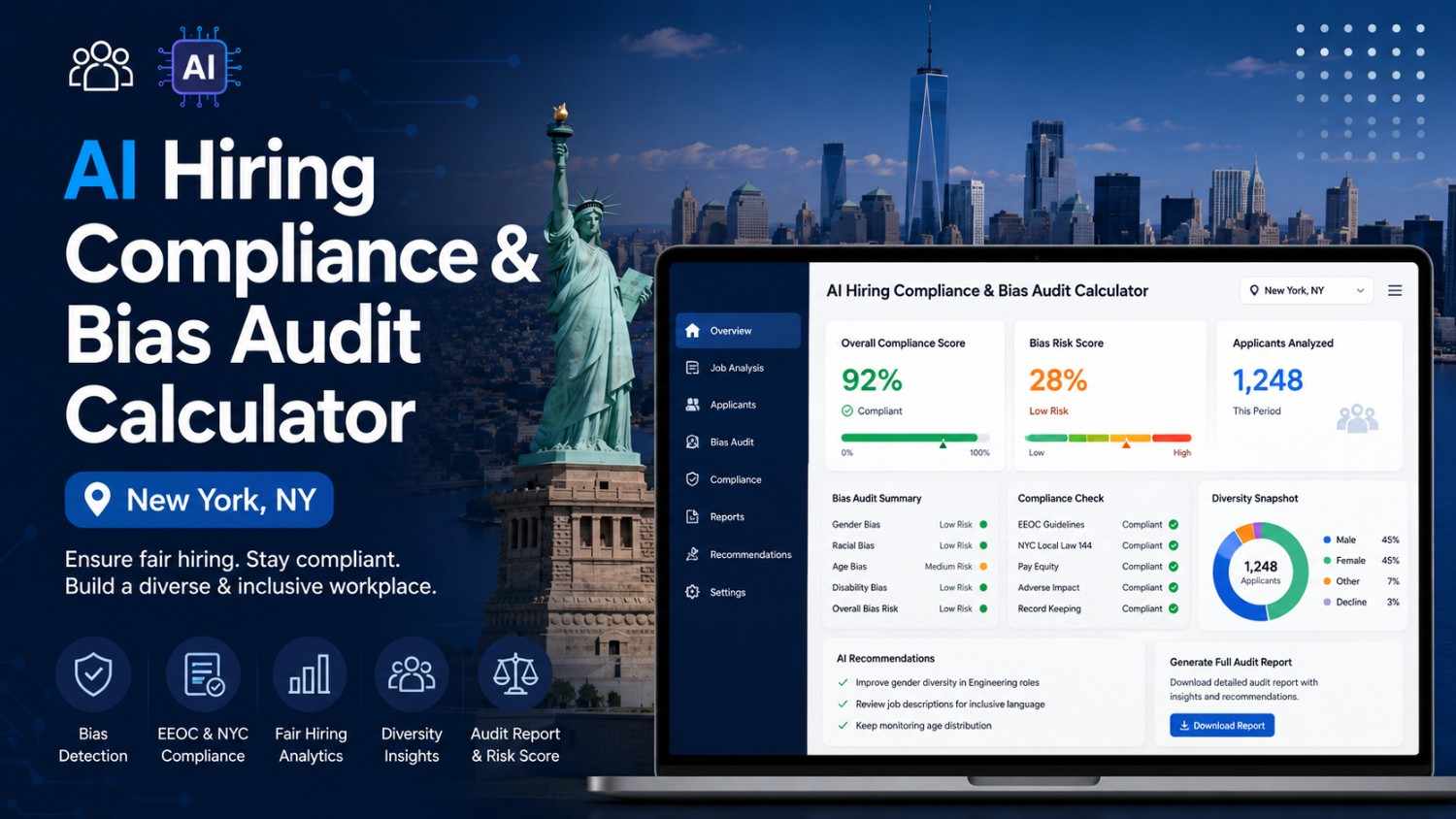
The AI Hiring Compliance & Bias Audit Calculator New York on this page helps employers, HR professionals, recruiters, and compliance teams examine two important areas: potential differences in hiring outcomes and their preparation for applicable compliance requirements.
Use the calculator to compare applicant selection rates, examine the four-fifths screening threshold, and review practical audit-readiness questions. The results are intended to help you identify issues that deserve further investigation. They are not a substitute for an independent bias audit, legal advice, or a formal determination of compliance.
AI Hiring Compliance & Bias Audit Calculator
New York City • Preliminary selection-rate analysis and compliance readiness review
Enter aggregate hiring data to examine selection outcomes. No applicant names are needed.
1. Hiring review details
These choices are for planning only. They do not determine legal coverage. A qualified scope review may be needed.
2. Enter aggregate applicant data
Add groups using a consistent selection outcome and the same relevant hiring period. Use the categories and method required for your actual audit.
| Group label | Applicants | Selected | Action |
|---|---|---|---|
| Reference | |||
3. Compliance readiness checklist
Mark an item only when you have verified it and have supporting evidence. “Not applicable” still requires a documented scope decision.
How to interpret your results
A selection rate is the number selected divided by the number of applicants in the group. The impact ratio compares a group’s selection rate with the highest selection rate in the comparison set.
The four-fifths rule is a screening convention, not a universal legal test. A ratio below 80% may warrant investigation; a ratio at or above 80% does not establish that a system is unbiased or compliant.
This tool does not conduct a formal independent bias audit, validate an AI model, test statistical significance, or determine legal coverage. NYC Local Law 144 may require specific selection or scoring calculations, demographic categories, and independent review beyond this calculator.
Official guidance: NYC DCWP — Automated Employment Decision Tools.
What Is an AI Hiring Compliance and Bias Audit Calculator?
An AI hiring compliance and bias audit calculator is a practical assessment tool for reviewing the use of automated technology in employment decisions. Depending on its features, it may calculate selection rates, compare outcomes between demographic groups, identify potential adverse-impact concerns, and organize compliance tasks.
For example, a company might use software to rank resumes, score online assessments, recommend candidates for interviews, or evaluate recorded interviews. If the system produces different selection outcomes for different groups, the employer needs to understand why those differences exist and whether the process is appropriate for the job.
A calculator helps organize the initial analysis. It does not independently examine an AI model’s code, verify the quality of its training data, or establish whether a particular hiring practice violates the law.
That distinction matters. A hiring process can produce an impact ratio above a commonly used screening threshold and still have other legal or fairness problems. A result below that threshold may warrant closer examination, but it does not automatically prove unlawful discrimination.
New York AI Hiring Laws: What Employers Need to Know
NYC Local Law 144
New York City enacted Local Law 144 of 2021 to regulate certain automated employment decision tools, commonly called AEDTs. Enforcement began on July 5, 2023.
For covered uses, the law generally prohibits employers and employment agencies from using an AEDT unless the applicable requirements for an independent bias audit, public disclosure of audit information, and candidate or employee notice have been satisfied.
The law focuses on covered uses of technology in employment decisions, including hiring and promotion. It is not a blanket ban on every software product that uses artificial intelligence.
Whether a particular product qualifies as an AEDT depends on the applicable legal definition and how the tool is actually used. A product’s marketing description alone does not settle the question.
Employers should review the current official rules before deciding that a tool is covered or exempt.
Official resource: NYC Department of Consumer and Worker Protection — Automated Employment Decision Tools
What Is an Automated Employment Decision Tool?
NYC’s rules focus on computational processes involving machine learning, statistical modelling, data analytics, or artificial intelligence that generate simplified outputs used to substantially assist or replace discretionary employment decision-making.
The practical question is not simply whether a company uses AI. It is how much influence the tool has over an employment decision.
Consider these examples:
- Resume ranking: A system ranks candidates and determines which applications receive attention first.
- Automated assessments: Software produces a pass/fail recommendation based on a candidate’s assessment.
- Interview evaluation: A platform scores interview responses and recommends which candidates should advance.
- Administrative scheduling: Software arranges interview times without evaluating candidates’ qualifications.
The first three examples may warrant a detailed AEDT scope review, depending on their actual functionality and use. A scheduling tool that does not evaluate or rank candidates is less likely to meet the definition simply because it uses software.
Resume parsing, keyword matching, and other seemingly basic features also need to be evaluated in context. If an employer uses an apparently administrative feature to rank applicants or substantially influence decisions, the analysis may change.
Does New York City Law Apply to Every New York Employer?
No. NYC Local Law 144 is a city law, and its scope should not be confused with the requirements that apply across New York State.
Employers should examine the location of the position, the people affected, the function of the tool, and the circumstances in which it is used. A company’s headquarters outside New York City does not, by itself, resolve every question about whether the law applies.
Remote hiring can make this assessment more complicated. Employers should review the current rules and applicable guidance rather than assuming that a remote position is automatically excluded.
New York State has also considered additional legislation concerning automated employment decisions. Proposed bills are not the same as enacted requirements. For example, the status of New York Senate Bill S4394A and Assembly Bill A9601 should be checked directly before relying on either proposal as binding law.
How to Use the AI Hiring Compliance & Bias Audit Calculator
The calculator on this page is designed for an initial review. You can use it to compare selection outcomes and identify documentation or compliance questions that need attention.
Step 1: Enter the applicant data
For each group you want to examine, enter the number of applicants and the number selected to advance or receive the relevant outcome.
Use data from the same hiring stage, job category, and relevant measurement period. Do not compare the final hiring rate for one group with the initial interview rate for another.
For a basic selection-rate calculation, the required inputs are:
- Number of applicants in the group
- Number selected from that group
- A consistent definition of the selection outcome
Use accurate aggregate data wherever possible. Missing or inconsistent records can distort the results.
Step 2: Calculate each group’s selection rate
The selection rate is the percentage of applicants in a group who received the selected outcome.
Selection rate = Selected applicants ÷ Total applicants × 100
Suppose a company evaluates 200 applicants in Group A and selects 80. The selection rate is:
80 ÷ 200 × 100 = 40%
If 150 applicants in Group B produce 45 selections, the selection rate is:
45 ÷ 150 × 100 = 30%
The two groups have different selection rates. That difference is a reason to investigate the process, not a conclusion about its cause.
Step 3: Compare the impact ratios
The four-fifths rule, often called the 80% rule, is a commonly used screening approach for identifying possible adverse impact.
For this calculation, divide a group’s selection rate by the highest selection rate among the groups being compared.
Impact ratio = Group selection rate ÷ Highest group selection rate × 100
Using the example above:
- Group A selection rate: 40%
- Group B selection rate: 30%
- Highest selection rate: 40%
- Group B impact ratio: 30% ÷ 40% × 100 = 75%
The result is below 80%, which indicates that the result deserves closer review under this screening approach.
It does not, by itself, prove discrimination. Likewise, a result of 80% or higher does not guarantee that a hiring process is fair or legally compliant.
The appropriate comparison group, data period, demographic categories, and method must be selected for the purpose of the assessment.
Step 4: Review compliance readiness
A numerical comparison is only one part of an AI hiring review. Employers should also examine whether the tool falls within the applicable law, whether a qualifying audit exists, whether required information is public, and whether applicable notices have been provided.
Use the compliance checklist in the calculator to identify tasks that need follow-up.
An answer indicating that a task has been completed is not independent verification that the task satisfies every legal requirement. Keep supporting documents and confirm the requirements against the official rules.
What Does NYC Local Law 144 Require for Covered AEDTs?
For a covered AEDT, employers and employment agencies should pay particular attention to three main requirements.
1. An independent bias audit
A qualifying bias audit must have been conducted within the applicable one-year period before use of the tool.
The audit is not simply an internal spreadsheet comparison. The applicable rules address auditor independence, the data used, and calculations relevant to the tool’s selection or scoring process.
Depending on the system, the assessment may involve selection rates, scoring rates, impact ratios, and intersectional categories involving sex, race, and ethnicity.
Employers should retain the audit documentation and confirm that it covers the relevant tool and intended use. If a vendor supplies an audit report, the employer should not assume that the existence of a document automatically establishes that all applicable requirements have been met.
2. Publicly available audit information
The applicable rules require information about the bias audit to be publicly available.
Employers should confirm that the required summary is accessible, contains the necessary information, and relates to the tool being used. They should also verify that the relevant dates and data descriptions are accurate.
A report saved in an internal HR folder is not necessarily sufficient to satisfy a requirement for public disclosure.
The official NYC guidance and implementing rules should be consulted for the exact publication requirements.
3. Candidate or employee notice
Covered uses also involve notice requirements.
NYC’s official guidance explains that the applicable notice must generally be provided at least 10 business days before the AEDT is used. The required information depends on the circumstances and the rule, including relevant information about the tool and how to request an alternative selection process or accommodation where applicable.
Employers should verify the notice wording, delivery method, timing, and records of delivery. A notice drafted after a tool has already been used may not resolve a failure to provide advance notice.
The notice obligation should be checked separately from the audit obligation. Completing one does not automatically complete the other.
How to Conduct a More Useful AI Hiring Bias Review
A meaningful review should go beyond entering numbers into a calculator.
Check the data before interpreting the results
Confirm that applicant counts and selection counts are accurate. Check for duplicate records, inconsistent definitions, missing demographic information, and differences in how candidates were evaluated.
If one group has a very small number of applicants, a single decision may substantially change its rate. Report the sample size and avoid presenting unstable results as definitive evidence.
Missing demographic data should not simply be treated as proof that there is no disparity. Determine what information is available, why data is missing, and what conclusions the available data can reasonably support.
Evaluate each stage of hiring
A final hiring rate may conceal differences earlier in the process.
For example, an automated resume screener may determine who receives an interview. A later human interview may determine who receives an offer. If only final hires are examined, a disparity arising at the screening stage may be missed.
Where appropriate, examine the relevant stages separately:
- Applications received
- Applications passing automated screening
- Candidates invited to interview
- Candidates passing assessments
- Offers made
- Offers accepted or final hires recorded
Use consistent definitions and avoid combining stages that measure different outcomes.
Examine intersectional outcomes
Looking at a single broad demographic category may conceal differences within that category.
For example, a review of gender alone might not reveal the same pattern as a review of gender combined with race or ethnicity.
NYC’s AEDT rules address intersectional analysis in the applicable audit framework. The precise categories and calculations should follow the current rule rather than a generic calculator’s assumptions.
Small intersectional groups also create statistical and privacy challenges. Do not draw strong conclusions from inadequate samples, and protect sensitive demographic information.
Check whether the tool measures job-related skills
An automated assessment should be examined to determine whether its outputs are relevant to the actual job.
A tool that rewards a particular communication style, speaking speed, facial expression, or historical employment pattern may not measure the skills the employer actually needs.
Review the job criteria, validation evidence, scoring method, and reasons for rejecting candidates. Consider whether a less discriminatory alternative could measure the relevant skills effectively.
Under federal employment discrimination law, a selection procedure that causes adverse impact can raise legal questions even when discrimination was not intended. Depending on the circumstances, job-relatedness, business necessity, and alternative selection procedures may become relevant.
See the EEOC’s guidance on discrimination theories and adverse impact.
AI Hiring, Disability, and Accessibility
A hiring system may create barriers that are not apparent from a standard demographic selection-rate comparison.
For example, an online assessment may depend on hearing, vision, speech, motor control, or a particular interaction style. A video interview system might evaluate speech patterns or facial movements that are unrelated to the essential duties of the position.
The U.S. Department of Justice explains that employers using hiring technologies must consider disability discrimination risks under the Americans with Disabilities Act. Employers may need to provide reasonable accommodations and ensure that assessments measure relevant skills rather than disability-related limitations.
Employers should consider the following questions:
- Can applicants using assistive technology complete the assessment?
- Does the test measure an essential job skill or an unrelated physical or communication characteristic?
- Is there a clear process for requesting an accommodation?
- Can an applicant seek an appropriate alternative assessment?
- Are accommodation requests handled without unfairly reducing an applicant’s chances?
Read the official ADA.gov guidance on AI and disability discrimination in hiring.
A bias calculator cannot establish that an assessment is accessible. Accessibility requires a separate review of the technology, assessment design, and accommodation process.
Vendor Responsibility and Human Oversight
Employers frequently purchase hiring technology from external vendors. That can make it difficult to understand the underlying model, the data used to develop it, and the reasons behind its recommendations.
A vendor’s statement that its product is fair or compliant should not replace the employer’s own review.
Before using a system, ask the vendor for:
- Documentation describing the tool’s intended use and limitations
- The relevant independent bias audit and its date
- The methodology and data used for the audit
- Selection-rate or scoring-rate calculations where applicable
- Information about the version of the product covered by the audit
- Known accessibility limitations and available accommodations
- Procedures for reporting problems and investigating unexpected outcomes
- Information about material changes to the model or assessment process
Employers should also establish a meaningful review process for questionable results. Human involvement is most useful when reviewers have the authority, information, time, and training needed to evaluate the recommendation rather than automatically accepting it.
Document why significant decisions were made, who reviewed them, and how exceptions were handled. This can improve accountability and make later investigations more practical.
Common AI Hiring Compliance Mistakes
Assuming that every AI tool is covered by Local Law 144. The legal definition depends on the tool’s function and its role in employment decisions.
Assuming that no AI means no discrimination risk. Conventional tests and other selection procedures can also create adverse impact and may be subject to employment discrimination law.
Treating the 80% rule as a legal verdict. It is a screening approach, not a universal legal safe harbor or automatic finding of discrimination.
Using inconsistent data. Comparing different hiring stages, job categories, or measurement periods can make a calculation misleading.
Relying entirely on a vendor. Employers should independently confirm the documentation and requirements applicable to their use of the system.
Forgetting the notice and publication requirements. A bias audit does not automatically satisfy separate disclosure obligations.
Ignoring accessibility. A selection-rate calculation cannot establish that an assessment is accessible to applicants with disabilities.
Failing to review changes. A new tool version, altered scoring threshold, different job use, or changed hiring workflow may require renewed evaluation.
Publishing unsupported compliance claims. A calculator result should not be described as legal certification, an official government approval, or proof that a hiring system is unbiased.
Practical Example: Reviewing an AI Resume Screening Tool
Imagine a New York City employer uses an AI platform to rank applicants for a customer service position.
During an initial review, the HR team finds that 35% of applicants in one group advance to interviews, while 24% of applicants in another group advance.
The second group’s impact ratio is:
24% ÷ 35% × 100 = approximately 68.6%
That figure is below the commonly used 80% screening threshold. The employer should investigate the difference rather than immediately conclude that the system is discriminatory or that a legal violation has occurred.
The team could review the screening criteria, job-related validation, applicant data quality, missing records, and the effect of individual filtering rules. It could also compare results at later stages and consider whether alternative criteria would identify qualified candidates more fairly.
Separately, the team should determine whether the tool is an AEDT under NYC’s rules and confirm whether the applicable audit, public summary, and notice requirements have been satisfied.
This example illustrates why a numerical result and a legal compliance review must remain separate.
Frequently Asked Questions
Is an AI hiring bias audit required in New York?
NYC Local Law 144 requires a qualifying independent bias audit for covered uses of AEDTs in New York City, along with applicable public disclosure and notice requirements. Other federal and state laws may also be relevant. The exact obligations depend on the tool, its use, and the applicable jurisdiction.
Does a score above 80% mean my AI hiring system is compliant?
No. An impact ratio at or above 80% does not guarantee compliance or establish that a selection procedure is free from discrimination. Other legal, statistical, accessibility, and procedural issues may remain.
Does a score below 80% prove discrimination?
No. A result below the four-fifths screening threshold indicates that closer review may be appropriate. The cause, data quality, sample size, job relevance, and applicable legal standards must be examined before reaching conclusions.
Can I use this calculator instead of an independent bias auditor?
No. This calculator performs preliminary calculations and provides a checklist. It does not independently audit a hiring system, verify source data, validate a statistical model, or certify legal compliance.
How often must an NYC AEDT bias audit be conducted?
For covered use, the law generally requires an audit within one year before use. Employers should confirm the applicable timing, scope, and other requirements under the current rules before continued use.
What is a public bias audit summary?
It is the publicly available information about the required audit. Employers should check the current NYC rules for the specific information, publication method, and timing that apply to their tool.
Are remote jobs covered?
Remote hiring requires a careful scope assessment. Employers should not assume that a position is exempt solely because the employer’s headquarters or the applicant’s physical workplace is outside a particular location. Review the current NYC rules and relevant facts.
Does Local Law 144 cover AI used only to schedule interviews?
A tool used only for administrative scheduling may fall outside the AEDT definition if it does not substantially assist or replace discretionary employment decision-making. Its actual function and use matter more than its label.
Does a vendor’s bias audit automatically satisfy an employer’s obligations?
Not necessarily. Employers should verify that the audit is independent, current, relevant to the tool and use, and consistent with the applicable rules. They should separately verify publication and notice obligations.
What should an employer do after finding a possible disparity?
Check the underlying data, confirm the comparison is appropriate, investigate the selection criteria, assess job-relatedness and accessibility, and seek qualified statistical or legal advice where needed. Document the investigation and any changes.
Official Resources for New York Employers
Use primary sources when checking legal obligations or updating your compliance process.
- NYC Department of Consumer and Worker Protection — AEDT requirements
- NYC Local Law 144 FAQ
- New York State Senate — Bill S4394A
- New York State Assembly — Bill A9601
- EEOC — Discrimination theories and adverse impact
- ADA.gov — AI and disability discrimination in hiring
Legislative proposals may change, and agency guidance may be updated. Check the current official text and status before making decisions based on a particular requirement.
Final Thoughts
Responsible AI hiring requires more than a single number. Selection rates and impact ratios can help identify potential problems, but a sound review also examines the data, the job requirements, accessibility, audit documentation, candidate notices, and the way human decision-makers use automated recommendations.
Use the AI Hiring Compliance & Bias Audit Calculator on this page as an initial screening and planning aid. If the results reveal a possible disparity or the checklist identifies missing documentation, investigate the issue before relying on the system for additional employment decisions.
The goal is not simply to produce a passing score. It is to build a hiring process that is explainable, appropriately documented, accessible, and consistent with the laws that actually apply.
Disclaimer: This page provides general educational information and preliminary calculations. It is not legal advice, a formal independent bias audit, statistical certification, or a guarantee of compliance with any federal, New York State, or New York City law. Consult qualified legal and statistical professionals for advice on a specific hiring system.