
Written by Junaidul Islam
Last updated: October 2026
If you are working in New York—or planning to move to New York for a better-paying job—your current salary is only part of the picture.
A more useful question is:
How much could I earn in the future?
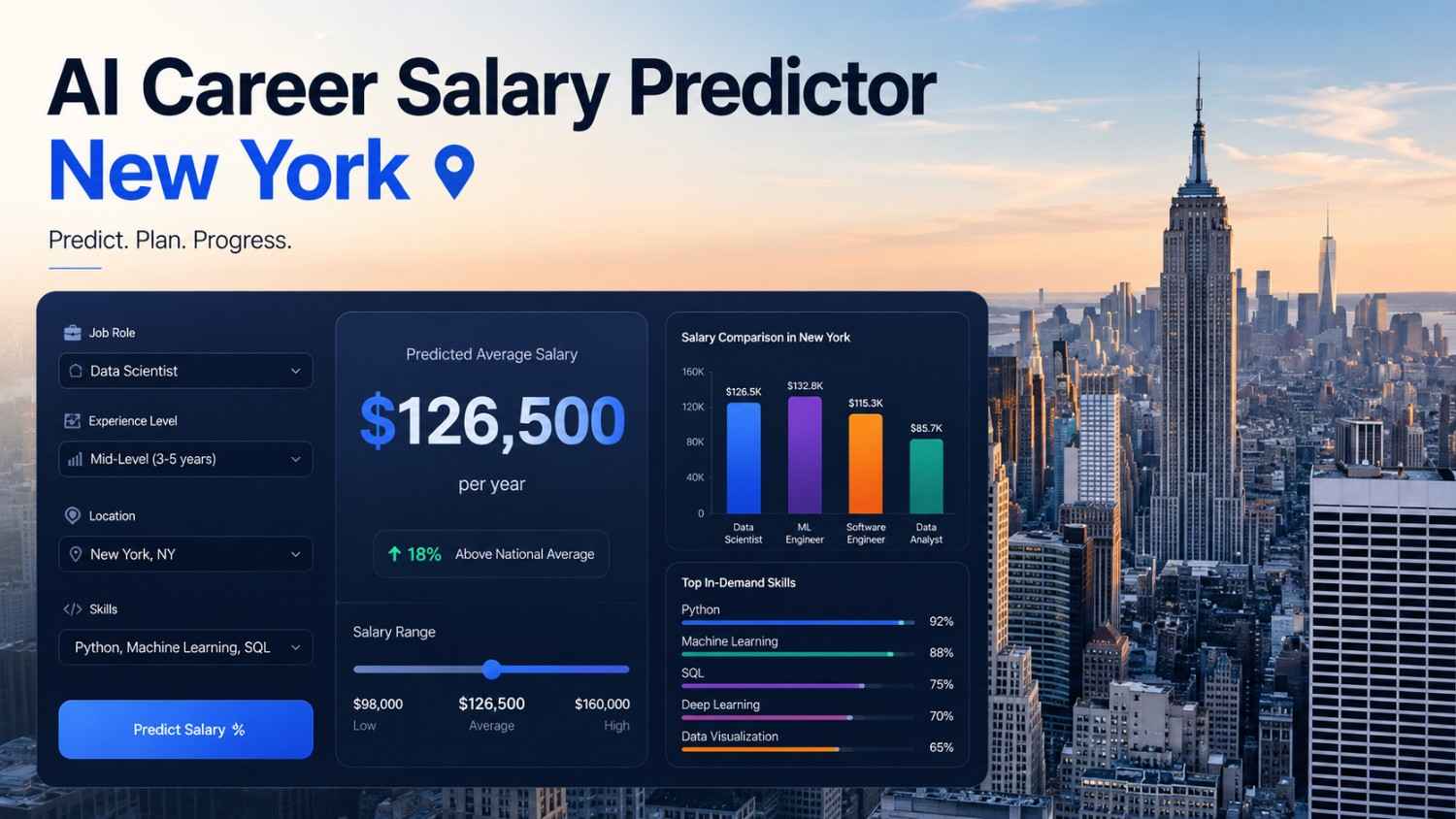
That is what a New York Salary Predictor is designed to help you explore.
Our New York Salary Predictor lets you enter your current salary, occupation, years of experience, education level, work location, and expected annual raise to create an estimated salary outlook for the next 1, 3, 5, and 10 years.
The result is not a promise of what an employer will pay you. Instead, it is a planning estimate that can help you understand how experience, career growth, raises, and occupation-related factors may affect your future earnings.
New York Salary Predictor
Estimate your potential salary growth over 1, 3, 5 and 10 years using your current salary, career stage and selected growth assumptions.
| Year | Estimated Salary | Increase vs. Current |
|---|
Conservative
$0Lower annual growth scenario.
Expected
$0Your selected growth assumption.
High Growth
$0Higher career-growth scenario.
What Is a New York Salary Predictor?
A New York Salary Predictor is a planning tool that estimates how a person’s salary could change over time.
Unlike a traditional paycheck calculator, which mainly answers questions such as “How much will I take home after taxes?”, a salary predictor looks at the future earning path.
For example, suppose you currently earn $70,000 per year.
If you receive an average annual raise of 4%, your salary would not remain at $70,000. Over several years, compounding increases can make a substantial difference.
A simple projection might look like this:
| Year | Example projected salary |
|---|---|
| Current | $70,000 |
| Year 1 | $72,800 |
| Year 3 | About $78,739 |
| Year 5 | About $85,194 |
| Year 10 | About $103,607 |
These numbers are only an example. Your actual salary progression may be faster or slower depending on your occupation, employer, experience, location, education, promotions, job changes, economic conditions, and individual performance.
Why Predicting a New York Salary Is More Complicated Than Applying One Percentage
It is tempting to say that everybody’s salary will increase by 3% or 5% every year.
Real careers do not work that way.
Someone entering a technology occupation may experience a different salary path from someone working in retail. A nurse, electrician, teacher, accountant, software developer, construction worker, and financial professional can all have very different compensation patterns.
Experience also matters.
A worker with two years of experience may be in a completely different position from someone with ten years of experience, even when they have the same job title.
Location matters as well. New York City and other parts of New York State do not have identical labor markets or wage levels.
That is why a useful salary predictor should allow people to look at several factors instead of producing one unexplained number.
New York Salary Trends in 2026
Current labor-market data provides useful context for anyone trying to understand New York wages.
According to the U.S. Bureau of Labor Statistics, New York’s statewide average weekly wage reached $2,363 in the first quarter of 2026, up 6.5% year over year. New York ranked second among states and the District of Columbia by average weekly wage level and first by wage growth in that release.
However, a statewide average should not be treated as the salary of a typical individual worker.
Averages can be heavily affected by high-paying industries and occupations. Your own salary may be much lower or higher depending on your profession, experience and location.
BLS data for the New York metropolitan area also showed that private-industry compensation costs increased 3.3% over the year ending June 2026, while wages and salaries increased 3.1%.
These figures demonstrate why current salary trends can be useful when thinking about future earnings—but they should not be treated as a guaranteed annual raise for every employee.
How the New York Salary Predictor Works
The predictor starts with your current annual salary and then considers the assumptions you provide.
The basic inputs include:
- Current annual salary
- Occupation
- Years of experience
- Education level
- New York location
- Expected annual raise
- Career-growth scenario
- Number of years you want to project
The calculator then compounds the selected growth assumptions to show estimated future earnings.
The important point is that the result is a planning estimate, not a guaranteed employment offer.
Your Current Salary Is the Starting Point
Your current salary is the most important starting input.
For example:
Current salary: $65,000
The predictor can use that amount as the starting point and calculate possible future values.
But two people earning $65,000 today may have very different future salaries.
One person might remain in the same position for ten years.
Another might receive promotions every few years.
Someone else might change employers and move into a higher-paying occupation.
Therefore, the calculator should be used to compare scenarios rather than to predict one certain outcome.
How Experience Can Affect Future Salary
Experience is one of the most important factors in career earnings.
Many occupations have different wage levels for entry-level and experienced workers.
The New York State Department of Labor publishes occupational wage information covering approximately 830 job titles. Its data includes wage and employment information by occupation and region, with the latest wage information updated through the first quarter of 2026 using cost-of-living adjustments.
The Department of Labor’s long-term occupational projection system also provides information such as median wages, entry wages, experienced wages, annual openings, education and training requirements, and expected employment growth.
That makes experience an important variable when thinking about future earnings.
For example, a worker might move from:
Entry level → Experienced → Senior → Management
The salary difference between those stages can be much larger than the difference created by a normal annual raise.
Education Can Influence Your Salary Path
Education does not automatically guarantee a higher salary.
However, some occupations require specific degrees, licenses, certifications or technical training.
For example, a career that requires a bachelor’s degree may have a different entry barrier and salary structure from a job that requires only a high school diploma.
The New York Department of Labor includes education and training information alongside its occupational projections.
When using a salary predictor, education should therefore be considered as part of the overall career path rather than as a simple “degree = higher salary” formula.
New York Location Matters
“New York salary” can mean very different things depending on where you work.
New York City has a different labor market from Buffalo, Rochester, Albany, Syracuse, Long Island, or other parts of the state.
The Department of Labor publishes occupational information for New York State and its labor-market regions, making regional comparison possible.
Current BLS county data also demonstrates substantial geographic differences.
In the first quarter of 2026, average weekly wages among large New York counties ranged from $4,902 in New York County to $1,215 in Kings County, while statewide average weekly wages were $2,363. These are county-level averages, not individual salary predictions, but they demonstrate why location should not be ignored.
New York City vs. Upstate New York
A salary number by itself can be misleading.
An $80,000 salary in New York City and an $80,000 salary in a lower-cost part of the state do not necessarily provide the same financial experience.
Housing costs, transportation, taxes, commuting, healthcare, childcare and other expenses can change the practical value of a salary.
For that reason, salary planning should ideally consider both:
How much do I earn?
and
What does that income allow me to afford where I live?
1-Year Salary Prediction
A one-year projection is useful for short-term planning.
For example, if your current salary is $75,000 and your assumed annual increase is 4%:
Current salary: $75,000
Estimated Year 1 salary: $78,000
This could represent a normal raise, although an actual raise could be smaller, larger, or zero.
3-Year Salary Prediction
A three-year forecast gives you a better picture of compounding salary growth.
With a starting salary of $75,000 and a 4% annual increase:
Year 1: $78,000
Year 2: $81,120
Year 3: $84,365
The calculation assumes the raise compounds annually.
Real-world salary growth may not follow this pattern.
5-Year Salary Prediction
Five years is often a useful career-planning horizon.
Using the same $75,000 starting salary and 4% annual growth:
Estimated Year 5 salary: approximately $91,249
But a worker who changes employers, earns a promotion, obtains a valuable certification, or moves into a higher-paying occupation could follow a very different path.
This is why our predictor should be viewed as a scenario tool rather than a crystal ball.
10-Year Salary Prediction
Long-term projections become more uncertain.
A $75,000 salary growing at 4% annually would reach approximately:
$111,024 after 10 years
But there is an important limitation.
Ten-year career outcomes can be affected by economic cycles, automation, technology, industry changes, employer decisions, inflation, demand for particular skills and changes in the labor market.
New York’s Department of Labor specifically warns that occupational projections contain uncertainty because future developments—including economic shocks and new technologies—cannot be predicted precisely.
That is why a responsible salary predictor should clearly label long-term results as estimates.
Conservative, Expected and High-Growth Scenarios
One of the most useful improvements over a basic salary calculator is to show multiple scenarios.
Imagine a person earning $70,000.
Instead of saying:
“Your future salary will be $95,000.”
a better approach is:
Conservative scenario
Lower annual growth with limited career advancement.
Expected scenario
Moderate annual salary growth based on the user’s selected assumptions.
High-growth scenario
Higher growth that could represent promotions, strong performance or a successful job change.
This approach gives users a range instead of creating false confidence around one number.
What Happens If You Change Jobs?
A normal annual raise is not the only way to increase earnings.
Changing employers can sometimes produce a larger salary change than staying in the same position.
However, there is no universal percentage that applies to every job change.
The salary increase depends on the occupation, employer, experience, skills, location, negotiation, labor demand and the position being offered.
A salary predictor can therefore be used to compare two scenarios:
Stay with current employer
versus
Move to a new role
That comparison can be much more useful than simply calculating a 3% or 4% annual raise.
Career Growth Is Different From a Normal Raise
This distinction is important.
Suppose someone earns $60,000.
A 4% annual raise produces gradual growth.
But if that worker becomes a supervisor and receives a substantially higher salary, the career progression may produce a larger jump.
For this reason, future salary planning should consider:
- Annual raises
- Promotions
- New responsibilities
- Employer changes
- Certifications
- Education
- Specialized skills
- Industry changes
- Geographic changes
The strongest salary forecast is therefore a scenario, not a promise.
New York Occupational Outlook Matters
Salary is only one part of a career decision.
A job paying $100,000 today may not necessarily have the same employment prospects as another occupation paying $80,000.
New York’s Department of Labor publishes long-term occupational projections covering expected employment growth and annual openings. The current statewide projection period covers 2024–2034, while regional projections cover 2022–2032.
The same source also provides annual wage information, education and training measures, employment prospects and comparisons between New York and U.S. occupational growth rates.
That information is particularly useful when someone is deciding whether to invest time or money in a new career.
Salary Prediction Is Not the Same as a Salary Guarantee
This is perhaps the most important limitation.
A salary predictor cannot know:
- Whether your employer will give you a raise
- Whether you will be promoted
- Whether you will change companies
- Whether your industry will expand or contract
- Whether economic conditions will change
- Whether technology will change the occupation
- Whether you will move to another city
- Whether your personal performance will improve
Therefore, the results should always be treated as estimates.
The further into the future you project, the more uncertainty you should expect.
How Accurate Is a New York Salary Predictor?
Accuracy depends heavily on the quality of the assumptions and underlying data.
A calculator based only on a single national salary-growth percentage will provide a very general estimate.
A more useful model considers:
- Current salary
- Occupation
- Experience
- Education
- Location
- Historical wage information
- Employment outlook
- User-selected annual raise
- Career-growth scenario
Official New York occupational data can provide useful benchmarks, but even official projections are not guarantees of future employment or salary outcomes.
Does the Calculator Predict My Take-Home Pay?
A salary prediction and a paycheck calculation are two different things.
For example:
Projected salary: $100,000
does not mean:
Take-home pay: $100,000.
Federal income tax, New York State tax, payroll taxes, local taxes where applicable, retirement contributions, health benefits and other deductions can reduce the amount that actually reaches your bank account.
Many existing New York salary calculators focus heavily on this take-home calculation. They commonly include federal tax, New York State tax, FICA, NYC tax, deductions, bonus and W-4-related inputs.
The purpose of a salary predictor is different: it focuses first on future earning potential.
Why You Should Not Use a Statewide Average as Your Personal Salary
A statewide average is useful for understanding the broader market, but it should not be used as a personal benchmark without context.
High-paying industries can significantly increase an average.
Occupation matters.
Experience matters.
Location matters.
Hours worked matter.
Full-time and part-time employment also matter.
For example, the BLS Q1 2026 New York county data shows substantial variation between counties.
Therefore, a good salary comparison should use occupation-specific and location-specific information whenever possible.
How to Use the New York Salary Predictor
Using the calculator is straightforward.
Step 1: Enter your current salary
Enter your current annual gross salary.
Step 2: Select your occupation
Choose the occupation that most closely matches your current work.
Step 3: Select your experience
Choose your approximate years of experience.
Step 4: Select education
Choose your highest relevant education or training level.
Step 5: Choose your New York location
Select the area closest to where you work or plan to work.
Step 6: Enter your expected annual raise
If you have no idea what raise to assume, use a conservative number and compare multiple scenarios.
Step 7: Choose the forecast period
Compare 1, 3, 5 and 10 years.
Step 8: Compare scenarios
Do not focus on one result. Compare conservative, expected and high-growth outcomes.
Example: New York Salary Prediction
Suppose you earn:
Current salary: $80,000
Experience: 5 years
Annual raise assumption: 4%
Forecast: 5 years
A simple compound-growth model would produce:
Year 1: $83,200
Year 2: $86,528
Year 3: $89,989
Year 4: $93,589
Year 5: $97,332
This is a mathematical projection based on the selected growth assumption.
It is not a statement that your employer—or any employer—will actually pay you $97,332 in five years.
What Could Make Your Salary Grow Faster?
Your future earnings may increase faster than a normal annual raise if you:
- Move into a higher-paying role
- Become a manager
- Develop specialized technical skills
- Obtain an industry certification
- Complete a relevant degree
- Change employers
- Move into a stronger-paying industry
- Relocate to a higher-paying labor market
- Take on additional responsibilities
- Negotiate compensation successfully
But none of these outcomes is automatic.
What Could Cause Salary Growth to Be Slower?
The opposite can also happen.
Salary growth can be slower because of:
- Hiring freezes
- Economic downturns
- Company restructuring
- Industry decline
- Lack of promotion opportunities
- Reduced demand for a skill
- Career changes
- Part-time work
- Reduced working hours
- Changes in technology
That is why the best forecast is one that allows users to test different assumptions.
Why This Tool Is Useful for Job Seekers
If you are considering a New York job offer, salary should not be the only number you compare.
You can use a salary predictor to ask:
What might this salary become after five years?
You can then compare that estimate with another career or job offer.
For example:
Offer A: $70,000 starting salary
Offer B: $78,000 starting salary
Offer B looks better immediately.
But if Offer A has significantly better promotion potential, training opportunities or career mobility, the long-term comparison could be different.
A predictor cannot make the decision for you, but it can help you think beyond the starting salary.
New York Salary Predictor vs. Salary Calculator
These terms are sometimes used interchangeably, but they have different purposes.
Salary Calculator
Usually answers:
“How much money will I receive after taxes and deductions?”
Salary Predictor
Answers:
“How could my salary change over time?”
Paycheck Calculator
Usually answers:
“What might my paycheck look like for this pay period?”
A useful New York financial planning toolkit can eventually include all three.
Frequently Asked Questions
What is a New York Salary Predictor?
It is a planning calculator that estimates how your salary could change over time based on your current salary and selected career-growth assumptions.
Can a salary predictor guarantee my future salary?
No. No calculator can guarantee a future salary. Actual earnings depend on your employer, occupation, experience, performance, promotions, job changes and economic conditions.
How far into the future can I predict my salary?
The calculator can show short- and long-term scenarios such as 1, 3, 5 and 10 years. Longer forecasts should be interpreted with greater caution.
What salary growth percentage should I use?
There is no single percentage that is correct for everyone. If you are unsure, compare conservative, expected and higher-growth scenarios instead of relying on one assumption.
Does occupation affect salary prediction?
Yes. Occupation is one of the most important factors because different jobs have different wage levels, career paths and employment outlooks.
Does location affect New York salaries?
Yes. New York has significant regional differences in wages and labor-market conditions. Statewide and county-level averages should not be treated as an individual’s expected salary.
Does education affect future salary?
Education and training can affect access to certain occupations and career paths, although a degree does not automatically produce a higher salary.
Does experience affect salary?
It can. Many occupations have different entry-level and experienced wage levels. New York’s official occupational data includes experience-related wage information.
Can I use the predictor for a career change?
Yes. It can be useful for comparing possible salary-growth scenarios, but career-change results should be treated as estimates.
Is the New York Salary Predictor a tax calculator?
No. Its primary purpose is future salary planning. A future take-home estimate requires additional tax and deduction assumptions.
Final Thoughts
A salary number tells you where you are today.
A salary projection can help you think about where your career could go.
For someone living or working in New York, the most useful approach is not to ask only:
“What is the average salary?”
Instead, ask:
“What could my salary look like if I stay in my current career, gain experience, receive normal raises, change jobs, or move into a higher-paying role?”
That is the purpose of the New York Salary Predictor.
Use the calculator as a planning tool, compare several scenarios, and use official labor-market information when making major career decisions.
New York’s Department of Labor provides occupational wage and employment data as well as long-term projections, while the U.S. Bureau of Labor Statistics provides current wage and compensation indicators. These sources are valuable for understanding the broader market, but they cannot predict an individual’s exact future income.
The smartest salary prediction is therefore not a promise—it is a range of informed possibilities that helps you make a better decision.
Sources used for this article
- New York State Department of Labor — Occupational Wages
- New York State Department of Labor — Long-Term Occupational Projections
- U.S. Bureau of Labor Statistics — New York County Employment and Wages
- U.S. Bureau of Labor Statistics — New York Metropolitan Area Employment Cost Index
Author: Junaidul Islam