
By Junaidul Islam
Last reviewed: October 10, 2026
Have you ever moved to another apartment, changed your last name, closed a bank account, or left a job in New York and wondered whether an old payment was ever collected? You might have an uncashed paycheck, an unused utility deposit, an insurance payment, or another financial asset that has been separated from its rightful owner.
New York State maintains an official system for returning certain unclaimed funds to their owners. The challenge is knowing where to search, which names and addresses to try, and how to verify a possible match.
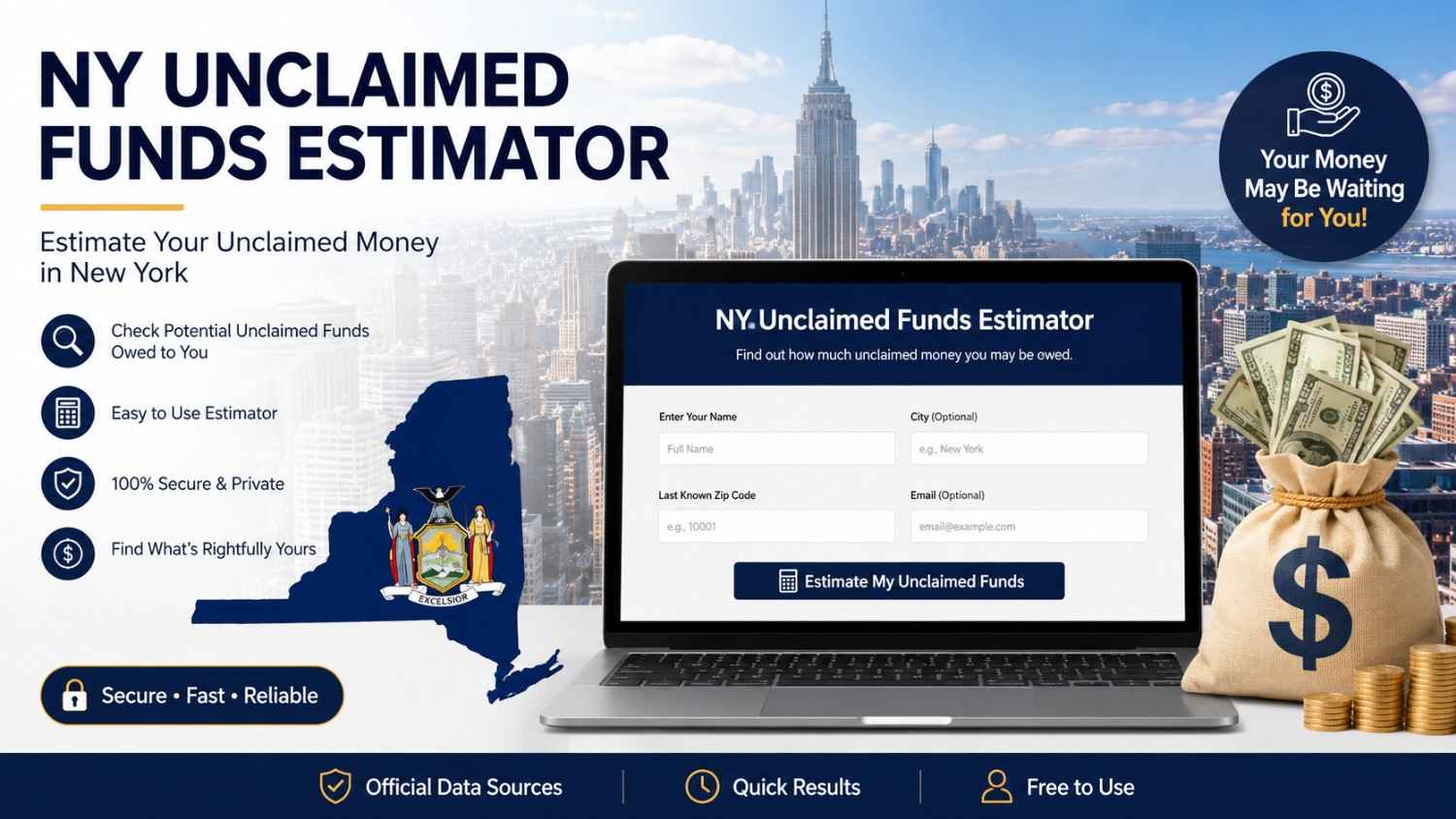
Our New York Unclaimed Funds Estimator helps you organize that search. It identifies the names, previous addresses, and property categories you may want to check before visiting the official state database.
There is one important distinction: this estimator does not access your personal financial records or calculate a confirmed dollar balance. Only the official records and the state’s ownership-verification process can establish whether money belongs to you and how much you can claim.
Start with the estimator below, then use the official New York State search to check your records.
New York Unclaimed Funds Estimator
Build a personalized checklist to help you search for potentially unclaimed money associated with your New York history.
Free planning tool · No account required · No financial information requested
Your New York search checklist
Checklist preparation progress
Recommended next steps
Independent informational tool by NewYorkCalculator.com. Not affiliated with or endorsed by the New York State government.
What Is a New York Unclaimed Funds Estimator?
A New York Unclaimed Funds Estimator is a planning tool that helps you prepare for an unclaimed-property search. It can organize your search history, identify possible name variations, and remind you to check previous addresses and different types of property.
It is not the same as the official New York State unclaimed funds database.
For example, suppose you lived in Queens several years ago, moved to Albany, and later changed your surname. Searching only your current name and address might leave out useful search variations. A structured checklist helps you remember to check the name and location details connected with your earlier financial activities.
The estimator is especially useful if you:
- Currently live in New York or lived there in the past.
- Changed your name after marriage or another legal change.
- Moved between New York City, Long Island, Albany, Buffalo, Rochester, or other parts of the state.
- Had an old bank account, job, insurance policy, or utility account.
- Are helping an estate or investigating a deceased relative’s financial affairs.
- Own or previously operated a business in New York.
The tool helps you prepare a more complete search. It cannot confirm that you have unclaimed funds, assign a reliable probability of finding money, or predict a payout.
How to Use the New York Unclaimed Funds Estimator
You do not need to provide your Social Security number, bank password, or account credentials to use this planning tool.
Step 1: Identify your connection to New York
Choose whether you currently live in New York, lived there previously, operated a business there, or are researching a deceased relative’s property.
Your selection helps you think about the records that may be relevant. Former residents should not assume that moving away makes them ineligible to investigate property associated with their previous New York activities.
Step 2: List the names you have used
Start with your current legal name, then consider other names associated with your financial history.
Depending on your circumstances, these may include:
- A maiden name or previous legal surname.
- A former spelling of your name.
- A nickname or shortened first name.
- A business or organization name.
- A deceased relative’s legal name and known variations.
Use genuine name variations rather than inventing unrelated identities. When searching the official database, follow its instructions and compare the returned information carefully.
Step 3: Remember previous addresses
An old address can be useful when distinguishing between people with similar names and locating records connected with earlier accounts.
Consider the New York addresses where you previously lived, worked, rented property, or maintained financial accounts. You do not need to remember every apartment number before beginning your search.
If you cannot recall an address, check old tax records, employment documents, leases, utility statements, or other records you already possess. The state explains that documents such as W-2 and 1099 forms may help establish a previous address when proof is requested.
Step 4: Select the property categories you want to investigate
Think about the financial relationships you have had in New York. An old employer, utility provider, bank, insurer, or investment account may provide a useful starting point.
The estimator creates a checklist from your selections. It does not search the underlying records or establish that any particular category contains money belonging to you.
Step 5: Open the official search database
After preparing your checklist, visit the New York State Office of Unclaimed Funds.
Search using your last name or business name first. If necessary, refine the search with your first name, city, and ZIP code. Try relevant name variations and previous addresses.
The state’s database is updated regularly, so a search that produces no result today does not guarantee that no relevant property will ever appear.
What Types of Unclaimed Funds Can You Find in New York?
Unclaimed property can originate from many ordinary financial transactions. The following examples describe categories recognized in New York’s official guidance; they are not a list of assets you personally own.
| Property category | Examples |
|---|---|
| Bank accounts | Forgotten savings accounts, checking accounts, and certificates of deposit |
| Uncashed payments | Certain checks, refunds, and payments that were never collected |
| Wages | Eligible unclaimed wage-related property |
| Insurance | Certain insurance benefits or policy proceeds |
| Investments | Stocks, bonds, mutual funds, and dividends |
| Utilities | Certain telephone, utility, or security deposits |
| Estates and courts | Eligible estate proceeds and court-related funds |
Other property types may also qualify, depending on the applicable rules and reporting requirements.
For the official category list, visit the state’s About Unclaimed Funds page.
What about U.S. savings bonds?
Do not assume that every missing financial asset appears in the New York State database. New York’s official guidance specifically directs people seeking U.S. savings bonds to TreasuryDirect for assistance.
You can start at TreasuryDirect.gov.
This distinction matters because searching one database cannot establish that you have searched every possible source of missing assets.
How Much Unclaimed Money Could You Have?
This is usually the first question people ask, but it is also where an online estimator can easily become misleading.
There is no reliable way to calculate your personal unclaimed-funds balance from your name variations, number of previous addresses, or selected property categories alone.
For example, choosing five property categories does not mean you have five accounts. Having lived at four addresses does not establish that any money remains there. A search may produce no matches, several records belonging to different people, or a record that requires further verification.
New York’s Comptroller explains that the office cannot disclose the value of funds before reviewing a claim and verifying ownership. This is a fraud-prevention measure.
The correct approach is to separate three stages:
- Search preparation: Organize your names, previous addresses, and relevant property categories.
- Possible match: Find a record that may relate to you and examine its available identifying details.
- Verified claim: Follow the state’s process to establish your ownership and obtain information about the claim amount.
Do not interpret a search-readiness score, checklist count, or online estimate as money owed to you.
New York’s Latest Unclaimed Funds Information
New York’s program is substantial, but statewide totals should never be confused with an individual’s possible recovery.
According to the Office of the New York State Comptroller’s annual report for State Fiscal Year 2025–26, published in August 2026, the office returned a record $651 million to rightful owners during that fiscal year.
That is a statewide result. It does not mean every resident has a claim or that an individual can expect any particular payment.
You can review the official Comptroller’s reports for the latest published figures.
The state’s unclaimed funds website also states that certain newly reported property can be returned directly to verified owners without requiring a conventional claim. If you receive a check from the state, read the accompanying information and verify that it is legitimate before responding to any unexpected request for personal information.
For the latest procedures, always use the official New York State Unclaimed Funds website.
How to Search for Unclaimed Funds in New York
Follow these steps after using the estimator.
1. Open the official state database
Go directly to ouf.osc.ny.gov. You can also reach the service through NY.gov’s Find Lost Money page.
Searching through the official service is free.
2. Search your last name or business name
Enter your last name or business name in the appropriate field and submit the search. Refine the results with your first name, city, and ZIP code when needed.
3. Repeat the search with relevant variations
If you have changed your name or moved, repeat the search using relevant historical information. Do not assume that a search using only your current details is exhaustive.
For an estate or business, use the appropriate legal names and follow the specific instructions provided by the state.
4. Examine possible matches carefully
A matching name is not proof of ownership. Another person may have the same name, and a record may be associated with an address you no longer use.
Review the information provided by the official system and proceed only when you have a reasonable basis to believe the record relates to you or the estate you are authorized to represent.
5. Follow the claim instructions
If a relevant record appears, select the applicable claim option and follow the official prompts. Some claims can be filed online; others may require additional documentation or a different submission method.
The state may request proof of identity, a previous address, ownership, or legal authority to act for another person. Requirements depend on the claim.
6. Track your claim
Keep the confirmation information and Claim ID associated with your submission. Use the official service to check the status of your claim and upload requested documents.
Do not submit the same claim repeatedly simply because you have not received an immediate response.
What If You Find a Record but Cannot Prove Your Old Address?
This is a practical issue for people who moved years ago, especially those who no longer have their original lease or utility bills.
The New York State Comptroller lists documents such as W-2 and 1099 forms among the records that may help establish a previous address.
Start by reviewing the state’s Required Documentation guidance and identify the documents applicable to your situation.
If you cannot provide the requested evidence, do not invent an address or submit altered documents. The Comptroller’s contact guidance says claimants can include a written explanation along with other requested documents when uploading their claim documentation, after which the office can provide further instructions.
A missing document does not automatically establish that you are ineligible, but the state must determine what evidence is acceptable for your specific claim.
Can You Claim Unclaimed Funds for a Deceased Relative?
Potentially, yes. However, locating a deceased person’s name in the database does not automatically give every family member the right to receive the funds.
The process may depend on the estate, the person’s legal arrangements, the claimant’s relationship to the deceased, and the documents required by the state.
If you are helping an estate:
- Search using the deceased person’s legal name and relevant previous names.
- Review any potential record through the official database.
- Read the state’s instructions for deceased owners and estates.
- Determine which person is legally authorized to submit the claim.
- Prepare only the documentation requested for that situation.
Start with the official Claims for Deceased Owners and Estates guidance.
If several relatives are involved, do not assume that the person who discovered the record is necessarily the person entitled to collect it.
What If the Money Belongs to an Old Business?
Business owners should search using relevant legal business names and follow the state’s business-claim instructions.
A business may have changed its name, moved, merged with another entity, or ceased operations. A possible record may therefore require additional verification before a claim can proceed.
Keep in mind that finding a record associated with a business name does not establish that the funds belong to you personally. The state’s requirements will depend on the business structure and your legal authority to act for it.
Use the official database and follow the applicable documentation instructions rather than relying on the estimator to establish ownership.
Is New York’s Unclaimed Funds Search Free?
Yes. The New York State Office of Unclaimed Funds provides its official search and claim service free of charge.
Private companies may offer to locate property or assist with claims for a fee. Using a paid service is not a requirement for searching the state’s database or filing a claim yourself.
New York’s Comptroller publishes information about location-service providers and the rules governing their fees. Under the state’s published guidance, the maximum permitted fee for covered location services is 15% of the cash or value of securities refunded.
Read any agreement carefully before signing it, and compare it with the official guidance. Do not assume that a company contacting you is affiliated with the state simply because it knows your name or mentions an apparent record.
How to Avoid Unclaimed Money Scams
A message claiming that you have thousands of dollars waiting for you may sound convincing, but an unexpected notification is not proof that the sender is legitimate.
Use these precautions:
- Start with the official website. Type the government address yourself rather than trusting an unsolicited link.
- Never pay to use the official search. The state’s search and claim service is free.
- Protect sensitive information. Do not provide bank passwords, one-time verification codes, or unnecessary identity information to an unknown person.
- Check unexpected emails and letters. Verify the claim through the official state service before acting.
- Read fee agreements. If a private finder offers assistance, understand the service and fee before signing.
- Do not trust guaranteed-payout promises. A private estimator cannot guarantee that a record exists or that a claim will be approved.
The estimator on this page does not ask for Social Security numbers, bank account details, or passwords. It is designed to help you prepare a search, not collect financial credentials.
Common Mistakes When Searching for New York Unclaimed Funds
Searching only your current name: Older records may use a previous legal name or another relevant variation.
Checking only your current address: Historical addresses may help identify records associated with earlier financial activity.
Assuming a name match proves ownership: You must follow the state’s verification process.
Expecting the estimator to show an exact balance: A planning tool cannot access or verify your personal claim value.
Ignoring other databases: Some missing assets, including U.S. savings bonds, require a different search route.
Paying someone before checking the free state service: Begin with the official database and understand your options before agreeing to a private fee.
Assuming a claim is complete once submitted: Monitor the claim status and respond to any legitimate documentation request.
Frequently Asked Questions
How do I find unclaimed money in New York?
Visit the official New York State Office of Unclaimed Funds database at ouf.osc.ny.gov, search your name or business name, and refine the search using relevant identifying information. Review any possible match and follow the state’s claim instructions.
Can the New York Unclaimed Funds Estimator tell me how much money I have?
No. This estimator organizes your search preparation. It does not access personal financial records, verify ownership, or calculate your actual claim balance. The state provides claim-value information through its ownership-verification process.
Does it cost money to search for unclaimed funds in New York?
No. The official New York State search and claim service is free. Private assistance may carry a fee, so review any agreement before accepting it.
How often should I search?
The state says its database is updated daily. If your first search does not identify a relevant record, consider checking again later, particularly if you have not searched every relevant name variation or previous address.
What if I find someone with the same name?
Do not claim the record based on the name alone. Review the available details, follow the state’s instructions, and provide the required evidence to establish ownership.
Can former New York residents search for funds?
Yes. Former residents can search the official database for property associated with their earlier New York activities. Moving away does not, by itself, mean that they should stop investigating a possible record.
Can I claim money for my deceased parent?
You may be able to claim funds for a deceased relative if you meet the applicable legal and documentation requirements. Review the official deceased-owner and estate instructions before submitting a claim.
Are all missing financial assets held by New York State?
No. Different assets may be handled by different agencies or programs. For example, New York’s official guidance directs people looking for U.S. savings bonds to TreasuryDirect.
How long does a claim take?
Processing time depends on the claim and whether additional verification is required. The Comptroller’s current guidance says many claims are paid within 30 days, but that is not a guarantee for every claim. Check the official instructions and your claim status for the most relevant information.
What should I do if I cannot prove my old address?
Read the official documentation guidance to identify acceptable alternatives. If you cannot supply a requested document, explain the situation honestly and follow the instructions provided by the state.
Final Thoughts
Searching for unclaimed funds is a practical way to check whether money from an old account, payment, job, insurance policy, or another financial relationship may still be waiting for its rightful owner.
The best approach is to start with your current name, work through relevant previous names and addresses, and review the property categories connected with your financial history. Then use New York’s official database to identify possible records and follow the claim process.
Use the New York Unclaimed Funds Estimator on this page as your preparation checklist—not as proof that money is owed to you. For actual records, claim eligibility, and payment details, rely on the New York State Office of Unclaimed Funds.
Official resources
- New York State Unclaimed Funds Search
- How to Search and Claim Property
- About Unclaimed Funds
- Required Documentation
- Claims for Deceased Owners and Estates
- Official Annual Reports
Editorial note: This article is for general informational purposes. The estimator is an independent planning tool and is not affiliated with or endorsed by the New York State government. Official government guidance controls the actual search and claim process.