
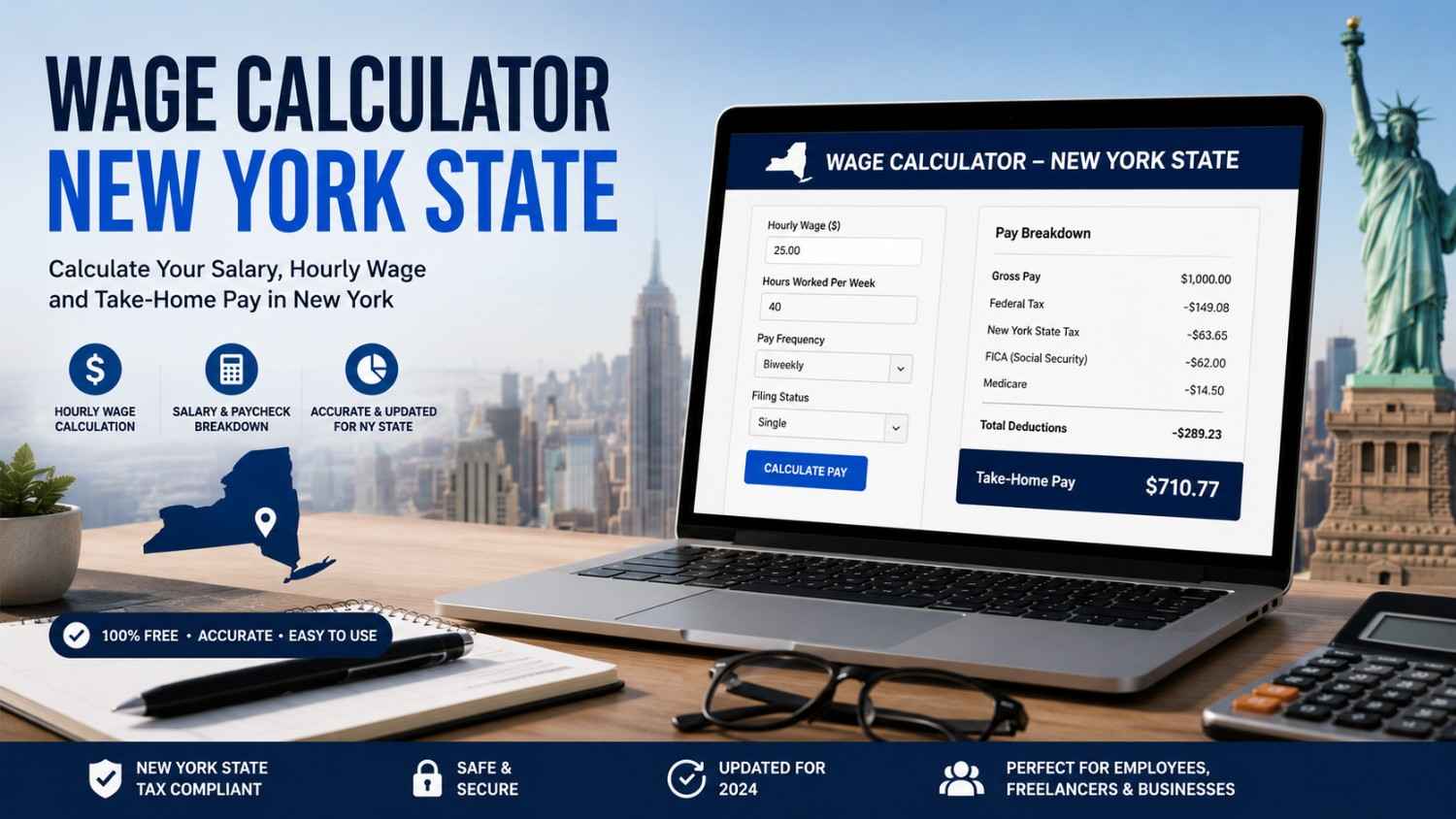
Understanding what you earn in New York is not always as simple as multiplying your hourly rate by the hours you work. Your total income can change depending on your weekly schedule, overtime hours, unpaid time off, pay frequency, and the part of the state where you work.
The Wage Calculator New York State on NewYorkCalculator.com helps you estimate your gross earnings before taxes and other payroll deductions. Enter your hourly wage, regular hours, overtime hours, and paid weeks per year to see your estimated weekly, biweekly, monthly, and annual earnings in one place.
Whether you work in New York City, Long Island, Westchester County, Albany, Buffalo, Rochester, Syracuse, or another part of the state, this guide explains how to calculate your wages and understand the numbers.
Last reviewed: October 10, 2026
New York State Wage Calculator
Calculate hourly, weekly, biweekly, monthly and annual gross pay.
Your Estimated Gross Pay
Estimates are gross wages before taxes and deductions. The calculator does not determine overtime eligibility, verify employer compliance, or estimate take-home pay. Special wage rules may apply.
What Is a New York State Wage Calculator?
A wage calculator converts your hourly pay and working schedule into estimated earnings over different periods. Instead of calculating every amount manually, you can enter your pay details once and compare the results.
For example, someone earning $25 per hour and working 40 paid hours each week earns $1,000 in gross weekly wages. If that person works 52 paid weeks in a year, the estimated annual gross wage is $52,000.
The actual amount received in a bank account may be lower because federal income tax, New York State income tax, applicable local taxes, Social Security, Medicare, insurance premiums, retirement contributions, and other deductions may apply.
This calculator focuses on gross wages. It does not claim to calculate your exact paycheck after taxes.
New York State Minimum Wage in 2026
New York has different general minimum wage rates depending on where the work is performed. As of January 1, 2026, the standard rates are:
| Work location | General minimum wage |
|---|---|
| New York City | $17.00 per hour |
| Long Island: Nassau and Suffolk counties | $17.00 per hour |
| Westchester County | $17.00 per hour |
| Rest of New York State | $16.00 per hour |
These are the general minimum wage rates, not a universal rate for every occupation. Certain workers, including eligible tipped employees and home care aides, may be subject to separate wage rules.
The New York State Department of Labor has also announced that these general rates will remain unchanged on January 1, 2027. Check the official wage guidance before relying on a rate for a future pay period.
Source: New York State Department of Labor — Minimum Wage.
How to use the minimum wage information
First, identify the location where you perform your work. Then check the wage rate that applies to your occupation and employment arrangement.
For example, a worker earning $16 per hour in Buffalo should not automatically use the New York City rate as the comparison point. Buffalo is in the remainder-of-state category for the general minimum wage, while New York City falls under the $17 rate.
The calculator provides a general benchmark. It does not determine whether a particular employer complies with every applicable wage order, tip-credit requirement, or industry-specific rule.
How to Calculate Hourly Wages in New York
For a straightforward hourly job, the basic formula is:
Gross pay = Hourly wage × Paid hours worked
Suppose you earn $22 per hour and work 35 paid hours in one week.
$22 × 35 = $770 in gross weekly pay.
If you work the same schedule for 52 paid weeks:
$770 × 52 = $40,040 in annual gross pay.
This estimate assumes that your hourly rate and weekly schedule remain unchanged throughout the year. It excludes bonuses, commissions, tips, reimbursements, unpaid absences, and other adjustments unless they are separately included.
Hourly-to-annual salary examples
The following examples assume 40 paid hours each week and 52 paid weeks per year, without overtime.
| Hourly wage | Weekly gross | Annual gross |
|---|---|---|
| $16.00 | $640 | $33,280 |
| $17.00 | $680 | $35,360 |
| $20.00 | $800 | $41,600 |
| $25.00 | $1,000 | $52,000 |
| $30.00 | $1,200 | $62,400 |
| $35.00 | $1,400 | $72,800 |
| $40.00 | $1,600 | $83,200 |
| $50.00 | $2,000 | $104,000 |
These are mathematical estimates, not a statement of the average wage for a particular occupation or city. Your actual earnings depend on your paid hours, employment agreement, and other compensation.
How to Calculate Weekly, Biweekly and Monthly Pay
Pay frequency can make an hourly wage feel different from one paycheck to another. A weekly paycheck covers one week, while a biweekly paycheck usually covers two weeks. Semi-monthly payroll generally pays twice a month, resulting in 24 pay periods annually.
For consistent earnings, you can use these formulas:
- Weekly gross: Weekly gross earnings.
- Biweekly gross: Weekly gross × 2.
- Semi-monthly average: Annual gross ÷ 24.
- Monthly average: Annual gross ÷ 12.
- Annual gross: Hourly wage × paid hours per week × paid weeks per year, plus separately calculated overtime if applicable.
Biweekly and semi-monthly are not interchangeable. There are 26 biweekly pay periods in a typical 52-week year, compared with 24 semi-monthly pay periods.
For example, a worker earning $1,000 per week for 52 paid weeks has $52,000 in annual gross wages. The average monthly gross is approximately $4,333.33. A biweekly paycheck at the same regular schedule would be approximately $2,000 before deductions.
Actual payroll calendars may include an additional payday in some calendar years, so use your employer's payroll schedule when reconciling a particular year's paychecks.
How Overtime Pay Works in New York
Overtime is an important part of calculating wages, but the correct rule depends on your job and employment classification.
For most covered, non-exempt employees, overtime is generally required for hours worked over 40 in a workweek, at no less than 1.5 times the employee's regular rate of pay. Some categories have different thresholds. For example, New York's rules for residential employees and farmworkers differ from the general rule.
A salary alone does not automatically make an employee exempt from overtime. Job duties, applicable law, and other classification requirements matter.
Source: New York State Department of Labor — Wages and Hours FAQs.
Example: Calculating overtime at $24 per hour
Suppose an eligible employee earns $24 per hour and works 45 hours in a week, with 40 regular hours and five qualifying overtime hours.
Regular pay:
40 × $24 = $960
Illustrative overtime rate:
$24 × 1.5 = $36 per hour
Overtime pay:
5 × $36 = $180
Total gross weekly pay:
$960 + $180 = $1,140
This example assumes that $24 is the applicable regular rate for the overtime calculation and that the five additional hours qualify for the standard 1.5-times rate. Bonuses, commissions, shift differentials, industry-specific rules, and other compensation can affect the legally required regular rate.
Do not assume that every employee who works more than 40 hours is automatically entitled to precisely the same overtime treatment. Consult the applicable wage order or official guidance if your situation is unusual.
New York Tipped Workers: Why the General Minimum Wage May Not Be Enough
Workers who regularly receive tips may be covered by specific cash-wage and tip-credit rules.
For the 2026 calendar year, the New York State Department of Labor lists the following hospitality cash-wage rates:
| Location | Service employee cash wage | Food-service worker cash wage |
|---|---|---|
| NYC, Long Island and Westchester | $14.15 | $11.35 |
| Remainder of New York State | $13.30 | $10.70 |
These figures are not permission to pay any tipped employee the listed cash wage without meeting the applicable legal requirements. Tip credits have conditions and restrictions, and different industries can have different rules.
For example, employers must satisfy applicable notice and tip-credit requirements, and the rules may restrict tip credits for certain non-tipped duties or when required tip thresholds are not met.
Source: New York State Department of Labor — Minimum Wage for Tipped Workers.
If you work in a restaurant, hotel, salon, home-care position, or another occupation with special wage rules, verify the rate for your exact job instead of relying solely on the general minimum wage table.
Part-Time vs. Full-Time Earnings
A part-time worker may earn a higher hourly rate but still receive less annual income because of fewer paid hours. Comparing hourly wages alone does not always show the complete financial picture.
Consider two hypothetical schedules at $25 per hour:
| Schedule | Weekly hours | Weekly gross | Annual gross at 52 paid weeks |
|---|---|---|---|
| Part-time | 20 | $500 | $26,000 |
| Reduced schedule | 30 | $750 | $39,000 |
| Full-time | 40 | $1,000 | $52,000 |
These examples assume no overtime and no unpaid weeks. They do not imply that every 40-hour schedule automatically meets every legal definition of full-time employment.
When comparing job offers, also consider benefits, paid leave, commuting costs, schedule reliability, health insurance, retirement contributions, and eligibility for overtime. A job with a higher hourly rate may not necessarily provide a higher annual income if the available hours are inconsistent.
How Unpaid Time Off Changes Annual Wage Estimates
The standard hourly-to-annual formula often assumes 52 paid weeks. That may overstate earnings if you take unpaid leave or do not receive pay for every week of the year.
Suppose you earn $25 per hour, work 40 hours each week, and receive pay for 48 weeks:
$25 × 40 × 48 = $48,000 in annual gross wages.
Using 52 paid weeks would produce $52,000, which is $4,000 more than this example's estimate.
This is why the calculator lets you adjust paid weeks per year. Use the number of weeks for which you expect to receive the wages being estimated. Do not automatically subtract paid vacation or paid holidays, because those may still be compensated.
For variable schedules, consider using a realistic average number of paid hours and weeks rather than assuming that every week will be identical.
Gross Wages vs. Take-Home Pay
Gross wages are your earnings before payroll deductions. Take-home pay is the amount remaining after applicable withholding and deductions.
Depending on your circumstances, deductions may include:
- Federal income tax withholding.
- New York State income tax withholding.
- New York City or Yonkers local income tax withholding, where applicable.
- Social Security and Medicare taxes.
- New York disability insurance and Paid Family Leave contributions, when applicable.
- Health insurance premiums, retirement contributions, or other authorized deductions.
The amount withheld from a paycheck is not always identical to your final tax liability. Your filing status, other income, dependents, elections, benefits, and tax-return adjustments can affect the final result.
For that reason, this wage calculator reports gross earnings instead of presenting an unverified take-home figure as exact.
A note about the 2026 federal overtime deduction
Federal tax law introduced a deduction for certain qualified overtime compensation for tax years 2025 through 2028. The deduction generally concerns the qualifying overtime premium above the employee's regular rate, not all overtime wages. It has eligibility rules, income-based phaseouts, and annual limits.
The IRS states that the maximum deduction is $12,500 for an eligible individual return and $25,000 for an eligible joint return, subject to the applicable requirements and limitations. The deduction does not make qualifying overtime wages generally exempt from Social Security and Medicare taxes.
This is a federal income-tax deduction, not a change to New York's minimum wage or a blanket exemption from payroll taxes. Check the latest IRS guidance or consult a tax professional before claiming it.
Source: IRS — Updated Questions and Answers About the Qualified Overtime Deduction.
How to Use the NewYorkCalculator.com Wage Calculator
Follow these steps to estimate your earnings:
- Enter your hourly wage. Use the rate that applies to your job.
- Select your work region. Choose New York City, Long Island, Westchester County, or the rest of the state.
- Enter regular weekly hours. Exclude hours that you are entering separately as overtime.
- Enter qualifying overtime hours. Leave this at zero if you do not have overtime.
- Choose the overtime multiplier. Use the applicable rate for your employment situation; 1.5 is the common example for eligible overtime.
- Set paid weeks per year. Use 52 for a full year of paid work or a lower number if you expect unpaid weeks.
- Calculate your results. Review regular pay, overtime pay, weekly gross wages, and annual gross wages.
The tool uses the selected region to show the general minimum-wage benchmark. That benchmark is informational and does not independently verify the legality of a particular wage arrangement.
How the Wage Calculator Works
For a straightforward hourly schedule, the calculator uses the following formulas:
Regular weekly pay
Hourly rate × regular hours per week
Overtime weekly pay
Hourly rate × overtime multiplier × overtime hours
Total weekly gross pay
Regular weekly pay + overtime weekly pay
Annual gross pay
Total weekly gross pay × paid weeks per year
Average monthly gross pay
Annual gross pay ÷ 12
Average biweekly gross pay
Annual gross pay ÷ 26
These calculations assume that the selected rate, hours, and weeks are consistent throughout the period. They do not automatically determine legal overtime eligibility, calculate a legally correct regular rate from every type of compensation, or account for taxes and deductions.
If you receive a salary, tips, commissions, bonuses, or other compensation, your actual payroll calculation may require additional inputs.
Frequently Asked Questions
1. What is the minimum wage in New York State in 2026?
The general minimum wage is $17 per hour in New York City, Long Island, and Westchester County, and $16 per hour in the rest of the state. Some industries and worker categories have different requirements.
2. How much is $20 an hour annually in New York?
At 40 paid hours per week and 52 paid weeks per year, $20 per hour equals $41,600 in annual gross wages before taxes and deductions.
3. How much is $25 an hour per month?
At 40 paid hours per week for 52 paid weeks, $25 per hour equals $52,000 annually. Dividing by 12 gives an average monthly gross wage of approximately $4,333.33.
4. How is overtime calculated in New York?
For most covered, non-exempt employees, overtime is generally payable at no less than 1.5 times the regular rate for hours worked over 40 in a workweek. Different rules and exemptions may apply to particular occupations.
5. Does the calculator show take-home pay after taxes?
No. This calculator estimates gross wages before taxes and deductions. An accurate take-home estimate requires additional tax and payroll information.
6. Is biweekly pay the same as semi-monthly pay?
No. Biweekly pay generally means 26 pay periods per year, while semi-monthly pay usually means 24. This distinction matters when comparing paycheck amounts.
7. Can tipped employees use the standard minimum wage rate?
They can use the calculator for a basic earnings estimate, but tipped employees may have special cash-wage, tip-credit, and overtime rules. Check the official guidance for the relevant occupation.
8. Does a salary automatically mean an employee is exempt from overtime?
No. Salary alone does not establish exemption. Job duties, compensation requirements, and applicable federal and state rules must be considered.
9. How much do I earn if I work only 30 hours a week?
Multiply your hourly wage by 30 to estimate regular weekly gross pay. For example, $20 per hour × 30 hours = $600 per week, before deductions and excluding other compensation.
10. Will the calculator tell me whether my employer is underpaying me?
It provides a general minimum-wage comparison and gross-pay estimate, but it is not a legal compliance determination. Industry rules, tip credits, overtime eligibility, and other circumstances may change the applicable requirements.
Official Sources and Calculation Limitations
For current rules, use the original government sources rather than relying only on third-party calculator websites:
- New York State Department of Labor — Minimum Wage
- New York State Department of Labor — Wages and Hours FAQs
- New York Attorney General — Wages and Pay
- Internal Revenue Service — Qualified Overtime Deduction
The wage calculator is intended for general informational and planning purposes. Its estimates are based on the inputs supplied by the user and the assumptions described on this page. It does not replace official payroll records, legal advice, or individualized tax guidance.
About the Author
Junaidul Islam writes practical online tools and informational guides for NewYorkCalculator.com. This guide is designed to help workers understand hourly wages, overtime estimates, and annual earnings using transparent calculations and official wage references.
Editorial note: Review this page whenever New York wage rates, relevant wage orders, or federal tax rules change. Confirm official rates before publishing or updating calculations.
This wage calculator sounds handy for planning ahead. How accurate do you think the projections will be for 2026?
It would be very, very good.