
Planning what happens to your assets after your death involves more than deciding who receives your property. If you own a home, investment accounts, retirement savings, or a business in New York, estate taxes may affect how much wealth eventually passes to your beneficiaries.
New York has its own estate tax system, separate from the federal estate tax. One of its most important features is the 105% estate tax cliff. Depending on the value of an estate, crossing a relatively small financial threshold can result in a substantial tax liability.
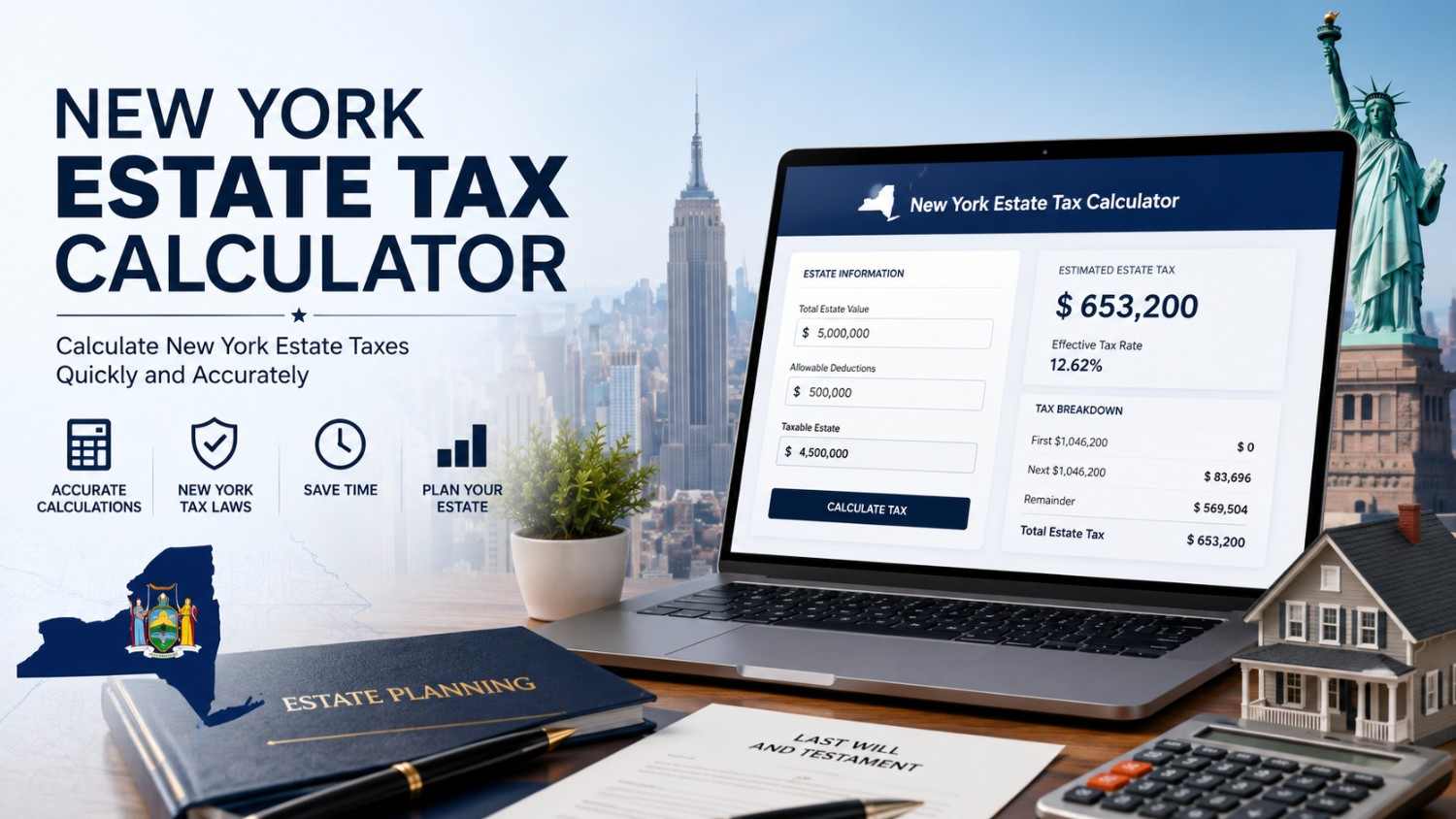
Our New York Estate Tax Calculator helps you estimate potential New York State estate tax for 2026, understand the basic exclusion amount, and see how the estate tax credit changes as an estate approaches the cliff.
Whether you are a New York homeowner, business owner, investor, executor, or someone researching estate planning, this guide explains the rules in practical terms.
2026 New York estate tax figures at a glance
- Basic exclusion amount: $7,350,000
- 105% cliff threshold: $7,717,500
- New York estate tax rates: 3.06% to 16%
- Federal estate tax basic exclusion: $15,000,000
- New York estate tax return: Form ET-706
- General filing deadline: Nine months after death
These figures apply to the relevant 2026 tax year and should be checked against the applicable official forms before filing.
Use the calculator below to estimate your New York estate tax. Enter the estimated New York taxable estate rather than simply the value of your home or bank account.
New York Estate Tax Calculator
Estimate your 2026 New York estate tax, understand the $7.35 million exclusion and see how the 105% estate tax cliff may affect your estate.
Estimated New York Estate Tax
Estate Tax Cliff Progress
Federal Estate Tax Comparison
Official source: New York State Estate Tax
The calculator provides an educational estimate using the New York tax rate schedule and the 2026 exclusion and credit phaseout rules. It is not a substitute for preparing an official estate tax return.
What Is New York Estate Tax?
New York estate tax is a state-level tax imposed on the taxable estate of a person who dies while subject to New York estate tax rules.
Unlike an inheritance tax, which is generally imposed on the person receiving an inheritance, an estate tax is calculated against the estate itself.
For example, imagine a New York resident dies leaving a home, investment accounts, bank deposits, and other assets. The executor must determine the value of the includible assets, applicable deductions, and other required adjustments.
If the resulting New York taxable estate is above the applicable exclusion amount, the estate may owe New York estate tax.
The tax is generally paid from estate assets before the remaining property is distributed to beneficiaries.
New York does not impose a separate inheritance tax on beneficiaries simply because they receive an inheritance.
What Is the New York Estate Tax Exemption in 2026?
For individuals who die between January 1 and December 31, 2026, New York’s basic exclusion amount is $7,350,000.
This means an estate at or below the applicable exclusion amount generally has no New York estate tax liability, assuming the calculation and applicable credit requirements are satisfied.
However, New York’s system is more complicated than a simple exemption.
The exclusion is delivered through an applicable credit, and that credit is reduced when the taxable estate exceeds the basic exclusion amount.
The credit eventually disappears when the estate reaches 105% of the exclusion amount.
New York estate tax exemption history
The exclusion amount changes over time. The following figures are useful when reviewing estates from different years.
| Year of death | Basic exclusion amount |
|---|---|
| 2026 | $7,350,000 |
| 2025 | $7,160,000 |
| 2024 | $6,940,000 |
| 2023 | $6,580,000 |
| 2022 | $6,110,000 |
| 2021 | $5,930,000 |
| 2020 | $5,850,000 |
Always select the exclusion amount that corresponds to the actual date of death. A calculator designed for 2026 should not automatically be used to prepare a return for someone who died in 2024 or 2025.
Understanding the New York Estate Tax Cliff
The estate tax cliff is one of the most important features of New York estate planning.
In 2026, the basic exclusion is $7,350,000. The 105% threshold is:
$7,350,000 × 1.05 = $7,717,500.
When the taxable estate exceeds the exclusion, the applicable credit begins to decrease. When it reaches the 105% threshold, the credit becomes zero.
Consequently, the estate may owe tax on the entire taxable estate under the graduated rate schedule rather than only on the amount above the exclusion.
How the 105% cliff works
Consider these simplified examples:
| New York taxable estate | Estimated NY estate tax |
|---|---|
| $7,000,000 | $0 |
| $7,350,000 | $0 |
| $7,500,000 | $386,400 |
| $7,717,500 | $734,780 |
The examples assume the 2026 exclusion, the applicable graduated tax table, and the standard credit phaseout calculation.
An important detail is that the credit does not suddenly disappear only when an estate crosses the 105% threshold. It is progressively reduced between 100% and 105% of the exclusion.
This is why estate owners approaching the threshold should not rely on a basic exemption calculator alone.
New York Estate Tax Rates for 2026
New York uses a graduated estate tax schedule. The rates range from 3.06% to 16%.
The following schedule is based on the official New York Form ET-706 rate table.
| New York taxable estate | Tax calculation |
|---|---|
| $0–$500,000 | 3.06% |
| $500,000–$1,000,000 | $15,300 + 5% over $500,000 |
| $1,000,000–$1,500,000 | $40,300 + 5.5% over $1 million |
| $1,500,000–$2,100,000 | $67,800 + 6.5% over $1.5 million |
| $2,100,000–$2,600,000 | $106,800 + 8% over $2.1 million |
| $2,600,000–$3,100,000 | $146,800 + 8.8% over $2.6 million |
| $3,100,000–$3,600,000 | $190,800 + 9.6% over $3.1 million |
| $3,600,000–$4,100,000 | $238,800 + 10.4% over $3.6 million |
| $4,100,000–$5,100,000 | $290,800 + 11.2% over $4.1 million |
| $5,100,000–$6,100,000 | $402,800 + 12% over $5.1 million |
| $6,100,000–$7,100,000 | $522,800 + 12.8% over $6.1 million |
| $7,100,000–$8,100,000 | $650,800 + 13.6% over $7.1 million |
| $8,100,000–$9,100,000 | $786,800 + 14.4% over $8.1 million |
| $9,100,000–$10,100,000 | $930,800 + 15.2% over $9.1 million |
| Over $10,100,000 | $1,082,800 + 16% over $10.1 million |
These rates calculate the preliminary tax. The applicable credit and estate-specific adjustments determine the final New York estate tax.
How to Calculate New York Estate Tax
A proper calculation involves several steps.
Step 1: Determine the gross estate
Start by identifying all property and interests that must be included in the decedent’s federal gross estate.
Depending on the circumstances, this may include:
- Residential and commercial real estate
- Bank and savings accounts
- Stocks, bonds, and investment funds
- Business ownership interests
- Retirement accounts
- Certain life insurance proceeds
- Jointly owned property
- Other includible assets
The value generally needs to be established under the applicable valuation rules, usually using fair market value at the date of death unless a permitted alternative valuation applies.
Step 2: Identify allowable deductions
Potential deductions may include:
- Qualifying debts and mortgages
- Funeral expenses
- Estate administration expenses
- Certain legal and professional fees
- Qualifying charitable transfers
- Allowable marital deductions
Not every expense or debt automatically qualifies. The estate must satisfy the relevant tax rules and documentation requirements.
Step 3: Account for includible gifts
Certain taxable gifts made during the three-year period before death may be included in New York’s estate tax calculation.
This rule can make the calculation different from simply adding up the assets owned on the date of death.
Step 4: Determine the New York taxable estate
The executor must determine the amount applicable under New York’s estate tax rules.
For a New York resident, the calculation generally starts with the federal gross estate and applicable adjustments, including includible gifts and allowable deductions.
For a nonresident, additional rules apply to New York-situs property and the allocation of the estate.
Step 5: Apply the graduated tax table
The preliminary New York estate tax is calculated using the official Form ET-706 rate schedule.
Step 6: Calculate the applicable credit
The credit is determined using the applicable exclusion amount and the phaseout rules.
If the taxable estate is at or below the basic exclusion amount, the applicable credit generally offsets the preliminary tax.
Between the exclusion and 105% threshold, the credit is reduced.
At or above the 105% threshold, the credit is zero.
Step 7: Determine the remaining tax liability
Subtract the applicable credit from the preliminary estate tax and consider other adjustments required by the return.
The result is the estimated New York estate tax liability.
Gross Estate vs. Taxable Estate: What Is the Difference?
These two terms are frequently confused.
Gross estate generally refers to the value of property and interests included under estate tax rules before applicable deductions.
Taxable estate is the amount remaining after the relevant deductions and adjustments have been applied.
For example, suppose an estate has $9 million in includible assets. It may also have qualifying debts, administration expenses, and other deductions.
The taxable estate may therefore be lower than the gross estate.
However, New York’s filing threshold uses specific statutory calculations involving the federal gross estate and includible gifts. It should not be confused with the final taxable estate used in the tax computation.
This distinction is especially important when an estate is close to the filing threshold.
New York Estate Tax for Residents vs. Nonresidents
New York resident and nonresident estates do not follow identical rules.
New York residents
For a New York resident, the filing test generally considers the federal gross estate plus includible gifts.
If the applicable amount exceeds the basic exclusion amount, the estate generally needs to file a New York estate tax return.
The calculation can involve assets located both inside and outside New York.
Nonresidents who own New York property
A person who lives outside New York may still have New York estate tax exposure.
For example, consider someone whose permanent residence is Florida but who owns a New York vacation property or commercial real estate.
New York may require an estate tax return if the estate includes New York real or tangible property and the applicable filing threshold is exceeded.
The tax calculation may require an allocation based on New York-situs property.
Intangible assets, business interests, and ownership structures can involve more complicated domicile and situs rules. A nonresident should not assume that every asset is treated in the same way.
Federal Estate Tax vs. New York Estate Tax in 2026
New York estate tax and federal estate tax are separate systems.
For 2026:
| Tax feature | New York | Federal |
|---|---|---|
| Basic exclusion | $7,350,000 | $15,000,000 |
| Maximum marginal rate | 16% | 40% |
| Estate tax cliff | Yes | No equivalent New York-style 105% cliff |
| Tax authority | NYS Department of Taxation and Finance | IRS |
| Return | ET-706 | Form 706 |
The federal basic exclusion for 2026 is $15 million under the applicable federal law.
An estate may therefore owe New York estate tax without owing federal estate tax.
For example, a taxable estate of $8 million may be above New York’s 105% cliff threshold while remaining below the federal basic exclusion amount.
This is an important reason why New York estate planning requires a separate state-level review.
Do Married Couples Get a Double New York Estate Tax Exemption?
Not automatically.
A married couple may each have an individual New York basic exclusion amount, but the unused exclusion of a deceased spouse does not transfer to the surviving spouse in the same way as federal estate tax portability.
The federal system provides a deceased spousal unused exclusion election, commonly called DSUE portability, when the required conditions are met.
New York does not provide equivalent general portability.
This means that simply leaving everything to a surviving spouse may not preserve both spouses’ New York exclusions for the future.
What is a credit-shelter trust?
A credit-shelter trust, sometimes called a bypass trust, may be used as part of a couple’s estate plan.
Depending on the structure and applicable legal requirements, assets can be allocated to a trust at the first spouse’s death.
The purpose may be to preserve the first spouse’s exclusion for future estate tax planning.
However, trust planning involves legal, tax, and control considerations. It is not automatically beneficial for every family.
A New York estate planning attorney should review the proposed structure before documents are changed.
Does New York Have a Three-Year Gift Addback Rule?
Yes. Certain taxable gifts made within three years before death can be included in the New York estate tax calculation.
This is an important detail because a person may believe that transferring assets shortly before death automatically removes those assets from estate tax consideration.
That assumption can be incorrect.
The applicable New York rules contain exceptions and specific conditions. Not every gift is treated identically.
An executor should review:
- The date each gift was made
- The type of property transferred
- Whether the gift was taxable under the applicable rules
- Whether an exclusion or exception applies
- The supporting gift tax records
The federal gift tax and New York estate tax are related but should not be treated as identical systems.
How Are Real Estate and Retirement Accounts Treated?
New York real estate
A home, rental property, commercial building, or other real estate interest may form a substantial part of an estate.
Its fair market value can affect the gross estate and the resulting tax calculation.
A mortgage may be relevant to the deductions, but the value of the property and the amount of debt should be documented separately.
Retirement accounts
Traditional IRAs, employer-sponsored retirement accounts, and other retirement assets can have estate tax implications.
Their treatment depends on ownership, beneficiary arrangements, and applicable federal and state rules.
An account naming a beneficiary does not automatically mean its value is excluded from the decedent’s gross estate.
Also, estate tax and income tax are different. A beneficiary may face income tax consequences when receiving distributions even if no federal estate tax is due.
Life insurance
Life insurance proceeds may be included in the gross estate under certain ownership and policy-control circumstances.
The fact that a policy pays directly to a beneficiary does not, by itself, settle the estate tax question.
Policy ownership, incidents of ownership, and applicable transfer rules should be reviewed.
What Is the New York Estate Tax Filing Deadline?
Generally, Form ET-706 must be filed within nine months after the date of death.
If the estate needs more time, it may apply for an extension using the appropriate New York form.
However, an extension to file should not automatically be treated as an extension to pay.
The executor should review Form ET-133 and its instructions to determine the available filing and payment options.
Additional payment arrangements or deferred payment provisions may apply in certain qualifying circumstances.
What documents may an executor need?
The estate may need:
- A certified death certificate
- A complete asset inventory
- Real estate valuation documents
- Bank and investment account statements
- Business valuation information
- Debt and mortgage statements
- Expense records
- Charitable transfer documentation
- Federal estate tax return and supporting schedules, where applicable
- Gift tax records
New York’s estate tax return generally uses federal estate tax information as its starting point. A completed federal return may be required as supporting documentation even when a federal estate tax payment is not due.
Can You Reduce New York Estate Tax Legally?
Estate planning may help families manage potential estate tax exposure, but the correct strategy depends on the person’s assets, family circumstances, and timing.
Some planning approaches include:
1. Review the estate value regularly
Property prices and investment values change. An estate that was below the exclusion several years ago may now be above it.
Periodic reviews help identify potential tax exposure before a crisis.
2. Consider charitable planning
Qualifying charitable bequests may reduce the taxable estate.
For estates close to the 105% threshold, properly structured charitable planning may also affect the applicable credit calculation.
3. Review trust arrangements
Certain irrevocable trusts and other estate planning structures may help achieve specific transfer or ownership goals.
However, transferring property into a trust does not automatically remove it from the estate.
4. Review lifetime gifts carefully
Lifetime gifting may be useful in some estate plans, but New York’s three-year gift addback rule and federal gift tax requirements must be considered.
5. Review life insurance ownership
Life insurance can provide liquidity for estate expenses and other needs, but ownership and policy structure may affect estate tax inclusion.
6. Plan for both spouses
Couples should understand the differences between federal portability and New York’s rules.
A properly designed estate plan may help preserve tax planning opportunities across both spouses’ lifetimes.
Never transfer property, change beneficiary designations, or establish a trust solely because of a calculator result. Get advice from an appropriately qualified professional.
New York Estate Tax Calculation Examples
The following examples use the 2026 New York exclusion and official rate schedule. They illustrate the general tax mechanism, not an individual estate tax return.
Example 1: Estate valued at $5 million
Suppose the New York taxable estate is $5 million.
The amount is below the $7.35 million basic exclusion.
Estimated New York estate tax: $0.
Example 2: Estate valued at $7.35 million
The estate is exactly equal to the 2026 exclusion amount.
The applicable credit generally offsets the preliminary tax.
Estimated New York estate tax: $0.
Example 3: Estate valued at $7.5 million
The estate is $150,000 above the basic exclusion.
The credit begins to phase out.
Using the official rate table and credit phaseout calculation:
Estimated New York estate tax: $386,400.
Example 4: Estate valued at $7,717,500
The estate reaches 105% of the exclusion.
At this point, the applicable credit is eliminated.
Estimated New York estate tax: $734,780.
Example 5: Estate valued at $10 million
The estate exceeds the 105% threshold.
The entire taxable estate is subject to the graduated rate schedule without the exclusion credit.
The preliminary tax is calculated using the applicable tax table.
These examples demonstrate why an estate near the New York exclusion requires careful planning.
Frequently Asked Questions
1. What is the New York estate tax exemption for 2026?
The New York basic exclusion amount is $7,350,000 for individuals who die between January 1 and December 31, 2026.
2. Does New York have an estate tax cliff?
Yes. New York has a 105% estate tax cliff. For 2026, the threshold is $7,717,500. The applicable credit is phased out as the taxable estate rises from the basic exclusion to that threshold.
3. What is the highest New York estate tax rate?
The highest marginal New York estate tax rate is 16%.
4. Does New York have an inheritance tax?
New York does not impose a separate inheritance tax on beneficiaries. It imposes an estate tax on qualifying estates.
5. Do I pay both federal and New York estate tax?
Potentially. The two systems are separate. An estate may owe New York estate tax while remaining below the federal exclusion.
6. Does New York allow estate tax portability between spouses?
New York does not provide general portability of a deceased spouse’s unused state exclusion. Federal portability is a separate rule.
7. Do nonresidents pay New York estate tax?
They may. Nonresidents with New York real or tangible property can have New York estate tax filing and payment obligations when the applicable threshold is exceeded.
8. Are retirement accounts included in an estate?
Certain retirement account interests may be included in the gross estate, depending on ownership and applicable rules. Income tax treatment for beneficiaries is a separate matter.
9. Are gifts made before death included in New York estate tax?
Certain taxable gifts made within three years before death may be included. The rules contain exceptions and must be reviewed individually.
10. When is Form ET-706 due?
Generally, it is due nine months after the date of death. An extension may be available through the appropriate application.
11. Can an estate owe New York tax but no federal tax?
Yes. New York’s 2026 basic exclusion is $7.35 million, while the federal basic exclusion is $15 million.
12. Is the New York Estate Tax Calculator an official tax calculator?
No. It is an independent educational estimator. It is not operated by the New York Department of Taxation and Finance or the IRS.
Final Thoughts
New York estate tax planning deserves special attention because of the state’s relatively low exclusion compared with the federal threshold and its unusual 105% cliff.
Understanding the difference between gross estate, taxable estate, filing requirements, and the applicable credit can help families avoid costly assumptions.
Our New York Estate Tax Calculator is designed to make the initial estimate easier to understand. Use it as a starting point, review the official tax forms, and consult a qualified estate planning attorney or tax professional before making financial or legal decisions.
About the Author
Junaidul Islam writes practical financial calculators and educational resources for NewYorkCalculator.com. His focus is making complex financial and tax topics easier for everyday users to understand.
Important Disclaimer: This article and calculator provide general educational information, not legal, tax, accounting, or financial advice. Tax rules and forms can change. Actual liability depends on the decedent’s circumstances, applicable law, elections, deductions, and official tax return calculations. Verify all figures with the New York State Department of Taxation and Finance and the IRS before filing or making estate planning decisions.
Official Resources
- New York State Department of Taxation and Finance: https://www.tax.ny.gov/pit/estate/etidx.htm
- New York Form ET-706: https://www.tax.ny.gov/pdf/current_forms/et/et706_fill_in.pdf
- New York Form ET-706 Instructions: https://www.tax.ny.gov/pdf/current_forms/et/et706i.pdf
- IRS Estate Tax Information: https://www.irs.gov/businesses/small-businesses-self-employed/estate-tax