
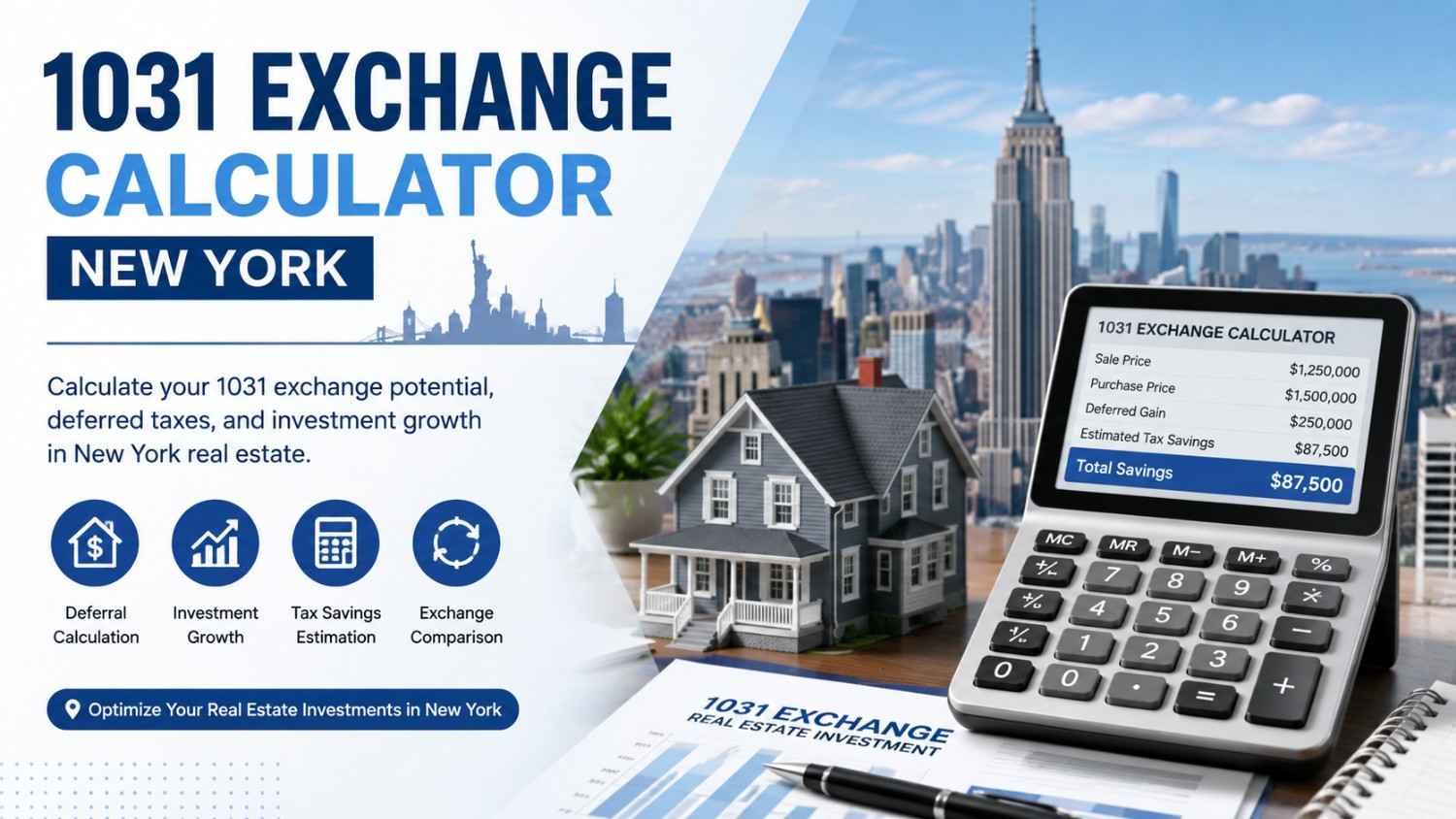
Selling an investment property in New York can create a substantial tax liability, particularly when the property has appreciated significantly or accumulated years of depreciation. Before accepting an offer, many property owners want to know one thing: How much of the gain could be deferred if they reinvest in another qualifying property?
A 1031 Exchange Calculator New York can help answer that question by estimating realized gain, potential taxable boot, replacement property requirements, and the amount of gain that may remain deferred under Section 1031 of the Internal Revenue Code.
This guide and calculator are designed for New York real estate investors, rental property owners, commercial property owners, and other taxpayers considering a like-kind exchange. It explains the federal rules, New York-specific considerations, calculation methods, deadlines, and potential costs that can affect an exchange.
Use the calculator below to explore your own scenario. The results are planning estimates, not a tax return or a guarantee of tax savings.
1031 Exchange Calculator New York
Estimate realized gain, potential taxable boot, deferred gain, replacement property requirements and important exchange deadlines.
1. Relinquished Property Details
2. Replacement Property Details
3. Estimated Tax Assumptions
Your Estimated Exchange Results
Property Calculation Breakdown
Replacement Property Planning
Exchange Deadline Planner
The 180-day completion period is shortened when the applicable federal return due date, including extensions, comes earlier.
What Is a 1031 Exchange in New York?
A Section 1031 exchange is a federal tax-deferral provision that can allow an investor to exchange qualifying real property held for investment or productive use in a trade or business for other qualifying like-kind real property without immediately recognizing all of the gain.
The provision takes its name from Section 1031 of the Internal Revenue Code.
For example, imagine an investor owns a rental property in Queens that has increased considerably in value. Instead of selling the property, receiving the proceeds personally, and immediately purchasing another rental building, the investor may structure a qualifying exchange through a Qualified Intermediary.
If the transaction satisfies the applicable requirements, the investor may defer some or all of the otherwise recognizable gain.
The important distinction is that a 1031 exchange generally defers tax rather than permanently eliminates it. The deferred gain normally carries into the replacement property’s tax basis.
A New York property owner can potentially exchange qualifying investment real estate for qualifying replacement real estate in another US state. The exchange does not generally have to remain within New York, although state tax treatment and reporting requirements must be reviewed.
Who Can Use a 1031 Exchange?
Section 1031 is generally available to taxpayers exchanging qualifying real property held for investment or productive use in a trade or business.
Potentially qualifying properties include:
- Residential rental buildings.
- Multifamily investment properties.
- Commercial office buildings.
- Retail investment properties.
- Industrial buildings and warehouses.
- Investment land.
- Certain long-term leasehold interests.
- Other qualifying business or investment real estate.
A property does not automatically qualify simply because it is located in New York or generates rental income. Its actual ownership, use, tax classification, and transaction structure matter.
Properties That Generally Do Not Qualify
The following situations require particular attention:
- A personal residence used primarily as the taxpayer’s home.
- Property held primarily for resale, such as dealer inventory.
- Stocks, bonds, and partnership interests.
- Personal-use assets that are not qualifying real property.
- Certain transactions involving related parties or disqualified intermediaries.
A property with mixed personal and rental use may require a more detailed analysis. Similarly, converting a personal residence into a rental does not automatically make the entire property eligible.
The IRS generally limits Section 1031 to real property following the Tax Cuts and Jobs Act changes effective for exchanges after 2017.
How to Use Our New York 1031 Exchange Calculator
The calculator is intended to help investors understand the financial structure of a proposed exchange before committing to a transaction.
For a useful estimate, gather the following information first:
1. Sale price
Enter the expected or contracted selling price of the relinquished property.
2. Original purchase price
Use the property’s original tax purchase cost, not its current estimated market value.
3. Capital improvements
Include qualifying capital improvements that increased the property’s tax basis. Ordinary repairs and routine maintenance generally should not be treated as capital improvements.
4. Accumulated depreciation
Enter depreciation allowed or allowable over the property’s ownership period. This amount can materially affect adjusted basis and the character of the taxable gain.
5. Selling expenses
Include eligible transaction costs such as brokerage commissions and qualifying closing expenses. Not every expense appearing on a closing statement is automatically an exchange expense or basis adjustment.
6. Existing mortgage
Enter the outstanding debt expected to be paid off when the relinquished property is transferred.
7. Replacement property value
Enter the anticipated purchase price of the replacement investment property.
8. New mortgage and additional cash
These figures help evaluate whether the investor is replacing the debt and equity involved in the original property.
9. Exchange closing date
Enter the actual transfer date of the relinquished property. This date is essential for calculating the identification and completion deadlines.
Once the information is entered, review the estimated realized gain, potential boot, deferred gain, replacement property requirements, and exchange dates.
How Is Realized Gain Calculated?
Realized gain is the economic gain recognized for tax-analysis purposes before applying the Section 1031 deferral rules.
A simplified starting formula is:
Adjusted Tax Basis = Original Purchase Cost + Qualifying Capital Improvements − Depreciation
The basis may require additional adjustments for acquisition costs, casualty losses, prior transactions, and other tax items.
Next:
Estimated Amount Realized = Sale Price − Eligible Selling Expenses
Finally:
Realized Gain = Amount Realized − Adjusted Tax Basis
New York Property Example
Consider an investor selling a rental property in Brooklyn with these illustrative figures:
| Item | Amount |
|---|---|
| Original purchase cost | $400,000 |
| Capital improvements | $50,000 |
| Accumulated depreciation | $80,000 |
| Adjusted basis | $370,000 |
| Sale price | $750,000 |
| Eligible selling expenses | $35,000 |
| Estimated amount realized | $715,000 |
| Estimated realized gain | $345,000 |
The investor has an estimated realized gain of $345,000 before applying the exchange rules.
This is not automatically the amount of taxable income. A qualifying exchange may defer some or all of the gain, depending on the actual transaction.
How Depreciation Affects a 1031 Exchange
Depreciation is one of the most important details to understand before selling an investment property.
Owners of depreciable rental and commercial property may have claimed depreciation deductions during their ownership period. Those deductions generally reduce the property’s adjusted tax basis.
For example, an investor who purchased a property for $500,000 and claimed $100,000 in accumulated depreciation may have a substantially lower adjusted basis than the original purchase cost, before considering other adjustments.
When the property is sold without an applicable deferral, depreciation-related gain can receive different tax treatment from the remaining capital gain.
For certain depreciable real property, unrecaptured Section 1250 gain may be subject to a maximum federal rate of 25%. This is not a universal flat tax rate on all depreciation, and the actual treatment depends on the taxpayer’s circumstances and the property.
A properly structured Section 1031 exchange can defer qualifying gain, including gain associated with prior depreciation. It does not necessarily erase the depreciation history or remove future tax consequences.
The replacement property’s basis must be calculated using the applicable carryover and adjustment rules.
What Is Boot in a 1031 Exchange?
Boot is generally the non-like-kind value received in an exchange that can trigger current gain recognition.
It is a major reason an investor may not achieve complete tax deferral even when the replacement property qualifies.
There are two important concepts.
1. Cash Boot
Cash boot can arise when an investor receives cash or other non-like-kind property rather than reinvesting all the value required for the intended exchange.
Example:
- Original property value: $700,000.
- Replacement property value: $620,000.
- Potential value difference: $80,000.
The $80,000 difference is a warning sign that requires further analysis. It does not automatically establish the final taxable gain because transaction expenses, liabilities, additional funds, and the actual exchange structure can affect the result.
2. Mortgage or Debt-Relief Boot
Mortgage boot can arise when debt on the relinquished property is paid off and the investor does not sufficiently replace that debt or offset the reduction with additional money contributed to the exchange.
Example:
An investor transfers a property with a $300,000 mortgage and acquires a replacement property with a $220,000 mortgage.
The $80,000 debt reduction may create debt-relief boot, subject to applicable liability-netting rules and other adjustments.
This issue is particularly important for New York investors who are moving from a heavily financed multifamily property into a lower-priced or less-leveraged investment.
Can Cash and Debt Boot Be Offset?
Potentially, yes. Additional cash contributed by the investor and certain liabilities assumed can affect the calculation of net liabilities and boot.
However, simply adding the cash difference and mortgage difference together is not a complete legal or tax calculation in every transaction.
A proper analysis should account for the actual consideration transferred, liabilities assumed, money contributed, and applicable Section 1031 regulations.
How Much Must You Reinvest to Defer the Full Gain?
A common planning guideline for a fully deferred exchange is to acquire qualifying replacement property with a value at least equal to the relinquished property’s value, reinvest the required net exchange equity, and avoid unoffset debt relief.
These are practical planning benchmarks, not a substitute for calculating recognized gain under the statute and regulations.
Consider this example:
An investor sells a New York rental building for $900,000 and has $250,000 in outstanding debt.
The investor is considering a replacement property worth $1,000,000.
The investor should review:
- The amount of net exchange proceeds available.
- Eligible exchange expenses.
- The mortgage payoff.
- The replacement property’s financing.
- Any additional personal funds contributed.
- Whether the transaction creates cash or mortgage boot.
Buying a more expensive property alone does not guarantee complete tax deferral. The equity and liability structure also matters.
Our calculator provides an initial planning comparison, but the final replacement-property requirements should be confirmed by a tax professional and Qualified Intermediary.
The 45-Day Identification Rule
The 45-day identification period is one of the strictest requirements in a delayed exchange.
It begins on the day the investor transfers the relinquished property.
The investor must identify potential replacement property in writing no later than midnight on the 45th calendar day after the transfer.
Identification should be delivered to the appropriate person under the exchange agreement, commonly the Qualified Intermediary, following the required identification procedures.
The Three-Property Rule
An investor may generally identify up to three potential replacement properties without regard to their combined fair market value.
This is often the simplest identification approach.
The 200% Rule
An investor may identify more than three properties if the total fair market value of all identified properties does not exceed 200% of the aggregate fair market value of the relinquished property, subject to the applicable regulations.
The 95% Exception
If the investor exceeds the relevant identification limits, the identification can still qualify under the 95% rule if the investor acquires replacement property representing at least 95% of the aggregate fair market value of all identified properties.
This exception is demanding and should not be treated as a casual workaround.
The 180-Day Exchange Deadline
The investor generally must receive the replacement property by the earlier of:
- The 180th day after transferring the relinquished property; or
- The due date of the taxpayer’s federal income tax return for the year of transfer, including extensions.
This second rule is frequently overlooked.
For example, an investor who transfers a property late in the calendar year may face a tax-return deadline earlier than the ordinary 180-day deadline.
An eligible filing extension may change the return-due-date calculation, but investors should not assume an extension automatically solves every timing issue.
The 45-day and 180-day periods run concurrently. The 180-day period does not begin after the 45-day identification period ends.
Important: These are calendar-day deadlines, not ordinary business-day periods. Limited statutory disaster or other relief may apply in specific situations, but investors should not plan around an assumed extension.
New York State and NYC Tax Considerations
A New York 1031 exchange requires more than a federal calculation.
Investors should distinguish between income taxes on recognized gain and real estate transfer taxes associated with a conveyance.
New York State Real Estate Transfer Tax
New York State generally imposes a basic real estate transfer tax of $2 for every $500, or fraction thereof, of consideration.
A separate 1% mansion tax generally applies to qualifying residential conveyances with consideration of $1 million or more.
These are transaction taxes, not the same thing as federal or state capital gains income taxes.
Certain qualifying Section 1031 transactions may receive specific transfer-tax treatment, and New York law includes rules for qualifying exchange property. Investors should review the actual conveyance and applicable statutory provisions rather than assuming every deed transfer is exempt.
New York City Real Property Transfer Tax
New York City has its own Real Property Transfer Tax (RPTT).
For covered residential transfers:
- Consideration of $500,000 or less generally attracts a 1% rate.
- Consideration above $500,000 generally attracts a 1.425% rate.
For other covered property transfers:
- Consideration of $500,000 or less generally attracts a 1.425% rate.
- Consideration above $500,000 generally attracts a 2.625% rate.
Certain high-value NYC conveyances may also be subject to additional New York State taxes.
The classification of the property and the actual transaction matter. These rates should not be blindly applied to every exchange or treated as a tax on capital gain.
New York State Income Tax
A taxpayer’s New York State income tax position depends on residency, the source of the gain, the taxpayer’s filing status, and applicable state tax rules.
A nonresident selling New York real estate may have New York estimated income tax and filing obligations even when the person lives elsewhere.
New York City Personal Income Tax
NYC personal income tax generally depends on whether the taxpayer is a New York City resident and other applicable tax rules.
A property located in Manhattan does not automatically make every owner liable for NYC resident income tax.
A nonresident owner and a NYC resident owner may have different tax situations.
For these reasons, the calculator should allow users to distinguish New York State and NYC tax assumptions instead of treating every New York investor as a city resident.
Can You Exchange a New York Property for Property in Another State?
Generally, yes.
Federal Section 1031 rules do not require an investor to acquire replacement real estate in the same state where the relinquished property was located.
For example, an investor may sell a qualifying rental property in Manhattan and acquire qualifying investment property in Florida, Texas, or another US state.
However, moving the replacement property outside New York does not automatically remove every New York tax obligation.
New York source income, nonresident reporting, state conformity, and transaction-specific rules must be considered.
Cross-state exchanges deserve particular attention when the investor changes residency around the time of the sale.
What Is a Qualified Intermediary?
A Qualified Intermediary (QI) is a third party used in many deferred exchange structures to facilitate the exchange and hold the exchange proceeds.
In a standard delayed exchange, the investor should arrange the exchange agreement and QI relationship before transferring the relinquished property.
The investor generally must not receive actual or constructive control of the exchange proceeds in a way that disqualifies the transaction.
A QI is not automatically a CPA, attorney, investment adviser, or government agency.
What Should You Check Before Choosing a QI?
Before signing an agreement, consider:
- The intermediary’s experience with the type of exchange.
- How exchange funds are held and protected.
- Whether funds are segregated or placed in appropriate accounts.
- The institution holding the funds.
- Insurance coverage and any limitations.
- Fees and administrative charges.
- Wire transfer and withdrawal procedures.
- What happens if the intermediary becomes insolvent.
- The intermediary’s disqualified-person status.
- The timing and process for identifying replacement properties.
A QI’s failure or a poorly structured agreement can create significant problems. Investors should complete their due diligence before closing.
Reverse 1031 Exchange: Buying Before Selling
A reverse exchange is a structure in which the investor acquires the replacement property before transferring the relinquished property.
It can be useful in competitive markets where an attractive replacement property becomes available before the investor’s existing property sells.
However, a reverse exchange is more complicated than a conventional delayed exchange.
It commonly involves an Exchange Accommodation Titleholder (EAT), a qualified exchange accommodation arrangement, and additional financing and documentation.
The IRS safe-harbor framework generally includes a 45-day identification period and a 180-day exchange period under the applicable reverse-exchange guidance.
A reverse exchange should be arranged with experienced tax and legal professionals before the acquisition takes place.
Improvement or Construction 1031 Exchange
An improvement exchange may allow an investor to use exchange funds for qualifying improvements to replacement property within the exchange structure.
This can be useful when an investor wants to acquire a property that needs construction, renovation, or additional improvements.
However, the improvements generally must be completed and properly structured within the applicable exchange period.
The replacement property must satisfy the relevant ownership and value requirements when transferred to the taxpayer.
An investor should not assume that renovation expenses paid after personally receiving the replacement property automatically count toward a qualifying exchange.
Related-Party 1031 Exchanges
Transactions involving relatives, commonly controlled businesses, or other related parties can trigger additional Section 1031 restrictions.
The related-party rules under Section 1031(f) are designed to prevent taxpayers from using an intermediary to circumvent restrictions on certain related-party exchanges.
A special two-year holding rule can apply, subject to statutory exceptions.
Before arranging a transaction with a family member, controlled entity, partnership, or other related party, obtain advice on the exact ownership relationships and transaction structure.
How Is the New Replacement Property Tax Basis Calculated?
One of the most misunderstood parts of a 1031 exchange is the replacement property’s tax basis.
A qualifying exchange generally does not reset the replacement property’s tax basis to its full purchase price.
Instead, the basis is generally determined under Section 1031(d), taking into account the relinquished property’s basis, additional money or property transferred, recognized gain, and other applicable adjustments.
A simplified illustration:
- Adjusted basis of relinquished property: $300,000.
- Realized gain: $400,000.
- Gain currently recognized: $0.
- Replacement property value: $700,000.
In a simplified fully deferred exchange with no other adjustments, the replacement property’s carryover basis may be approximately $300,000 rather than $700,000.
The deferred gain remains embedded in the new property’s tax position.
The exact calculation can change when boot, additional cash, liabilities, exchange expenses, or other adjustments are involved.
This is why investors should not confuse the replacement property’s purchase price with its tax basis.
Real-Life 1031 Exchange Scenarios
The following examples are simplified illustrations intended to explain common planning situations.
Scenario 1: Full Tax Deferral
An investor sells an investment property for $800,000 and acquires qualifying replacement property worth $900,000.
The investor reinvests the required equity, properly replaces the relevant liabilities, uses a QI, and satisfies the exchange deadlines.
If all other requirements are satisfied and no boot is recognized, the investor may defer the full qualifying gain.
Scenario 2: Cash Boot
An investor sells an investment property and receives $50,000 in cash from the exchange rather than reinvesting all the value required for full deferral.
The cash may represent boot.
Recognized gain is generally limited by the realized gain and the applicable boot rules. The investor should not automatically assume the entire amount will be taxed as ordinary income or at one flat rate.
Scenario 3: Mortgage Reduction
An investor pays off a $400,000 loan on the relinquished property and takes a $300,000 loan on the replacement property.
The $100,000 difference may create mortgage boot if it is not offset under the applicable liability and cash contribution rules.
This can happen even when the investor never physically receives the difference in cash.
Scenario 4: Replacement Property in Florida
An investor sells qualifying New York investment real estate and purchases qualifying replacement property in Florida.
The interstate location difference does not automatically prevent federal Section 1031 treatment.
However, the investor should evaluate New York source-income and nonresident reporting obligations along with Florida transaction costs and applicable local rules.
What Happens If You Miss the 45-Day or 180-Day Deadline?
Missing a required exchange deadline can cause the transaction to fail Section 1031 treatment.
If a deferred exchange does not qualify, the gain may become recognizable in the year of the original transfer.
A property becoming unavailable, a lender delaying financing, or a buyer withdrawing from a replacement-property contract does not ordinarily give the taxpayer an automatic extension.
Limited relief may be available under specific disaster or other IRS procedures, but it should never be assumed.
The safest approach is to identify replacement properties early, maintain written documentation, and monitor the deadlines from the actual transfer date.
Common 1031 Exchange Mistakes New York Investors Should Avoid
Receiving sale proceeds personally
Taking control of sale proceeds can disqualify a deferred exchange. Arrange the QI structure before the relinquished property closes.
Waiting until after closing to hire a QI
The exchange must be structured in advance. A taxpayer generally cannot turn an ordinary completed sale into a qualifying delayed exchange afterward.
Forgetting the tax-return due date
The 180-day period can be shortened by the applicable tax-return deadline.
Ignoring accumulated depreciation
Depreciation changes adjusted basis and can materially affect the potential tax exposure.
Buying a cheaper property without checking boot
A lower replacement-property value may create taxable gain, depending on the complete transaction.
Reducing mortgage debt without calculating the consequences
Debt relief can create boot even when the investor receives no cash.
Assuming New York and NYC transfer taxes are income taxes
These are different tax categories with different rules and potential exemptions.
Using an ordinary residence as an investment exchange
Personal-use and investment-use classifications must be evaluated carefully.
Ignoring related-party rules
Transactions with relatives or related entities can create additional restrictions.
Relying entirely on an online calculator
A calculator can organize information and estimate results, but it cannot review all contracts, title documents, tax returns, entity structures, or statutory exceptions.
1031 Exchange vs. Selling Without an Exchange
| Consideration | Taxable Sale | Qualifying 1031 Exchange |
|---|---|---|
| Current gain recognition | Generally recognized | May be deferred |
| Reinvestment requirement | No Section 1031 requirement | Applicable exchange requirements |
| Qualified Intermediary | Not required | Commonly required for delayed exchange |
| 45-day identification | No | Yes, for delayed exchange |
| 180-day completion | No | Yes, subject to earlier return deadline |
| Replacement property | Not required | Required |
| Carryover basis | Not applicable | Generally applies |
| Future tax consequences | Depend on future ownership | Deferred gain generally remains |
The right choice depends on the investor’s financial objectives, liquidity requirements, property plans, and tax position.
A 1031 exchange is not automatically the best option for every seller. In some circumstances, paying current tax and keeping the proceeds may be more appropriate.
Frequently Asked Questions
1. Is a 1031 exchange tax-free in New York?
Not necessarily. A qualifying exchange can defer recognition of gain, but the deferred gain generally remains embedded in the replacement property’s tax basis. Other recognized gain and transaction taxes may still apply.
2. How much tax can I save with a New York 1031 exchange?
The potential current tax deferral depends on the realized gain, depreciation, boot, federal tax treatment, New York State tax treatment, NYC residency, and other circumstances. The calculator provides an estimate rather than a guaranteed savings amount.
3. Can I exchange a New York rental property for a property in Florida?
Generally, yes, if both properties meet the applicable federal investment or business-use requirements and the transaction is properly structured.
4. Can I use a 1031 exchange for my primary residence?
A primary residence generally does not qualify under Section 1031. Special situations involving mixed-use property require individual review.
5. Can I exchange one rental property for several properties?
Yes. Multiple replacement properties may be acquired, subject to the identification rules and other Section 1031 requirements.
6. Can I buy a more expensive replacement property?
Yes. Purchasing a higher-value property is a common planning strategy, although value alone does not guarantee complete deferral.
7. What happens if I buy a cheaper replacement property?
The transaction may produce boot or otherwise result in recognized gain. The amount depends on cash received, liabilities, funds contributed, expenses, and other applicable adjustments.
8. Does a 1031 exchange eliminate depreciation recapture?
Generally, a qualifying exchange can defer eligible gain associated with depreciation. It does not automatically eliminate the future tax consequences of that depreciation.
9. Does the 45-day period include weekends?
Yes. The identification period is generally measured in calendar days, not just business days.
10. Can I extend the 180-day exchange deadline?
The normal deadline is the earlier of 180 days or the applicable tax-return due date, including extensions. Limited special relief may apply, but there is no general extension simply because a purchase is delayed.
11. Do I need a Qualified Intermediary?
A QI is commonly used to satisfy the safe-harbor requirements for a deferred exchange. The exchange should be arranged before the sale closes.
12. Can a nonresident sell New York investment property through a 1031 exchange?
Potentially, yes. However, New York nonresident reporting and source-income rules must be considered separately from the federal exchange rules.
13. Is NYC transfer tax automatically eliminated by a 1031 exchange?
No blanket assumption should be made. New York State and NYC transfer-tax treatment depends on the conveyance, applicable statutes, exemptions, and documentation.
14. Can I use a 1031 exchange for vacant land?
Vacant land held for investment or qualifying business use can generally be eligible. Personal-use land or property held primarily for resale may not qualify.
15. How do I report a 1031 exchange to the IRS?
Taxpayers generally report a qualifying like-kind exchange on IRS Form 8824 for the year of the exchange, even when no gain is recognized. Additional forms may be necessary depending on the transaction.
16. What happens to my tax basis after the exchange?
The replacement property’s basis generally reflects the carryover basis and statutory adjustments rather than simply becoming its full purchase price.
17. Can I exchange property owned by an LLC?
Potentially, but the tax classification and ownership continuity matter. A single-member disregarded LLC may be treated differently from a partnership or corporation for federal tax purposes.
18. Can I use a reverse 1031 exchange in New York?
Yes, reverse exchanges may be possible under applicable federal rules, but they require specialized advance planning and documentation.
19. Can I exchange commercial property for residential rental property?
Potentially. The federal like-kind standard for qualifying real property is generally broad, provided the properties meet the required investment or business-use conditions.
20. What is the biggest risk in a 1031 exchange?
Failing to satisfy the eligibility, timing, identification, proceeds-control, documentation, and other exchange requirements can result in current gain recognition. Advance planning is essential.
Final Thoughts: Plan Your New York 1031 Exchange Before Selling
A 1031 exchange can be a valuable strategy for New York real estate investors who want to keep more capital invested in qualifying property rather than immediately recognizing the entire gain on a sale.
However, the details matter. Adjusted basis, accumulated depreciation, mortgage balances, exchange expenses, replacement-property value, identification deadlines, and New York tax considerations all influence the final outcome.
Start with the New York 1031 Exchange Calculator to understand the numbers. Then review the proposed transaction with a qualified tax professional and an experienced Qualified Intermediary before signing or closing any sale agreement.
Good exchange planning begins before the property is transferred—not after the proceeds arrive.
Sources and Further Reading
The following primary government resources should be used to verify the legal and tax information in this guide:
- Internal Revenue Service — Instructions for Form 8824
- Internal Revenue Service — About Form 8824
- Internal Revenue Service — Sales, Trades and Exchanges
- New York State Department of Taxation and Finance — Real Estate Transfer Tax
- New York City Department of Finance — Real Property Transfer Tax
- New York State — Tax Law Section 999-A
About the Author
Junaidul Islam writes practical financial and real estate calculation guides for NewYorkCalculator.com. His work focuses on helping readers understand complex calculations, compare financial scenarios, and find useful information before making important decisions.
Disclaimer: This guide and its calculator are for general educational and informational purposes only. They do not provide legal, tax, accounting, investment, or financial advice. Tax laws and transaction requirements can change, and individual circumstances may produce different results. Consult a qualified CPA, tax attorney, and Qualified Intermediary before relying on a proposed exchange structure.