
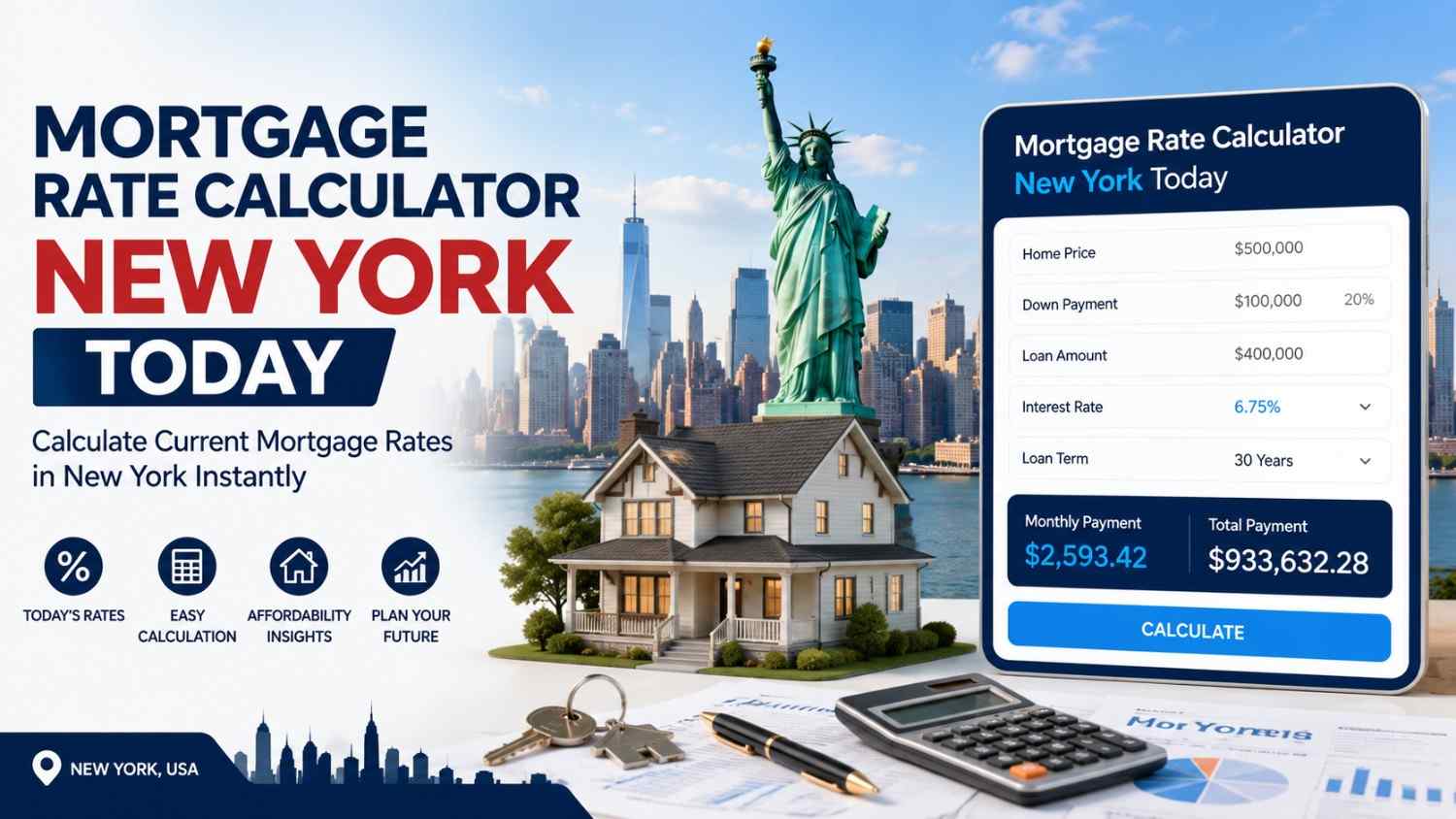
Buying a home in New York is a major financial decision. Whether you are considering an apartment in Manhattan, a condo in Brooklyn, a family house in Queens, or a single-family property near Buffalo or Albany, understanding your mortgage payment before making an offer can help you avoid costly surprises.
Our New York Mortgage Rate Calculator helps you estimate your monthly principal and interest, property taxes, homeowners insurance, private mortgage insurance (PMI), and other housing expenses. You can also explore your total loan interest, estimated closing cash, and how additional payments may shorten your mortgage term.
Unlike a basic mortgage calculator that focuses only on the loan payment, this guide explains the costs that can make homeownership in New York different from buying a home elsewhere in the United States.
Use the calculator below to explore different home prices, down payments, mortgage rates, and loan terms before speaking with a lender.
New York Mortgage Rate Calculator
Estimate your monthly mortgage payment, property expenses and total homebuying costs.
The table shows yearly principal, interest and remaining balance. Extra payments are included when entered.
| Year | Principal Paid | Interest Paid | Remaining Balance |
|---|
Use your actual lender quote whenever possible. Mortgage rates shown in financial news or comparison websites are market references, not guaranteed offers. Your rate may depend on your credit profile, loan amount, property type, down payment, occupancy, and other underwriting factors.
How to Use the New York Mortgage Calculator
You do not need to be a mortgage expert to estimate your potential monthly payment. Start with the property price and the amount you expect to put down. Then add the interest rate and repayment term from your lender’s quote.
For a more realistic estimate, include property taxes, homeowners insurance, PMI, and any monthly HOA or condominium charges.
1. Enter the Home Purchase Price
Enter the amount you expect to pay for the property, not the amount you plan to borrow.
For example, if a home costs $500,000 and you make a $100,000 down payment, your starting loan amount is $400,000 before any financed fees or other adjustments.
2. Add Your Down Payment
Your down payment is the portion of the purchase price you pay upfront.
A larger down payment generally reduces the amount you borrow and may reduce your monthly payment. It can also help you avoid PMI on many conventional loans when you reach the required equity threshold.
However, putting every available dollar into the down payment is not always the best decision. You may also need money for closing costs, moving, repairs, emergency savings, and initial homeownership expenses.
3. Enter Your Mortgage Interest Rate
Use the rate quoted by your lender for the loan type and term you are considering.
Do not assume that a national average or an advertised rate is the rate you will receive. Some advertised rates require excellent credit, a particular down payment, discount points, or other conditions.
4. Select Your Mortgage Term
Common fixed-rate mortgage terms include 15 and 30 years. Some lenders also offer other repayment periods.
A shorter term generally means a higher monthly principal-and-interest payment but less total interest over the life of the loan, assuming the same loan amount and rate.
5. Include Taxes, Insurance, PMI, and HOA Fees
These expenses can make a significant difference to your actual housing budget.
Enter annual property taxes and insurance as annual amounts if the calculator requests yearly figures. Enter HOA, condo common charges, and PMI as monthly amounts if requested.
Your result should show the difference between the mortgage payment itself and the broader monthly cost of owning the property.
How Much Is a Monthly Mortgage Payment in New York?
Your mortgage payment depends on the amount borrowed, interest rate, repayment period, and additional property expenses.
The principal-and-interest portion of a standard fixed-rate mortgage is calculated using the loan amount, monthly interest rate, and total number of monthly payments.
Consider this illustrative example:
| Mortgage detail | Example |
|---|---|
| Home purchase price | $500,000 |
| Down payment | $100,000 |
| Down payment percentage | 20% |
| Mortgage loan | $400,000 |
| Annual interest rate | 6.50% |
| Loan term | 30 years |
| Estimated monthly principal and interest | $2,528.27 |
At these assumptions, the estimated principal-and-interest payment is approximately $2,528.27 per month.
This is not the complete cost of homeownership. Property taxes, homeowners insurance, HOA or maintenance charges, and other applicable expenses must be added separately.
The example is for illustration, not a current lender offer or a prediction of future mortgage rates.
What Is Included in a Mortgage Payment?
A mortgage payment is often described using the abbreviation PITI: principal, interest, taxes, and insurance.
Depending on your loan and property, you may also have PMI, HOA charges, or condominium maintenance costs.
Principal
Principal is the amount of money you borrowed from the lender. Each scheduled mortgage payment generally reduces the outstanding principal balance.
During the early years of a typical fully amortizing mortgage, a larger share of the payment goes toward interest than principal.
Interest
Interest is the cost of borrowing money. Your mortgage rate and outstanding balance determine how much interest accrues.
A small difference in the interest rate can produce a substantial difference in the total interest paid over a 30-year loan.
Property Taxes
Property taxes are assessed by local taxing authorities. They can vary significantly between New York counties, cities, towns, villages, school districts, and individual properties.
If your mortgage has an escrow account, your loan servicer may collect a portion of the expected annual tax bill with each monthly payment and pay the tax bill when it becomes due.
Do not assume that a neighbor’s property tax bill will be the same as yours. Check the actual property’s assessment, exemptions, tax rates, and recent bills.
Homeowners Insurance
Homeowners insurance protects against covered property losses and certain liability risks. The premium depends on the property’s characteristics, coverage limits, deductible, claims history, location, and insurer.
Properties in areas exposed to flooding or other specific risks may need additional coverage. Standard homeowners insurance generally does not cover every type of flood loss.
Private Mortgage Insurance (PMI)
Private mortgage insurance may be required on conventional loans when the down payment is below 20%, depending on the loan structure and lender requirements.
PMI protects the lender, not the homeowner. Its cost depends on factors such as the loan-to-value ratio, credit profile, loan amount, and insurer.
For many eligible conventional mortgages, borrowers can request PMI cancellation when the loan balance reaches the applicable 80% threshold, subject to the rules and conditions. Automatic termination generally applies under federal law when the scheduled balance reaches 78% of the property’s original value, provided the borrower meets applicable requirements.
FHA mortgage insurance works differently. Do not assume that FHA mortgage insurance follows conventional PMI cancellation rules.
HOA and Condominium Fees
If you purchase a condominium or a property within a homeowners association, you may have recurring monthly charges.
These fees can cover shared building maintenance, common areas, amenities, management, and other services. Some buildings also impose special assessments.
For NYC buyers, building charges can be a major part of the monthly housing budget.
New York Mortgage Costs That Many Buyers Overlook
New York home purchases can involve costs beyond the down payment and ordinary lender fees. The exact charges depend on the property location, transaction structure, mortgage amount, and property type.
Understanding these expenses before signing a purchase contract can help you prepare the correct amount of cash.
1. New York Mortgage Recording Tax
New York is one of the states that imposes a mortgage recording tax when certain mortgage documents are recorded.
The applicable tax depends on the location and mortgage amount. New York City has combined state and local mortgage recording tax rules, and the calculation may differ based on the property and applicable exemptions.
A co-op purchase may be treated differently from a condominium or one-to-three-family property because the buyer’s transaction structure and recorded documents differ.
Do not apply one universal percentage to every New York property.
For an NYC transaction, use the New York City Department of Finance’s official mortgage recording tax information and ACRIS tax and fee calculation resources. For properties outside NYC, confirm the relevant county and local requirements.
Official reference: https://www.nyc.gov/site/finance/property/property-mortgage-recording-tax.page
2. New York Mansion Tax
Certain New York residential property purchases are subject to an additional transfer tax commonly known as the mansion tax.
For qualifying residential conveyances of $1 million or more, the basic New York State mansion tax generally starts at 1% of the purchase price. Additional graduated rates apply to qualifying residential transactions in New York City under the applicable tax rules.
The exact amount and responsible party should be confirmed for the specific transaction. Do not assume that every property transfer or every buyer has identical tax obligations.
A buyer considering a $1.2 million NYC property should therefore review mansion tax exposure before calculating the cash required at closing.
Official reference: https://www.tax.ny.gov/
3. Title Insurance
Title insurance helps protect against certain covered title-related problems involving ownership rights, liens, and defects in the property’s title.
The applicable premium depends on the transaction, coverage, and New York title insurance rate rules.
A condominium purchase and a co-op share purchase can have different title-related requirements and costs.
4. Attorney Fees
Real estate transactions in New York commonly involve attorneys representing the buyer and seller.
Your legal costs depend on the attorney, transaction complexity, property type, contract terms, and other services provided.
Ask for a written fee estimate rather than relying on a generic online average.
5. Lender and Appraisal Fees
Your lender may charge application, underwriting, processing, appraisal, credit report, flood determination, and other loan-related fees.
Not every lender charges identical amounts, and some costs may be paid before closing.
Compare official Loan Estimates from different lenders to understand the complete cost of borrowing.
NYC vs. Upstate New York: Why Mortgage Costs Differ
New York is not one uniform housing market.
A buyer purchasing a condominium in Manhattan may face a very different financial situation from someone buying a detached home in Rochester, Syracuse, Albany, or Buffalo.
New York City
NYC buyers should consider:
- Mortgage recording tax where applicable.
- Mansion tax for qualifying purchases.
- Property-specific property taxes.
- Condo common charges or co-op maintenance.
- Building financial condition and potential assessments.
- Insurance and lender requirements.
- Additional closing expenses.
A co-op apartment is not the same as a condominium. In a co-op, buyers generally purchase shares in a corporation and receive a proprietary lease rather than obtaining a conventional deed to an individual apartment.
That difference can affect financing, closing costs, building approval, and monthly carrying costs.
Upstate New York
Outside New York City, buyers may find different home prices, tax structures, insurance costs, and local closing requirements.
However, lower purchase prices do not automatically mean lower total ownership costs.
A property may have higher annual property taxes, older systems requiring repairs, or insurance requirements that change the affordability calculation.
Always use the actual property’s tax bill and insurance quote rather than relying solely on regional averages.
New York Property Taxes: What Homebuyers Should Check
Property taxes are one of the most important variables in a realistic mortgage estimate.
New York property tax bills may include county, city, town, village, school district, and other applicable charges.
Before making an offer, consider these steps:
- Obtain the latest property tax bill.
- Confirm the municipality and school district.
- Check the property’s assessment.
- Review whether current exemptions apply.
- Confirm whether exemptions will continue after the sale.
- Ask whether the property has pending reassessment or tax changes.
A seller’s current tax bill may not represent your future tax obligation if exemptions, ownership status, or assessments change.
New York City property owners can review official property tax information through the Department of Finance.
Reference: https://www.nyc.gov/site/finance/property/property.page
15-Year vs. 30-Year Mortgage: Which Is Better?
The right mortgage term depends on your budget, financial priorities, and how long you expect to keep the property.
A 15-year mortgage generally has a higher monthly principal-and-interest payment but allows you to repay the loan sooner.
A 30-year mortgage spreads payments over a longer period. This can improve monthly cash flow, although it usually results in more total interest if the loan is held to maturity at the stated terms.
Consider the following before choosing:
- Can you comfortably afford the shorter-term payment?
- Will you still have emergency savings?
- Do you have other high-interest debts?
- Does the shorter-term rate offer a meaningful advantage?
- Are you planning to sell or refinance before the loan matures?
Do not choose a shorter mortgage term simply because it produces less total interest on paper. Your complete financial situation matters.
Fixed-Rate vs. Adjustable-Rate Mortgage in New York
A fixed-rate mortgage generally keeps the interest rate unchanged for the agreed loan term.
An adjustable-rate mortgage (ARM) typically begins with an initial fixed-rate period and then adjusts according to the loan’s terms.
For example, a 5/1 ARM generally has an initial five-year fixed period before annual adjustments begin. The actual adjustment frequency and caps depend on the loan agreement.
An ARM may offer a lower initial payment, but that does not mean the payment will remain low.
Before choosing an ARM, review:
- Initial interest rate.
- Initial fixed period.
- First adjustment cap.
- Subsequent adjustment cap.
- Lifetime rate cap.
- Index and margin.
- Maximum possible payment.
- Whether you could afford the payment after an adjustment.
This is especially important for buyers who expect to keep the home for many years.
How Much House Can You Afford in New York?
A mortgage lender may approve you for a particular loan amount, but the approved amount is not necessarily the amount you should borrow.
Your personal affordability depends on income, existing debt, savings, housing expenses, and future financial obligations.
One useful measure is the debt-to-income ratio (DTI).
DTI compares your monthly debt payments with your gross monthly income.
For example:
- Gross monthly income: $10,000
- Proposed monthly housing payment: $3,000
- Other monthly debt payments: $1,000
- Total monthly debt: $4,000
DTI = ($4,000 ÷ $10,000) × 100 = 40%
This is an illustrative calculation, not a universal lender approval threshold. Different mortgage programs and lenders use different underwriting standards.
When estimating affordability, remember to include utilities, maintenance, commuting costs, childcare, emergency savings, and other recurring expenses that may not appear in your mortgage statement.
How Extra Mortgage Payments Can Save Interest
Additional principal payments can reduce the outstanding loan balance faster.
When the balance becomes smaller, less interest generally accrues over subsequent periods.
For example, a borrower with a 30-year mortgage may choose to pay an additional amount toward principal each month.
However, there are several things to check first:
- Confirm that extra payments are applied to principal.
- Review the mortgage’s prepayment terms.
- Maintain adequate emergency savings.
- Consider higher-interest debts before accelerating a relatively low-rate mortgage.
- Check whether your lender charges any applicable prepayment penalty.
Your calculator’s extra-payment feature can help estimate potential savings and a revised payoff date.
The result assumes the additional payment is made consistently and is applied as intended.
Mortgage Discount Points: Are They Worth Buying?
A mortgage discount point is an upfront fee paid to the lender in exchange for a lower interest rate.
One point generally costs 1% of the loan amount, although the rate reduction offered for each point is not fixed across lenders or transactions.
For example, on a $400,000 mortgage, one point would cost $4,000.
Whether paying points makes sense depends on the monthly savings and how long you keep the mortgage.
A simple break-even estimate is:
Break-even months = Upfront point cost ÷ Monthly payment savings
If the point costs $4,000 and saves $80 per month, the simple break-even period is 50 months.
This calculation does not account for the time value of money, taxes, or changes caused by refinancing or selling. Compare lender quotes both with and without points.
What Is the Difference Between Mortgage Interest Rate and APR?
The interest rate determines the cost of borrowing the principal under the loan’s interest calculation.
The annual percentage rate (APR) is a broader measure that generally includes the interest rate plus certain loan costs, expressed as an annualized percentage under applicable disclosure rules.
APR can help borrowers compare mortgage offers, but it is not a perfect comparison tool for every situation.
Different loan structures, discount points, adjustable-rate features, and the time you expect to keep the mortgage can affect which offer is better for you.
Review the Loan Estimate rather than comparing only the advertised interest rate.
New York Mortgage Closing Costs: How Much Cash Do You Need?
Your down payment is only one part of the money needed to complete a home purchase.
The amount you need at closing may include:
- Down payment.
- Lender charges.
- Appraisal and inspection expenses.
- Title-related charges where applicable.
- Attorney fees.
- Mortgage recording tax where applicable.
- Mansion tax for qualifying transactions.
- Prepaid property taxes.
- Homeowners insurance premiums.
- Initial escrow deposits.
- Condo or co-op adjustments.
- Other transaction-specific costs.
Some charges may be paid before closing, while others appear on the final settlement statement.
For a more reliable estimate, review your lender’s Loan Estimate and later your Closing Disclosure. Ask your attorney and lender to explain any transaction-specific tax or fee.
The amount shown by an online calculator is an estimate, not a final settlement figure.
What Is a Mortgage Refinance?
Refinancing means replacing an existing mortgage with a new loan.
Homeowners may consider refinancing to:
- Obtain a lower interest rate.
- Change from an adjustable-rate mortgage to a fixed-rate mortgage.
- Shorten or extend the repayment term.
- Change the monthly payment.
- Access home equity through an eligible cash-out refinance.
However, refinancing is not automatically beneficial when rates fall.
You should compare the new loan’s monthly savings against closing costs, points, the new repayment term, and the amount of interest you may pay over time.
A lower monthly payment can still cost more overall if you extend the loan term substantially.
What Is a Loan Estimate and Why Does It Matter?
A Loan Estimate is a standardized document that a lender generally provides after receiving a mortgage application with the required information.
It helps you review important loan details, including:
- Interest rate.
- Monthly principal and interest.
- Estimated taxes and insurance.
- Estimated closing costs.
- Cash needed to close.
- Loan terms and potential risks.
When comparing lenders, request Loan Estimates for the same property, loan amount, loan type, and lock period where possible.
The Consumer Financial Protection Bureau offers guidance on reviewing Loan Estimates and Closing Disclosures.
Reference: https://www.consumerfinance.gov/owning-a-home/loan-estimate/
Common Mortgage Calculator Mistakes to Avoid
Even a good calculator can produce misleading results if the inputs are incorrect.
Using a national rate as a personal offer: Market averages do not guarantee your approved rate.
Forgetting property taxes: A payment estimate without property taxes may significantly understate your monthly housing cost.
Ignoring HOA or co-op maintenance: These expenses can be substantial in New York City.
Assuming every home has the same closing costs: Mortgage recording tax, title charges, and other expenses vary by location and property type.
Confusing APR with interest rate: They measure different aspects of borrowing.
Using an outdated tax bill: Exemptions and reassessments can change the amount.
Ignoring ARM adjustments: An initial adjustable rate is not necessarily a long-term payment estimate.
Spending all your savings on the down payment: Keep money available for closing, repairs, moving, and unexpected expenses.
Frequently Asked Questions
1. How do I calculate my monthly mortgage payment in New York?
Enter your home price, down payment, mortgage interest rate, and loan term into the calculator. Then include property taxes, homeowners insurance, PMI, and monthly HOA or maintenance charges for a broader estimate.
2. What is a good mortgage rate in New York in 2026?
There is no single rate that is best for every borrower. Rates vary by lender, credit profile, loan term, points, loan type, and market conditions. Compare current written offers from multiple lenders using the same loan assumptions.
3. Are New York mortgage rates different from national rates?
They can be. Lenders may offer different rates and pricing depending on the borrower, property, and loan. National averages are useful benchmarks, but they do not guarantee a New York borrower’s individual offer.
4. How much down payment do I need to buy a home in New York?
The required down payment depends on the loan program, property, lender, and borrower qualifications. Some eligible conventional loans allow down payments below 20%, while certain government-backed programs have different requirements. A larger down payment may reduce borrowing costs but requires more upfront cash.
5. Does New York charge mortgage recording tax?
Yes. New York State imposes mortgage recording tax on qualifying mortgage recordings. Rates vary by location and transaction. NYC has additional local rules, so buyers should confirm the applicable amount before closing.
6. Do co-op apartments have mortgage recording tax?
A co-op share purchase is structured differently from a condominium or house purchase. The applicable recording and financing costs can therefore differ. Have your real estate attorney and lender confirm which taxes and fees apply to the specific transaction.
7. What is the NYC mansion tax?
It is an additional tax on qualifying residential property transfers at or above the applicable price threshold. The basic New York State rate generally begins at 1% for qualifying transactions of $1 million or more, with additional NYC graduated rates for qualifying transactions. Confirm the current rules and responsibility for payment before closing.
8. Can I calculate my mortgage payment without PMI?
Yes. Enter zero for PMI if it does not apply to your loan. However, do not assume PMI is unnecessary simply because you prefer not to include it. Confirm the lender’s requirements.
9. Is a 15-year mortgage cheaper than a 30-year mortgage?
A 15-year loan typically has a higher monthly principal-and-interest payment but lower total interest when the same amount is borrowed at comparable rates and held to maturity.
10. Should I choose a fixed-rate or adjustable-rate mortgage?
A fixed-rate loan offers predictable principal-and-interest payments. An ARM may begin with a lower rate but can adjust later. Compare the initial period, adjustment caps, lifetime cap, and maximum potential payment before deciding.
11. Can extra mortgage payments reduce my total interest?
Yes, when additional payments are applied to principal, they generally reduce the balance on which future interest is calculated. Check your loan’s terms and payment instructions before making extra payments.
12. What costs are not included in a basic mortgage payment?
A basic principal-and-interest calculation excludes property taxes, homeowners insurance, PMI, HOA or co-op charges, utilities, maintenance, and many closing expenses. A complete affordability estimate should account for these costs separately.
13. How much cash should I save before buying a home in New York?
There is no universal amount. Your cash requirement depends on the down payment, closing costs, prepaid expenses, property type, and loan program. Keep an additional reserve for repairs, moving, and emergencies.
14. Does the mortgage calculator show an exact lender payment?
No. It provides an estimate based on the assumptions entered. Your actual payment may differ because of lender pricing, escrow calculations, insurance, taxes, mortgage insurance, loan fees, and other terms.
15. Where can I check current mortgage rates?
You can review Freddie Mac’s Primary Mortgage Market Survey, lender rate sheets, and written mortgage quotes. Always compare the interest rate, APR, points, fees, and loan terms rather than relying on a single advertised figure.
Final Thoughts: Plan Your New York Mortgage Before Buying
Buying a home in New York involves more than choosing a property and calculating a down payment. Your mortgage rate, local property taxes, insurance, building charges, closing expenses, and loan structure can all influence what you actually pay.
Use the New York Mortgage Rate Calculator to test different home prices, down payments, and loan terms. Compare the results with written lender estimates, review property-specific tax information, and ask qualified professionals about transaction costs before signing.
A realistic mortgage budget is not simply the largest loan a lender will approve. It is a payment you can manage while still maintaining financial flexibility.
Article by Junaidul Islam
Financial disclaimer: This calculator and educational guide provide general information and estimates, not a mortgage approval, loan offer, tax opinion, legal opinion, or financial advice. Rates, fees, taxes, insurance premiums, and loan eligibility can change. Verify all figures with your lender, local taxing authority, insurance provider, and qualified New York real estate professionals before making a financial decision.
Research and official references
- Freddie Mac Primary Mortgage Market Survey: https://www.freddiemac.com/pmms
- Consumer Financial Protection Bureau – Owning a Home: https://www.consumerfinance.gov/owning-a-home/
- New York City Department of Finance – Mortgage Recording Tax: https://www.nyc.gov/site/finance/property/property-mortgage-recording-tax.page
- New York State Department of Taxation and Finance: https://www.tax.ny.gov/
- Federal Housing Finance Agency: https://www.fhfa.gov/
- New York State Homes and Community Renewal: https://hcr.ny.gov/