
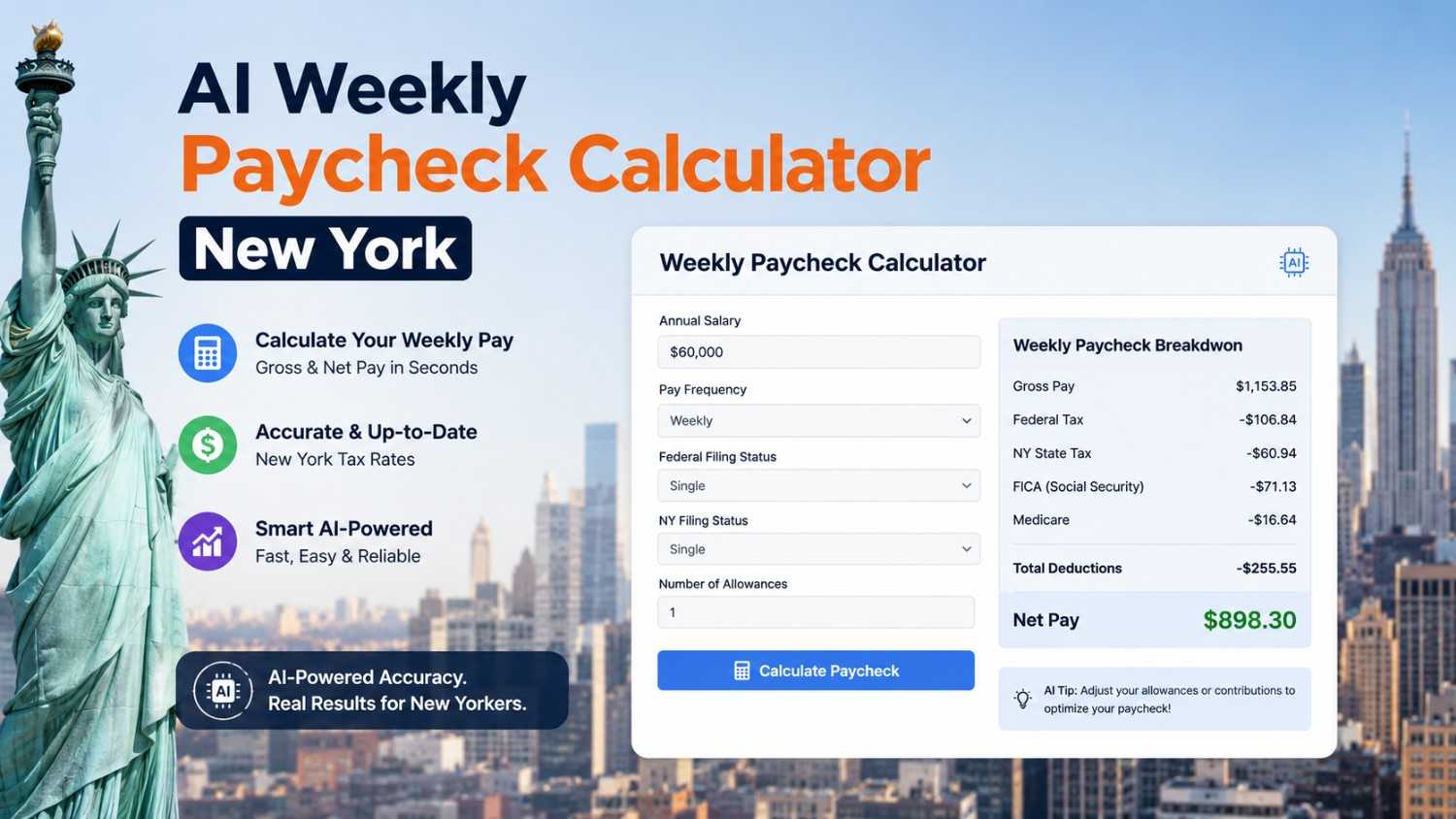
Understanding how much money you actually take home each week is an important part of managing your finances in New York. Your hourly wage or annual salary may look attractive, but your actual paycheck can be significantly different after federal income tax, New York State income tax, Social Security, Medicare, and other payroll deductions.
Our AI Weekly Paycheck Calculator New York helps employees estimate their weekly take-home pay using their earnings, working hours, filing status, and location. Whether you work in Manhattan, Brooklyn, Queens, Buffalo, Albany, Yonkers, or another part of New York State, you can use this calculator to understand how different payroll deductions may affect your earnings.
Instead of relying on a simple hourly-to-weekly conversion, this guide explains the different tax components, overtime calculations, local tax considerations, and deductions that can influence your paycheck in 2026.
AI Weekly Paycheck Calculator New York
Estimate your weekly earnings, payroll taxes and take-home pay with a detailed New York paycheck breakdown.
1. Your Pay Information
2. Your Tax Information
Weekly Paycheck Breakdown
Important: This is an educational estimate, not an official payroll withholding calculation or tax advice. Federal and New York withholding tables, W-4 and IT-2104 elections, tax credits, NYS supplemental tax, local taxes outside NYC, benefit-plan treatment and other individual circumstances may change your actual paycheck. The calculation uses simplified annualized tax liability estimates divided by 52. It does not reproduce IRS Publication 15-T or the complete New York employer withholding worksheets.
What Is an AI Weekly Paycheck Calculator?
An AI Weekly Paycheck Calculator is a financial estimation tool that helps employees understand how much of their weekly earnings may remain after payroll taxes and selected deductions.
A traditional weekly salary calculator usually multiplies your hourly wage by the number of hours worked. However, that calculation only provides your gross earnings. It does not tell you how much money you may actually receive in your bank account.
A more useful paycheck calculator considers several factors:
- Your hourly wage or weekly salary.
- Regular working hours.
- Overtime earnings.
- Federal income tax withholding.
- New York State income tax.
- New York City or applicable local income tax.
- Social Security and Medicare.
- Retirement contributions.
- Health insurance and other deductions.
The calculator on this page is designed to make these estimates easier to understand. It separates major deductions and provides an estimated weekly net-pay figure.
How to Use the New York Weekly Paycheck Calculator
You do not need payroll or accounting experience to estimate your weekly paycheck. Follow these steps:
Step 1: Select your pay type
Choose whether you receive an hourly wage, an annual salary, or a fixed weekly gross amount.
Step 2: Enter your earnings
If you are paid hourly, enter your hourly rate. For example, an employee earning $25 per hour can enter $25.
Step 3: Enter your working hours
Add your regular weekly hours and any overtime hours. If you work 40 regular hours and five overtime hours, enter both separately.
Step 4: Select your location
Choose New York City if you are an NYC resident, or select another New York location if you live outside the city. Your residence matters because NYC resident income tax generally applies based on residency rather than simply where your employer is located.
Step 5: Select your filing status
Choose the appropriate filing status for your tax situation. Federal and state withholding calculations can vary depending on filing status and other payroll information.
Step 6: Add optional deductions
Enter your 401(k) contributions, health insurance premiums, and other deductions if applicable.
Step 7: Calculate your paycheck
Select the calculate button to see your estimated gross pay, payroll taxes, deductions, and weekly take-home pay.
For a more accurate comparison with your actual paycheck, use the information on your latest pay statement and your current withholding elections.
How Much Is Your Weekly Pay After Taxes in New York?
Your weekly take-home pay depends on your earnings, tax filing status, residence, withholding elections, and employer benefits.
For example, consider an employee who earns $25 per hour and works 40 hours each week.
| Earnings detail | Amount |
|---|---|
| Hourly wage | $25 |
| Weekly hours | 40 |
| Gross weekly pay | $1,000 |
| Annualized gross pay | $52,000 |
The employee earns $1,000 before deductions each week. However, the actual deposit will normally be lower because payroll taxes and other deductions may apply.
An employee living in New York City may have a different result from an employee living in Buffalo because NYC residents generally have an additional local income tax.
There is no single take-home-pay amount that applies to every employee earning $1,000 weekly. Filing status, withholding information, pre-tax benefits, and other circumstances matter.
Understanding Your New York Paycheck Tax Breakdown
A New York employee may see several different taxes and deductions on a pay statement. Understanding each one makes it easier to identify where your earnings go.
1. Federal Income Tax
Federal income tax is collected by the Internal Revenue Service (IRS). Employers generally withhold federal income tax from employees’ wages using the information provided on Form W-4 and the applicable IRS withholding method.
For tax year 2026, federal income tax has seven marginal rates:
| Federal tax rate | Single taxable income |
|---|---|
| 10% | $0–$12,400 |
| 12% | $12,400–$50,400 |
| 22% | $50,400–$105,700 |
| 24% | $105,700–$201,775 |
| 32% | $201,775–$256,225 |
| 35% | $256,225–$640,600 |
| 37% | Over $640,600 |
These are marginal rates, not flat rates applied to your entire salary. Only the portion of taxable income within each bracket is taxed at that bracket’s rate.
The 2026 federal standard deduction is $16,100 for single filers, $32,200 for married couples filing jointly, and $24,150 for heads of household.
Your actual paycheck withholding is calculated using the applicable payroll method, rather than simply dividing your final annual tax bill by 52.
2. New York State Income Tax
New York State has its own personal income tax system. Employees who are New York residents generally need to consider both federal and state income tax.
For 2026, New York State revised certain income tax rates and withholding tables. The changes apply to payrolls made on or after January 1, 2026.
The state has progressive tax brackets. For example, the 2026 single-filer rates begin at 3.90%, followed by 4.40%, 5.15%, and 5.40% in the lower and middle brackets.
Your applicable rate depends on taxable income and filing status. Higher-income taxpayers may also be subject to additional tax calculations.
Employers use New York’s official withholding tables and methods, including Publication NYS-50-T-NYS, when calculating state income tax withholding.
3. New York City Income Tax
New York City has a separate personal income tax for qualifying city residents.
This is an important distinction for employees who work in NYC but live elsewhere.
For example:
- An employee who lives in Brooklyn and works in Manhattan is generally subject to NYC resident income tax.
- An employee who lives in Buffalo and works remotely for a Manhattan company generally does not become an NYC resident merely because the employer is located in Manhattan.
- An employee who lives in Yonkers may have different local tax considerations.
NYC’s resident income tax uses progressive rates. For single filers, the statutory rate schedule begins at 2.7%, followed by 3.3%, 3.35%, and 3.4% across higher income brackets.
Your final tax liability and payroll withholding may differ because of deductions, filing status, and applicable withholding rules.
4. Social Security Tax
Social Security is a federal payroll tax that helps fund retirement, survivor, and disability benefits.
For 2026, the employee Social Security tax rate is 6.2% on covered wages up to the annual wage base of $184,500.
For example, if your weekly Social Security wages are $1,000 and you have not reached the annual wage limit, the employee portion is:
$1,000 × 6.2% = $62.
This amount is generally withheld from your paycheck.
5. Medicare Tax
Medicare payroll tax helps fund the federal Medicare program.
The standard employee Medicare tax rate is 1.45% of covered wages. Unlike Social Security, regular Medicare tax does not have an annual wage cap.
Employees with wages above the applicable $200,000 employer withholding threshold may also have Additional Medicare Tax withheld at 0.9%.
The Additional Medicare Tax is ultimately determined using the applicable individual filing thresholds, so employer withholding and final tax liability are not always identical.
6. New York Paid Family Leave
New York Paid Family Leave (PFL) provides eligible employees with job-protected paid time off for certain family-related situations.
For 2026, the employee contribution rate is 0.432% of gross wages per pay period, subject to an annual maximum contribution of $411.91.
This is an important deduction to understand when estimating a New York paycheck.
However, the contribution should not be confused with the amount of paid leave benefits an employee may receive.
7. New York Disability Benefits
New York’s statutory Disability Benefits Law provides eligible employees with certain temporary disability benefits.
Employers are permitted to collect employee contributions to help fund this coverage. The statutory employee contribution is generally calculated at 0.5% of wages, up to a maximum of $0.60 per week.
This deduction is subject to the applicable rules and employer arrangements.
NYC vs. Yonkers vs. Other New York Locations
Your home address can affect your paycheck even when two employees earn exactly the same salary.
| Location | Important tax consideration |
|---|---|
| New York City | NYC resident income tax may apply |
| Yonkers | Yonkers resident tax and applicable nonresident earnings tax rules |
| Buffalo | New York State income tax; no NYC resident tax |
| Albany | New York State income tax; no NYC resident tax |
| Rochester | New York State income tax; no NYC resident tax |
| Syracuse | New York State income tax; no NYC resident tax |
An important point is that Yonkers has separate resident and nonresident tax rules. Therefore, selecting a location should reflect your actual residency and work circumstances.
Employees who move during a tax year may also need to consider part-year residency rules.
How to Calculate Hourly Pay in New York
If you receive an hourly wage, your regular weekly gross earnings can be calculated using a simple formula:
Weekly Gross Pay = Hourly Wage × Regular Hours Worked
Consider these examples:
| Hourly wage | Weekly hours | Gross weekly pay |
|---|---|---|
| $15 | 40 | $600 |
| $18 | 40 | $720 |
| $20 | 40 | $800 |
| $25 | 40 | $1,000 |
| $30 | 40 | $1,200 |
| $35 | 40 | $1,400 |
| $40 | 40 | $1,600 |
| $45 | 40 | $1,800 |
| $50 | 40 | $2,000 |
These figures represent gross pay before taxes and deductions.
Your take-home pay will depend on the tax and deduction information applicable to your situation.
How Overtime Affects Your Weekly Paycheck
Overtime can increase your gross weekly earnings significantly.
Under the federal Fair Labor Standards Act, most covered, nonexempt employees must receive overtime pay at not less than one and one-half times their regular rate for hours worked over 40 in a workweek.
For example, assume an eligible employee earns $20 per hour and works 45 hours during a workweek.
Regular earnings:
40 × $20 = $800.
Overtime rate:
$20 × 1.5 = $30.
Overtime earnings:
5 × $30 = $150.
Total gross weekly pay:
$800 + $150 = $950.
Actual overtime eligibility and regular-rate calculations can be affected by job classification, applicable exemptions, and other compensation.
It is also important to distinguish the new federal tax deduction for qualified overtime compensation from the amount of overtime wages earned. The deduction does not mean all overtime earnings are automatically free from payroll taxes or income tax withholding.
How 401(k) Contributions Affect Your Paycheck
Many New York employees contribute to an employer-sponsored 401(k) retirement plan.
Traditional 401(k) contributions generally reduce federal income-taxable wages for current withholding purposes, but they usually remain subject to Social Security and Medicare taxes.
Roth 401(k) contributions are generally made from after-tax income.
For example, an employee contributing $100 per week to a traditional 401(k) will normally have less take-home pay than an otherwise identical employee who makes no contribution.
However, the contribution also increases retirement savings.
The tax treatment of other retirement arrangements can differ, so it is important to identify the type of contribution rather than treating every retirement deduction identically.
Health Insurance and Other Payroll Deductions
Employer-sponsored health insurance can also affect your weekly paycheck.
Common deductions include:
- Medical insurance premiums.
- Dental insurance.
- Vision insurance.
- Health Savings Account contributions.
- Flexible Spending Account contributions.
- Retirement plan contributions.
- Union dues.
- Other employer-authorized deductions.
Some benefit deductions are pre-tax for certain taxes, while others are taken after tax. The treatment depends on the benefit plan and applicable law.
For this reason, a paycheck estimate becomes more useful when you enter the deductions shown on your actual payroll statement.
Weekly vs. Biweekly Paycheck: What’s the Difference?
Not every New York employee receives payment weekly.
The most common payroll schedules include weekly, biweekly, semimonthly, and monthly payments.
| Pay frequency | Typical payments per year |
|---|---|
| Weekly | 52 |
| Biweekly | 26 |
| Semimonthly | 24 |
| Monthly | 12 |
Suppose your annual gross salary is $52,000.
Your gross earnings would be:
- Weekly: $1,000.
- Biweekly: $2,000.
- Semimonthly: approximately $2,166.67.
- Monthly: approximately $4,333.33.
The annual salary remains the same, but the amount received per paycheck changes with the payroll schedule.
Do not assume that two biweekly paychecks equal one month’s salary. There are 26 biweekly pay periods in a typical year, which means some months contain three paydays.
Why Your Actual Paycheck May Be Different From the Calculator
An online paycheck calculator provides an estimate, not an official payroll statement.
Your employer may calculate withholding differently because of information that is not included in a basic calculator.
Common reasons for differences include:
- Your Form W-4 elections.
- Your New York Form IT-2104 elections.
- Additional withholding requests.
- Multiple jobs or household income.
- Pre-tax and post-tax benefit deductions.
- Bonuses and commissions.
- Changes in your annual Social Security wages.
- Additional Medicare withholding.
- Employer payroll rounding.
- Special tax deductions or adjustments.
If the calculator result differs from your paycheck, compare the gross wages, taxable wages, withholding amounts, and benefit deductions on your pay statement.
For exact payroll withholding, your employer’s payroll department and the official government withholding tables are the appropriate references.
2026 New York Payroll Tax Updates You Should Know
Tax rules can change from one year to another. Using an outdated calculator can produce misleading estimates.
Here are important 2026 figures and updates:
| Tax or contribution | 2026 information |
|---|---|
| Federal standard deduction – Single | $16,100 |
| Federal standard deduction – Married filing jointly | $32,200 |
| Federal standard deduction – Head of household | $24,150 |
| Social Security employee rate | 6.2% |
| Social Security wage base | $184,500 |
| Medicare employee rate | 1.45% |
| Additional Medicare withholding threshold | $200,000 in wages from an employer |
| NY Paid Family Leave contribution | 0.432% |
| NY Paid Family Leave annual contribution cap | $411.91 |
| NY State withholding tables | Revised for 2026 |
| NYC withholding tables | 2026 publication applies |
These figures are intended to help employees understand important payroll changes. Other deductions and eligibility rules may apply.
Who Should Use a New York Weekly Paycheck Calculator?
This calculator can be useful for several types of workers.
Hourly employees: Estimate take-home pay based on your hourly rate and working hours.
Full-time employees: Convert your annual salary into an estimated weekly paycheck.
Part-time employees: Understand how fewer working hours may affect weekly earnings.
Overtime workers: Estimate the gross-pay impact of additional eligible overtime hours.
Job seekers: Compare potential weekly earnings before accepting a new position.
New York City residents: Understand how local income tax can affect your take-home pay.
Employees changing jobs: Compare estimated pay from different hourly rates or salary offers.
Frequently Asked Questions
1. How much is $1,000 a week after taxes in New York?
Your take-home pay depends on your filing status, residence, withholding elections, and deductions. A New York City resident may have additional local income tax compared with an employee living outside NYC. Enter your actual payroll information into the calculator above for an individualized estimate.
2. Does New York City income tax apply if I work in NYC but live outside the city?
Generally, NYC resident personal income tax is based on residency. Simply working for an NYC employer does not automatically make a nonresident liable for NYC resident income tax. Other applicable tax rules should still be considered.
3. How much Social Security tax is deducted from a weekly paycheck?
For 2026, the employee Social Security tax rate is 6.2% on covered wages up to the annual wage base of $184,500.
4. What is the Medicare tax rate in 2026?
The standard employee Medicare tax rate is 1.45%. An additional 0.9% withholding may apply to wages above the employer’s $200,000 threshold.
5. How do I calculate weekly pay from an annual salary?
Divide your annual gross salary by 52 to estimate gross weekly pay. For example, a $78,000 annual salary equals $1,500 in gross weekly earnings.
6. How is overtime calculated in New York?
For most covered, nonexempt employees, federal law requires at least 1.5 times the regular rate for hours worked over 40 in a workweek. Applicable New York labor rules and employee classifications should also be considered.
7. What is the difference between gross pay and net pay?
Gross pay is your earnings before deductions. Net pay is the amount remaining after applicable taxes, benefits, and other payroll deductions.
8. Does a 401(k) reduce my weekly take-home pay?
Yes. A 401(k) contribution reduces the amount deposited into your bank account. Traditional contributions generally receive different tax treatment from Roth contributions.
9. What is New York Paid Family Leave in 2026?
The 2026 employee contribution rate is 0.432% of gross wages, subject to an annual maximum contribution of $411.91.
10. Is an online weekly paycheck calculator completely accurate?
No online calculator can guarantee an exact employer paycheck without all relevant payroll information. This tool provides an estimate for planning purposes. Your employer’s payroll statement is the best source for your actual withholding.
11. Can I use this calculator if I am paid every two weeks?
Yes. You can convert your annual salary into a weekly equivalent or use your gross earnings and pay frequency to compare different payroll schedules.
12. Do employees in Buffalo pay New York City income tax?
Generally, no. Buffalo residents are subject to applicable federal and New York State taxes, but not NYC resident income tax merely because they live in New York State.
Important Disclaimer
This calculator is an educational financial planning tool. Its results are estimates and should not be treated as official payroll calculations, tax advice, or a guarantee of your actual take-home pay.
Actual withholding depends on your employer’s payroll method, Form W-4, New York Form IT-2104, residency, deductions, benefits, tax status, and applicable federal and state rules.
Always consult official IRS and New York State resources or a qualified tax professional when making tax decisions.
Official Tax Resources
For the most reliable and current payroll information, consult these government resources:
- IRS Publication 15-T: Federal Income Tax Withholding Methods.
- IRS Publication 15: Employer’s Tax Guide.
- New York State Department of Taxation and Finance: Withholding Tax Publications.
- New York Paid Family Leave: 2026 Contribution Information.
- Social Security Administration: 2026 Contribution and Benefit Base.
Article Author: Junaidul Islam
This guide is designed to help New York employees understand their weekly earnings, payroll deductions, and estimated take-home pay using clear explanations and practical examples.
Last reviewed: October 11, 2026.