
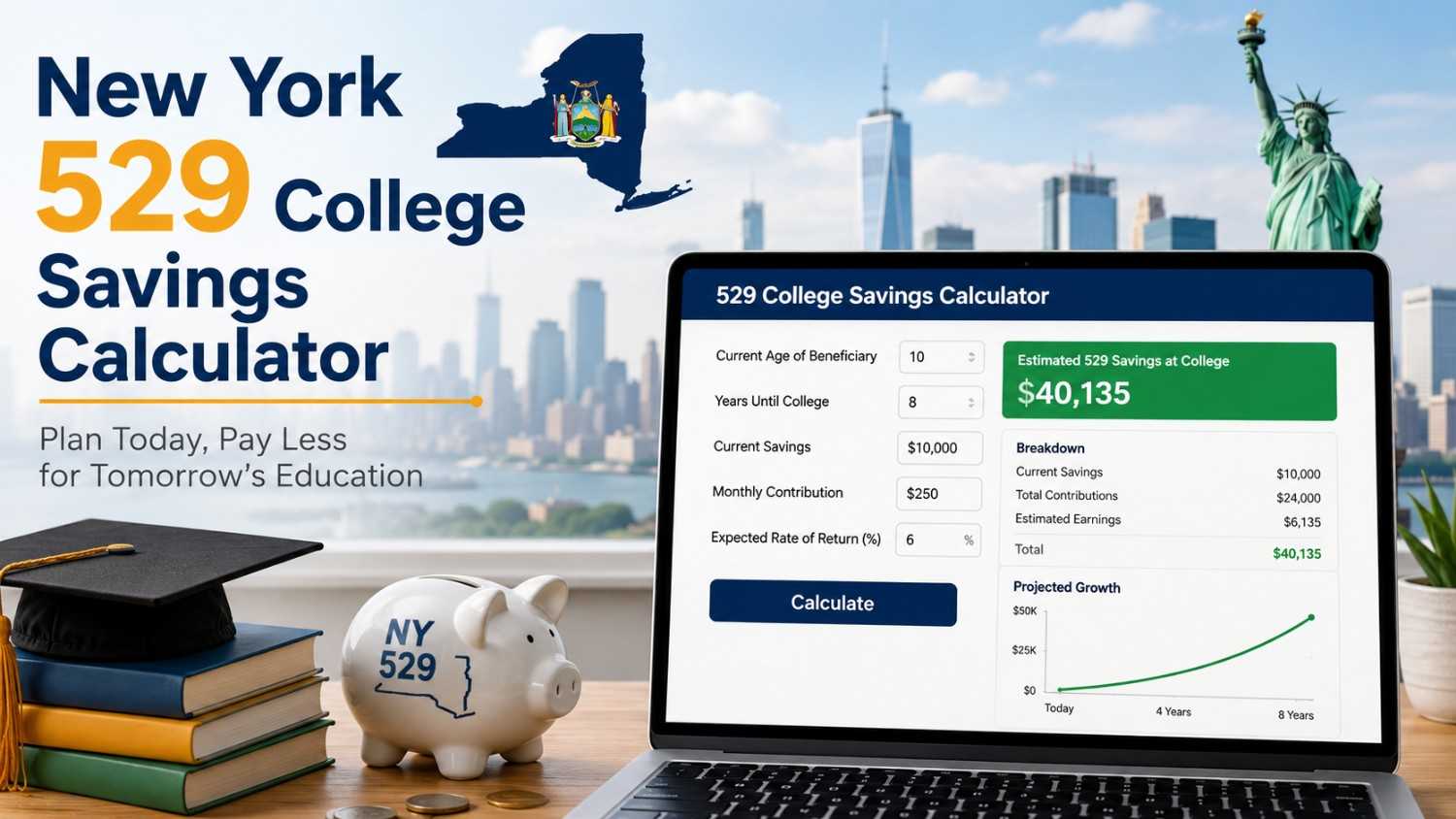
Saving for college in New York can feel overwhelming when tuition, housing, food, books and other expenses may rise for years before your child enrolls. A contribution that seems affordable today might not cover as much of a college education in the future.
Our New York 529 College Savings Calculator helps you estimate how your savings could grow, how much a future college education might cost, and whether your current monthly contributions are on track to meet your goal. You can adjust your child’s age, current savings, monthly deposits, investment-return assumption and expected college-cost inflation to compare different savings strategies.
The calculator also includes an illustrative New York State tax-benefit estimate. Your actual tax treatment depends on your eligibility, filing status, account ownership and the rules applicable to your tax year.
Use the calculator to explore your options before deciding how much to save.
What Is a New York 529 College Savings Calculator?
A 529 college savings calculator is a planning tool that estimates the future value of money saved for education through a tax-advantaged account or another college savings arrangement.
For a New York family, the calculation involves two separate questions:
- How much could the money already saved, together with future contributions, grow by the time college begins?
- How much might the education itself cost after accounting for the expected increase in college expenses?
Comparing these estimates can reveal a potential funding gap. It can also help you test whether increasing your monthly contribution, starting earlier or changing your target college budget would make a meaningful difference.
The results are estimates, not guarantees. Investment returns fluctuate, education costs change, and financial aid may differ from what you expect.
Use the interactive calculator on this page to enter your savings details and estimate your future college funding.
New York 529 College Savings Calculator
Estimate future college costs, savings growth and your potential funding gap.
Your Estimated Results
For a useful starting estimate, enter the amount you have already saved, the monthly contribution you can realistically afford, the number of years until college and the current annual cost of your preferred type of school.
If you do not know your future investment return or college-cost inflation rate, try several scenarios rather than relying on a single prediction.
How to Use the Calculator
1. Enter your child’s current age
Your child’s age determines how many years remain before college begins. A longer savings period gives contributions more time to accumulate and potentially earn investment returns.
For example, a family saving for a newborn has a longer time horizon than a family whose child is already 14. The second family may need a larger monthly contribution to reach the same future goal.
2. Choose the expected college-start age
Many families use age 18 as an initial planning assumption, but college enrollment can happen earlier or later. Change the starting age to reflect your family’s plans.
The difference between the child’s current age and the target enrollment age determines the number of years available for saving.
3. Enter your current college savings
Include the amount already set aside for education. If you are just starting, enter zero.
The calculator projects growth on this existing balance separately from the future deposits you plan to make.
4. Set your monthly contribution
Enter an amount you could maintain within your household budget. You can then increase or decrease it to see how the result changes.
A consistent contribution that fits your finances is often a more practical starting point than an ambitious amount you may struggle to maintain.
5. Select an expected annual investment return
Your investment return depends on your chosen investments, market conditions, fees and time horizon. It is not guaranteed.
Compare conservative, moderate and more optimistic assumptions. A higher assumed return may produce a larger projected balance, but it also creates the risk of overestimating what you will actually have available.
6. Estimate future college costs
Enter the current annual cost of the type of college you are considering. Include the expenses relevant to your goal, such as tuition, mandatory fees, housing and food.
Then choose an annual college-cost inflation assumption. The calculator uses it to estimate future costs rather than treating today’s price as if it will remain unchanged.
7. Review the results
The calculator estimates your savings at enrollment, projected college expenses, the percentage of costs potentially covered and any remaining funding gap.
Use these figures as a starting point for planning. They do not account for every possible scholarship, grant, tax consequence, account fee or change in family circumstances.
How Much Should You Save Monthly for College in New York?
There is no single monthly contribution that works for every New York family. The appropriate amount depends on your child’s age, your college-cost target, current savings, investment assumptions and how much of the total cost you intend to cover.
Consider an illustrative example.
Suppose a family has $5,000 saved, contributes $250 at the end of every month and has 13 years before college begins. If the investment earns a hypothetical 5% annual return compounded monthly, the projected balance would be approximately $66,000 before taxes, account expenses and any adjustments not included in the model.
This is a mathematical illustration, not a forecast of actual investment performance. Real returns will vary, and the balance could be lower or higher.
The family must then compare that projected balance with its estimated future education costs. If the projected cost is substantially higher, it could consider increasing contributions, extending the savings period where possible, reducing the amount it expects to fund from savings or planning for other resources.
The most useful question is not simply, “How much will my 529 account grow?” It is, “How much of the education cost could that balance realistically cover?”
How Does College-Cost Inflation Affect Your Savings Goal?
College-cost inflation and investment growth are different calculations.
Investment growth estimates how your savings might increase over time. College-cost inflation estimates how the price of education might change before your child enrolls.
For example, if a hypothetical education budget costs $30,000 per year today and increases by 4% annually for 13 years, the estimated annual cost at the end of that period would be about $49,980.
The calculation is:
Future annual cost = Current annual cost × (1 + inflation rate)^years
For a four-year degree, the total projected cost would depend on the annual cost in each year of attendance. This calculator models the cost of each college year separately, allowing the later years to reflect additional inflation.
The 4% assumption is an example, not a claim that every college’s prices will rise at that rate. Tuition, housing, fees and other expenses may increase at different speeds. Use a rate that fits your planning scenario and compare alternatives.
What Is the New York 529 College Savings Program?
The New York 529 College Savings Program is a state-sponsored education savings program designed to help eligible families save for future education expenses. Contributions are invested, and the account value depends on contributions, investment performance, fees and withdrawals.
A 529 account is not a bank account with a guaranteed interest rate. Investment options carry different levels of risk, and you can lose money.
Before opening or contributing to an account, review the official program’s current information about investment options, fees, program rules, eligible expenses and state tax benefits.
Official resource: NY 529 College Savings Program.
New York State 529 tax deduction
New York provides a state income-tax deduction for eligible contributions to the New York 529 College Savings Program, subject to applicable requirements.
The published instructions for 2025 New York resident income tax returns allow qualifying account owners to claim up to:
- $5,000 for an individual filer in the categories covered by the instructions.
- $10,000 for married taxpayers filing a joint return.
These are deduction limits, not direct tax credits. The instructions for the tax year you are filing should always be checked before claiming a benefit.
Official reference: New York State Form IT-201 instructions.
For a simplified illustration, a $5,000 eligible deduction combined with a 5% marginal state income-tax rate could correspond to approximately $250 in state income-tax savings. The actual result may differ because of your taxable income, filing circumstances, eligibility and other applicable rules.
A deduction reduces the income subject to tax; it does not automatically reduce your tax bill by the full amount of the deduction.
Important: Do not assume that every 529 account qualifies for New York’s deduction. Confirm the plan and account-ownership requirements with the official program and New York tax guidance.
Federal tax treatment is different from New York State tax treatment
Under federal rules, qualified 529 distributions generally receive favorable tax treatment when used for eligible expenses. However, earnings associated with nonqualified distributions may be taxable, and additional tax may apply unless an exception is available.
New York State tax treatment may not always follow federal treatment for every type of withdrawal or expense. This distinction matters when using an account for expenses that have recently become eligible under federal law.
For example, New York’s official program announced federal changes effective in 2026 that expand eligible K–12 expenses and increase the federal annual K–12 expense limit to $20,000. Do not automatically assume the state tax treatment is identical.
References:
Because tax laws can change, confirm the current federal and New York rules before taking a distribution or claiming a deduction.
What Expenses Can a 529 Plan Cover?
Qualified expenses depend on the applicable federal rules, the type of education and the specific expense.
Eligible higher-education expenses may include qualifying tuition, fees, books, supplies, equipment and certain room-and-board costs for eligible students and institutions. Special rules apply to other categories of education expenses.
Some distributions that are eligible under federal law may receive different treatment under state law. Keep receipts and account records, and check the official rules before withdrawing funds.
The IRS provides current guidance in Topic 313: Qualified Tuition Programs and Publication 970: Tax Benefits for Education.
What If You Save More Than Your Child Needs?
Saving more than the eventual education bill is a possibility worth planning for. Your child might receive a scholarship, choose a less expensive school, attend college for fewer years or decide not to attend college.
A 529 account may offer options such as changing the beneficiary to another eligible family member, subject to the program’s rules. Certain transfers to a beneficiary’s Roth IRA may also be possible if strict federal requirements are met.
The Roth IRA rollover provision is not an unrestricted way to withdraw unused college savings. Requirements include a 15-year account-age rule, annual IRA contribution limits, a $35,000 lifetime rollover limit and restrictions on amounts attributable to recent contributions and earnings. Other conditions may apply.
Read the current IRS rules and consult a qualified tax professional before acting:
IRS: Qualified Tuition Programs.
529 Savings vs. Student Loans
College savings and student loans serve different purposes. Savings may reduce the amount a family needs to borrow, while loans can help cover costs that savings and other resources do not meet.
However, contributing too much to a college account at the expense of essential household needs can create other financial problems. Families should consider emergency savings, high-interest debt, retirement planning and their expected education budget before deciding on a contribution amount.
A calculator can help you compare possible outcomes, but it cannot determine the right financial decision for every household.
Consider using several scenarios:
- A savings-first scenario with a higher monthly contribution.
- A balanced scenario that combines savings with possible grants or scholarships.
- A lower-cost college scenario.
- A late-start scenario with fewer years to accumulate savings.
These comparisons help make trade-offs more visible without assuming that a scholarship, grant or investment return is guaranteed.
How the Calculator Estimates Your Results
The calculator uses a simplified monthly-compounding model for investment growth.
For an existing balance, the estimated future value is calculated using the assumed monthly rate and the number of months until enrollment.
For regular end-of-month contributions, the model estimates the accumulated value of the deposits over that same period. The two values are added to estimate total savings at college start.
The college-cost projection applies the selected annual inflation assumption to the current annual cost and estimates the expenses for each year of the planned college period.
The projected funding gap is the amount by which estimated costs exceed projected savings. The percentage funded compares projected savings with projected total costs.
These calculations do not predict market returns, account for every plan fee or model every tax consequence. The tax estimator is a simplified illustration and should not be treated as a tax-return calculation.
Frequently Asked Questions
Is the New York 529 College Savings Calculator free?
Yes. The calculator on this page is designed as a free planning tool. You do not need to provide account credentials or connect a financial account to estimate potential college savings.
How much can I deduct for a New York 529 contribution?
The published instructions for 2025 New York resident income tax returns allow eligible account owners to deduct up to $5,000 in the applicable individual filing categories or $10,000 for married taxpayers filing jointly. Confirm the rules and forms for the tax year you are filing.
Are 529 investment returns guaranteed?
No. Investment returns depend on the investments selected and market performance. A calculator’s return rate is an assumption, not a promise of future growth.
Can I use a New York 529 account for a college outside New York?
Federal 529 rules can permit qualified distributions for eligible institutions outside the state. Review the official plan rules and current federal requirements before using the funds.
What happens if my child receives a scholarship?
You may have options for using the remaining account balance, subject to applicable rules. The tax treatment of a withdrawal depends on the circumstances, so review the official program guidance before making a distribution.
Can unused 529 funds be transferred to a Roth IRA?
Certain 529-to-Roth IRA rollovers are allowed under federal law when the applicable conditions are met. These include a 15-year account-age requirement and a $35,000 lifetime limit, along with annual contribution limits and other restrictions. Check current IRS guidance before relying on this option.
Does a New York 529 tax deduction reduce federal income tax?
The New York deduction is a state income-tax benefit. Do not treat it as a federal deduction or as a dollar-for-dollar tax credit.
Should I use the calculator’s default investment return?
Use the default only as a starting point. Test different rates and consider how a lower return would affect your projected balance. Actual investment results can vary significantly.
How often should I update my college savings estimate?
Review your plan at least annually and whenever your income, contribution level, college preferences or savings goal changes. Update tax assumptions when official rules change.
Final Thoughts
Planning for college is easier when you separate the amount you hope to save from the amount education may eventually cost.
Use the New York 529 College Savings Calculator to test different contribution levels, compare future college-cost scenarios and identify a potential funding gap. Review the results alongside your household budget, official New York 529 guidance and current tax rules.
The goal is not to predict the future perfectly. It is to make better-informed decisions today and revisit your plan as circumstances change.
About the author: Junaidul Islam writes practical online calculators and educational guides designed to help readers understand everyday financial decisions. This article is for general educational purposes and is not individualized financial, investment, tax or legal advice.
Sources and further reading
- NY 529 College Savings Program
- New York State Department of Taxation and Finance
- IRS: Qualified Tuition Programs
- IRS Publication 970
Content reviewed for publication: October 2026. Tax rules and program details can change; verify official guidance for the relevant tax year.