
By Junaidul Islam
Last updated: October 10, 2026
If you earn between $10,000 and $1,000,000 a year in New York, your take-home pay depends on more than your salary. Federal income tax, New York State income tax, New York City resident tax, Social Security, Medicare, your filing status, and eligible deductions can all affect how much money reaches your bank account.
Use the salary after-tax calculator below to estimate your annual, monthly, biweekly, and weekly income after major taxes. You can also compare the potential difference between living in New York City and living elsewhere in New York State.
Important: This calculator provides an estimate for financial planning, not an official tax return or payroll withholding calculation. Your actual result may differ because of deductions, tax credits, benefit elections, special tax provisions, and individual circumstances.
New York Salary After-Tax Calculator
Estimate your 2026 take-home pay from $10,000 to $1,000,000.
Estimated Tax Breakdown
| Tax category | Estimated annual amount |
|---|---|
| Federal income tax | $— |
| New York State income tax | $— |
| NYC resident income tax | $— |
| Social Security | $— |
| Medicare | $— |
| Additional Medicare Tax | $— |
| Total estimated taxes | $— |
| Estimated take-home pay | $— |
Enter your annual gross salary, choose your filing status and location, and review the estimated tax breakdown. The calculator is designed to help you understand the relationship between gross income, estimated taxes, and take-home pay.
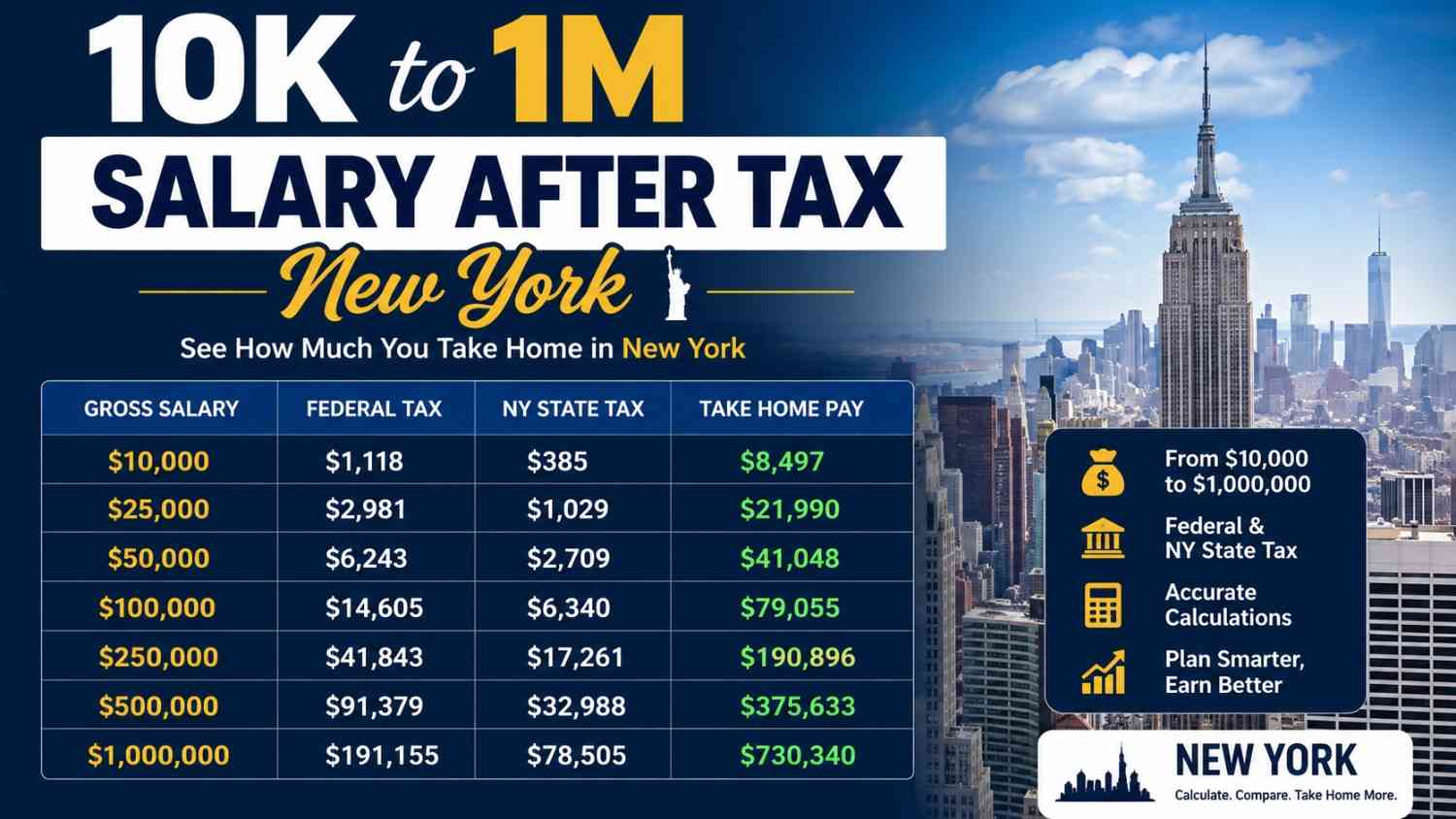
How Much Is a $10K to $1M Salary After Tax in New York?
The amount you keep depends on your taxable income and the tax rules that apply to you. A $50,000 salary does not produce the same net pay for every taxpayer, and a $500,000 salary should not be estimated by simply multiplying the tax on a lower salary.
For a useful comparison, consider these annual gross salary levels:
| Annual gross salary | Main question to answer |
|---|---|
| $10,000 | How do low earnings interact with tax thresholds and payroll taxes? |
| $25,000 | How much might federal and state taxes reduce take-home pay? |
| $50,000 | What remains after the major income and payroll taxes? |
| $75,000 | How do tax brackets affect the next increase in income? |
| $100,000 | What is the difference between gross salary and spendable income? |
| $150,000 | How do state and local taxes affect a higher salary? |
| $250,000 | When can Additional Medicare Tax become relevant? |
| $500,000 | How much of a high salary is affected by different tax systems? |
| $750,000 | How do marginal and effective tax rates differ? |
| $1,000,000 | How should a high-income New York resident estimate total taxes? |
These are comparison points, not fixed take-home amounts. To obtain a meaningful estimate, use the calculator with the correct tax year, location, filing status, and assumptions.
What Taxes Apply to a New York Salary?
Employees who live and work in New York may be affected by several different tax systems. Understanding each one helps explain why a gross salary and a paycheck can look very different.
1. Federal income tax
The federal government taxes taxable income using progressive tax brackets. In a progressive system, different portions of taxable income are taxed at different rates. Reaching a higher bracket does not mean all your income is suddenly taxed at that higher rate.
For tax year 2026, the federal standard deduction is $16,100 for single filers and married individuals filing separately, $32,200 for married couples filing jointly, and $24,150 for heads of household. The 2026 federal tax brackets include a top marginal rate of 37% for single filers with taxable income above $640,600 and married couples filing jointly with taxable income above $768,700.
These are federal figures. They do not represent the total tax rate for a New York resident. See the IRS 2026 tax adjustments for the published figures.
2. New York State income tax
New York State has its own income tax system. Its tax calculation does not simply copy the federal result: state taxable income, state-specific deductions, filing status, tax schedules, and applicable adjustments matter.
For tax year 2026, New York enacted reductions to certain personal income tax rates. The state also publishes updated withholding tables and calculation methods for payrolls beginning January 1, 2026.
A calculator that continues to use an older tax year’s state rates may produce misleading estimates. Check the New York State withholding rate updates and the official tax rates and tables when reviewing a calculation.
3. New York City resident income tax
Living in New York City can create an additional income tax obligation beyond New York State tax. NYC’s personal income tax is separate from the state tax, although the state administers the city’s individual income tax system.
This distinction matters when comparing two people with the same salary. One may live in Manhattan, Brooklyn, Queens, the Bronx, or Staten Island, while the other lives elsewhere in New York State. Their local tax treatment may differ.
For the applicable rules and official information, consult the New York City Department of Finance and New York State’s tax rates and tables.
Do not assume that everyone who works in New York City owes NYC resident income tax. Residence, work location, and individual circumstances can affect the result. Nonresidents may have different obligations, and other local taxes may apply in particular circumstances.
4. Social Security tax
For 2026, the employee Social Security tax rate is 6.2% on covered wages up to the annual wage base of $184,500. Once covered wages reach that limit, additional wages are not subject to the regular employee Social Security tax for that year.
For someone earning $1 million, this creates an important difference between Social Security tax and Medicare tax: the Social Security wage base is capped, but Medicare generally continues to apply to covered wages.
The wage base and employee tax rates are published in IRS Topic No. 751.
5. Medicare tax and Additional Medicare Tax
The regular employee Medicare tax rate is 1.45% on covered wages, without the Social Security-style wage cap. An additional 0.9% Medicare tax may apply when Medicare wages exceed the applicable threshold: generally $200,000 for single filers and $250,000 for married couples filing jointly.
The employer withholding threshold is not always the same as the final liability threshold for a joint tax return. For example, an employer generally begins withholding Additional Medicare Tax from an employee’s wages after those wages exceed $200,000, regardless of the employee’s spouse’s income.
This is one reason a paycheck estimate can differ from the final tax return. Review IRS Topic No. 751 for the official rules.
New York State vs. New York City: Why Location Matters
When comparing salaries, make sure you are comparing the same kind of residence.
New York State outside NYC: You may owe federal income tax, New York State income tax, and applicable payroll taxes. Depending on your location and circumstances, other taxes may also matter.
New York City resident: You may owe federal income tax, New York State income tax, NYC resident income tax, and applicable payroll taxes.
Someone who works in NYC but lives elsewhere: Do not automatically apply NYC resident income tax simply because the workplace is in the city. The correct treatment depends on residence and the applicable rules.
For budgeting purposes, location is especially important when comparing a job offer in NYC with one in another part of New York State. A salary comparison should consider both take-home pay and living expenses, including housing, transportation, insurance, and commuting costs.
$100,000 Salary After Tax in New York
A $100,000 salary is a useful benchmark because it allows you to see how federal, state, local, and payroll taxes interact.
Your actual take-home pay depends on whether you file as single, married filing jointly, or head of household; whether you qualify for deductions or credits; and whether you live in NYC.
To estimate the amount you may receive:
- Enter $100,000 as your annual gross salary.
- Select the correct filing status.
- Choose NYC resident or another New York State location.
- Review the estimated federal income tax, state income tax, city income tax if applicable, and payroll taxes.
- Compare annual net income with monthly and biweekly estimates.
Do not treat the result as an exact paycheck amount. Employer-sponsored health insurance, retirement contributions, other payroll deductions, and withholding elections can reduce the deposit you receive even when those amounts are not income taxes.
$250,000, $500,000, and $1 Million Salary After Tax
Higher earners need to look beyond the headline federal bracket.
At these income levels, Social Security’s annual wage cap, Additional Medicare Tax, New York State tax schedules, potential state tax benefit recapture, and other individual tax circumstances may become more significant.
A reliable high-income estimate should show each component separately rather than combining every deduction into one unexplained percentage.
Why a $1 million salary is not taxed at one rate
Suppose a person has $1 million in gross wages. It would be incorrect to multiply the entire amount by the top federal marginal rate and call the result their federal income tax. Progressive brackets tax different portions of taxable income at different rates, and the taxable amount can differ from gross wages because of deductions and other adjustments.
It would also be incomplete to stop at federal tax. State tax, city tax for applicable residents, Social Security, Medicare, and Additional Medicare Tax may affect the total.
For high earners, special state provisions can also change the final state tax calculation. A simple bracket calculation without applicable adjustments may therefore understate or overstate the result.
Use the calculator as an initial estimate, and verify complex high-income situations against official tax instructions or a qualified tax professional.
Effective Tax Rate vs. Marginal Tax Rate
These two terms answer different questions.
Effective tax rate measures total tax as a percentage of the income used in the calculation. If a person’s total tax were $20,000 on $100,000 of gross income, the gross-income-based effective rate would be 20%.
Formula:
Effective tax rate = Total tax ÷ Gross income × 100
Marginal tax rate is the tax rate that applies to the next dollar of taxable income within the relevant bracket. It does not mean that every dollar earned is taxed at that rate.
A person’s combined marginal rate may also involve more than one tax system. For example, federal, state, city, and payroll taxes can interact. The exact result depends on taxable income, residence, and applicable rules.
When evaluating a raise, promotion, or new job, compare the increase in take-home pay rather than assuming that your full raise will be reduced by a single tax percentage.
Why Your Paycheck May Be Different From Your Annual Take-Home Estimate
An annual salary calculator and an actual paycheck calculator do not always produce identical results. There are several reasons:
- Withholding elections: Your employer uses payroll forms and applicable withholding rules to determine how much tax to deduct during the year.
- Health insurance: Employee premiums can reduce your paycheck.
- Retirement contributions: Traditional 401(k) contributions may reduce federal taxable wages, but their treatment is not identical for every tax.
- Pay frequency: Monthly, biweekly, semimonthly, and weekly payroll schedules produce different payment amounts.
- Bonuses and stock compensation: Supplemental wages and equity compensation may have separate withholding treatment.
- Tax credits and adjustments: The final tax liability can differ from the amount withheld.
- Multiple jobs or a working spouse: Household income and withholding may affect the amount ultimately due.
A biweekly payroll usually means 26 pay periods in a year. Semimonthly payroll generally means 24. Dividing an annual net estimate by 12 gives a monthly average, not necessarily the exact amount of every paycheck.
What Information Do You Need for a More Accurate Estimate?
Before using a salary after-tax calculator, identify the following:
| Information | Why it matters |
|---|---|
| Annual gross salary | Establishes the starting income |
| Tax year | Rates, thresholds, and deductions can change |
| Filing status | Federal and state tax schedules differ by filing status |
| Residence | NYC resident tax may apply |
| Pre-tax deductions | Can affect taxable wages or income |
| Other income | May change your total tax liability |
| Tax credits | Can reduce the final amount owed |
| Pay frequency | Helps estimate the amount per paycheck |
If you receive bonuses, commissions, restricted stock, or self-employment income, a basic wage-only calculator may not capture your full tax situation.
How to Use the Salary After-Tax Calculator
The easiest way to use the calculator is to start with your annual salary and add details as you know them.
Step 1: Enter your gross salary. Use your annual salary before income taxes and payroll deductions. You can start with $10,000 and test salaries up to $1,000,000.
Step 2: Choose your filing status. Select the status that most closely matches how you expect to file your federal return.
Step 3: Choose your location. Identify whether you are an NYC resident or live elsewhere in New York State. Do not select NYC solely because your office is located there.
Step 4: Review the breakdown. Examine each estimated tax component and the remaining income after the modeled taxes.
Step 5: Compare pay periods. Use annual, monthly, weekly, and biweekly results to plan your budget. Remember that actual deposits can be reduced by benefits and other payroll deductions.
Step 6: Verify the assumptions. Check the tax year and the sources used. Recalculate after material tax changes or when your personal circumstances change.
Frequently Asked Questions
How much is $50,000 after tax in New York?
There is no single take-home amount for every person earning $50,000. The result depends on filing status, taxable income, NYC residency, deductions, payroll taxes, and other circumstances. Enter $50,000 into the calculator and select your details to obtain an estimate.
How much is $100,000 after tax in NYC?
A $100,000 gross salary is subject to the applicable federal and New York State tax rules, NYC resident tax when applicable, and payroll taxes. The exact net amount depends on your filing status, deductions, credits, and other income. Use the calculator for a personalized estimate rather than relying on a single number.
How much tax do you pay on a $1 million salary in New York?
A $1 million salary may involve federal income tax, New York State tax, NYC resident tax for applicable residents, Social Security up to its annual wage base, Medicare, and potentially Additional Medicare Tax. State tax calculations can also involve special provisions. An accurate estimate needs to account for the relevant rules instead of applying one flat rate to the entire salary.
Is New York City income tax different from New York State income tax?
Yes. NYC has a separate personal income tax for applicable city residents. New York State income tax is a separate obligation. Your residence and tax circumstances determine which rules apply.
Does the highest federal tax bracket apply to my entire salary?
No. Federal income tax uses progressive brackets. Different portions of taxable income are taxed at different marginal rates.
Does a $1 million earner still pay Social Security tax?
Covered employee wages are generally subject to Social Security tax only up to the annual wage base. For 2026, the wage base is $184,500. Medicare tax does not have the same annual wage cap, and Additional Medicare Tax may apply above the relevant threshold.
Why is my paycheck smaller than the calculator’s monthly estimate?
The calculator may estimate annual tax liability rather than actual employer withholding. Health insurance, retirement contributions, other benefits, withholding elections, and pay frequency can all affect the deposited amount.
Is this calculator suitable for filing a tax return?
No. It is designed for planning and educational estimates. Use official tax forms and instructions for filing, and consult a qualified tax professional if you have complex income, deductions, credits, or residency questions.
Official Tax Sources and Calculation Notes
Tax estimates should be based on official information rather than unverified percentages. These resources are useful when checking a calculation:
- IRS: 2026 tax brackets and standard deduction
- IRS: Social Security and Medicare withholding
- IRS Publication 15 for 2026
- New York State: Tax rates and tables
- New York State: 2026 withholding tax rate changes
- New York City Department of Finance
Tax laws, rates, thresholds, and calculation methods can change. This article is intended for general educational use and does not constitute tax, legal, or financial advice. The calculator’s output is an estimate and should not be used as a substitute for official tax calculations.
About the Author
Junaidul Islam writes practical online guides and calculator resources for people who want to understand income, taxes, and everyday financial decisions. This guide is intended to help New York readers compare gross salary with estimated take-home pay using clearly explained assumptions and official tax references.
NewYorkCalculator.com aims to make financial calculations easier to understand. Readers should always verify important tax decisions against current official guidance.