
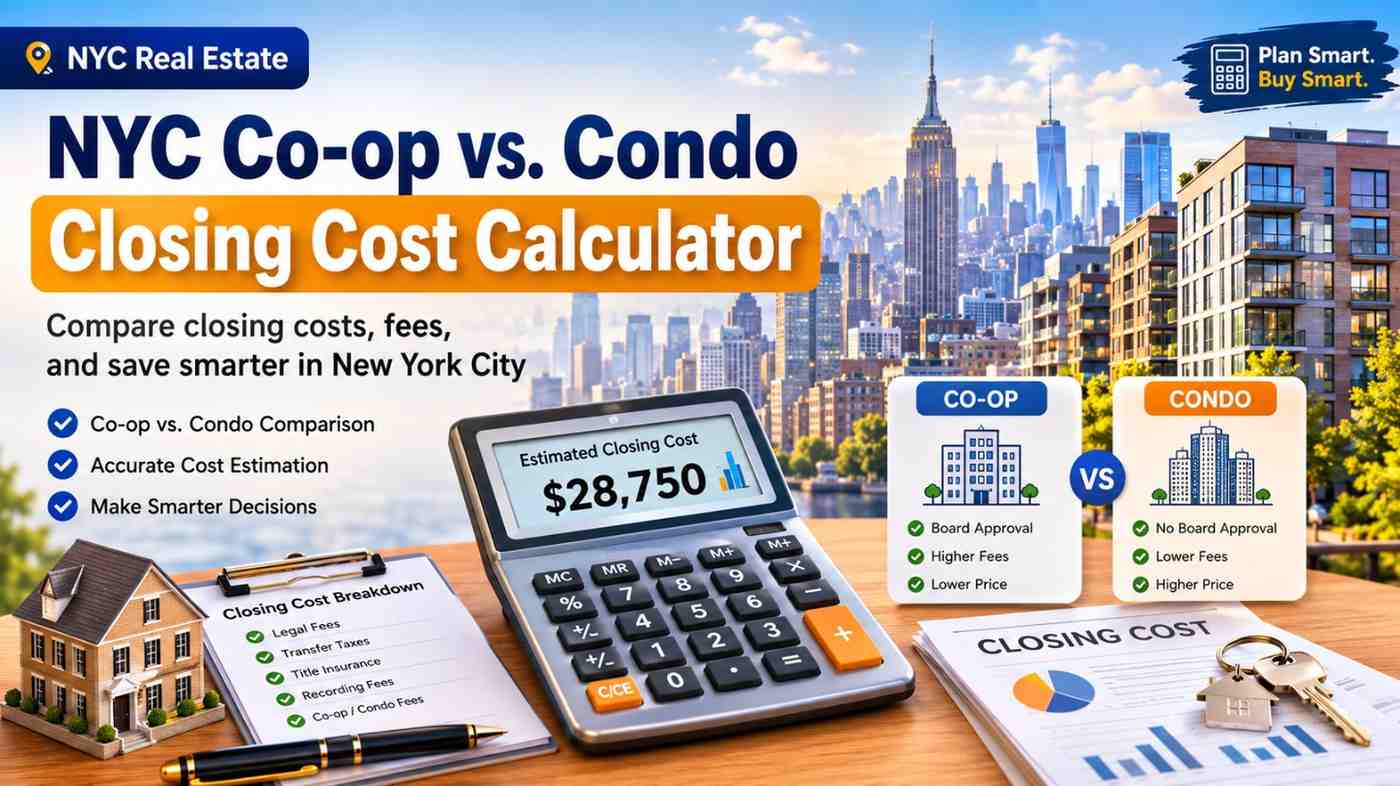
NYC Co-op vs. Condo Closing Cost Calculator
Compare the true cost of buying a co-op vs. a condo in New York City — closing costs, monthly costs, tax benefits, and 5-year total cost of ownership, all in one side-by-side comparison.
Side-by-Side Cost Comparison
—| Cost Component | Co-op | Condo |
|---|
What This Means For You
—
What Exactly Is the NYC Co-op vs. Condo Closing Cost Calculator?
This calculator gives New York City homebuyers a complete, side-by-side comparison of the true cost of buying a co-op versus a condo at the same purchase price. It goes far beyond the basic “closing cost percentage” estimates that most real estate websites provide — it accounts for the specific fees that exist in New York City and nowhere else, the fundamentally different financial structures of co-ops and condos, and the tax implications that make the sticker price misleading for both property types.
What makes this calculator specifically necessary for New York is that the co-op vs. condo distinction is a uniquely New York phenomenon. Approximately 75% of all owner-occupied apartments in Manhattan are co-ops, and the figure is similarly high in parts of Brooklyn and Queens. In most other American cities, co-ops are rare or nonexistent — buyers choose between single-family homes and condos. In New York, the co-op vs. condo decision is one of the first and most consequential choices a buyer makes, and the financial differences extend far beyond the purchase price into closing costs, monthly carrying costs, tax benefits, resale flexibility, and long-term wealth building.
The calculator handles three categories of costs that most generic closing cost calculators ignore or mishandle. First, the NYC-specific taxes that apply only in New York: the Mortgage Recording Tax (a graduated tax that can exceed $20,000 on a typical Manhattan apartment), the Mansion Tax (which kicks in at $1 million and reaches 3.9% at $25 million), and the NYS Transfer Tax. Second, the co-op-specific costs that have no equivalent in the condo world: the co-op application fee, move-in fee, potential flip tax, share loan title insurance (which is fundamentally different from condo title insurance), and the different attorney review process. Third, the ongoing monthly cost structure: co-op maintenance (which includes property taxes and is partially tax-deductible) versus condo common charges plus separate property tax payments (where the common charges are not deductible but the property tax is).
Why Co-op vs. Condo Costs Matter More in NYC Than Anywhere Else
In most cities, the closing cost difference between two property types at the same price is minimal — maybe a few hundred dollars in title insurance or recording fees. In New York, the difference can be tens of thousands of dollars at closing and hundreds of dollars per month in carrying costs. This isn’t an academic distinction — it directly affects how much house you can afford, what your monthly budget looks like, and how much wealth you build over time.
Closing Costs Differ by Thousands
Condo title insurance alone costs $2,000-$5,000+ more than co-op share loan coverage. On a $1M apartment, total closing costs can differ by $5,000-$15,000 between co-op and condo.
Monthly Costs Have Hidden Tax Benefits
Co-op maintenance includes property taxes, and that portion is tax-deductible. Condo common charges are not deductible, but separate property tax payments are. The net effect favors co-ops in most scenarios.
NYC Taxes Hit Harder on Condos
The Mortgage Recording Tax and Mansion Tax are the same for both, but condos often have higher purchase prices at comparable sizes, pushing you into higher Mansion Tax brackets.
5-Year Total Cost Changes the Decision
A condo that costs $10,000 more at closing but saves $100/month could break even in 8 years. The 5-year comparison shows you the real winner for your time horizon.
The flip tax issue is particularly important for co-op buyers to understand because it’s a cost that catches many first-time NYC buyers completely by surprise. A flip tax (also called a transfer fee) is a fee paid to the co-op when a unit is sold. It’s designed to discourage rapid turnover and to generate revenue for the building’s reserve fund. Flip taxes range from 1% to 3% of the sale price, or sometimes 2-3 times the monthly maintenance per year of ownership. In most co-ops, the seller pays the flip tax — but an increasing number of co-ops have amended their bylaws to shift all or part of the flip tax to the buyer. If you’re buying a co-op where the buyer pays a 2% flip tax on a $750,000 apartment, that’s an extra $15,000 in closing costs that a condo buyer would never face. This calculator includes the flip tax so you can see its full impact.
The Mortgage Recording Tax is another cost that shocks out-of-state buyers. In most states, recording a mortgage costs $50-$200. In New York City, it costs 1.8% to 2.175% of the mortgage amount — on a $600,000 mortgage, that’s $10,800 to $13,050. This tax is paid by the buyer (it’s technically charged to the lender but passed through to the borrower) and applies equally to co-ops and condos. However, because co-op share loans are technically different from real property mortgages, some co-op lenders use alternative structures that may reduce or avoid the Mortgage Recording Tax — though this is increasingly rare and shouldn’t be relied upon. The calculator includes the full Mortgage Recording Tax for both property types to provide a conservative, reliable estimate.
How to Use This Calculator (Takes 30 Seconds)
Enter Purchase Details
Input the purchase price, down payment percentage, mortgage rate, and term. These apply equally to both the co-op and condo calculations for a fair comparison.
Enter Monthly Costs
Enter the co-op’s monthly maintenance and the condo’s common charges plus property tax. These are the biggest ongoing cost difference between the two property types.
Add Special Fees
Include any co-op flip tax (if buyer pays), attorney fees, and indicate whether you’re paying mansion tax and transfer tax (new development only).
Compare and Decide
Hit calculate to see a full side-by-side comparison: closing costs, monthly costs, tax benefits, net monthly cost, and total 5-year cost of ownership.
Complete NYC Closing Cost Breakdown: Co-op vs. Condo
The tables below show every closing cost component for both co-ops and condos in New York City, along with typical ranges and who typically pays. These are the costs the calculator uses in its comparison.
| Cost Component | Co-op (Typical) | Condo (Typical) | Who Pays |
|---|---|---|---|
| Down Payment | 20-50% of price | 10-20% of price | Buyer |
| Mortgage Recording Tax | 1.8-2.175% of loan | 1.8-2.175% of loan | Buyer |
| Title Insurance | $250-$500 (share loan) | 0.35-0.50% of price | Buyer |
| Attorney Fees | $1,500-$3,500 | $1,500-$3,500 | Buyer |
| Co-op Application Fee | $500-$1,500 | N/A | Buyer |
| Co-op Move-in Fee/Deposit | $500-$2,000 | N/A | Buyer |
| Flip Tax (if buyer pays) | 1-3% of price | N/A | Varies |
| Lender Origination Fee | 0.5-1.5% of loan | 0.5-1.5% of loan | Buyer |
| Appraisal | $500-$800 | $500-$800 | Buyer |
| Credit Report | $25-$50 | $25-$50 | Buyer |
| Flood Certification | $15-$25 | $15-$25 | Buyer |
| NYC Mansion Tax | 1-3.9% (over $1M) | 1-3.9% (over $1M) | Seller (usually) |
| NYS Transfer Tax | 0.4-0.65% | 0.4-0.65% | Seller (usually) |
NYC Mansion Tax Tiers: When It Applies and How Much
The NYC Mansion Tax is a transfer tax that applies to residential properties selling for $1 million or more. It was significantly restructured in 2019, moving from a flat 1% to a graduated system with much higher rates for luxury properties. While the mansion tax is technically the seller’s responsibility in standard resale transactions, new development condos and sponsor resales in co-ops often pass this cost to the buyer through the purchase contract.
| Purchase Price | Mansion Tax Rate | Tax on $1.5M Purchase | Tax on $3M Purchase |
|---|---|---|---|
| Under $1,000,000 | 0% | $0 | — |
| $1,000,000 – $1,999,999 | 1.00% | $15,000 | — |
| $2,000,000 – $2,999,999 | 1.25% | — | $37,500 |
| $3,000,000 – $4,999,999 | 1.50% | — | $45,000 |
| $5,000,000 – $9,999,999 | 2.25% | — | $67,500 |
| $10,000,000 – $14,999,999 | 3.25% | — | $97,500 |
| $15,000,000 – $24,999,999 | 3.50% | — | $105,000 |
| $25,000,000+ | 3.90% | — | $117,000 |
The $1 million threshold is particularly painful in New York because $1 million buys a relatively modest apartment in many Manhattan neighborhoods — a one-bedroom in many parts of the Upper East Side, Upper West Side, or downtown Manhattan easily exceeds $1 million. In Brooklyn, $1 million buys a decent two-bedroom in many neighborhoods but the threshold is still hit regularly. The mansion tax creates a “cliff effect” where a $999,000 purchase pays $0 in mansion tax but a $1,001,000 purchase pays $10,010 — a $20,010 difference for a $2,000 increase in price. Savvy NYC buyers and their attorneys often negotiate to keep the contract price at or below $1 million when possible, though this is less common in competitive bidding situations.
NYC Mortgage Recording Tax: The Hidden $10,000+ Fee
The Mortgage Recording Tax (MRT) is one of the largest closing costs for NYC buyers, and it’s a tax that doesn’t exist in most other states. It’s calculated as a percentage of the mortgage amount (not the purchase price), and it uses a graduated rate structure that increases with the loan size. The tax is paid when the mortgage is recorded with the city register’s office, and it’s typically passed through to the borrower as a closing cost.
| Mortgage Amount | Tax Rate | Tax on $500K Mortgage | Tax on $800K Mortgage |
|---|---|---|---|
| $0 – $500,000 | 1.80% | $9,000 | $9,000 (first $500K) |
| $500,001 – $1,000,000 | 1.925% | — | $5,775 (next $300K) |
| Over $1,000,000 | 2.175% | — | — |
| Total Example | Graduated | $9,000 | $14,775 |
On a $750,000 purchase with 20% down ($600,000 mortgage), the MRT is $9,000 + $1,925 = $10,925. On a $1.5 million purchase with 20% down ($1.2 million mortgage), it’s $9,000 + $9,625 + $4,350 = $22,975. This is real money that comes out of your pocket at closing, and it’s one of the reasons why New York’s closing costs are among the highest in the country. The MRT applies equally to co-ops and condos — there’s no difference in how it’s calculated for the two property types, though the mortgage amount may differ if co-ops require higher down payments.
Co-op Maintenance vs. Condo Common Charges + Tax: The Monthly Reality
The ongoing monthly cost difference between co-ops and condos is one of the most misunderstood aspects of NYC real estate. At first glance, co-op maintenance always looks more expensive than condo common charges — and it usually is in raw dollar terms. But the comparison is misleading because co-op maintenance includes costs that condo owners pay separately, and because a significant portion of co-op maintenance is tax-deductible while condo common charges are not.
- What’s in co-op maintenance: Your monthly co-op maintenance payment covers the building’s underlying mortgage (if any), property taxes for the entire building, building insurance, staff salaries (doorman, super, porters), utilities for common areas, elevator maintenance, landscaping, water and sewer, and contributions to the building’s reserve fund. The key point is that property taxes — which are often 25-40% of the total maintenance charge — are included in this number. You don’t pay property taxes separately as a co-op owner; the co-op pays them as a single entity and passes the cost through to shareholders via maintenance.
- What’s in condo common charges: Condo common charges cover building insurance, staff salaries, utilities for common areas, elevator maintenance, landscaping, water and sewer, and reserve fund contributions. They do NOT include property taxes. As a condo owner, you receive a separate property tax bill from the NYC Department of Finance and pay it directly — it’s not part of your common charges. This is why condo common charges are typically 40-60% lower than co-op maintenance at the same building size and quality level: the common charges are only covering half the picture.
- The tax deduction advantage: The portion of co-op maintenance that represents your share of the building’s property taxes (typically 25-40% of the total maintenance) is deductible on your federal income tax return as property tax. Additionally, the portion that represents your share of the building’s underlying mortgage interest is also deductible as mortgage interest. For a co-op with $1,800/month maintenance where 40% is tax-deductible ($720/month), a taxpayer in the 22% federal bracket saves approximately $158/month in federal taxes — reducing the effective maintenance cost to $1,642/month. For a condo owner paying $900/month common charges and $850/month property tax, only the $850 property tax is deductible (saving approximately $187/month at 22%), while the $900 common charges provide no tax benefit whatsoever. The net monthly cost: co-op at ~$1,642 vs. condo at ~$1,563. The gap narrows significantly after taxes.
- Co-op maintenance tends to increase: Because maintenance includes property taxes, and NYC property taxes have been increasing steadily (especially after the 2021-2022 reassessment that hit many co-op and condo buildings), co-op maintenance often increases by 3-6% per year. Condo common charges also increase, but the property tax portion is separate and may increase at a different rate. Over a 5-10 year period, co-op maintenance increases can significantly outpace condo common charge increases, gradually eroding the initial tax advantage.
Non-Financial Factors: Co-op vs. Condo Beyond the Numbers
This calculator focuses on costs, but the co-op vs. condo decision in New York involves significant non-financial factors that can outweigh the dollar difference for many buyers. Understanding these helps put the calculator’s output in context.
- Board approval: Co-op boards have the right to approve or reject buyers, and they exercise this right frequently. The approval process involves a detailed application (financial disclosures, reference letters, personal essays, board interview), and rejections are common — estimated at 10-30% of all co-op applications in some Manhattan buildings. Condos generally do not have board approval (the right of first refusal is rarely exercised), making the purchase process faster and more certain. If you’re self-employed, have non-traditional income, or have anything in your financial profile that a board might question, a condo eliminates this risk entirely.
- Subletting and flexibility: Most co-ops restrict or prohibit subletting, typically allowing it for only 1-2 years out of every 5, and only with board approval. Some co-ops don’t allow subletting at all. Condos generally allow subletting freely (subject to reasonable building rules). If there’s any chance you’ll need to rent out your apartment in the future — for job relocation, travel, or investment purposes — a condo provides vastly more flexibility.
- Purchasing power and down payment: Co-ops typically require 20-25% down (and many require 25-30% or more), while condos can be purchased with as little as 10% down (and some programs allow 5% or even 3.5% with FHA). If you have limited cash for a down payment, a condo may be your only option regardless of what the monthly cost comparison shows. A $750,000 co-op requiring 25% down needs $187,500 cash; the same-priced condo at 10% down needs only $75,000 — a $112,500 difference in required cash.
- Financing restrictions: Some co-op boards restrict the amount of financing a buyer can use, requiring higher down payments than the building’s minimum. They may also require specific lender approval or impose minimum liquidity requirements (often 1-2 years of maintenance and carrying costs in post-closing reserves). Condos have none of these restrictions — if a lender is willing to finance you, the condo building won’t add additional hurdles.
- Resale value and marketability: Condos are generally easier to sell than co-ops because there’s no board approval process for the buyer, the financing requirements are more flexible, and the pool of potential buyers is larger (including investors who want to rent the unit). In a soft market, co-ops can sit on the market significantly longer than comparable condos. This liquidity difference is worth considering even if the co-op looks cheaper on paper.
What This Calculator Can’t Do — And How To Fill Those Gaps
- It doesn’t include seller-paid costs: In standard resale transactions, the seller pays the mansion tax, NYS transfer tax, broker commission (typically 5-6% split between buyer’s and seller’s brokers), and their own attorney. These costs don’t come out of your pocket at closing, but they affect the seller’s net proceeds and therefore the price they’re willing to accept. In some cases, the “true cost” of buying includes these indirectly if they’re baked into the price.
- It assumes the same purchase price for both: In reality, comparable co-ops and condos rarely have identical prices. Co-ops typically sell for 10-20% less than comparable condos because of the restrictions (board approval, subletting limits, higher down payments). A more sophisticated analysis would compare a $650,000 co-op with a $750,000 condo — but this calculator lets you model that by simply running it twice with different prices.
- It doesn’t model maintenance increases over time: The 5-year total cost uses today’s maintenance, common charges, and property tax figures. In reality, these increase 3-6% per year in NYC. Co-op maintenance tends to increase faster because it includes property taxes, which are subject to reassessment and rate changes. Over 5-10 years, this can significantly change the comparison.
- It uses a simplified tax benefit calculation: The calculator estimates your federal tax savings based on the deductible portion of your housing costs and your stated tax bracket. The actual calculation depends on whether you itemize deductions (which requires your total itemized deductions to exceed the standard deduction of $14,600 for single filers or $29,200 for married filing jointly in 2024-2025), whether you’re subject to the SALT deduction cap ($10,000), and other factors. For high-income New Yorkers, the SALT cap significantly reduces the tax benefit of both co-op maintenance deductions and condo property tax deductions.
- It doesn’t include building-specific financial health: A co-op with a strong reserve fund, low underlying mortgage, and well-managed finances is a very different proposition from one with a thin reserve fund, high underlying mortgage, and pending assessments. Similarly, a condo with healthy reserves and no special assessments is very different from one that’s about to hit owners with a $20,000 special assessment for facade work. These building-specific factors can dwarf the cost differences this calculator shows.
- Share loan vs. mortgage rate differences: Some co-op share loans have slightly higher interest rates than conventional condo mortgages because the secondary market for share loans is smaller and less liquid. This calculator uses the same rate for both, but in practice, you might pay 0.125-0.25% more for a share loan, which would slightly increase the co-op’s monthly cost.
What Happens With Your Financial Information
Nothing — your purchase price, down payment, mortgage rate, monthly costs, tax bracket, and all other inputs are processed entirely in your browser. No data is sent to any server. No financial, real estate, or personal information is stored, logged, or transmitted. No cookies, no tracking. Your homebuying finances are among the most sensitive information you can share, and a calculator has no business sending it anywhere. Close the tab and it’s completely gone.
Frequently Asked Questions
It depends on the specific buildings and your personal situation, but in general: yes, co-ops are cheaper both at closing (lower title insurance, no separate title search fees) and on a tax-adjusted monthly basis (because a portion of maintenance is deductible). However, co-ops require more cash up front (higher down payments), are harder to finance, and are harder to sell. The “cheaper” label only holds if you can get approved, can afford the higher down payment, and plan to stay long enough for the monthly savings to matter. For a 2-3 year stay, the closing cost savings alone might not justify the co-op’s restrictions.
A flip tax is a fee paid to the co-op when an apartment is sold. Traditionally, the seller pays it — and in most co-ops, the seller still does. However, an increasing number of co-ops (particularly those that have recently amended their bylaws) require the buyer to pay some or all of the flip tax. This is disclosed in the co-op’s offering plan and bylaws. Before making an offer on a co-op, ask your attorney to check whether the flip tax is seller-paid or buyer-paid. If it’s buyer-paid and set at 2% on a $750,000 apartment, that’s $15,000 extra in closing costs that you need to budget for. This calculator includes the flip tax so you can see its full impact on the comparison.
When you buy a condo, you’re buying real property — a specific unit with a defined legal description. The title insurance policy protects you (and your lender) against any defects in the title: liens, encumbrances, recording errors, forgery, or other issues that could affect your ownership. This requires a full title search and a comprehensive insurance policy, which costs 0.35-0.50% of the purchase price. When you buy a co-op, you’re buying shares in a corporation and getting a proprietary lease — you don’t hold title to real property in the traditional sense. The “title” risk is much lower because the co-op corporation already holds the building’s title, and your share loan lender’s risk is different. The share loan title policy is a much simpler document that costs $250-$500. This single difference saves co-op buyers $2,000-$4,000+ at closing on a typical NYC apartment.
While it’s technically not legally required, literally every real estate professional in New York will tell you that you need an attorney for any real estate transaction in NYC — co-op or condo. The reason is that NYC real estate transactions are significantly more complex than in other states: the contracts are longer, the due diligence requirements are more extensive, the co-op board process adds a layer of complexity, and the financial stakes are higher. An experienced NYC real estate attorney charges $1,500-$3,500 for a standard purchase and handles contract review, due diligence, title issues, negotiation of terms, and closing coordination. Skipping an attorney to save $2,500 on a $750,000+ purchase is false economy — a single missed issue (a building with pending litigation, an understated common charge increase, a flip tax you didn’t know about) could cost you tens of thousands of dollars.
For a standard resale (not new development), buyer closing costs in NYC typically total 2-4% of the purchase price for a condo and 1.5-3% for a co-op. On a $750,000 condo, expect approximately $15,000-$30,000 in buyer closing costs (excluding down payment). On a $750,000 co-op, expect approximately $11,000-$22,500. The wide range depends on the mortgage size (which drives the Mortgage Recording Tax), lender fees, and whether any unusual co-op fees apply. For new development condos where the buyer pays mansion tax and transfer tax, closing costs can jump to 5-8% of the purchase price — on a $1.5 million new development condo, buyer closing costs can exceed $75,000-$120,000.
In practice, no — not legally. The MRT applies to any mortgage on real property in New York City, and avoiding it would require not having a mortgage (paying all cash) or using a financing structure that doesn’t qualify as a “mortgage” under NYC law. In the past, some co-op share loans were structured as personal loans or “security agreements” rather than traditional mortgages, which technically avoided the MRT. However, the NY State Department of Taxation and Finance has cracked down on these structures, and most reputable lenders now use standard mortgage documents that trigger the MRT even for co-op share loans. If a lender offers you a “no MRT” co-op loan, have your attorney review it carefully — it may not hold up under scrutiny and could create problems at closing or when you eventually sell.
Yes, significantly. The federal SALT deduction cap of $10,000 means you can only deduct $10,000 in state and local taxes (including property taxes) on your federal return, regardless of how much you actually pay. For a co-op owner with $7,200/year in deductible maintenance ($600/month × 12 × 40%), the full amount is under the $10,000 cap and fully deductible. But if your deductible portion is $15,000/year, you can only deduct $10,000 — losing $5,000 in deductions. The same cap applies to condo owners’ property tax payments. For high-income New Yorkers in high-tax buildings, the SALT cap significantly reduces the tax advantage of both co-ops and condos, narrowing the gap between the two. This calculator lets you input your tax bracket but doesn’t model the SALT cap — for high-deduction scenarios, reduce the “tax deductible %” input to reflect the effective deduction after the cap.
Co-op boards set minimum down payment requirements as part of their bylaws, and these requirements exist for two reasons. First, the co-op corporation is ultimately responsible for the building’s underlying mortgage — if many shareholders default on their share loans, the co-op could face financial distress. Higher down payments reduce the risk of default. Second, co-op boards use down payment requirements as a screening tool — requiring 25-30% down ensures that buyers have significant financial resources, which boards view as reducing the likelihood of financial problems, noise complaints, or other issues. Many co-op boards also require post-closing liquidity (cash reserves after closing) of 6-24 months of maintenance and carrying costs. Condos don’t have these requirements because the condo association isn’t on the hook for individual owners’ mortgages — each owner’s lender bears that risk.
Absolutely. In the real NYC market, comparable co-ops and condos don’t sell for the same price. A typical co-op might sell for $650,000 while a comparable condo sells for $750,000 — a 15% difference. To get a realistic comparison, run the calculator once with the co-op’s actual price and maintenance, then again with the condo’s actual price and costs. The 15% price difference may completely flip the calculator’s conclusion: even though the co-op is cheaper on a cost-per-dollar basis, the condo at a lower effective price (after negotiating) might be the better deal. Running both scenarios gives you the full picture.