
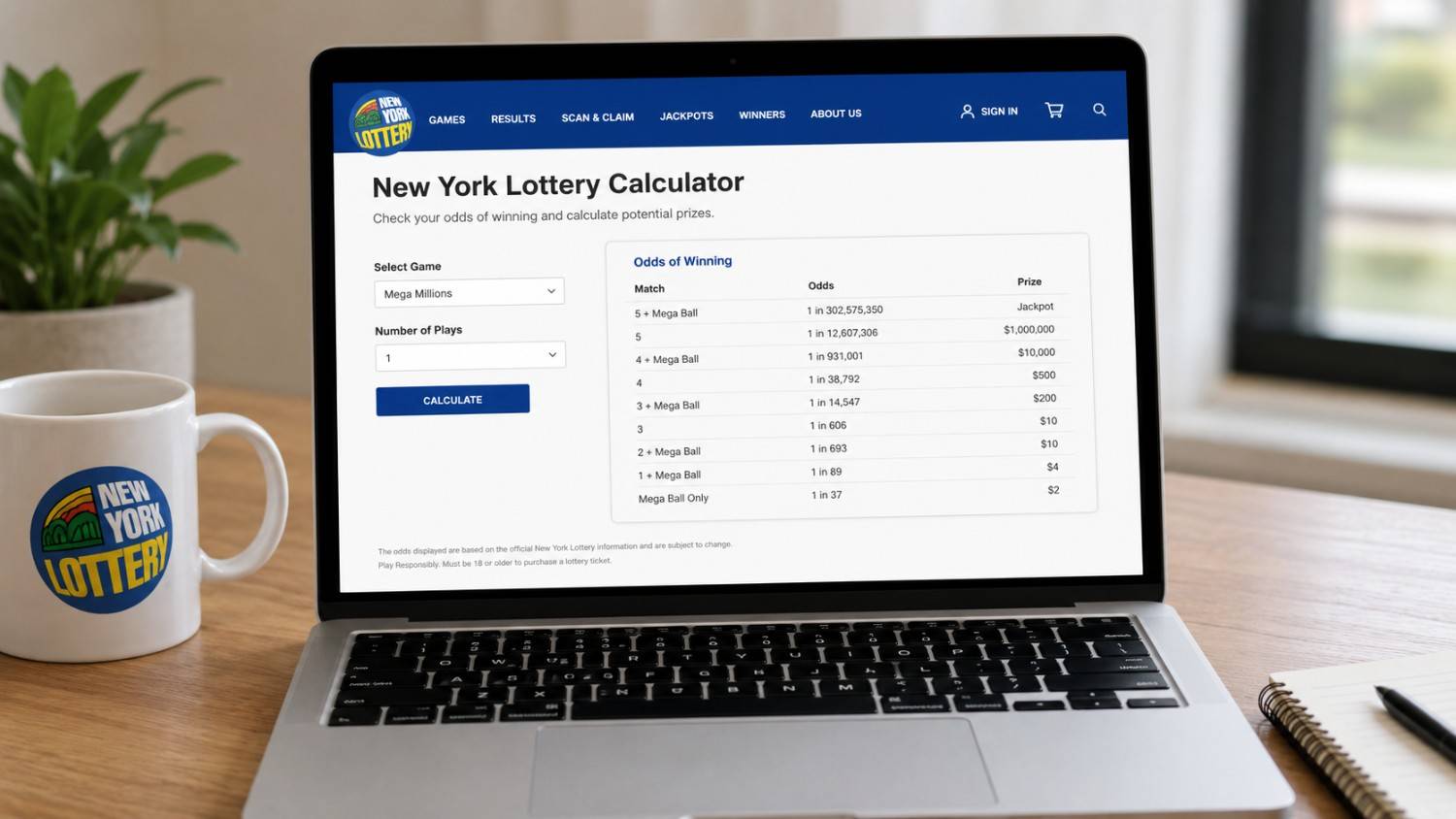
Winning the lottery can change your financial future, but the amount printed on a winning ticket or advertised in a jackpot announcement is not necessarily the amount you will keep. Federal income tax, New York State income tax, applicable local taxes, and your choice of payout can all affect the final result.
Our New York Lottery Calculator helps you explore an estimated payout and understand how different assumptions affect your potential take-home winnings. You can compare a lump-sum payment with an annuity scenario and review the tax categories that may apply to your situation.
The goal is simple: help New York lottery players make sense of the numbers before making important financial decisions.
Important: This calculator provides an educational estimate, not a tax return or a guaranteed payout quote. Your actual liability depends on your total taxable income, filing status, tax year, residency, the lottery game, and other circumstances.
Lottery Calculator New York
New York Lottery Calculator
Explore a hypothetical lottery payout after assumed taxes. Adjust the rates to compare different scenarios.
| Entered prize amount | $0 |
| Assumed federal amount | $0 |
| Assumed NY State amount | $0 |
| Illustrative local amount | $0 |
| Total assumed deductions | $0 |
| Illustrative annual payment before assumed taxes | $0 |
| Illustrative annual payment after assumed taxes | $0 |
Educational use only. This tool does not determine official lottery cash values, game-specific annuity schedules, final federal or state tax, withholding eligibility, or refunds. Verify current rules with the IRS, New York State Department of Taxation and Finance, and the official New York Lottery.
Use the calculator above to explore an estimated lottery payout. For a jackpot, use the official cash value when estimating a lump-sum payment rather than automatically entering the advertised annuity amount.
How Does the New York Lottery Calculator Work?
A useful lottery calculator should do more than subtract one flat percentage from a prize. It should help you understand which amount you are starting with, which taxes may apply, and why the estimate may differ from the money you eventually receive.
Our calculator is designed as a starting point for that process.
1. Enter Your Lottery Prize
Begin by entering the prize amount you want to evaluate. For a smaller prize, this may be the stated cash prize. For a major Powerball or Mega Millions jackpot, first determine whether the amount you have is the advertised annuity value or the available cash option.
These figures are not interchangeable. Using the wrong starting amount can make the entire estimate misleading.
2. Choose a Payout Method
Select the payment method that matches your scenario:
- Lump sum: An eligible winner receives a single cash payment based on the lottery’s cash option and applicable rules.
- Annuity: The winner receives payments according to the specific game’s payment schedule.
Not every prize offers the same payment choices. Confirm the available options with the official lottery for the game you won.
3. Consider Your Tax Location
New York State income tax is not the only location-related consideration for every player. New York City residents may have an additional city income tax, while Yonkers residents may be subject to a resident income tax surcharge.
Your residency and the tax rules for the year of the winnings matter. A person who lives outside New York, someone who moved during the year, and a full-year New York City resident may not have identical filing obligations.
4. Review the Estimated Take-Home Amount
After entering the relevant information, review the estimated taxes and remaining amount. Treat the result as a planning estimate rather than a promise of the exact amount the lottery will deposit.
For a large prize, consider consulting a qualified tax professional before selecting a payment option or making major financial commitments.
How Much Tax Do You Pay on Lottery Winnings in New York?
Lottery winnings are generally taxable income. The total tax depends on the applicable federal and state rules and, for some residents, local income taxes.
There is no single percentage that accurately describes every winner’s final tax bill.
Federal Income Tax on Lottery Winnings
Lottery winnings are generally included in federal taxable income. The IRS requires federal income tax withholding on qualifying lottery winnings under its gambling-withholding rules.
Under the IRS instructions revised in January 2026, regular federal gambling withholding generally applies when lottery winnings, reduced by the wager, exceed $5,000 and the winnings meet the applicable reporting test. The regular withholding rate is 24%.
However, 24% withholding is not necessarily your final federal tax rate. Your final liability is determined under the federal tax rules that apply to your circumstances and total income. A winner may owe more than the amount withheld or may qualify for a refund, depending on the complete tax calculation.
For current details, see the IRS Instructions for Forms W-2G and 5754 and Publication 17.
New York State Income Tax
New York generally treats lottery winnings as taxable income. The applicable state income tax is based on the rules and tax brackets for the relevant year, not simply on a universal lottery tax percentage.
New York’s published income tax schedules include graduated rates. For example, the top New York State marginal rate shown in the published 2025 resident and nonresident schedules is 10.9% for the highest taxable-income bracket. A marginal rate applies to income within a particular bracket; it does not mean that every dollar of a person’s income is automatically taxed at that rate.
New York enacted changes affecting state income tax rates beginning in 2026, so users should consult the current tax-year instructions before relying on an older rate table.
Official resources:
New York City Income Tax
New York City residents may owe city personal income tax in addition to New York State income tax and federal tax.
The city tax calculation uses its own brackets and rules. For that reason, a calculator that applies only federal and state percentages may overstate the take-home amount for some NYC residents.
New York City includes the Bronx, Brooklyn, Manhattan, Queens, and Staten Island.
Check the current New York State guidance for NYC and Yonkers residents when determining whether a local tax applies.
Yonkers Resident Tax Surcharge
Yonkers has a resident income tax surcharge calculated under New York’s applicable rules. It should not simply be treated as an identical flat percentage of every lottery prize.
A nonresident of Yonkers may face different rules for particular income sources, so residency and income classification should be reviewed carefully.
See the state’s official tax guidance for details.
Lump Sum vs. Annuity: Which Lottery Payout Is Better?
For a major jackpot, the choice between a lump sum and an annuity can affect your financial planning, investment options, and tax timing.
What Is a Lump-Sum Payment?
A lump-sum option pays an eligible winner once, using the cash value established for the specific prize. That cash value can be substantially lower than the advertised annuity jackpot.
Potential advantages include immediate access to the money, flexibility in investing, and the ability to plan a large purchase or debt repayment. However, receiving a large amount at once may also create substantial tax and money-management challenges.
The cash option is not simply the advertised jackpot minus a standard tax percentage.
What Is an Annuity Payment?
An annuity distributes the prize over time according to the rules of the particular lottery game.
Depending on the game, the schedule may include payments that increase over time. The precise schedule should come from the official game rules rather than from a generic assumption that every lottery pays the same amount every year.
Potential advantages include receiving money over an extended period and having a structured payment schedule. Potential disadvantages include less immediate access to the full advertised amount and the need to plan around future payments.
How Should You Compare Them?
Compare the options using the official cash value and payment schedule. Then consider the estimated taxes for the relevant payment years, your financial needs, and the risks of managing a large sum.
Do not compare an untaxed advertised jackpot with an after-tax lump-sum amount. Those figures measure different things.
A qualified financial adviser and tax professional can help evaluate the consequences of either option.
Example: Estimating Taxes on a $1 Million Lottery Prize
Imagine a player wants to understand a hypothetical $1 million cash prize. The correct result depends on more than the prize amount.
The player may need to consider:
- Other taxable income received during the year.
- Federal filing status and applicable deductions.
- New York State tax brackets for the relevant year.
- Whether the player is a New York City or Yonkers resident.
- Federal and state withholding already taken from the payment.
- Whether the prize is paid in one amount or in installments.
For example, a simplified calculation that subtracts a single assumed tax percentage from $1 million may be useful for rough planning, but it is not a reliable substitute for calculating the winner’s actual tax liability.
A realistic example should state its assumptions. If an example assumes a single filer with no other income, it should say so. If it uses an illustrative combined tax rate, it should identify that rate as an assumption rather than an official rate for every winner.
For the same reason, this page avoids presenting an invented universal after-tax amount as though every New York winner would receive it.
Does Your Other Income Affect Lottery Taxes?
Yes. Your other income can affect your final tax liability because lottery winnings generally form part of your taxable income.
A winner who already earns a substantial salary may have a different final federal or state tax result from someone with little other income. Filing status, deductions, credits, and the tax year can also change the outcome.
Withholding at the time of payment is designed to collect tax in advance under the applicable rules. It does not necessarily settle the winner’s complete tax obligation.
For a major prize, review your estimated tax payments and filing obligations with a qualified tax professional.
What If You Win Powerball or Mega Millions in New York?
Powerball and Mega Millions are multi-state lottery games, but the prize claim is handled under the rules applicable to the state where the ticket was purchased.
If you purchased your ticket in New York, begin with the official New York Lottery instructions. Confirm the prize amount, the available payment options, the claim deadline, and any documents required for the claim.
For a major jackpot, do not rely on an old online example to determine the cash value. Advertised jackpot figures and cash values can change as sales and prize details are finalized.
Official starting points:
New York Lottery Prize Claim Rules and Deadlines
Tax planning is only one part of handling a winning ticket. Claim procedures and deadlines are also important.
According to the New York Lottery’s official claim guidance:
- Draw-game prizes generally must be claimed within one year of the drawing date.
- Scratch-off prizes generally must be claimed within one year after the announced end of the game.
- Prizes under $600 can generally be claimed at licensed retailers, customer service centers, prize claim centers, or by mail.
- Prizes of $600 or more require an eligible claim process through the lottery’s designated channels.
The official lottery page provides additional instructions for larger prizes, including identity documents, claim forms, and where to submit a claim.
Rules and procedures can change, so confirm the details directly with the official New York Lottery claim page before sending a ticket or documents.
Protect your winning ticket, follow the official instructions, and keep copies of your claim documents.
How Accurate Is This New York Lottery Calculator?
The calculator is an educational tool for exploring potential payouts. Its usefulness depends on the quality of the inputs and the assumptions used.
An estimate can differ from your final tax return because of:
- Changes in tax law or tax brackets.
- Other income, deductions, and credits.
- Your filing status and residency.
- Whether the entered amount is a cash value or advertised annuity amount.
- The official payment schedule for the specific lottery game.
- Taxes withheld before you receive the prize.
For these reasons, users should not treat a calculator result as a guarantee or as personalized tax advice.
We recommend checking the official IRS and New York State resources linked on this page before making a major financial decision.
Frequently Asked Questions
Is lottery money taxable in New York?
Lottery winnings are generally taxable income for federal and New York State purposes. Additional local tax may apply depending on the winner’s residency and circumstances.
Is the 24% federal withholding rate my final tax rate?
Not necessarily. The 24% rate applies to qualifying gambling winnings under the federal withholding rules. Your final federal tax liability depends on the tax rules that apply to your total income and circumstances.
Do New York City residents pay additional tax on lottery winnings?
New York City residents may owe city personal income tax in addition to applicable federal and state taxes. The final calculation depends on the relevant tax-year rules.
Do Yonkers residents pay a separate lottery tax?
Yonkers residents may be subject to the resident income tax surcharge under New York’s rules. Check the current state instructions to determine how it applies to your situation.
Is a lump sum better than an annuity?
There is no universally correct answer. The choice depends on the official cash value, payment schedule, tax timing, financial goals, and ability to manage the money.
Can I use this calculator for Powerball and Mega Millions?
You can use it to explore estimates, provided you enter the appropriate prize amount and payment assumptions. For a jackpot, verify the official cash value or annuity schedule before relying on the result.
Does the calculator provide an exact tax refund or final payout?
No. It provides an educational estimate. Your actual tax liability and payout may differ, so consult the official lottery and tax authorities for definitive information.
Where can I verify New York Lottery claim deadlines?
Use the official New York Lottery How to Claim a Prize page for current deadlines, documents, and claim procedures.
Final Thoughts
A lottery prize can create exciting opportunities, but the amount you keep depends on the payout option, your tax situation, and the rules in effect when you receive the winnings.
Use the New York Lottery Calculator to explore possible outcomes, compare assumptions, and understand the difference between a stated prize and an estimated take-home amount. Then verify the official cash value, payment schedule, and tax rules before making financial decisions.
Author: Junaidul Islam
This article is for educational purposes only and does not provide tax, legal, investment, or financial advice. Tax rules and lottery procedures may change. Always verify current information with the IRS, the New York State Department of Taxation and Finance, and the New York Lottery.