
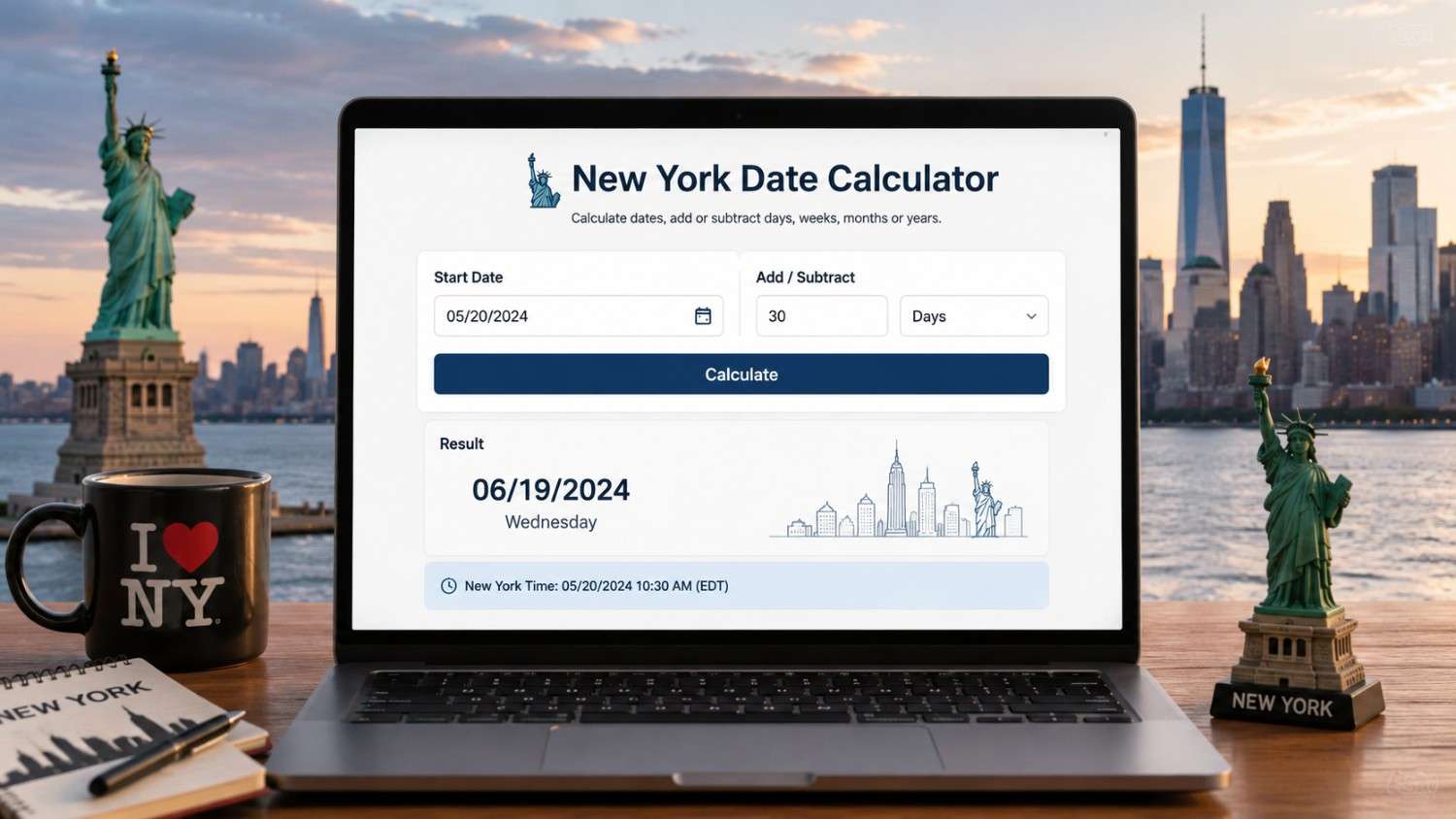
By Junaidul Islam Whether you are planning a trip, organizing a project, counting the days until an important event, or estimating how much time remains before a deadline, getting the date calculation right matters. Our New York Date Calculator helps you count the days between two dates, find future or past dates, and estimate the number of weekdays or business days in a selected period.
The important detail is that not every date calculation follows the same rule. Counting calendar days is different from counting weekdays, and business days may exclude public holidays in addition to weekends. The correct method depends on what you are trying to calculate.
Use the calculator below to choose your dates and counting method. Then read the examples to understand exactly what your result means.
New York Date Calculator
Calculate days between dates or find a future or past date. Free and easy to use.
What Is a New York Date Calculator?
A New York Date Calculator is an online tool for working with dates in the calendar system used in New York, United States. Depending on the selected mode, it can calculate the time between two dates, add or subtract a specified number of days, or estimate working days by excluding weekends and selected holidays.
For example, you might want to know:
- How many days remain between two appointments?
- What date falls 30 calendar days after a particular date?
- How many Monday-through-Friday days fall within a project period?
- What date is reached after adding a certain number of business days?
- How does the answer change when weekends or selected holidays are excluded?
These questions may sound similar, but they can produce different answers. Choosing the right counting method is therefore just as important as entering the correct dates.
How to Use the New York Date Calculator
Start by selecting the calculation you need. Enter the date or dates, choose the appropriate counting options, and run the calculation.
1. Calculate the days between two dates
Choose the start date and end date. The calculator measures the elapsed calendar days between them. If you want to count both the starting and ending dates as included days, select the inclusive-counting option.
For example, the elapsed time from Monday, October 5, 2026, to Friday, October 9, 2026, is four days. If you are counting every date covered by a Monday-to-Friday leave period, however, the total is five dates.
Both answers are correct for their respective purposes.
2. Add or subtract days from a date
Choose a starting date, enter the number of days, and select whether you want to move forward or backward. This is useful for planning events, preparing schedules, or checking a date a specified number of days before or after another date.
Remember that adding 30 calendar days does not necessarily produce the same result as adding 30 business days.
3. Count business days
Business-day calculations usually exclude Saturdays and Sundays. Depending on your requirements, you may also need to exclude specific public holidays or other non-working days.
Use the holiday options carefully. A standard weekday calculator does not automatically know whether your employer, bank, school, court, or another organization is closed on a particular date.
4. Review the counting rule
Before relying on the result, check whether the start date, end date, weekends, and selected holidays are included or excluded. This small step can prevent misunderstandings when planning work, travel, appointments, or administrative tasks.
Calendar Days vs. Weekdays vs. Business Days
These three terms are often used interchangeably, but they do not always mean the same thing.
| Counting method | What it counts | Typical use |
|---|---|---|
| Calendar days | Every date, including Saturdays and Sundays | Travel planning, general date differences, personal events |
| Weekdays | Monday through Friday | School schedules, routine work planning |
| Business days | Usually weekdays, excluding applicable holidays or closure days | Delivery estimates, business correspondence, work schedules |
The exact definition of a business day depends on the organization or rule involved. Some organizations follow federal holidays, while others follow a state calendar, an industry-specific schedule, or their own closure policy.
Example: Counting a Monday-to-Friday period
Suppose a period starts on Monday and ends on Friday of the same week.
- Elapsed days between the two dates: 4 days.
- Dates covered when both Monday and Friday are included: 5 days.
- Weekdays in that inclusive period: 5.
- Business days: potentially 5, if none of those weekdays is an excluded holiday or closure day.
This distinction is useful when calculating leave periods, planning work, or interpreting instructions that specify a number of days.
How to Calculate Business Days in New York
For a basic business-day estimate, count Monday through Friday and exclude Saturday and Sunday. If the calculation requires a holiday-aware result, identify which holiday calendar or workplace policy applies.
New York has state-specific legal holidays, but the calendar published for eligible New York State employees does not automatically determine the closing schedule for every private employer or organization. For example, the official 2026 state employee calendar lists holidays such as New Year’s Day, Martin Luther King Jr. Day, Washington’s Birthday, Memorial Day, Juneteenth, Labor Day, Columbus Day, Veterans Day, Thanksgiving Day, and Christmas Day. It also includes specific notes about holidays such as Lincoln’s Birthday and Independence Day observance. See the official New York State 2026 legal holiday calendar.
Before excluding a holiday, ask which rule applies:
- Federal holidays: Relevant to federal offices and some other organizations, but not an automatic paid day off for every private-sector employee.
- New York State holidays: Relevant to particular state offices, employees, and official schedules, subject to the applicable rules.
- Employer holidays: Determined by an employer’s own policy or collective bargaining agreement.
- Court or agency closures: May follow a published calendar that differs from a general holiday list.
A date calculator can apply the calendar you select, but it cannot determine which legal or contractual rule applies to your individual situation.
Why holiday selection matters
Imagine that you need to estimate the working days in a two-week period. A Monday-to-Friday count gives you a starting point. If one of those weekdays is a holiday observed by the organization concerned, the number of available working days may be lower.
The difference matters for delivery estimates, project schedules, payroll planning, and routine correspondence. If a deadline is legally significant, confirm the applicable rule directly with the responsible organization instead of relying solely on a general-purpose calculator.
How to Add 30 Days to a Date
Adding calendar days is straightforward: move forward on the calendar by the specified number of days. The starting date is normally day zero when someone asks what date falls a certain number of days after it.
For example, October 14, 2026, plus 30 calendar days is November 13, 2026.
If you instead count October 14 as day one, the 30th counted date is November 12, 2026. This is an inclusive-counting convention, not a mathematical error.
For clarity, use these rules:
- “30 days after October 14” normally means October 14 is the starting point, and the result is 30 days later.
- “Count October 14 as day one” means the starting date is included in the count.
- “30 business days after October 14” requires skipping non-business days and applying the relevant holiday rules if required.
When instructions are ambiguous, confirm whether the starting date is included.
How Months, Leap Years, and Month-End Dates Affect Calculations
Calendar months do not all contain the same number of days. Some have 30 days, some have 31, and February has 28 days in a common year or 29 in a leap year.
This means that adding one month is not necessarily the same as adding 30 days.
For example, adding one calendar month to January 31 creates a month-end question because February does not have a 31st day. A calculator must adopt a rule, such as moving to the last valid day of the target month. Different software, contracts, and business rules may use different conventions, so do not assume that every system handles month-end dates identically.
Leap years also matter when calculating periods that include February 29. A reliable date calculator should use actual calendar dates rather than treating every year as exactly 365 days.
If you are calculating a contract period, benefit period, filing deadline, or other date governed by specific rules, use the definition supplied by the relevant authority or agreement.
Common Reasons to Use a Date Calculator in New York
Work and project planning
Calculate the length of a project, estimate the weekdays available before a milestone, or determine a planned completion date. For business schedules, remember to account for the working calendar used by your team.
Travel and event planning
Count the days until a trip, compare the dates of two bookings, or work out how many calendar dates a vacation covers. If the first and last dates both count as days away, use inclusive counting.
Personal organization
Track anniversaries, appointments, study schedules, reminders, and important milestones. A date calculator is useful when counting manually across months with different lengths becomes inconvenient.
Delivery and payment estimates
Some services and business agreements describe time frames in business days rather than calendar days. Check the provider’s terms before calculating the expected date. Processing times, cut-off times, holidays, and local operating policies may change the actual schedule.
Administrative and legal planning
Date calculations can help you organize documents and prepare reminders. However, legal deadlines may depend on statutes, court rules, service methods, weekends, holidays, and other specific conditions. A general calculator should not be treated as a final authority on a legal deadline.
How to Check Whether Your Date Calculation Is Correct
Before using a result, run through this short checklist:
- Confirm the start and end dates, including the year.
- Check whether you need elapsed days or an inclusive count.
- Decide whether weekends should be included.
- Identify the correct holiday calendar, if holidays must be excluded.
- Confirm the rules for adding months or years when the target date falls near the end of a month.
- Verify any important deadline against the official instructions of the relevant organization.
These checks are especially useful when different people use different definitions of “days,” “working days,” or “business days.”
Frequently Asked Questions
How many days are between two dates?
Subtract the start date from the end date to get the elapsed calendar days. If you want to count both dates as included dates, add one day when the dates are in chronological order and both endpoints are intended to count.
Does a date calculator count the start date?
Not necessarily. Elapsed-day calculations generally exclude the starting date from the number of days that have passed. Inclusive calculations count both endpoints. Always check the selected option and the wording of your instructions.
Are Saturdays and Sundays business days in New York?
For a standard Monday-to-Friday business calendar, Saturday and Sunday are excluded. Some industries, employers, and services operate on weekends, so their schedules may be different.
Are New York State holidays automatically excluded?
No general rule makes every New York State holiday an automatic exclusion for every person or organization. The correct holiday list depends on the calendar or policy that applies to the calculation.
Is a federal holiday a day off for every New York employee?
No. Federal holiday observance does not automatically mean that every private employer closes or gives employees paid leave. Check the applicable employer policy or agreement.
What is the difference between 30 days and 30 business days?
Thirty calendar days include weekends and holidays. Thirty business days usually count weekdays while excluding weekends and any applicable holidays. The business-day period can therefore extend beyond 30 calendar days.
Does a date calculator account for leap years?
A properly implemented calculator should account for February 29 in leap years. When working with a long date range, use a tool that calculates with real calendar dates.
Can I use this calculator for a court or legal deadline?
Use it for general planning only. Court and legal deadlines may follow special counting rules, including rules for holidays, weekends, service dates, and filing cut-off times. Confirm the final date with the relevant court, agency, attorney, or official instructions.
Is my date information uploaded when I use this calculator?
The calculator provided on this page is designed to perform calculations in your browser. If implemented as supplied, the date inputs are processed locally by JavaScript rather than submitted to a calculation server. Normal website infrastructure, analytics, or other scripts may still collect separate technical information, so the site’s privacy policy should describe the website’s actual data practices.
Final Thoughts
A New York Date Calculator can make everyday date planning easier, but the most useful result is one that matches the rule you actually need. Calendar days, inclusive date counts, weekdays, and business days answer different questions.
Use the calculator to check your dates, select the appropriate counting method, and verify the relevant holiday calendar when necessary. For an official or legally important deadline, confirm the final calculation with the organization responsible for the rule.