
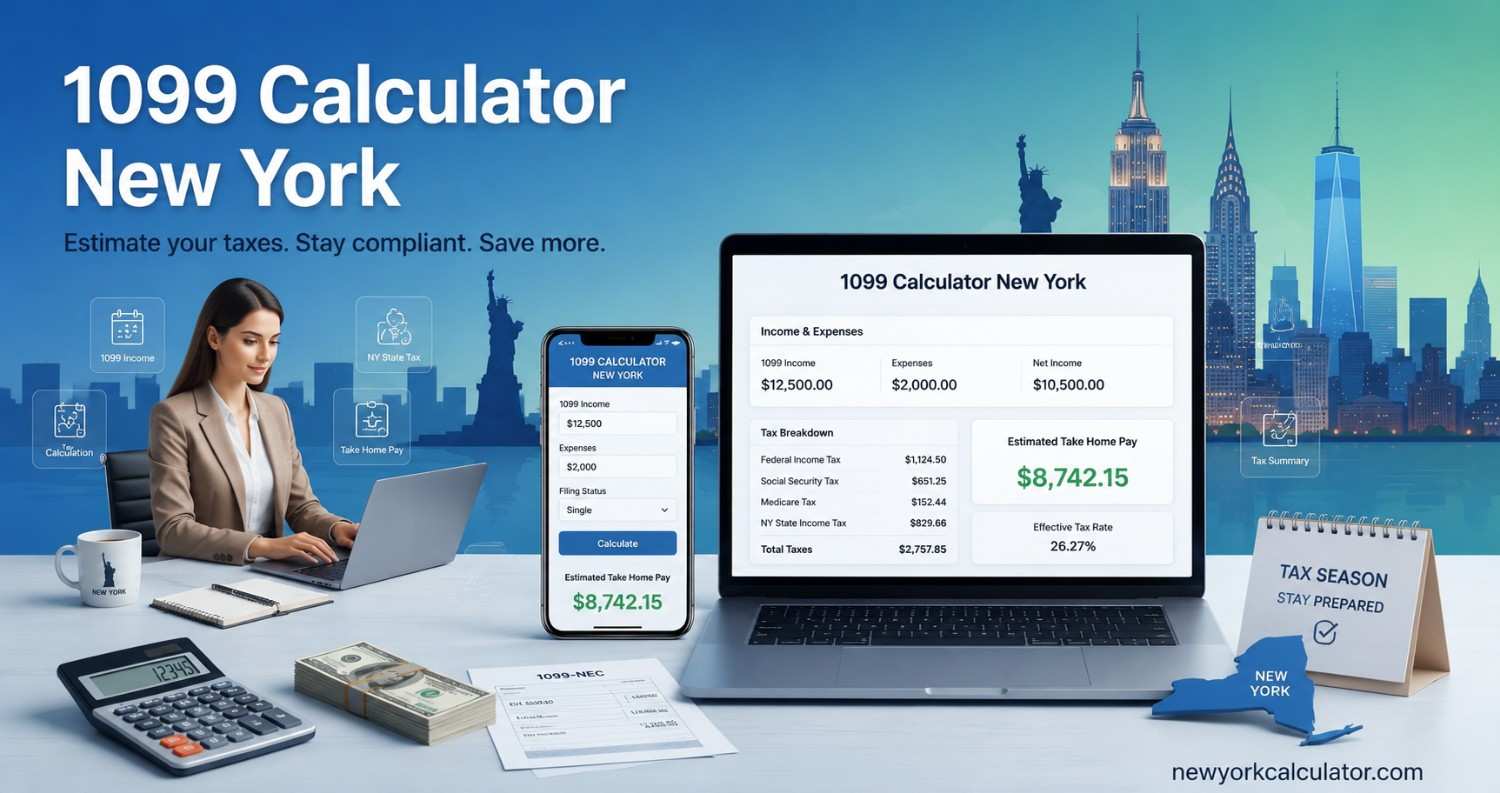
If you work for yourself in New York, receive 1099-NEC or other 1099 income, freelance online, drive for a gig platform, run a small business, or work as an independent contractor, your tax bill can look very different from a traditional W-2 employee’s tax bill.
The biggest mistake is to look at your 1099 income and simply multiply it by one tax rate.
That is not how your actual tax calculation works.
Your final tax situation can involve business expenses, self-employment tax, federal income tax, New York State income tax, New York City income tax if applicable, deductions, other W-2 income, estimated payments and your filing status.
I built this guide to make that process easier to understand.
Author: Junaidul Islam
Tax year covered: 2026
New York 1099 Tax Calculator
Use the calculator below to get a planning estimate based on your income, expenses, filing status and other information.
New York 1099 Tax Calculator 2026
Estimate federal income tax, self-employment tax, New York State tax, NYC tax, estimated payments and after-tax income.
Estimated Tax Breakdown
The calculator is designed for planning rather than preparing or filing a tax return. Your actual liability can be different because individual tax returns can involve credits, itemized deductions, special income, business structures and other tax rules.
What Is a 1099 Worker in New York?
A 1099 worker is generally someone who earns money as an independent contractor, freelancer, gig worker or self-employed business owner rather than receiving the income as regular employee wages.
For example, you may receive 1099 income if you work as:
- A freelance designer
- A software developer
- A consultant
- A photographer
- A real estate professional
- A rideshare driver
- A delivery driver
- An online creator
- An Etsy or e-commerce seller
- A contractor
- A home-service provider
- An independent salesperson
You might receive a Form 1099-NEC, 1099-K, 1099-MISC or another information return depending on the type of income.
However, the important point is this:
Not receiving a 1099 does not automatically make income tax-free.
If you earned taxable business or self-employment income, you may still have a reporting obligation.
How Much Tax Does a 1099 Worker Pay in New York?
There is no single New York 1099 tax rate.
Your overall tax burden can contain several different components.
1. Federal income tax
Your federal income tax depends on your taxable income and filing status.
For 2026, federal income tax uses seven marginal rates: 10%, 12%, 22%, 24%, 32%, 35% and 37%. The 2026 federal standard deduction is $16,100 for single filers and married individuals filing separately, $24,150 for heads of household and $32,200 for married couples filing jointly.
2. Self-employment tax
Self-employment tax is separate from ordinary federal income tax.
The 2026 IRS estimated-tax worksheet uses 92.35% of net self-employment profit for the self-employment-tax calculation. Social Security tax applies to earnings up to the 2026 $184,500 wage base, while the Medicare portion continues beyond that limit. The worksheet also allows a deduction for one-half of self-employment tax.
3. New York State income tax
New York uses a progressive income-tax system rather than one flat percentage.
For 2026, several lower and middle New York rates were reduced, so using an old calculator can produce a misleading estimate. New York’s published 2026 schedules should be used when building a tax-year-specific calculator.
4. New York City income tax
If you are a New York City resident, you may also owe NYC personal income tax.
That tax is separate from New York State income tax. Current NYC rates range from 3.078% to 3.876%, depending on taxable income and filing status.
This is one reason a New York State-only calculator can underestimate the tax burden for someone living in NYC.
New York 1099 Tax Example
Suppose you receive:
1099 business revenue: $100,000
And your legitimate business expenses are:
Business expenses: $15,000
Your starting business profit would be approximately:
$100,000 − $15,000 = $85,000
That $85,000 is much more useful for estimating self-employment tax than simply applying a tax percentage to the original $100,000.
But the calculation does not stop there.
The IRS self-employment calculation uses an adjustment to net earnings, and your federal income-tax calculation can then be affected by the deduction for one-half of self-employment tax, your standard or itemized deduction, filing status and other factors.
Your New York calculation is also not simply:
$85,000 × 10.9%
New York has graduated tax brackets.
The 10.9% rate is a top marginal rate and does not mean that every dollar earned by a typical freelancer is taxed at 10.9%.
Why Your 1099 Gross Income Is Not Your Taxable Income
This is one of the most important concepts for independent contractors.
Imagine two New York freelancers each receive $100,000.
Freelancer A
- Revenue: $100,000
- Business expenses: $5,000
- Net business profit: $95,000
Freelancer B
- Revenue: $100,000
- Business expenses: $20,000
- Net business profit: $80,000
They do not necessarily have the same tax liability.
That is why a useful New York 1099 calculator should ask about expenses instead of treating every dollar received as profit.
Business expenses generally need to be legitimate business expenses rather than personal spending.
Examples can include qualifying costs for:
- Advertising
- Software
- Professional services
- Business supplies
- Business insurance
- Business equipment
- Certain travel
- Business-use phone and internet
- Qualifying vehicle expenses
- Other ordinary and necessary business costs
You should keep documentation for expenses you claim.
What Taxes Should a New York Freelancer Expect?
A self-employed New Yorker should generally think about taxes in layers.
Layer 1: Business profit
Start with:
Business revenue − eligible business expenses
This gives you an estimated business profit.
Layer 2: Self-employment tax
Your self-employment tax is calculated separately from ordinary federal income tax.
The 2026 IRS calculation starts with 92.35% of net earnings for the self-employment-tax computation.
Layer 3: Federal income tax
Your taxable income is then affected by deductions and your federal filing status.
For 2026, the federal standard deduction is:
| Filing status | 2026 standard deduction |
|---|---|
| Single | $16,100 |
| Married Filing Jointly | $32,200 |
| Married Filing Separately | $16,100 |
| Head of Household | $24,150 |
Layer 4: New York State income tax
New York applies its own tax rules and progressive brackets.
For 2026, the state has nine brackets with rates reaching 10.9% at the highest income levels. The lower and middle rates were reduced for 2026.
Layer 5: NYC tax
If you are a NYC resident, city income tax can be added on top of state income tax.
That means a freelancer in Manhattan, Brooklyn, Queens, the Bronx or Staten Island can have a different total tax burden from a freelancer with otherwise similar income who lives elsewhere in New York State.
New York State vs New York City: Why It Matters
One of the biggest weaknesses I found when comparing New York 1099 calculators is that some tools calculate New York State tax but leave the NYC calculation outside the main result.
That can be confusing.
If you live in New York City, your calculation may involve:
**Federal income tax
- Federal self-employment tax
- New York State income tax
- NYC personal income tax**
The NYC tax schedule currently uses rates of 3.078%, 3.762%, 3.819% and 3.876%, depending on taxable income and filing status.
Therefore, when using a calculator, always check whether the displayed New York tax includes NYC tax.
What Is MCTMT for a New York 1099 Worker?
MCTMT stands for Metropolitan Commuter Transportation Mobility Tax.
This is particularly important in a 2026 New York 1099 calculator because the rules changed.
For tax years beginning January 1, 2026, New York increased the self-employed MCTMT threshold from $50,000 to $150,000.
For self-employed individuals with earnings attributable to the Metropolitan Commuter Transportation District:
- Zone 1 rate: 0.60%
- Zone 2 rate: 0.34%
- Threshold: more than $150,000 for the applicable zone
The threshold is determined separately for each zone.
This is an important 2026 update because calculators using the old $50,000 threshold can overestimate MCTMT for some self-employed taxpayers.
Do All New York 1099 Workers Pay MCTMT?
No.
This is another area where a simple calculator can create confusion.
The 2026 rule uses a $150,000 threshold for self-employed individuals attributable to the MCTD.
So someone earning $60,000 or $100,000 of self-employment income should not automatically be shown an MCTMT liability simply because they work as a 1099 contractor.
The exact calculation can depend on the location and allocation of self-employment earnings.
For that reason, the calculator should treat MCTMT as a separate component rather than silently adding an old flat percentage to every New York freelancer.
What If I Have Both a W-2 Job and 1099 Income?
This situation is extremely common.
For example:
- W-2 salary: $70,000
- Freelance income: $30,000
Your tax calculation is not necessarily the same as someone whose only income is $100,000 of self-employment.
Your W-2 wages can also affect the Social Security portion of self-employment tax because the 2026 Social Security wage base applies to combined wages and self-employment earnings. The 2026 wage base is $184,500.
That is why an advanced 1099 calculator should allow you to enter W-2 income.
Can I Deduct Mileage From My 1099 Income?
Potentially, yes, when the mileage qualifies as a business expense and you use the appropriate method and records.
This can matter greatly for:
- Uber drivers
- Lyft drivers
- DoorDash drivers
- Delivery contractors
- Real estate agents
- Mobile service businesses
- Other workers who drive for business
Do not enter the same vehicle expense twice.
If you use the standard mileage method, keep appropriate mileage records and follow the applicable IRS rules for the relevant tax year.
The important point is that a calculator should treat business mileage separately from ordinary business expenses so users do not accidentally double-count deductions.
Health Insurance and Retirement Contributions
A more useful New York 1099 calculator should allow users to consider certain deductions that basic calculators often ignore.
Depending on eligibility and circumstances, self-employed people may have deductions related to:
- Self-employed health insurance
- SEP IRA contributions
- Solo 401(k) contributions
- Other eligible retirement arrangements
These can affect taxable income, but the limits and eligibility rules can be complicated.
For that reason, the calculator should treat these as planning inputs rather than promising that every dollar entered is automatically deductible.
What Is the QBI Deduction?
Qualified Business Income, commonly called QBI, can be an important consideration for eligible business owners.
A simplified calculator may model a QBI deduction, but the real calculation can depend on taxable income, business type, wages, property and whether the business is a specified service trade or business.
For 2026, the IRS published a QBI threshold of $201,750 for most taxpayers and $403,500 for married couples filing jointly, with phase-in ranges above those amounts.
Therefore, a calculator should not blindly subtract 20% of every freelancer’s income.
For lower-income eligible taxpayers, the calculation may be relatively straightforward; at higher income levels, additional limitations can become important.
How Much Should a New York Freelancer Set Aside for Taxes?
There is no universal percentage that is correct for everyone.
A freelancer with:
- low expenses,
- high income,
- NYC residency,
- no withholding,
- and few deductions
can have a very different tax burden from someone with:
- substantial legitimate business expenses,
- W-2 withholding,
- retirement contributions,
- tax credits,
- or a different filing status.
Instead of relying on a generic “save 30%” rule, use an actual estimate.
A good planning screen should show:
Estimated annual tax
Estimated monthly amount to set aside
Estimated quarterly amount
Estimated after-tax income
This is much more useful than displaying only one tax percentage.
New York Estimated Tax Payments for 1099 Workers
Because 1099 income normally does not have the same automatic withholding as W-2 wages, self-employed people often need to make estimated tax payments.
For federal estimated taxes, the IRS uses Form 1040-ES and its worksheets.
New York also has its own estimated-tax system.
For calendar-year taxpayers, the normal quarterly pattern generally falls around:
- April
- June
- September
- January of the following year
The exact due dates should always be checked against the current IRS and New York State instructions before making a payment.
For 2026, the federal estimated-tax schedule generally uses April 15, June 15, September 15 and January 15, 2027, subject to applicable weekend/holiday adjustments. The New York system has its own filing/payment rules.
What Is a Tax Safe Harbor?
A safe harbor can be important if you are trying to avoid an estimated-tax underpayment penalty.
Simply dividing your expected annual tax by four is not always the only way to think about estimated payments.
Your prior-year tax, current-year tax, withholding and other factors can matter.
This is one reason I recommend treating the calculator on this page as a planning tool rather than a substitute for Form 1040-ES, New York estimated-tax instructions or professional tax advice.
A future advanced version of the calculator can also compare current-year estimated tax with prior-year tax and payments already made.
What If I Didn’t Receive a 1099?
Not receiving a 1099 does not automatically mean that you can ignore income.
For example, if a client paid you $4,000 for freelance work and you never received a 1099, the payment can still be business income.
Your tax reporting obligation is not created only when a form arrives in your mailbox.
This is especially important for freelancers who receive:
- Direct bank payments
- Checks
- Cash
- PayPal or other payment-platform payments
- Multiple small client payments
Keep your own income records instead of relying only on information returns.
1099-NEC vs 1099-K: Are They the Same?
No.
Different 1099 forms can report different kinds of payments.
1099-NEC
Commonly associated with nonemployee compensation.
1099-K
Generally associated with payment-card and third-party network transactions.
1099-MISC
Can report various types of miscellaneous income.
The important tax-planning point is that the form you receive does not necessarily determine whether the underlying income is taxable.
Your actual business records are important.
New York 1099 Tax Calculator: What Information Should You Enter?
For the best estimate, prepare the following information:
Income
- Total 1099/business revenue
- W-2 income
- Other taxable income
Business deductions
- Business expenses
- Business mileage
- Other eligible deductions
Personal information
- Filing status
- New York residency
- NYC residency if applicable
- Dependents
Additional tax information
- Federal withholding
- Estimated tax payments already made
- Health insurance
- Retirement contributions
The more complete your information, the more useful the estimate can become.
Why You Should Not Use a Flat New York Tax Rate
Suppose a website says:
“New York tax rate = 10.9%.”
That statement can be technically misleading if a reader interprets it as a flat tax.
New York uses progressive rates.
The highest rate applies only to income entering the highest bracket. It does not mean that someone making $70,000 pays 10.9% on the entire amount.
This distinction between marginal rate and effective rate is important.
Marginal tax rate
The rate applied to the next dollar of taxable income within a bracket.
Effective tax rate
Your total tax divided by the relevant income measure.
For a tax calculator, displaying the effective rate is often more useful to a freelancer than displaying only the highest marginal rate.
Example: Why Two $100,000 Freelancers Can Pay Different Taxes
Imagine two people both earn $100,000 from freelance work.
Person A
- $100,000 revenue
- $5,000 business expenses
- Single
- No W-2
- Lives outside NYC
Person B
- $100,000 revenue
- $15,000 business expenses
- Single
- Has $50,000 W-2 wages
- Lives in NYC
Even though both started with the same 1099 revenue, their final tax calculations can be substantially different.
That is why a good New York 1099 tax calculator needs more than one income box.
New York 1099 Tax Calculator vs a Regular Salary Calculator
A salary calculator usually starts with wages and payroll withholding.
A 1099 calculator needs to think about business profit.
W-2 employee
Employer handles payroll withholding and pays part of payroll taxes.
1099 worker
The worker is generally responsible for tracking business income, expenses and estimated taxes.
That difference is why independent contractors should not use a standard salary calculator as their only tax-planning tool.
How to Lower Your New York 1099 Tax Bill Legally
The goal should not be to “avoid tax.”
The goal is to claim deductions and tax benefits you are legally entitled to.
Start by keeping accurate records.
Potential areas to review include:
- Business mileage
- Business equipment
- Software subscriptions
- Advertising
- Professional fees
- Business insurance
- Qualifying home-office expenses
- Business-use phone and internet
- Eligible health insurance deduction
- Eligible retirement contributions
- QBI deduction when applicable
Do not claim a personal expense as a business expense just because you are self-employed.
Documentation matters.
What Makes a Good New York 1099 Tax Calculator?
After reviewing the major New York 1099 calculator results currently available, there is a clear difference between a basic calculator and a genuinely useful planning tool.
A strong calculator should provide:
- 2026 tax-year data
- Gross 1099 income
- Business expenses
- Filing status
- W-2 income
- Mileage
- Health insurance
- Retirement contributions
- Federal withholding
- Estimated payments
- New York State tax
- NYC tax where applicable
- Self-employment tax
- Effective tax rate
- Estimated take-home income
- Monthly tax set-aside
- Quarterly planning amount
- Clear methodology
- Clear disclaimer
- No unnecessary signup
Several existing calculators already provide some of these features, but the implementations vary considerably. Some focus only on federal + state tax, while others include W-2 income, deductions or more detailed breakdowns.
The important thing is to avoid presenting a rough estimate as if it were an official tax return.
2026 New York Tax Changes You Should Know
The 2026 tax year is particularly important because several figures changed.
Federal standard deduction
- Single: $16,100
- Married filing jointly: $32,200
- Head of household: $24,150
Federal Social Security wage base
$184,500 for 2026.
New York MCTMT self-employed threshold
$150,000 for 2026 and later, compared with $50,000 for 2025 and prior years.
New York State tax rates
New York reduced several lower and middle rates for 2026, making it important to avoid calculators that simply reuse older tax-year figures.
These changes are exactly why a calculator should identify its tax year.
Is This Calculator an Official IRS or New York Tax Tool?
No.
The calculator is an independent planning tool.
It is not operated by the IRS, New York State Department of Taxation and Finance, New York City Department of Finance or any other government agency.
Its purpose is to help you understand the approximate tax impact of your 1099 income.
For an actual return or a complicated situation, use official tax forms/instructions or consult a qualified tax professional.
Important Limitations
This calculator should not be treated as a tax return.
The estimate may differ from your final tax liability if you have:
- Complex business structures
- Partnership or S-corporation income
- Large investment income
- Significant itemized deductions
- Unusual credits
- Multiple states
- Part-year residency
- Nonresident income
- Foreign income
- Special tax elections
- Advanced QBI limitations
- Alternative minimum tax
- Complex dependents or credits
If your tax situation is complicated, professional advice can be worthwhile.
Frequently Asked Questions
How much tax should I save from my 1099 income in New York?
There is no single percentage that works for everyone. Your expenses, federal tax bracket, self-employment tax, New York tax, NYC residency and deductions can all change the result. Use the calculator to create a personalized estimate rather than relying on a fixed percentage.
Does New York tax 1099 income?
Yes. Net self-employment income can be subject to New York State income tax, while federal self-employment and federal income taxes can also apply.
Do NYC freelancers pay an additional tax?
Yes. New York City residents can be subject to NYC personal income tax in addition to New York State tax. Current NYC rates range from 3.078% to 3.876%, depending on taxable income and filing status.
Is self-employment tax the same as federal income tax?
No. Self-employment tax is separate from ordinary federal income tax and primarily covers Social Security and Medicare taxes.
Can I deduct business expenses from my 1099 income?
Qualifying business expenses can generally reduce business profit, but the expense must meet the applicable tax rules and be properly documented.
Do I owe tax if I don’t receive a 1099?
Potentially yes. Taxability does not depend solely on receiving an information form.
Do I pay MCTMT on all New York 1099 income?
Not necessarily. For 2026, the self-employed MCTMT threshold is $150,000 for applicable earnings in the MCTD, with different rates for Zone 1 and Zone 2.
Can I use this calculator for Uber or DoorDash income?
Yes, it can be used as a planning starting point for gig income, provided you enter your business revenue and qualifying expenses accurately.
Can I use it if I have both W-2 and 1099 income?
Yes. Including W-2 income can make the estimate more useful because your overall federal tax situation and Social Security wage-base calculation can be affected.
Does the calculator calculate my exact tax refund?
No. A planning calculator estimates liability. Your final refund or balance due depends on your complete tax return, including withholding, payments, credits and deductions.
When are quarterly estimated taxes due?
Federal estimated tax payments generally follow an April, June, September and January schedule. Always confirm the exact date for the relevant tax year with the IRS and New York State because weekends and holidays can change deadlines.
Final Thoughts
Being a 1099 worker in New York does not have to mean guessing how much money to save for taxes.
The most useful approach is to start with your actual business revenue, subtract legitimate business expenses, estimate self-employment tax, calculate federal income tax, then account for New York State and, when applicable, NYC taxes.
For 2026, it is particularly important to use current figures rather than an old calculator. New York changed several tax rates, and the self-employed MCTMT threshold increased from $50,000 to $150,000.
Use the calculator above as a planning tool, keep good records throughout the year, and verify your final numbers against the current IRS and New York State instructions before filing or making a payment.
Last reviewed for the 2026 tax year: October 2026
Author: Junaidul Islam
Disclaimer: This article and calculator provide general educational and tax-planning information. They are not a substitute for professional tax, legal or financial advice and are not an official IRS or New York State calculator. Tax rules can change, and your actual liability may differ based on your individual circumstances.