
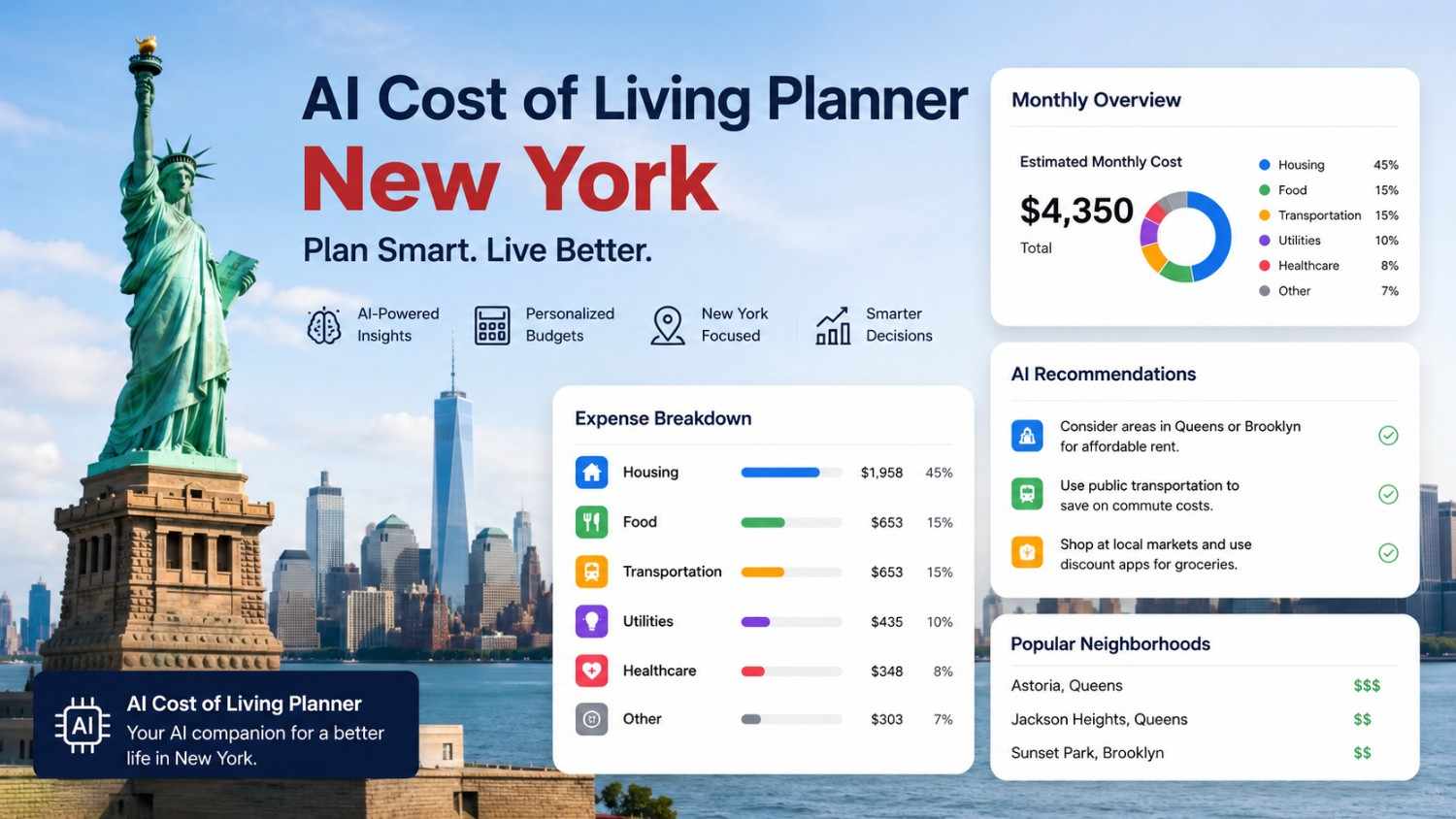
Living in New York City can be exciting, but figuring out how much money you actually need is a different story. Your rent might look manageable until you add transportation, groceries, healthcare, utilities, childcare, taxes, and the smaller expenses that seem to appear every week.
That is why having a realistic New York budget matters before you move, sign a lease, accept a job offer, or make a major financial decision.
Our AI Cost of Living Planner New York is designed to help you estimate your monthly living expenses, understand how much income you may need, and see how much money could remain after paying your bills. Instead of relying on one average cost for everyone, you can enter your own income, housing expenses, household size, transportation choices, and lifestyle preferences.
Whether you are a single professional moving to Manhattan, a couple considering Queens, a student sharing an apartment in Brooklyn, or a family comparing neighborhoods across the five boroughs, this guide will help you build a more useful financial picture.
Use the calculator below to create your personalized New York City living budget.
AI Cost of Living Planner New York
Discover how much it may cost to live in New York City. Build your personal monthly budget, compare expenses and plan your savings.
Your New York Living Plan
Your estimated household budget.
Monthly Expense Breakdown
| Total Monthly Expenses | $0 |
| Monthly Income | $0 |
| Remaining After Expenses | $0 |
| Annual Expense Estimate | $0 |
Rent Affordability Analysis
Your Savings Projection
| Potential Monthly Savings | $0 |
| Potential Annual Savings | $0 |
| Your Savings Goal | $0 |
| Emergency Fund Target | $0 |
| Current Savings | $0 |
| Emergency Fund Gap | $0 |
Your Personalized Budget Insights
Moving to New York: Initial Cash Planning
Important: This planner generates estimates from the information you enter. It does not retrieve live rental listings, verify local prices, calculate official tax liability, or provide professional financial advice. Your take-home income should already reflect taxes and payroll deductions. Borough selection is for organizing your plan; it does not automatically change your expenses. Verify actual prices, rental terms, taxes and fees before making decisions.
What Is an AI Cost of Living Planner for New York?
An AI Cost of Living Planner is a financial planning tool that helps people estimate the cost of living based on their individual circumstances.
A traditional cost of living calculator may show an average monthly expense for a city. However, that number cannot tell you exactly what your household will spend. Someone living alone in a small apartment in Queens has a very different budget from a family renting a larger home in Manhattan.
A more useful planner considers several factors together:
- Your annual or monthly income
- The New York borough where you plan to live
- Your monthly rent or housing payment
- The number of adults and children in your household
- Grocery and dining expenses
- Transportation and commuting choices
- Healthcare and insurance costs
- Utilities, phone, and internet
- Childcare and education expenses
- Debt payments and savings goals
- Unexpected and occasional expenses
The planner combines these inputs into an estimated monthly budget. It can also help you understand whether your housing costs are putting too much pressure on your income.
One important distinction: an automated calculator does not automatically become an artificial intelligence system simply because it produces a personalized result. The calculator on this page uses your inputs and budgeting rules to generate estimates. Any AI-generated explanation should be identified separately if an AI service is added in the future.
How Much Does It Cost to Live in New York City in 2026?
There is no single amount that accurately describes the cost of living for every New Yorker.
Housing is usually one of the biggest differences between households. A person sharing an apartment may spend substantially less than someone renting an entire apartment alone. Families may also face additional expenses for childcare, healthcare, food, and transportation.
The MIT Living Wage Calculator provides a useful research-based reference for comparing basic needs across locations and household types. Its New York metro and county datasets include food, housing, medical care, transportation, and other essential expenses.
You can review the latest methodology and location data at the MIT Living Wage Calculator.
When creating your personal budget, separate your expenses into three groups:
1. Essential Monthly Expenses
These are costs that most households need to pay regularly.
- Rent or mortgage
- Electricity and gas
- Water and other housing charges, where applicable
- Groceries
- Transportation
- Health insurance and medical expenses
- Phone and internet
- Essential household supplies
2. Lifestyle Expenses
These costs depend more heavily on your preferences.
- Restaurants and takeout
- Entertainment
- Gym memberships
- Shopping
- Streaming subscriptions
- Travel and weekend activities
- Personal care
3. Financial Protection
These expenses help you prepare for the future.
- Emergency savings
- Retirement contributions
- Debt repayment
- Life or disability insurance, where appropriate
- Savings for moving or major purchases
A budget that includes only rent and groceries may look affordable on paper but leave very little room for unexpected events.
New York City Cost of Living by Borough
New York City has five boroughs: Manhattan, Brooklyn, Queens, the Bronx, and Staten Island.
Each offers different housing options, commuting patterns, and lifestyle experiences. However, it is not accurate to assume that every apartment in one borough costs more than every apartment in another. Neighborhood, building condition, apartment size, lease terms, and access to transportation can make a major difference.
Manhattan
Manhattan is a practical choice for people who want access to many business districts, offices, restaurants, entertainment venues, and subway connections.
However, housing can place significant pressure on a monthly budget, particularly if you want to rent an entire apartment without roommates.
Before choosing Manhattan, compare the total cost of housing with the money you expect to save on commuting.
Brooklyn
Brooklyn includes a wide range of neighborhoods and housing arrangements.
Some areas offer convenient subway access and shorter commutes to Manhattan, while others may require additional travel time. Shared apartments can be an option for people who want to control housing expenses.
Do not compare rent alone. Consider the time and transportation costs involved in reaching your workplace.
Queens
Queens may be worth considering if you want to compare different residential neighborhoods, apartment types, and commuting options.
Your final budget will depend on your specific neighborhood and how often you travel into Manhattan or another business district.
A lower advertised rent does not always mean a lower overall cost if commuting expenses increase.
The Bronx
The Bronx offers different housing choices and access to several subway and bus routes.
It can be a useful location to compare when your priority is controlling housing expenses while maintaining access to work and other essential services.
Check the actual route to your workplace before choosing an apartment.
Staten Island
Staten Island has a different transportation pattern from the other four boroughs.
Depending on where you live and work, commuting may involve buses, the Staten Island Railway, or the Staten Island Ferry.
If you work in Manhattan, calculate the complete journey rather than looking only at the rent.
My recommendation: Enter your actual apartment rent and commuting expenses into the planner instead of relying on borough-wide averages.
How Much Rent Can You Afford in NYC?
Rent affordability is one of the most important decisions you will make when moving to New York.
A common budgeting guideline is to keep housing costs around 30% of gross household income. This is a planning guideline, not a guarantee that an apartment will be affordable.
For example:
| Annual gross income | Monthly gross income | 30% housing guideline |
|---|---|---|
| $40,000 | $3,333 | $1,000 |
| $60,000 | $5,000 | $1,500 |
| $80,000 | $6,667 | $2,000 |
| $100,000 | $8,333 | $2,500 |
| $120,000 | $10,000 | $3,000 |
| $150,000 | $12,500 | $3,750 |
These figures are illustrative calculations, not current market rent quotes.
Remember that your landlord may evaluate income, credit history, employment, guarantors, and other application requirements separately.
Also, the 30% guideline uses gross income. Your actual spending ability depends on take-home pay after taxes, insurance, retirement deductions, and other payroll deductions.
A household with substantial student loan payments or childcare costs may need a lower rent target.
Understanding NYC Apartment Move-In Costs
Many people plan for the monthly rent but forget about the money required before moving into an apartment.
Your initial housing budget may include:
- First month’s rent
- Security deposit
- Application or screening expenses
- Moving truck or professional movers
- Furniture and household supplies
- Utility setup or deposits, where applicable
- Storage expenses
- Temporary accommodation
New York renters should also understand the Fairness in Apartment Rental Expenses Act, commonly called the FARE Act.
The law took effect on June 11, 2025. It prohibits landlords from passing the fees of landlord-hired brokers to prospective tenants. A tenant who independently hires their own broker may still have a contractual fee obligation.
Landlords and their agents must disclose applicable rental fees. You can read the official information from the NYC Department of Consumer and Worker Protection.
New York State also limits residential security deposits to one month’s rent in the circumstances covered by the Housing Stability and Tenant Protection Act.
For a practical example, suppose your monthly rent is $2,000. A one-month security deposit would be $2,000. You should not automatically add an assumed landlord broker fee to every NYC rental budget.
Always check the current lease, itemized fee disclosure, and applicable law before paying.
Grocery and Food Expenses in New York
Food costs can vary significantly depending on where you shop and how frequently you eat outside your home.
A household that prepares most meals at home may have a different grocery budget from a professional who frequently buys lunch near the office.
Your food budget should include:
- Supermarket purchases
- Fresh fruit and vegetables
- Meat, fish, and other proteins
- Milk and dairy products
- Snacks and beverages
- Coffee
- Restaurant meals
- Takeout and delivery
- Occasional social dining
One useful strategy is to create two separate categories: groceries and dining out.
This makes it easier to see whether your food budget is increasing because of supermarket prices or restaurant spending.
For a more realistic estimate, review your bank or card statements from the previous two or three months and calculate your average spending.
NYC Transportation Costs: Subway, Bus, Car, and Commuting
Transportation is another important part of a New York budget.
Many residents rely on public transportation, while others use cars, rideshare services, taxis, bicycles, or a combination of options.
The MTA’s OMNY fare-capping program provides an important budgeting detail.
Under the published weekly fare cap, eligible subway and local bus rides are capped at $35 over a seven-day period when the same card or device is used consistently. After reaching the cap, eligible rides are free for the remainder of that period.
Check the latest details directly at OMNY Fares.
If you drive, remember to include more than fuel:
- Car insurance
- Parking
- Tolls
- Maintenance
- Repairs
- Registration
- Vehicle payments
- Possible traffic or parking-related expenses
For someone commuting every day, comparing the total monthly cost of public transportation with the full cost of owning a vehicle can reveal a significant difference.
Healthcare and Health Insurance Expenses
Healthcare should not be treated as an optional expense in your NYC budget.
Your costs depend on your employment benefits, insurance plan, household circumstances, and medical needs.
Consider the following categories:
- Monthly health insurance premium
- Deductible
- Copayments
- Prescription medications
- Dental care
- Vision care
- Specialist appointments
- Out-of-pocket medical expenses
If your employer provides health insurance, use the actual payroll deduction rather than estimating a random monthly premium.
If you purchase coverage independently, compare available plans and review their deductibles, provider networks, and out-of-pocket limits.
For official coverage information, visit NY State of Health.
Childcare and Family Living Expenses
A family budget can look very different from a single-person budget.
Parents may need to account for daycare, babysitting, school-related costs, children’s clothing, healthcare, activities, and additional groceries.
Before moving, calculate childcare expenses using the actual provider and schedule you expect to use.
Consider these questions:
- Will both adults work?
- How many children need childcare?
- Will childcare be full-time or part-time?
- Is a family member available to help?
- Will the children need after-school care?
- How far is the childcare provider from home and work?
Do not use a single childcare average for every family. The age of the child, provider, location, and schedule can all change the final amount.
New York Taxes and Your Actual Take-Home Pay
One of the biggest budgeting mistakes is planning around gross salary instead of take-home income.
If your annual salary is $80,000, that does not mean you receive $80,000 in spendable money.
Your paycheck may be affected by:
- Federal income tax
- Social Security and Medicare taxes
- New York State income tax
- New York City resident income tax, if applicable
- Health insurance deductions
- Retirement contributions
- Other employer deductions
Your tax situation depends on filing status, taxable income, deductions, credits, residency, and other circumstances.
For official calculations, use the IRS and New York State Department of Taxation and Finance.
If you live in NYC but work elsewhere, do not assume that your tax situation is the same as someone who works and lives in the city. Residency and employment location can affect your tax obligations.
For the most useful monthly budget, enter your actual average take-home pay from your pay statement.
How Much Salary Do You Need to Live in NYC?
There is no universal salary that guarantees a comfortable life in New York.
The answer depends on housing, household size, debt, healthcare, commuting, childcare, and your savings goals.
Here are some illustrative situations:
Scenario 1: Single Professional
A single professional renting a room in a shared apartment may have lower housing expenses than someone renting a studio alone.
The budget should include rent, groceries, public transportation, insurance, phone, entertainment, and savings.
Scenario 2: Couple Sharing Expenses
Two adults can share several household expenses, including rent, internet, utilities, and some grocery costs.
However, shared expenses do not automatically mean that every category is cut in half.
Scenario 3: Family With Children
A family may need more living space, additional groceries, healthcare coverage, and childcare.
The household should also consider emergency savings and potential changes in income if one parent reduces working hours.
Use the calculator with your actual numbers instead of treating these examples as guaranteed salary requirements.
Hidden Expenses New York Residents Should Include
Small expenses can quietly damage a monthly budget.
Many basic calculators focus on rent, food, and transportation but do not provide enough attention to irregular expenses.
Here are categories worth adding:
Household expenses: Cleaning products, paper goods, laundry, repairs, and replacement items.
Personal expenses: Haircuts, clothing, shoes, toiletries, and personal care.
Digital subscriptions: Streaming platforms, cloud storage, software, and memberships.
Social activities: Birthdays, gifts, celebrations, and weekend entertainment.
Travel: Family visits, holiday travel, and occasional trips outside NYC.
Unexpected costs: Emergency repairs, medical bills, replacement electronics, and other unplanned expenses.
A practical approach is to create a monthly allowance for irregular expenses instead of pretending they will not happen.
How Much Emergency Savings Should You Have in New York?
An emergency fund protects your household when something unexpected happens.
You may lose a job, face an unexpected medical bill, need urgent transportation, or experience a sudden increase in household expenses.
A common financial planning target is three to six months of essential expenses.
For example, if your essential monthly expenses are $3,500:
- Three months: $10,500
- Six months: $21,000
- Twelve months: $42,000
These are mathematical examples, not mandatory savings amounts.
A household with variable income, dependents, or limited employment security may prefer a larger reserve.
Keep emergency savings separate from money reserved for vacations, shopping, or regular monthly spending.
How to Reduce Your Cost of Living in New York
You do not necessarily need to sacrifice everything you enjoy to improve your financial situation.
Start with the categories that have the greatest effect on your monthly spending.
Choose Housing Carefully
Compare total housing expenses, not just advertised rent. Consider commuting time, utility responsibilities, lease terms, and move-in costs.
Use Public Transportation Strategically
If public transportation works for your daily routine, compare its total cost with car ownership before making a decision.
Plan Grocery Shopping
Create a weekly shopping list, compare supermarket prices, and reduce food waste.
Review Subscriptions
Cancel memberships and services that you rarely use.
Separate Needs From Wants
Create a realistic spending limit for restaurants, shopping, entertainment, and other lifestyle categories.
Build Savings Into Your Budget
Treat savings as a planned expense rather than waiting to see what remains at the end of the month.
Moving to New York City: A Financial Checklist
If you are relocating to NYC, prepare a separate moving budget before choosing an apartment.
Your checklist should include:
- First month’s rent.
- Security deposit.
- Any lawful and disclosed application expenses.
- Moving and transportation expenses.
- Furniture and basic household equipment.
- Utility and internet setup.
- Initial grocery purchases.
- Temporary accommodation, if necessary.
- Emergency savings.
- Money reserved for unexpected delays.
A particularly important point for newcomers: do not spend all your available cash on getting the apartment.
You may need money for food, transportation, work-related expenses, and bills before receiving your first paycheck.
How Our AI Cost of Living Planner Calculates Your Budget
The calculator is designed around the information you provide.
It considers your income, rent, household size, transportation, groceries, healthcare, utilities, childcare, debt, and other spending categories.
The result helps you understand:
- Estimated monthly expenses
- Estimated annual expenses
- Money remaining after expenses
- Monthly savings potential
- Housing cost as a share of income
- Emergency savings targets
- Budget pressure and potential shortfalls
- How a change in rent or income affects your budget
For better accuracy, use actual bills, pay statements, lease information, and insurance costs whenever possible.
If you enter estimates, remember that the results are only as reliable as the information you provide.
The planner is an educational budgeting tool. It is not a tax return preparation service, legal service, lender affordability decision, or personalized investment recommendation.
Frequently Asked Questions
1. How much money do you need to live comfortably in New York City in 2026?
There is no single figure for everyone. A single person sharing an apartment may have very different expenses from a family renting a larger home. Housing, transportation, healthcare, and savings goals are major factors. Use the calculator with your actual income and expected expenses.
2. Is $60,000 a year enough to live in NYC?
It may be possible under certain living arrangements, but it can be challenging depending on rent, taxes, debt, and household size. Sharing housing and controlling discretionary spending can make a difference.
3. Can a single person live in NYC on $80,000?
Some single residents may manage on this salary, particularly if housing costs are controlled. However, living alone in an expensive neighborhood, carrying debt, or having substantial medical expenses can make the budget much tighter.
4. Which NYC borough is the cheapest to live in?
There is no permanent cheapest borough for every renter. Individual neighborhoods, apartment types, building conditions, and commuting requirements matter. Compare actual rental listings and travel costs.
5. How much should I spend on rent in New York?
A common starting guideline is approximately 30% of gross income. However, it is important to compare rent with take-home income and other financial responsibilities before choosing an apartment.
6. Does the NYC cost of living calculator include taxes?
The calculator should be used with your actual take-home income whenever possible. If you use gross income, account separately for federal, New York State, and applicable NYC resident taxes.
7. What is the OMNY weekly fare cap?
The published full-fare weekly cap for eligible subway and local bus rides is $35 over a seven-day period when you use the same payment method. Check OMNY for current rules and exceptions.
8. How much money should I save before moving to NYC?
Your moving fund should cover upfront rental expenses, transportation, household setup, and an emergency reserve. The exact amount depends on your apartment, lease, moving distance, and employment situation.
9. Are NYC broker fees still charged to renters in 2026?
The FARE Act, effective June 11, 2025, generally prohibits landlord-hired brokers from passing their fees to prospective tenants. A tenant who independently hires a broker may still owe an agreed fee. Review the official law and fee disclosures.
10. How much emergency savings should a New York resident have?
Three to six months of essential expenses is a common starting target. People with irregular income or dependents may want to build a larger reserve.
11. Is living in Manhattan more expensive than Queens?
It depends on the specific neighborhood, apartment, and lifestyle. Compare actual rent, utilities, commuting costs, and other expenses rather than relying on a borough-wide assumption.
12. Can I use this planner if I am moving to New York from another state?
Yes. Enter your expected New York income, housing costs, household information, and transportation choices. Add your initial moving costs separately to understand the cash you may need before settling in.
13. Does the calculator provide exact living costs?
No calculator can predict every household’s exact expenses. The results are estimates based on your entries. Use current bills, rental quotes, official fees, and actual pay information for a more reliable plan.
14. Can I use the planner for a family budget?
Yes. Enter the number of adults and children and include childcare, healthcare, groceries, housing, transportation, and other household expenses.
15. How often should I update my New York budget?
Review your budget at least every few months and whenever rent, income, insurance, transportation, or household circumstances change. Recheck official rates and costs when planning a move or renewing a lease.
Final Thoughts
Living in New York City is not simply about earning a high salary. It is about understanding where your money goes and making decisions that fit your actual financial situation.
Before signing a lease or accepting a new job, take time to compare your expected income with housing, transportation, healthcare, food, and savings needs.
Use the AI Cost of Living Planner New York to build a personalized estimate, test different living arrangements, and identify expenses that may need attention.
A well-planned budget will not eliminate every financial surprise, but it can help you approach life in New York with greater confidence and a clearer financial direction.
Author: Junaidul Islam
Website: NewYorkCalculator.com
Financial information is provided for general educational and budgeting purposes. Costs, fees, tax rules, and transportation fares can change. Verify important decisions with the relevant official source.