
By Junaidul Islam Paying for college can be one of the biggest financial decisions you make in New York. Whether you attended a CUNY or SUNY school, a private college, graduate school, law school, or another higher-education program, understanding your student loan before the next payment is due can make a major difference.
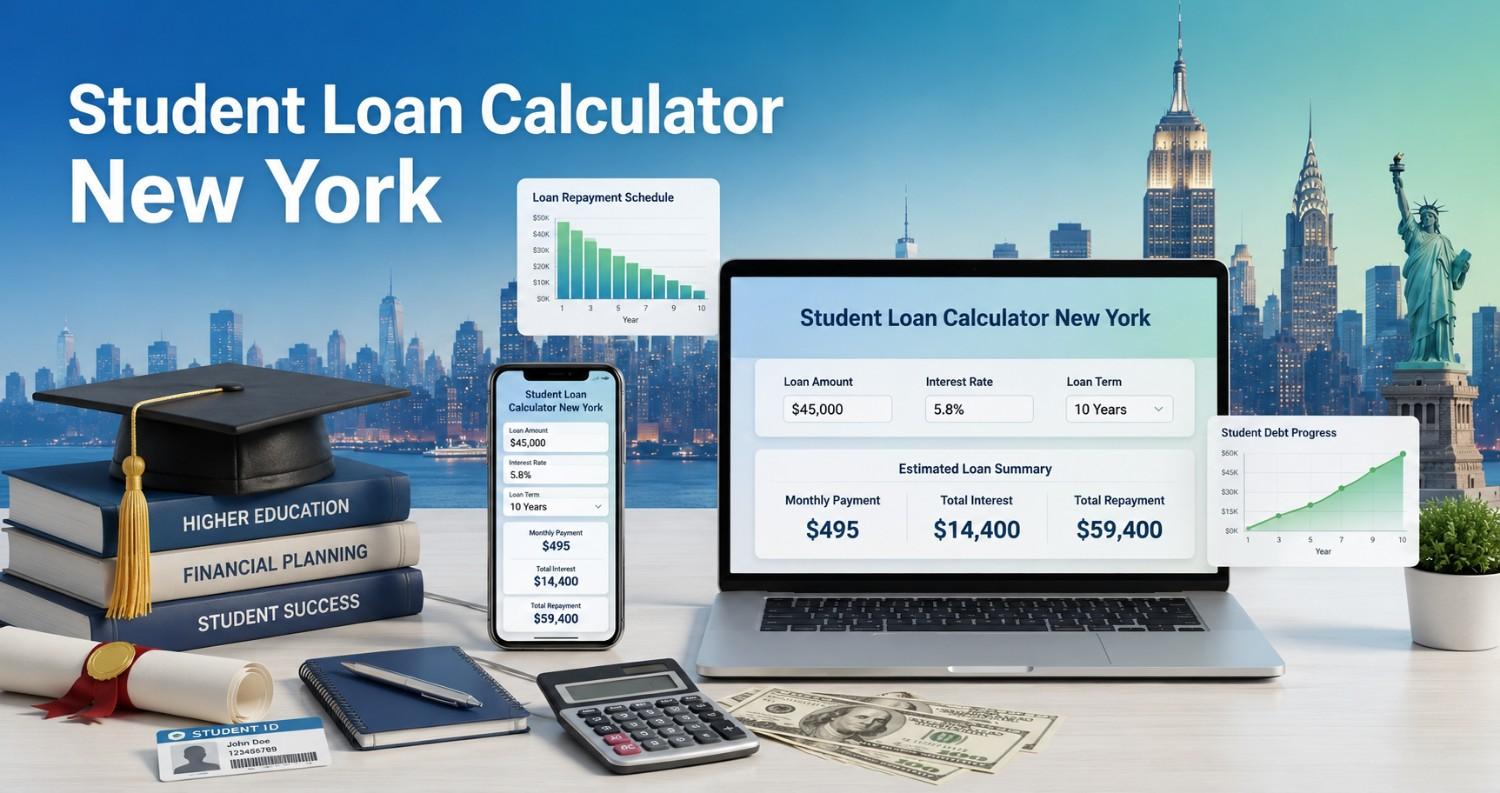
The New York Student Loan Calculator on NewYorkCalculator.com is designed to help you estimate your student loan payment, total interest, total repayment cost, payoff timeline, and the potential effect of making extra payments.
More importantly, the calculator is designed around the major federal repayment changes that took effect in 2026, including the Repayment Assistance Plan (RAP) and the Tiered Standard Repayment Plan.
Calculator estimate: The results are estimates for educational and planning purposes. Your actual payment can be different because of your loan type, servicer, disbursement date, unpaid interest, fees, eligibility, tax filing status, and other federal or private-loan rules. Always verify your actual repayment options through your loan servicer and StudentAid.gov.
New York Student Loan Calculator
Estimate your monthly payment, total interest, payoff time, extra-payment savings, Tiered Standard payment and RAP estimate.
Extra Payment Comparison
Regular Payment
Monthly: $0
Interest: $0
Payoff: 0 months
With Extra Payment
Monthly: $0
Interest: $0
Interest Saved: $0
Time Saved: 0 months
2026 Tiered Standard Estimate
Repayment Tier: —
Estimated Term: —
Estimated Monthly Payment: $0
Estimated Total Interest: $0
RAP Estimate
Estimated RAP Monthly Payment: $0
Income Percentage Used: —
Dependent Adjustment: $0
What Is a New York Student Loan Calculator?
A New York Student Loan Calculator is a planning tool that estimates how much you may need to pay toward your student debt.
A basic calculator usually asks for:
- Loan balance
- Interest rate
- Repayment term
But a more useful calculator should answer additional questions:
- How much will my monthly payment be?
- How much interest will I pay?
- What will my total repayment cost be?
- When could I pay off the loan?
- How much could I save by paying extra?
- What could my payment look like under the 2026 Tiered Standard Plan?
- What could my payment look like under RAP?
- How do dependents affect a RAP estimate?
- What happens if my loan was disbursed before or after July 1, 2026?
- Where can a New York borrower get legitimate student-loan help?
Those questions are especially important now because federal student-loan repayment rules changed in 2026.
Why Student Loan Calculations Matter More in 2026
Student-loan borrowers should not assume that the repayment rules they saw a few years ago are still the same.
Federal student-loan repayment changed significantly beginning July 1, 2026. Federal Student Aid describes the new repayment structure as including the Tiered Standard Plan and the Repayment Assistance Plan (RAP).
New York's Department of Financial Services also explains that borrowers with loans made after July 1, 2026 may be subject to the new Tiered Standard Plan or RAP depending on their circumstances.
That means a calculator based only on the old 10-year Standard Plan may not give a complete picture for every borrower.
For a New York borrower, the first question should not simply be:
“How much do I owe?”
It should also be:
“What type of loan do I have, when was it disbursed, and which repayment rules apply to me?”
How to Use the New York Student Loan Calculator
You can start with the information available on your latest student-loan statement or your federal StudentAid.gov account.
1. Enter Your Student Loan Balance
Enter the amount you currently owe.
If you have multiple loans, you can either:
- calculate them separately, or
- use a combined balance with an appropriate weighted-average interest rate.
NerdWallet, for example, recommends entering individual loans with their specific interest rates when possible because different loans can have different rates.
Using the exact information from your loan account generally gives you a more useful estimate than entering a rough number.
2. Enter Your Interest Rate
Your interest rate has a major effect on your total repayment cost.
For example, two borrowers could have the same $40,000 balance and the same repayment period but pay very different amounts of interest if their rates are different.
For multiple loans, a simple average may not be accurate. A balance-weighted average rate is generally more appropriate for an estimate.
Do not assume that the interest rate shown in an online example is your personal rate.
Federal and private student-loan rates can differ, and federal rates can also vary depending on the type and disbursement year of the loan.
3. Choose Your Repayment Term
The repayment term is the period over which the loan is scheduled to be repaid.
A shorter term normally means:
Higher monthly payment + less total interest
A longer term normally means:
Lower monthly payment + more total interest
That tradeoff is one of the most important things a student-loan calculator can show.
A payment that looks affordable today may cost considerably more if the repayment period is extended.
4. Understand the New Tiered Standard Plan
The new Tiered Standard Repayment Plan is one of the biggest changes borrowers need to understand in 2026.
Under the New York Department of Financial Services' current guidance, the repayment period is linked to the outstanding principal balance:
| Outstanding Principal Balance | Tiered Standard Term |
|---|---|
| Less than $25,000 | 10 years |
| $25,000–$49,999 | 15 years |
| $50,000–$99,999 | 20 years |
| $100,000 or more | 25 years |
The plan uses fixed payments rather than basing the payment directly on income.
This creates an important planning issue.
Someone with a $24,999 balance and someone with a $25,000 balance can potentially fall into different repayment-term bands.
That is why a useful calculator should show the repayment tier instead of simply giving the user a monthly payment.
5. What Is the Repayment Assistance Plan (RAP)?
The Repayment Assistance Plan, commonly called RAP, is the new income-driven repayment option created under the 2026 federal changes.
For eligible federal borrowers, RAP bases the payment on adjusted gross income and the number of dependents claimed on the federal tax return. New York DFS currently describes the basic calculation as a percentage of adjusted gross income ranging from 1% to 10%, less $50 per dependent, with a $10 minimum monthly payment.
That means RAP can look very different from a traditional fixed-payment loan.
For example, a borrower with a modest income may have a lower calculated RAP payment than they would have under a fixed repayment schedule.
However, a lower monthly payment does not automatically mean a lower overall financial cost.
The repayment period, forgiveness rules, income changes, and other eligibility requirements matter.
RAP Is Not Simply a Traditional Interest Calculator
One of the most important differences between RAP and a basic student-loan calculator is what happens when the calculated payment does not cover all monthly interest.
New York DFS states that under RAP, unpaid interest can be forgiven rather than added to the borrower's balance, and the federal government can provide a principal matching payment when the borrower's payment would otherwise fail to reduce principal by at least $50.
This makes RAP fundamentally different from a simple amortization calculation.
A basic calculator that assumes interest always accumulates and compounds into the balance cannot fully represent RAP.
That is one reason NewYorkCalculator.com's RAP result should be clearly labeled as an estimate, not as an official repayment determination.
How Dependents Can Affect RAP
Dependents are another detail that many basic student-loan calculators ignore.
Under the current New York DFS description of RAP, the monthly calculation includes a $50 reduction per dependent, subject to the plan's minimum-payment rules.
Therefore, two borrowers with the same income and student-loan balance can potentially have different estimated RAP payments.
When using a RAP calculator, make sure you understand whether the calculator is asking for:
- tax dependents,
- household size, or
- family size.
These terms are not automatically interchangeable.
Why Your Loan Disbursement Date Matters
If you are researching student-loan repayment in 2026, do not skip the question:
When was the loan first disbursed?
Federal repayment eligibility can depend on whether loans were first disbursed before or on/after July 1, 2026.
Federal Student Aid and federal loan servicer information explain that borrowers with qualifying loans first disbursed on or after July 1, 2026 can fall under the new Tiered Standard and RAP framework.
For borrowers with older loans, certain legacy repayment plans may still be relevant depending on the borrower's complete loan history.
This is why you should not select a repayment plan based only on your balance.
Federal Student Loans vs. Private Student Loans
Not every student loan follows the same rules.
Federal Student Loans
Federal loans are governed by federal student-aid rules and may provide repayment-plan and forgiveness options that are not available with ordinary private loans.
Private Student Loans
Private loans are generally governed by the contract with the lender.
Your private-loan interest rate, repayment term, deferment rules, fees, and available hardship options can differ significantly from federal loans.
Bankrate also emphasizes the difference between federal and private student loans, including how private rates can depend on the borrower or cosigner's credit profile.
New York HESC likewise separates federal and private student-loan information and advises borrowers to understand loan terms before taking out private financing.
Important: Do not use a federal RAP estimate as though it were a private student-loan payment calculation.
How Much Interest Will You Pay?
The interest rate is only part of the story.
The total interest you pay depends on:
- Starting balance
- Interest rate
- Repayment term
- Payment schedule
- Extra payments
- Whether interest accrues before repayment
- Loan-specific rules
For a fixed-rate amortizing loan, extending the repayment term can reduce the required monthly payment but increase the amount of interest paid over the life of the loan.
This is why our calculator should show both:
Monthly Payment
and
Total Interest
rather than showing only the first number.
Why Total Cost Is More Important Than Monthly Payment
Suppose one repayment option requires $350 per month and another requires $275.
It might appear that the $275 option is automatically better.
But if the $275 payment continues for substantially longer, the borrower could end up paying considerably more overall.
A useful student-loan comparison should therefore show:
- Estimated monthly payment
- Total principal
- Total interest
- Total amount paid
- Estimated payoff date
Bankrate's calculator follows a similar approach by displaying monthly payment, total interest, total cost and an amortization schedule.
What Happens If You Make Extra Student Loan Payments?
Extra payments can reduce the time required to repay a traditional amortizing loan and can reduce interest costs.
For example, suppose your regular payment is $400.
You may test:
- $25 extra per month
- $50 extra per month
- $100 extra per month
- $200 extra per month
The important question is not simply:
“Can I pay extra?”
It is:
“How much time and interest could the extra payment save?”
Bankrate's current student-loan calculator also allows users to model extra payments and compare the effect on payoff and interest.
Federal student loans generally do not have prepayment penalties, according to New York DFS.
However, always check how your servicer applies additional payments.
What Is an Amortization Schedule?
An amortization schedule breaks a repayment plan into individual payments.
It can show:
- Payment date
- Total payment
- Principal portion
- Interest portion
- Remaining balance
Early in a traditional amortizing loan, a larger portion of each payment can go toward interest.
As the balance falls, more of the payment generally goes toward principal.
Seeing the schedule can make a long repayment period much easier to understand.
Bankrate provides this type of month-by-month schedule in its student-loan calculator.
What About Interest During School or a Grace Period?
This is another area where simple calculators can be misleading.
Some student loans can accrue interest before regular principal-and-interest payments begin.
Sallie Mae specifically notes that its basic student-loan calculator does not account for time spent in school, the grace period, interest accrued during that period, or whether unpaid interest is capitalized when repayment begins.
That limitation is important.
If you are trying to estimate your actual repayment balance after school, your current loan balance from your servicer may be more useful than the original amount you borrowed.
Loan Fees Can Also Change the Real Cost
The amount you borrow and the amount that ultimately becomes part of your repayment balance are not always conceptually identical.
Depending on the loan type, fees may apply.
New York HESC notes that federal student loans can have loan fees and that the fee varies by loan type.
A good calculator should therefore make fees optional rather than silently assuming that every loan has no fees.
Can a Student Loan Calculator Tell You Which Plan You Should Choose?
No calculator should make that decision for you.
A calculator can compare scenarios.
It can help you understand:
- Estimated monthly payment
- Total repayment
- Interest
- Repayment duration
- Possible forgiveness scenario
- Effect of extra payments
But actual eligibility depends on your loan history and federal rules.
Federal Student Aid itself recommends using its official repayment calculator to determine plan eligibility and compare official repayment estimates.
Therefore, treat NewYorkCalculator.com's results as a planning estimate, not an official eligibility determination.
Public Service Loan Forgiveness and New York Borrowers
PSLF can be particularly important for borrowers who work full-time for qualifying government or nonprofit employers.
Federal Student Aid currently describes PSLF as a program that can forgive the remaining balance on eligible Direct Loans after the borrower satisfies the equivalent of 120 qualifying monthly payments while working full-time for an eligible employer.
Potentially relevant employers can include certain:
- Government organizations
- Public-sector employers
- Nonprofit organizations
But employment alone does not automatically qualify a borrower.
The borrower's loan type, repayment plan, employment status and qualifying payments matter.
If PSLF may apply to you, use the official Federal Student Aid resources to verify your situation.
Student Loan Forgiveness Is Not Always the Same as a Free Loan
The word “forgiveness” can be misleading.
A borrower may have a remaining balance forgiven under an eligible program, but the rules surrounding the forgiveness can depend on the program and the borrower's circumstances.
New York's Attorney General explains that federal repayment changes include forgiveness possibilities under certain income-driven repayment arrangements and RAP, with qualifying-payment periods that can reach 20, 25 or 30 years depending on the applicable plan.
Tax treatment can also matter.
For that reason, do not calculate your future finances assuming that every forgiven dollar will always have the same tax treatment.
What New York Borrowers Should Know About Student Loan Help
New York residents have access to state-specific resources that a generic national calculator may not explain.
The New York State Higher Education Services Corporation (HESC) provides student-loan information and connects borrowers with federal and state education resources.
New York also has the Education Debt Consumer Assistance Program (EDCAP).
HESC describes EDCAP as a New York State-funded nonprofit program that helps New Yorkers navigate the student-loan system and provides free one-on-one counseling.
The New York Attorney General also identifies HESC, EDCAP, Federal Student Aid and other legitimate resources for student-loan borrowers.
If you live in New York and are having trouble understanding your loans, these official or state-supported resources can be more useful than paying an unknown company for basic information.
Be Careful With Student Loan Relief Scams
Student-loan borrowers are often targeted by companies promising:
- Guaranteed forgiveness
- Immediate cancellation
- Special government programs
- “Secret” repayment options
- Guaranteed lower payments
Be cautious.
A legitimate government program does not require you to hand over your StudentAid.gov password to a stranger.
Never share sensitive account credentials simply because someone promises to reduce your debt.
New York's Attorney General specifically includes student-loan scams as part of its borrower guidance.
A good rule is simple:
Verify the program independently before paying anyone or sharing account information.
New York Student Loan Calculator Example
Imagine a borrower has:
- $40,000 student-loan balance
- 6.5% interest rate
- 15-year repayment period
A traditional fixed-payment calculation can estimate the monthly payment and total interest.
But the borrower may also want to test:
What if I pay $50 extra every month?
Then:
What if I pay $100 extra?
And if the borrower has an eligible federal loan:
How might RAP compare with the fixed repayment scenario?
This is much more useful than looking at a single monthly-payment number.
The goal is not to find a “magic” payment.
The goal is to understand the financial consequences of different choices.
Why a Lower Monthly Payment Isn't Always Better
A lower payment can be valuable when cash flow is tight.
But lower payments can also mean a longer repayment period.
Consider two hypothetical choices:
Option A
$400/month
Shorter repayment period
Lower total interest
Option B
$275/month
Longer repayment period
Higher potential total cost
Neither option is automatically right for everyone.
Someone with a tight monthly budget may prioritize affordability.
Someone with a stable income and strong cash flow may prioritize reducing interest.
The calculator gives you the numbers so you can make an informed decision.
Should You Pay Off Your Student Loans Early?
There is no universal answer.
Early repayment can make sense if:
- You have an emergency fund
- You have high-interest debt under control
- Your retirement savings are on track
- Your student loan has a relatively high interest rate
- You value becoming debt-free sooner
But aggressively paying a low-interest federal loan may not always be the best use of every available dollar, especially if you may qualify for a forgiveness program.
This is why it is better to compare scenarios instead of following a one-size-fits-all rule.
What Information Should You Have Before Using the Calculator?
For the best estimate, gather:
Loan information
- Current balance
- Interest rate
- Loan type
- Repayment term
- First disbursement date if known
Income information
For RAP estimates:
- Adjusted gross income
- Number of dependents
Optional information
- Extra monthly payment
- Loan fees
- Expected repayment start date
- Grace/in-school period assumptions
Do not enter your Social Security number, StudentAid.gov password, bank password, or other sensitive login credentials into a calculator.
A calculator should not need them.
Where Can You Find Your Federal Student Loan Information?
If you are unsure how much federal student debt you have, start with your official StudentAid.gov account.
Your federal dashboard can help you identify your federal loans and servicer information.
If you have private student loans, check your lender's website or your latest statement.
NerdWallet similarly advises borrowers who are unsure of their balance to check StudentAid.gov and/or contact their private lender.
New York Student Loan Calculator vs. Official Federal Calculator
The NewYorkCalculator.com tool is intended to make student-loan planning easier and more understandable, particularly for people searching for New York-specific information.
But it should not replace the official Federal Student Aid calculator.
The best approach is:
Step 1: Use NewYorkCalculator.com to understand the numbers and compare scenarios.
Step 2: Check your actual loan details.
Step 3: Use StudentAid.gov to verify federal repayment eligibility.
Step 4: Contact your loan servicer if you need an official payment amount.
Step 5: If you are a New York borrower who needs help, explore HESC and EDCAP resources.
This gives you both a simple planning tool and an official verification path.
Important 2026 Student Loan Changes at a Glance
Here is a simplified overview.
| Topic | What borrowers should know |
|---|---|
| RAP | New income-driven repayment option |
| Tiered Standard | Fixed payment plan with term based on balance |
| July 1, 2026 | Important date for new federal repayment rules |
| Dependents | Can affect RAP payment calculation |
| Federal vs. private | Different rules can apply |
| PSLF | Separate federal forgiveness program with eligibility requirements |
| Legacy plans | Availability can depend on loan history |
| Extra payments | Can reduce cost/time for applicable fixed loans |
| New York help | HESC and EDCAP provide state-specific resources |
These rules are detailed and loan-specific, so the table should be viewed as a starting point rather than a legal or official eligibility determination.
Frequently Asked Questions
What is the New York Student Loan Calculator?
It is an online planning tool that helps estimate student-loan payments, interest, total repayment cost and payoff timing. The NewYorkCalculator.com version is designed to include New York-focused guidance and current 2026 federal repayment considerations.
Is the calculator only for New York residents?
The calculator can be useful for borrowers anywhere in the United States, but the page includes information and resources specifically relevant to New York borrowers.
Does RAP apply to everyone?
No. RAP eligibility depends on federal student-loan circumstances, including loan type and disbursement history. Do not assume that entering your income into a calculator means you are automatically eligible.
What is the Tiered Standard Plan?
It is a federal fixed-payment repayment structure introduced for qualifying loans under the 2026 changes. The repayment term is linked to the borrower's outstanding principal balance.
Is RAP based on income?
Yes. RAP uses adjusted gross income and dependents as part of its payment calculation. The current New York DFS description uses a 1%–10% income percentage depending on the income range, less $50 per dependent, with a $10 minimum payment.
Can I use this calculator for private student loans?
Yes, for basic loan-payment estimates, but private loans do not automatically follow federal repayment rules. Your private lender's contract controls the applicable terms.
Does paying extra reduce student-loan interest?
For traditional amortizing loans, additional payments can reduce the outstanding balance faster and can reduce future interest. Your servicer's payment-allocation rules still matter.
Can the calculator tell me whether I qualify for PSLF?
No. It can help you understand repayment scenarios, but official PSLF eligibility depends on federal requirements, qualifying employment, loan type, repayment plan and qualifying payments.
Does New York have student-loan assistance?
Yes. New York provides student-loan resources through HESC, and EDCAP provides free student-loan guidance to eligible New Yorkers.
Where should I verify my federal student-loan information?
Start with your StudentAid.gov account and official Federal Student Aid resources. Your loan servicer can also provide your actual payment information.
Should I enter my Social Security number into a calculator?
No. A normal student-loan calculator should not require your Social Security number, StudentAid.gov password or bank-login credentials.
Final Thoughts
Student loans are not just about one monthly payment.
The more important questions are:
How much will I pay in total?
How long will the debt last?
How much interest could I pay?
Which repayment rules apply to my loan?
Could my income or dependents change my payment?
Could an extra payment shorten the repayment period?
And for New York borrowers:
Where can I get legitimate help if I have trouble understanding or repaying my loans?
The 2026 federal changes make these questions more important than ever. RAP and the Tiered Standard Plan have changed the repayment landscape, while older borrowers may still have different options depending on their loan history.
Use the New York Student Loan Calculator to explore your numbers, compare scenarios and understand the potential cost of your debt.
Then verify important decisions with your loan servicer and official Federal Student Aid resources.
A calculator can help you understand your choices. It should never replace the official rules or personalized guidance that applies to your specific loan.
Written by Junaidul Islam
NewYorkCalculator.com