
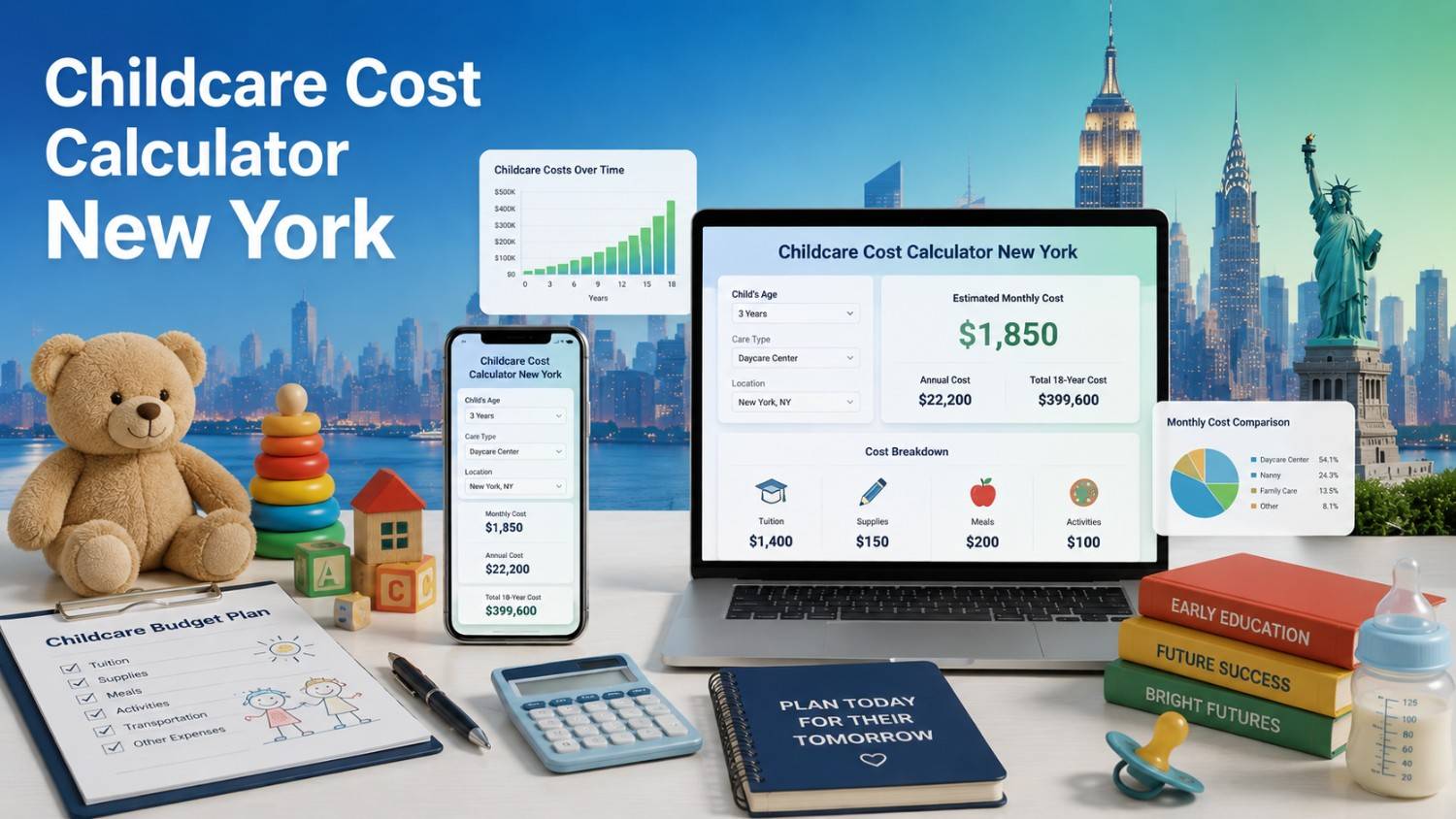
Written by Junaidul Islam Finding affordable childcare in New York is rarely as simple as looking up one average price. The cost can change dramatically depending on your child’s age, where you live, whether you use a daycare center or home-based provider, how many days your child needs care, and whether you qualify for childcare assistance or tax benefits.
That is why this New York Childcare Cost Calculator is designed to give parents a more useful estimate based on their own situation rather than relying on a single statewide number.
New York Childcare Cost Calculator
Estimate your weekly, monthly and annual childcare budget based on your location, child’s age, care type and schedule.
Your Estimated New York Childcare Budget
Estimated Hourly $0Estimated Weekly $0Estimated Monthly $0Estimated Annual $0Childcare income burden: 0%
Estimated annual childcare cost: $02026 Dependent Care FSA planning limit: $7,500
This is a general planning figure based on the IRS 2026 exclusion limit. Actual tax treatment depends on your situation.This calculator provides an estimate for budgeting purposes only. Actual childcare prices vary by provider, neighborhood, child age, schedule, fees and program availability. It does not determine eligibility for government assistance or calculate your official tax liability.
This guide explains how New York childcare pricing works, what families may actually spend each month and year, why New York City can be significantly more expensive than other parts of the state, and which programs and tax benefits may help reduce the final cost.
How Much Does Childcare Cost in New York in 2026?
There is no single childcare price that applies to every New York family.
Recent 2026 consumer-facing data shows a wide range of prices. For example, Care.com reports an average starting rate of about $24.34 per hour in New York, NY, based on provider listings, while its statewide New York starting rate is about $22.96 per hour. Those figures represent provider rates rather than a universal daycare tuition schedule.
Other sources using different datasets report substantially different numbers. Child Care Aware of America’s 2024 price data, for example, puts New York center-based infant care at $20,439 per year and toddler center care at $18,661 per year. Family childcare is lower in that dataset, at $16,415 annually for an infant and $15,516 for a toddler.
This difference is important.
A parent comparing childcare prices should not assume that an online statewide average is the price they will receive from a provider in Manhattan, Brooklyn, Long Island, Westchester, Buffalo or Syracuse.
Your actual quote can be higher or lower.
A practical 2026 planning range
For budgeting purposes, New York parents should think in terms of a range rather than one exact statewide price.
Full-time childcare can commonly run from roughly:
- Under $1,500 per month in some lower-cost areas or home-based arrangements
- $1,500–$2,500 per month for many full-time arrangements
- $2,500–$3,500+ per month in expensive NYC markets
- $4,000+ per month for some full-time nanny arrangements
- Premium Manhattan programs can be substantially higher
These are planning ranges, not guaranteed provider prices. Local tuition, hours, age, meals, enrollment fees, neighborhood and provider quality can all change the final bill.
Why New York Childcare Costs Are So Different
New York is not one childcare market.
A family in Manhattan can face a completely different price from a family in Syracuse. Even within New York City, prices can differ between neighborhoods and provider types.
The biggest factors are:
1. Your child’s age
Infant care is usually the most expensive stage.
Younger children require more intensive supervision and staffing. New York’s childcare regulations require lower caregiver-to-child ratios for infants than for older children, which increases the labor cost of providing care.
As children become toddlers and preschoolers, the staffing structure can change and the cost may decrease.
2. Location
Location is one of the biggest differences between New York childcare prices.
Recent New York childcare guides show a substantial gap between NYC, suburban areas and upstate markets. One 2026 analysis, for example, estimates typical full-time infant daycare ranges of approximately $2,200–$3,500 per month in NYC, compared with lower ranges in suburbs and upstate New York.
That does not mean every Manhattan provider charges $3,500 or every upstate provider charges $1,200.
It means parents should not use a statewide average as their personal quote.
3. Type of childcare
A licensed childcare center, family daycare, nanny and nanny share are completely different services.
A center may have a lower per-child cost because several children are cared for together.
A private nanny provides one-on-one care and may therefore cost significantly more.
Nanny compensation can also include costs beyond the advertised hourly wage, especially when the family becomes an employer.
Current 2026 New York nanny-market data shows provider rates can vary widely depending on experience, responsibilities, location and number of children.
New York City vs. New York State Childcare Costs
One of the biggest mistakes parents make is confusing New York State with New York City.
New York City is a much more expensive childcare market than many areas elsewhere in the state.
For example, current 2026 sources place full-time NYC infant daycare in ranges around $2,200–$3,500 per month, depending on the provider and location.
Meanwhile, statewide datasets can produce much lower averages because they include lower-cost markets outside NYC.
This is why our calculator asks for your location before estimating the cost.
NYC childcare costs can vary by borough
Parents should also compare:
- Manhattan
- Brooklyn
- Queens
- Bronx
- Staten Island
Even within one borough, neighborhood, provider type and program quality can make a large difference.
A Manhattan family should not automatically use a statewide New York average to build a childcare budget.
How Much Does Infant Daycare Cost in New York?
Infant childcare is generally one of the most expensive forms of daycare.
Child Care Aware of America’s 2024 New York data lists average center-based infant care at $20,439 per year, compared with $16,415 for infant family childcare.
However, current NYC market estimates can be considerably higher.
Some 2026 NYC sources report full-time infant center care in the approximate $2,200–$3,500 monthly range, with premium Manhattan programs sometimes exceeding that range.
The lesson for parents is simple:
Use statewide data for statewide planning and local data for local budgeting.
If you are planning for an infant in Manhattan, a national or statewide average may seriously underestimate your actual expenses.
Toddler and Preschool Childcare Costs
Childcare often becomes less expensive as children get older, although this is not guaranteed.
Recent 2026 estimates show lower typical prices for toddler and preschool care than infant care in many New York markets.
This can happen because older children generally require different staffing arrangements and can participate in larger groups.
But parents should still ask providers exactly what is included in the tuition.
A lower monthly rate may not be cheaper if it excludes:
- Meals
- Transportation
- Diapers
- Supplies
- Extended hours
- Summer programs
- Registration fees
- Late pickup
- Holiday care
Daycare Center vs. Home-Based Childcare
Family or home-based childcare can sometimes cost less than a traditional childcare center.
Child Care Aware’s New York data shows lower annual prices for family childcare than center-based infant care.
But price should not be the only consideration.
Before choosing a provider, parents should check:
- Licensing
- Staff qualifications
- Child-to-caregiver ratios
- Safety procedures
- Hours
- Holiday closures
- Sick-child policies
- Meals
- Transportation
- Backup care
- References and reviews
- Waitlist requirements
A cheaper provider may not actually be cheaper if you have to pay for additional services elsewhere.
What About Hiring a Nanny in New York?
A nanny is a completely different childcare model from daycare.
You are paying for individualized care, flexibility and convenience.
Current 2026 provider-market data shows New York nanny rates can reach several thousand dollars per month for full-time care, with the exact amount depending on experience, duties, location and number of children.
If you hire a nanny, do not budget only for the advertised hourly wage.
Depending on your circumstances, you may also need to consider:
- Employer payroll taxes
- Paid time off
- Holidays
- Overtime
- Workers’ compensation requirements
- Bonuses
- Transportation
- Guaranteed hours
For that reason, a nanny cost calculator should calculate the total employer cost, not just hourly pay.
Could a Nanny Share Save Money?
For some families, a nanny share can make one-on-one care more affordable.
Two families may share one nanny and divide the cost.
For example, if two families jointly hire a caregiver, the cost per family may be lower than hiring a private nanny alone.
However, parents should agree in writing about:
- Schedule
- Location
- Children’s ages
- Sick days
- Vacation
- Holidays
- Food
- Transportation
- Household rules
- Payment responsibilities
A nanny share can reduce cost, but it requires more coordination than traditional daycare.
How Much of Your Income Goes to Childcare?
The monthly price is only part of the story.
The more useful question is:
What percentage of my household income will childcare consume?
Child Care Aware’s New York data shows how severe this burden can be. Its 2024 data estimates center-based infant care at about 14% of the median income of a married-couple family and about 50% of the median income of a single-parent family.
Other New York datasets also show major county-level differences in childcare burden. ChildcareCost, using National Database of Childcare Prices data, reports a high burden across many New York counties.
That is why our calculator shows both:
Estimated childcare cost
and
Childcare cost as a percentage of household income.
A $2,000 monthly bill may be manageable for one household and extremely difficult for another.
New York Childcare Costs by County
New York has 62 counties, and childcare prices vary significantly.
A statewide average can hide those differences.
For example, current county-level childcare data shows substantial variation in infant center-care prices across New York counties.
When comparing counties, parents should look at:
- Weekly childcare price
- Monthly estimated cost
- Annual estimated cost
- Local household income
- Childcare burden
- Center-based care
- Family-based care
This is much more useful than asking only, “What is the average daycare cost in New York?”
Childcare Assistance in New York
If childcare is putting serious pressure on your household budget, do not assume that you have to pay the entire market price.
New York has the Child Care Assistance Program (CCAP), which can help eligible families receive childcare at low or no cost.
The official New York eligibility questionnaire allows families to answer questions about their circumstances and see whether they may qualify. It is only a screening tool; the official program makes the final eligibility determination.
Eligibility can depend on factors such as:
- Household income
- Household size
- Child’s age
- Employment
- Education or training
- Other qualifying circumstances
If you think you may qualify, check the official program rather than relying solely on an online calculator.
Important 2026 NYC Childcare Assistance Update
New York City families receiving childcare subsidies have an especially important 2026 development to know about.
In August 2026, the NYC Mayor’s Office announced that the City would cover the out-of-pocket childcare costs for families already receiving childcare assistance through vouchers and contracts, beginning in September 2026.
The announcement said the policy would benefit approximately 22,000 low-income families currently paying a sliding-scale fee.
This is an important reason why an old childcare calculator can produce an outdated picture of what an eligible NYC family may actually pay.
Parents should always check the current official program rules before making a financial decision.
NYC 3-K and Pre-K Can Change Your Childcare Budget
Families with young children in New York City should also investigate public early-childhood programs.
NYC Public Schools currently provides information for families applying for 3-K and Pre-K, along with Extended Day and Year programs for eligible families.
For 2026 admissions information, NYC Public Schools says children born in 2023 can apply for 3-K and children born in 2022 can apply for Pre-K. Extended Day and Year programs may provide care for 8 or 10 hours per day depending on the program and eligibility.
This matters because a family comparing a $2,500 private childcare bill with a qualifying public program should not simply compare tuition.
You should compare the total childcare budget after available public support.
Childcare Tax Credits in New York
Childcare expenses can also interact with federal, New York State and NYC tax benefits.
ACCESS NYC currently explains three relevant programs:
- Federal Child and Dependent Care Tax Credit
- New York State Child and Dependent Care Credit
- NYC Child Care Tax Credit
The federal credit can apply to up to $3,000 of qualifying care expenses for one qualifying person or $6,000 for two or more, subject to the applicable rules.
The New York State and NYC credits have their own eligibility requirements.
Do not assume that every family receives the maximum amount.
Your income, filing status, qualifying expenses, dependents and other tax information can change the result.
2026 Dependent Care FSA Limit
There is also an important 2026 change for families whose employers offer a dependent-care flexible spending arrangement.
The IRS states that the annual dependent-care FSA exclusion increased to $7,500 for the 2026 tax year, up from $5,000. For married taxpayers filing separately, the limit is $3,750.
A Dependent Care FSA can allow qualifying childcare expenses to be paid with pre-tax money.
However, the tax rules can interact with the Child and Dependent Care Credit, so families should not simply add every possible tax benefit together.
For complicated tax situations, speak with a qualified tax professional.
Your Gross Childcare Cost Is Not Always Your Final Cost
This is one of the most important ideas when comparing childcare options.
Imagine a family estimates:
$30,000 annual childcare
That does not necessarily mean the family will experience a $30,000 reduction in disposable income.
Depending on eligibility, the family may have access to:
- Childcare assistance
- Public early-childhood programs
- Dependent Care FSA
- Federal childcare tax credit
- New York State credit
- NYC credit
- Employer childcare benefits
The final result can be very different.
That is why our calculator separates:
Gross childcare cost
from
Potential savings
and
Estimated remaining childcare cost.
The calculator is designed for planning, not for determining your official tax liability or benefit eligibility.
How Many Hours of Childcare Do You Actually Need?
Before choosing a provider, calculate the schedule.
A family needing:
40 hours/week
has a very different budget from a family needing:
20 hours/week
But do not assume that cutting hours in half will cut the price in half.
Some childcare providers offer part-time care at a proportionally higher rate, while others may require minimum enrollment commitments.
Ask every provider:
- What is the full-time weekly price?
- What is the part-time price?
- Is there a minimum number of days?
- Are holidays charged?
- Are vacation weeks charged?
- What happens if my child is absent?
- Are there registration fees?
- Are meals included?
These questions can uncover hidden costs that an online average will never show.
Don’t Forget Registration and Extra Fees
Your childcare budget should include more than tuition.
Potential additional expenses include:
- Registration fee
- Enrollment fee
- Application fee
- Deposit
- Meals
- Diapers
- Formula
- Supplies
- Transportation
- Field trips
- Late pickup
- Weekend care
- Summer programs
- Holiday care
A provider charging $2,000 per month may actually cost more than another provider charging $2,100 if the first provider adds several hundred dollars in annual fees.
How to Use the New York Childcare Cost Calculator
Start by entering your location.
Then enter your child’s age and the type of care you need.
Next, enter:
- Number of children
- Hours per day
- Days per week
- Weeks per year
- Estimated hourly or weekly rate
- Household income
- Optional additional costs
- Potential discounts
The calculator then converts the estimate into:
Hourly → Daily → Weekly → Monthly → Annual
It also estimates the percentage of household income going toward childcare.
For a family comparing multiple options, this is much more useful than looking at one monthly number.
Example: Why Your Personal Estimate Matters
Suppose one family pays:
$2,500/month
for full-time childcare.
That is approximately:
$30,000/year
before additional expenses.
Another family may pay:
$1,500/month
or approximately:
$18,000/year
The difference is:
$12,000 every year.
Over several years, the location and care choice can therefore have a major effect on the household budget.
This is why parents should compare actual options instead of assuming that one statewide average represents the whole New York market.
How to Reduce Your New York Childcare Cost
There is no single strategy that works for every family, but these options are worth investigating:
Compare multiple provider types
Get quotes from:
- Childcare centers
- Licensed family daycare
- Nanny
- Nanny share
- School-based programs
Ask about sibling discounts
If you have two or more children, ask whether the provider offers a sibling rate.
Check employer benefits
Ask your employer whether you have:
- Dependent Care FSA
- Childcare reimbursement
- Backup childcare
- Employer-sponsored childcare
- Other family benefits
Check New York childcare assistance
Use the official New York CCAP screening and application information.
NYC families should check 3-K and Pre-K
A qualifying public program may substantially change your childcare budget.
Compare annual cost instead of monthly cost
A provider with a cheaper monthly rate may charge more weeks per year or additional fees.
Always calculate the full annual cost.
What Should You Ask a New York Daycare Before Enrolling?
Before paying a deposit, ask:
- What is the exact weekly or monthly tuition?
- Is tuition guaranteed to stay the same?
- Is there an annual increase?
- What is the registration fee?
- Are meals included?
- Are diapers included?
- Are there additional supply fees?
- How many days per week are required?
- What happens during holidays?
- Do I pay when my child is sick?
- Do I pay during vacation?
- What are the pickup and late fees?
- Is there a waitlist?
- Is the provider licensed?
- What are the caregiver-to-child ratios?
- What is the cancellation policy?
- Is there a sibling discount?
- What happens if the center closes unexpectedly?
These questions can save a family thousands of dollars over the course of a year.
Why You Should Not Trust One Online Childcare Average
Search results for New York childcare currently show dramatically different estimates because different websites use different methodologies.
Some use provider-reported hourly rates.
Some use historical government datasets.
Some use market-rate surveys.
Some adjust older data for inflation or local cost of living.
Some publish their own estimates.
For example, Care.com reports provider-listing rates, while Child Care Aware uses a different price dataset, and New York City market-rate information published by the Day Care Council uses specific ACS market-rate figures.
That does not automatically mean one source is wrong.
It means the numbers are measuring different things.
The safest way to use an online calculator is to treat the result as a budget estimate, then request an actual quote from licensed providers.
New York Childcare Cost Calculator: What the Result Means
Our calculator should be viewed as a planning tool.
It can help answer questions such as:
- How much could daycare cost per month?
- What could I spend per year?
- How expensive is infant care compared with preschool?
- How much of my income goes to childcare?
- Would home-based care change my budget?
- How does nanny care compare?
- What happens if I have two children?
- How much could a different schedule change the cost?
It does not replace:
- A provider’s official tuition quote
- An official CCAP eligibility determination
- A tax professional’s calculation
- An IRS tax determination
- A New York State or NYC benefits determination
Final Thoughts
Childcare is one of the largest recurring expenses many New York families face.
The right number for your family depends on much more than the phrase “average daycare cost.”
Your child’s age, location, provider type, schedule, number of children, household income, assistance eligibility and available tax benefits can all change the final amount.
For that reason, the best approach is to calculate your personal childcare budget, compare several care options, and then verify the final price directly with providers and official government programs.
If you are planning childcare in New York in 2026, start with the calculator above, then use the result as a budgeting estimate rather than a guaranteed quote.
Your actual childcare cost is the number that matters—not a national average.
Frequently Asked Questions
How much does childcare cost in New York in 2026?
There is no single statewide price. Current sources show large differences depending on location, child age and provider type. New York City generally costs substantially more than many upstate markets.
How much does daycare cost in NYC?
Current 2026 estimates vary by source and provider. Full-time infant center care is commonly reported in the roughly $2,200–$3,500 monthly range in NYC, while premium programs can be higher. Always request a current provider quote.
Is infant daycare more expensive than preschool?
Usually, yes. Infant care generally requires more intensive staffing, so it is commonly more expensive than toddler or preschool care.
Is home daycare cheaper than a childcare center?
It can be. Child Care Aware’s New York data shows lower average prices for family childcare than center-based infant care, although actual prices vary by provider and location.
Can I get help paying for childcare in New York?
Possibly. New York’s Child Care Assistance Program provides low- or no-cost childcare for eligible families. Eligibility must be determined through the official program.
Is childcare assistance free in NYC?
Some eligible NYC families receiving childcare subsidies may now have their out-of-pocket costs covered under the City’s September 2026 policy announced in August 2026. Families should check the current official rules and their individual status.
Is NYC Pre-K free?
NYC Public Schools offers Pre-K programs for eligible children, and families can apply through the city’s enrollment system. Program availability and eligibility vary.
What is the 2026 Dependent Care FSA limit?
The IRS says the 2026 dependent-care FSA exclusion limit is $7,500, or $3,750 for married taxpayers filing separately.
Can childcare expenses qualify for a tax credit?
Potentially. Federal, New York State and NYC childcare-related tax credits may be available to qualifying taxpayers. Eligibility and limits vary, so taxpayers should review the current rules or consult a tax professional.
Should I use a childcare calculator to choose a daycare?
Use it to build a budget and compare options, but do not treat the result as an official quote. Always confirm tuition, fees, schedule and policies directly with the provider.
Data and methodology note
Childcare prices change by provider, neighborhood, child age, schedule and data source. This article uses current publicly available 2026 information together with the latest available government and industry datasets. Where older official datasets are still the underlying source, the article identifies them rather than presenting them as a live provider quote.
The calculator provides estimates for budgeting purposes only. It does not determine eligibility for government assistance or calculate a taxpayer’s official tax liability.