
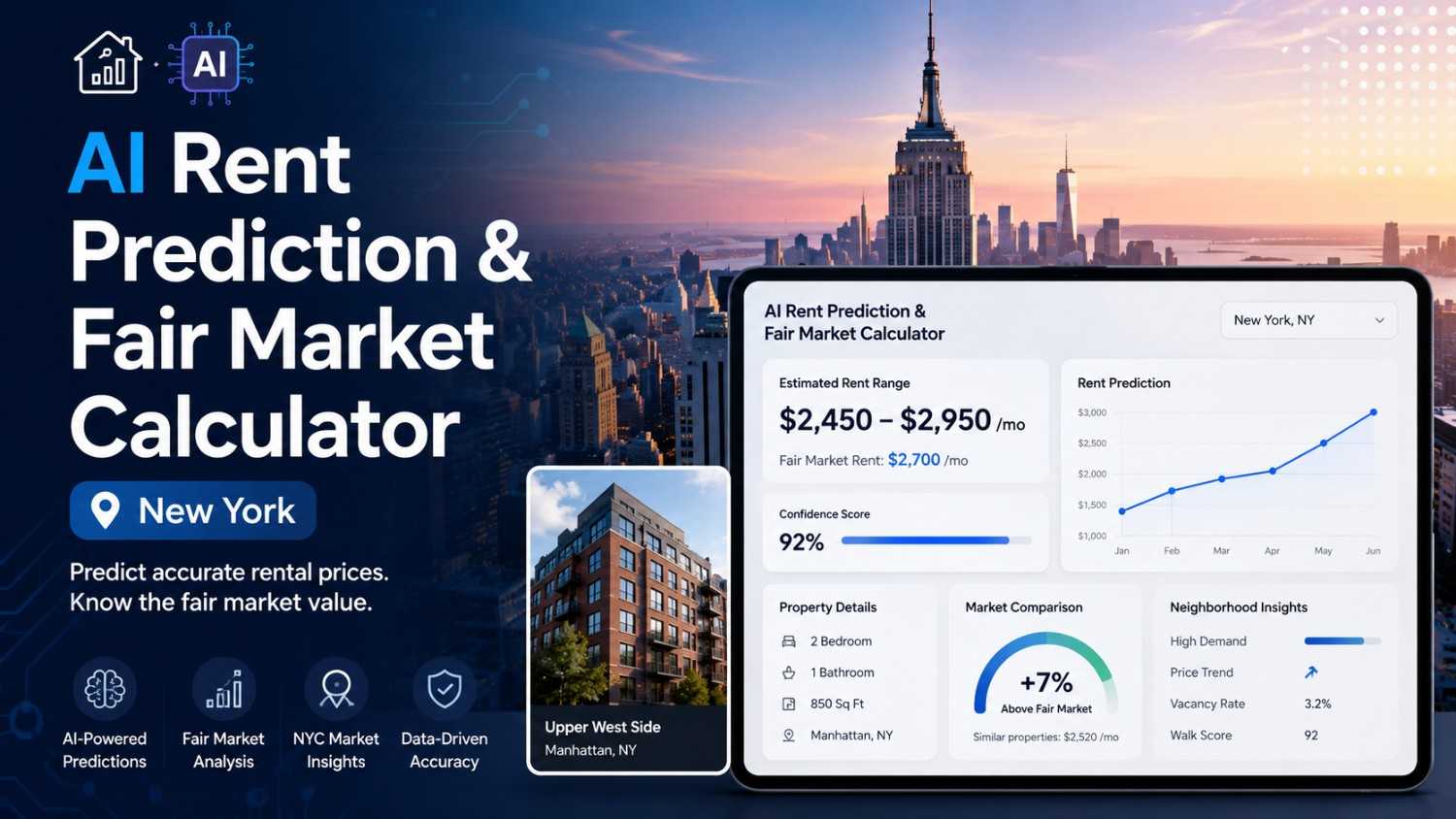
Renting an apartment in New York is a major financial decision. Whether you are searching for your first apartment, moving to another neighborhood, or preparing to renew your lease, knowing how an asking rent compares with similar properties can help you make a better decision.
The AI Rent Prediction & Fair Market Calculator for New York Apartments helps you compare an apartment’s asking rent with a comparable rental, estimate recurring housing costs, and explore possible rent scenarios for the next six and twelve months.
New York does not have one rental price that applies to every neighborhood. An apartment in Manhattan may have a very different asking rent from a similar-sized apartment in Queens, Brooklyn, the Bronx, or Staten Island. Property condition, square footage, building amenities, utilities, and lease terms can also affect the comparison.
This calculator uses the information you enter to produce an illustrative rent estimate. It does not retrieve live rental listings or provide a professionally validated AI prediction. For the most useful result, enter a recent asking rent from a genuinely comparable apartment.
AI Rent Prediction & Fair Market Calculator
Compare an apartment’s asking rent with a comparable rental, estimate total housing costs, and explore future rent scenarios.
Your rent comparison
Calculation breakdown
This calculator uses user-entered comparable rent and transparent illustrative adjustments. It does not access a live rental database, validate the comparable property, measure local market accuracy, or predict actual future rent. Its comparison range is not a confidence interval. Confirm prices with current listings and check official rules for regulated housing.
Use the calculator to compare an asking rent with an adjusted comparable-rent estimate. You can also include additional monthly expenses and test different future rent-growth assumptions.
The result is a planning estimate, not an official appraisal, a guarantee of market value, or a determination of the legal rent for a particular apartment.
What Is a Fair Market Rent Estimate in New York?
A fair rent estimate is an informed assessment of what an apartment might reasonably rent for based on its location, size, condition, features, and comparable properties.
However, the phrase Fair Market Rent also has a specific meaning in federal housing programs. The U.S. Department of Housing and Urban Development (HUD) publishes Fair Market Rents for use in certain housing assistance programs.
HUD’s methodology generally uses the 40th-percentile gross rent for standard-quality rental housing in a defined area, subject to applicable adjustments and utility considerations. This benchmark is not a personalized valuation of an individual apartment, and it should not automatically be treated as the legal rent or current asking price of a particular home.
You can review the official HUD Fair Market Rents data for the relevant fiscal year and geographic area.
For a renter evaluating an available apartment, recent listings for similar properties in the same neighborhood may offer a more direct comparison than a broad government benchmark.
Asking Rent vs. Market Rent vs. HUD Fair Market Rent
| Rental figure | What it means | How to use it |
|---|---|---|
| Asking rent | The monthly amount advertised by a landlord | Compare available apartments |
| Comparable-rent estimate | An estimate based on similar properties | Evaluate an apartment’s asking price |
| HUD Fair Market Rent | A government housing benchmark | Understand certain housing assistance calculations |
An apartment advertised above HUD’s Fair Market Rent is not automatically overpriced or illegal. Likewise, an asking rent below a benchmark does not necessarily mean that the apartment offers good value.
How to Use the New York Rent Calculator
You can get a more useful comparison by entering accurate apartment details and selecting a genuinely comparable property.
Step 1: Enter the asking rent.
Enter the monthly rent quoted in the listing or proposed by the landlord. Make sure you understand whether a promotional concession or temporary discount affects the advertised amount.
Step 2: Select the location.
Choose the relevant New York City borough or the option for locations elsewhere in New York State. Do not treat the entire state as one rental market.
Step 3: Add the apartment details.
Enter the bedroom count, approximate square footage, and property condition. These details help describe the apartment you want to evaluate.
Step 4: Enter a comparable rent.
Find a recent listing for an apartment with a similar location, bedroom count, size, and condition. Enter its asking rent and property details into the calculator.
Step 5: Review the adjusted estimate.
The calculator applies transparent illustrative adjustments for differences in apartment size, bedroom count, condition, and other features. These adjustments are planning assumptions, not scientifically validated New York market coefficients.
Step 6: Calculate total monthly housing costs.
Add utilities and other recurring expenses that apply to your situation. This helps you compare the actual budget impact of different apartments.
Step 7: Explore future scenarios.
Change the assumed annual rent-growth rate to see how the monthly rent could change mathematically over six and twelve months. These are hypothetical scenarios, not forecasts derived from live rental-market data.
What Affects Apartment Rent in New York?
Several factors can influence how much a landlord asks for an apartment. The importance of each factor depends on the local market and the particular property.
1. Neighborhood and location
Location can affect access to subway stations, employment centers, schools, parks, shopping, and other everyday services.
Manhattan, Brooklyn, Queens, the Bronx, and Staten Island each contain different rental submarkets. Even within one borough, prices can vary substantially between neighborhoods.
For a meaningful comparison, start with properties in the same neighborhood. Expand the search area only when there are too few suitable comparisons, and recognize that a wider search may produce a less precise estimate.
2. Bedrooms, bathrooms, and square footage
The number of bedrooms is a useful starting point, but it does not describe the entire apartment.
A larger apartment may command a higher total rent, while the rent per square foot may differ depending on layout, location, and the type of property. Bathroom count and usable living space may also affect how renters perceive value.
When comparing two apartments, look at their actual characteristics rather than assuming that every additional square foot has the same rental value.
3. Apartment condition
A recently renovated apartment may have a different asking rent from a similar property that needs repairs or updating.
Kitchen and bathroom condition, flooring, natural light, noise, heating, and general maintenance can all influence a renter’s decision. However, cosmetic improvements alone do not automatically justify a large rent premium.
4. Building amenities
Elevators, laundry facilities, outdoor space, parking, package rooms, gyms, and doorman services may affect asking rents.
Their value depends on the renter and the property. An amenity should not automatically receive the same premium in every neighborhood or building.
5. Utilities and recurring expenses
An apartment’s advertised rent may exclude electricity, internet, heating, parking, or other recurring costs.
Compare apartments on a consistent basis. If one apartment includes a utility and another does not, account for that difference before deciding which property offers better value.
6. Rental inventory and seasonality
The availability of apartments can change throughout the year. Different periods may offer different levels of choice, competition, and pricing.
Seasonality alone cannot tell you what a particular apartment will cost in the future. Check current comparable listings and use future-growth assumptions only as planning scenarios.
How to Find Reliable Comparable Rental Listings
Comparable properties are the foundation of a useful rent estimate. The following process can help you avoid misleading comparisons.
First, look for apartments in the same neighborhood. If there are too few suitable listings, expand to a nearby area with similar access and housing characteristics.
Second, compare properties with similar bedroom counts and square footage. A renovated apartment in a well-maintained building may not be comparable to an apartment that needs substantial work.
Third, check the listing date and availability. An old advertisement may not reflect the rent a landlord is currently asking.
Fourth, review concessions and included expenses. A promotional price may not represent the ongoing monthly rent, and included utilities can make two otherwise similar apartments less directly comparable.
Finally, examine several properties instead of selecting just one listing that supports your preferred result. If the asking rents vary widely, investigate the reasons before drawing a conclusion.
Rental websites such as StreetEasy, Apartments.com, and Zillow Rentals can help you find properties to compare. Advertised prices should be treated as asking rents, not verified records of the final rent agreed between a tenant and landlord.
Example: Is a $3,000 Apartment Overpriced?
Imagine you are considering an apartment advertised for $3,000 per month. You find a nearby apartment with similar characteristics advertised for $2,800 per month.
The difference is:
$3,000 − $2,800 = $200 per month.
Compared with the $2,800 listing, the asking rent is approximately 7.14% higher.
This calculation alone does not prove that the $3,000 apartment is overpriced. It might offer more space, better maintenance, additional amenities, or included utilities.
You should also look for additional comparable apartments, check whether the properties are genuinely similar, and consider the total cost of living in each home.
This is a hypothetical example, not a claim about current rents in any specific New York neighborhood.
Understanding Your Estimated Rent Range
A single rent estimate can create a misleading impression of precision. A comparison range can help you understand how sensitive the result is to the calculator’s assumptions.
The calculator displays an adjusted comparable estimate and an illustrative range around that figure. The range uses a simple percentage adjustment; it is not a statistical confidence interval and is not calculated from a large database of historical rents.
If the asking rent falls above the displayed range, investigate the differences between the apartment and your comparable properties. The result does not establish that the landlord is charging an unfair price.
If the asking rent falls below the displayed range, check the property’s condition, lease terms, included utilities, and listing details. A low asking price does not automatically establish that the apartment is a good deal.
The reliability of the comparison depends on the quality of the information you enter. A recent, closely matched comparable is more useful than an unrelated citywide average.
How to Estimate Rent Six or Twelve Months Ahead
Future rent is uncertain. Changes in housing supply, local demand, economic conditions, property features, and lease terms can affect rental prices.
A practical way to plan is to test several assumed growth rates, including a no-growth scenario and modest or higher-growth scenarios.
A simplified mathematical projection is:
Future monthly rent = Current monthly rent × (1 + annual growth rate)^(months ÷ 12)
For example, an annual growth assumption of 3% is entered as 0.03 in the formula.
This calculation shows what would happen if the selected growth assumption applied. It does not predict actual future New York market conditions.
For regulated apartments, the applicable legal guidelines and other lawful adjustments must be considered separately. A general market-growth assumption does not override the rules governing a particular lease.
New York Rent-Stabilization Rules: What Renters Should Know
New York City has specific rules for certain rent-stabilized apartments. These rules differ from the way rent is negotiated for unregulated market-rate apartments.
As of October 10, 2026, NYC Rent Guidelines Board Order #58 sets the following renewal adjustments for covered rent-stabilized apartments with leases commencing between October 1, 2026, and September 30, 2027:
- One-year renewal lease: 0%.
- Two-year renewal lease: 0%.
These guidelines apply to the covered rent-stabilized apartments and must be read alongside other applicable legal provisions. They do not establish a general rent freeze for every apartment in New York City.
For comparison, the guidelines for covered renewal leases commencing between October 1, 2025, and September 30, 2026, were 3% for one-year leases and 4.5% for two-year leases.
The applicable period depends on when the renewal lease commences. Check the official NYC Rent Guidelines Board website for the relevant order and supporting information.
If you believe your apartment may be rent-stabilized, do not rely on a market estimate to determine the lawful rent. The New York State Homes and Community Renewal agency provides information about rent history, rent regulation, and potential rent overcharges.
Start with the Office of Rent Administration and its rent increase and rent overcharge guidance.
Calculate the Total Cost of Renting
The advertised monthly rent is only one part of the financial decision.
Recurring expenses may include electricity, internet, tenant-paid heating, parking, and other applicable monthly costs. Some apartments include certain utilities, while others require tenants to pay separately.
One-time expenses may include moving services, furniture, utility setup, and other costs associated with moving into a new home. Review the lease and applicable rules before assuming that a particular fee is required or permitted.
For a useful comparison, calculate the recurring monthly cost of each apartment using the same categories. Keep one-time moving expenses separate from monthly expenses.
An apartment with a slightly higher rent may offer better overall value if it includes a utility or feature that would otherwise cost extra. Conversely, a low advertised rent may become less attractive once additional expenses are included.
How to Negotiate Rent Using Comparable Data
If an apartment appears expensive compared with similar properties, prepare your evidence before speaking with the landlord.
- Collect recent listings for genuinely comparable apartments.
- Note differences in size, condition, utilities, amenities, and lease terms.
- Calculate the dollar difference between the asking rent and the comparison figure.
- Ask whether the landlord has flexibility on the rent or other lease terms.
- Review the written agreement carefully before accepting any changes.
A useful negotiation is based on evidence rather than a claim that a calculator has discovered the one correct rental price.
You may find that the asking rent is justified by the apartment’s features, or you may identify comparable alternatives that offer better value.
If you are renewing a rent-stabilized lease, consult the applicable official rules rather than assuming that a general market estimate determines the permitted increase.
Common Mistakes When Estimating New York Apartment Rent
Using a citywide average for a specific apartment. Broad averages may conceal substantial differences between neighborhoods, apartment sizes, and building types.
Comparing different property types. A luxury building and a poorly maintained walk-up are not equivalent simply because both have the same bedroom count.
Ignoring concessions. Promotional offers may affect the effective cost during a lease. Check the written terms rather than relying solely on an advertised discount.
Treating asking rent as the final agreed rent. A listing price does not establish the amount ultimately agreed between the landlord and tenant.
Assuming a forecast is a promise. Future rent scenarios help with budgeting but cannot guarantee market conditions.
Confusing HUD Fair Market Rent with legal rent. A federal housing benchmark does not automatically determine the lawful rent of a particular New York apartment.
Ignoring missing information. A comparison based on incomplete or unreliable data should be treated with additional caution.
Frequently Asked Questions
Is the AI Rent Prediction Calculator accurate?
The result depends on the quality of your inputs. A recent, closely matched comparable is more informative than an unrelated citywide average. This calculator uses user-entered information and illustrative adjustments; it does not use a trained AI prediction model or independently verify rental data.
Does the calculator use live New York rental listings?
No. The calculator does not automatically retrieve current listings from Zillow, StreetEasy, Rentometer, or another rental database. You must find and verify comparable properties independently.
Can I use this calculator for apartments anywhere in New York?
You can use the comparison framework for many New York rental situations, including studios and larger apartments. However, the estimate may be less useful when the location, property type, or comparable information differs substantially from the apartment being evaluated.
What is the difference between fair market rent and asking rent?
Asking rent is the amount advertised by a landlord. A comparable-rent estimate uses similar properties to assess an apartment’s asking price. HUD Fair Market Rent is a specific government benchmark used in certain housing assistance programs.
Can this calculator tell me whether my landlord is overcharging me?
No. It can help you compare an asking rent with market information, but it cannot determine the lawful rent for a rent-regulated apartment or establish a legal overcharge. Consult New York State Homes and Community Renewal for rent-history and overcharge guidance.
How can I estimate rent six months from now?
Enter the current rent and test different assumed annual growth rates. The resulting figures are hypothetical budget scenarios, not forecasts based on live rental-market data.
Should I use the average or median rent?
Both can provide useful context, but they measure different things. The median is the middle observation, while the average can be affected by unusually high or low values. For an individual apartment, closely matched comparable listings are generally more useful than either citywide statistic alone.
Why do two apartments in the same neighborhood have different rents?
Differences in square footage, layout, building condition, amenities, included utilities, floor level, lease terms, and concessions can all affect asking rent. Neighborhood alone is not enough to determine a fair price.
Does a higher estimated rent mean I should reject an apartment?
Not necessarily. Investigate the differences between the apartment and your comparable properties. If the additional cost is justified by features you value and fits your budget, the apartment may still be suitable.
Are rent increases capped for all New York City apartments?
No. Rent Guidelines Board adjustments apply to covered rent-stabilized apartments and other specifically regulated housing categories. They do not establish a universal increase limit for every market-rate apartment. Check the applicable rules and lease terms.
Final Thoughts
Choosing an apartment in New York is about more than finding the lowest advertised rent. A sound decision takes into account location, apartment condition, comparable properties, recurring expenses, lease terms, and your own budget.
Use the AI Rent Prediction & Fair Market Calculator as a structured way to compare an asking rent with relevant information. Verify comparable listings, test different assumptions, and consult official housing resources whenever rent regulation may apply.
A careful comparison cannot eliminate every uncertainty in the New York rental market, but it can help you ask better questions, identify missing information, and make a more informed housing decision.
Sources and Methodology
This guide uses official housing resources and published rental-estimation methodologies. Market observations should always be interpreted in light of their publication dates and geographic scope.
- HUD Fair Market Rents — federal rental benchmarks and methodology.
- NYC Rent Guidelines Board — official rent-stabilization guidelines and research.
- NYC 311: Rent Increases — municipal rent-increase guidance.
- New York State HCR: Office of Rent Administration — rent regulation, rent history, and tenant assistance.
- Zillow Research Methodology — published rental-market measures and methodology.
- Rentometer Data Methodology — rental listing data and estimates.
- Google Search: Creating Helpful, Reliable, People-First Content — guidance on original, trustworthy content.
- Google AdSense Program Policies — publisher requirements.
Author: Junaidul Islam
Editorial note: Update this article when relevant official rent guidelines or underlying market information changes. Calculator results are estimates, not appraisals, legal advice, or verified live-market predictions.