
By Junaidul Islam
Last updated: October 10, 2026
Setting a freelance rate in New York is not as simple as choosing an hourly number that sounds competitive. Your rate needs to cover the work you deliver, the hours you cannot bill, the cost of running your business, taxes, time off, and the income you want to keep.
A designer in Manhattan, a web developer working remotely from Buffalo, and a marketing consultant serving New York City clients may have very different costs and pricing strategies. Even two freelancers doing the same work can need different rates because their expenses, experience, client mix, and available working hours are different.
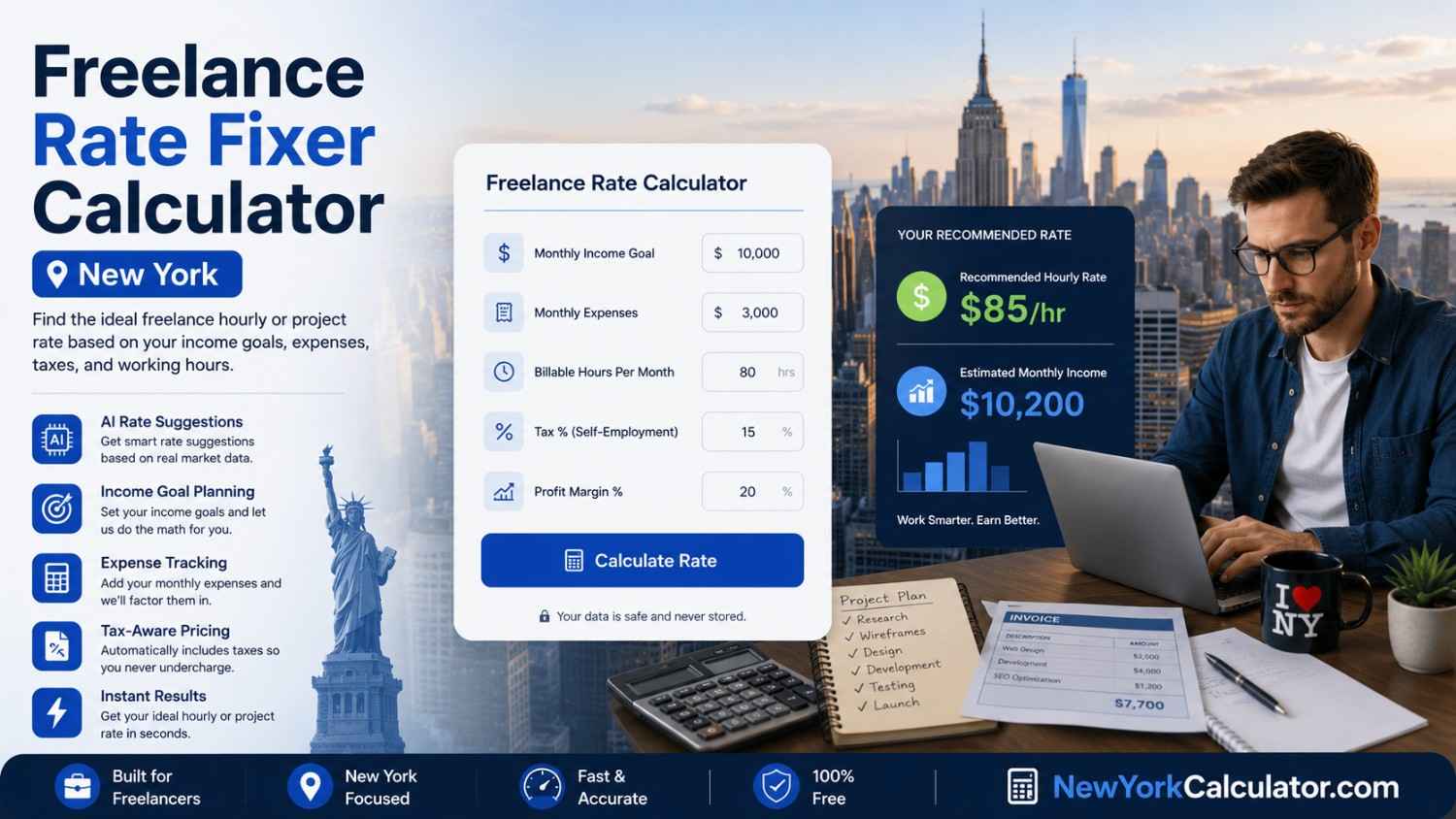
The Freelance Rate Fixer Calculator New York below helps you estimate a sustainable hourly rate, day rate, and project quote using your own numbers. Instead of relying only on what another freelancer charges, you can work backward from your financial goals.
Use the calculator as a planning tool rather than a tax return calculator or a guarantee of what clients will pay.
Freelance Rate Fixer Calculator
Estimate your sustainable hourly rate, day rate and project quote using your own income goals, costs and billable time.
Your estimated freelance pricing
Planning estimates based on the assumptions you entered.
This calculator provides a simplified business-planning estimate. The tax reserve is user-entered and does not calculate your actual federal, New York State, or New York City tax liability. The buffer is a pricing allowance, not guaranteed profit. Verify your assumptions before setting client prices.
What Is a Freelance Rate Fixer Calculator?
A freelance rate calculator estimates how much you need to charge clients to support your desired income and business costs.
Traditional salary calculators often divide an annual salary by a number of working hours. That approach does not fully reflect freelance work. Independent professionals generally spend time finding clients, preparing proposals, answering emails, handling invoices, improving their skills, and following up on payments. Not all of those hours can be billed to a client.
A useful freelance rate calculator considers:
- Your desired annual take-home income.
- Business expenses, including software, equipment, insurance, and accounting.
- An estimated tax reserve.
- Working hours and realistic billable capacity.
- Weeks off for holidays, illness, and personal commitments.
- Optional health insurance or retirement costs.
- Payment platform fees.
- A buffer for business uncertainty and changing project requirements.
The result is a starting point for pricing decisions. Your final quote should also reflect your experience, the value of the work, the project’s complexity, the deadline, and what the client has agreed to purchase.
How to Calculate Your Freelance Rate in New York
A reliable rate calculation begins with your financial target, not a random hourly figure.
Step 1: Decide how much income you want to keep
Start with the annual amount you want available for your personal finances after your estimated tax reserve and business expenses have been considered.
For example, suppose your goal is to keep $72,000 per year after estimated taxes and business expenses. This is your planning target, not the amount you necessarily need to invoice.
If your expenses or income goals change during the year, update the calculator rather than continuing to rely on an outdated rate.
Step 2: Estimate your annual business expenses
List the costs you need to operate professionally. Depending on your work, these may include:
- Design, development, writing, or project-management software.
- Computer equipment and replacement costs.
- Business insurance and professional services.
- Internet, phone, and coworking expenses.
- Marketing, portfolio hosting, and client acquisition.
- Payment processing or marketplace fees.
- Business travel and other legitimate operating costs.
Use an annual total. If you pay $120 each month for a recurring service, that represents $1,440 over twelve months.
Do not automatically treat every personal expense as a deductible business expense. Tax deductibility depends on the applicable rules and the nature of the expense.
Step 3: Calculate your realistic billable hours
Suppose you work 40 hours per week, take six weeks off per year, and can bill 60% of your working time.
Your estimated annual billable hours are:
40 × (52 − 6) × 60% = 1,104 billable hours
You may work 1,840 hours during those 46 weeks, but the remaining time is not necessarily chargeable to clients.
The 60% figure is an example, not a rule for every freelancer. A consultant with long-term clients may have a different billable share from a beginner who spends substantial time marketing and pitching.
Review your actual time records every few months and adjust the assumption to match your business.
Step 4: Include a realistic tax reserve
Freelancers often make the mistake of treating every dollar received from a client as personal income.
Federal self-employment tax generally covers Social Security and Medicare. The standard rate is 15.3%, but the actual calculation depends on the applicable earnings rules, wage limits, and other circumstances. Self-employment tax is also separate from federal income tax and any applicable state or local taxes. See the IRS self-employment tax guidance.
New York freelancers may also need to account for New York State income tax and, depending on residency and circumstances, New York City income tax. Some business arrangements can involve other obligations.
For that reason, the calculator lets you enter an estimated combined tax reserve rather than claiming that one percentage applies to every New York freelancer.
If you are unsure what percentage to use, consult the IRS estimated tax guidance and the New York State estimated tax information. A tax professional can help you estimate your own liability.
Step 5: Account for time off and benefits
Employees may receive paid holidays, paid leave, employer-sponsored health insurance, or retirement contributions. Freelancers need to plan for the costs that apply to their own situation.
Include annual health insurance or retirement funding in your planning where appropriate. Also allow for time off and periods when projects are unavailable.
A rate that works only when you have a full calendar every week may be too fragile for a business with seasonal demand or irregular client payments.
Step 6: Add payment fees and a reasonable buffer
If you use a freelance marketplace or payment processor, check its current fee schedule. Fees vary by platform, contract, payment method, and account terms, so do not assume that one percentage applies everywhere.
A buffer can also help account for uncertain workloads, unexpected project coordination, or business growth. It should be a deliberate pricing decision, not a hidden charge added without explanation.
For fixed-price projects, define what is included and what will count as additional work.
A Worked Example: Calculating a Sustainable Freelance Rate
Consider a hypothetical New York freelance professional using these assumptions:
| Input | Example amount |
|---|---|
| Desired annual take-home income | $72,000 |
| Annual business expenses | $12,000 |
| Estimated tax reserve | 25% |
| Working hours per week | 40 |
| Weeks off per year | 6 |
| Billable share | 60% |
| Platform fees | 0% |
| Additional buffer | 10% |
The estimated annual billable hours are 1,104.
For this example, the calculator first grosses up the take-home target using the entered tax reserve, adds annual business expenses, and then applies the selected buffer.
- Income target before the estimated tax reserve: $72,000 ÷ 0.75 = $96,000.
- Add annual business expenses: $96,000 + $12,000 = $108,000.
- Apply the 10% buffer: $108,000 × 1.10 = $118,800.
- Divide by 1,104 billable hours: approximately $107.61 per hour.
This is a hypothetical planning result, not a recommended market rate for every freelancer in New York. The 25% tax reserve is an illustrative input, not a verified tax liability. Actual taxes depend on factors the simplified calculator does not model.
The example also assumes that the tax reserve is applied to the income target in a simplified way. Your real tax treatment may differ, especially when business deductions, self-employment tax, and other income are considered.
How to Convert Your Hourly Rate Into a Day Rate
A day rate is useful when a client books you for a defined block of time rather than tracking every hour.
For example, if your calculated hourly quote is $100 and your standard billable day contains eight hours, the equivalent day rate is:
$100 × 8 = $800 per day
This is a mathematical conversion, not a promise that every client will pay that amount. Some engagements require a shorter day, travel, preparation, or availability beyond the billable hours.
Specify what a day includes. A six-hour workshop, an eight-hour production day, and a day that includes evening availability should not automatically receive the same price.
How to Price a Fixed-Price Freelance Project
Hourly billing is not the only way to charge for freelance work. Clients may prefer a fixed quote for a website, brand identity, content package, campaign, or consulting assignment.
A useful starting formula is:
Project quote = estimated project hours × your hourly planning rate
Suppose your planning rate is $110 per hour and a project is expected to take 25 hours.
25 × $110 = $2,750
Before sending the quote, check whether the estimate covers discovery, meetings, research, production, quality checks, delivery, and agreed revisions.
A fixed-price quote should also define:
- The exact deliverables.
- The number of included revision rounds.
- The client’s responsibilities and approval deadlines.
- The payment schedule and due dates.
- What happens when the scope changes.
- Whether rush work or additional meetings cost extra.
If the client requests a substantial change after approving the scope, provide a separate change estimate rather than silently absorbing unlimited work.
Why New York Freelancers Should Not Copy Another Person’s Rate
Market research can help you understand how clients value particular skills, but published rates do not reveal the whole story.
One freelancer may have low overhead, steady recurring contracts, and a narrow service offering. Another may pay for specialist software, subcontractors, professional insurance, or expensive equipment.
Their required rates will differ even if both charge for the same type of service.
Use market information to assess competitiveness, then use your own numbers to determine whether an engagement is financially worthwhile. If your minimum sustainable rate is higher than a prospective client’s budget, consider reducing the scope, extending the timeline, or declining the project instead of automatically accepting an unprofitable arrangement.
When you compare rates, look for information that identifies the type of work, level of experience, client segment, date, and methodology. Treat unsourced online averages as rough context rather than verified local market data.
New York City vs. Other Parts of New York State
New York City and the rest of New York State should not be treated as identical markets.
A freelancer based in Manhattan may face different workspace, transportation, and client-acquisition costs from a professional working remotely in Albany, Rochester, Buffalo, or another area.
However, location alone does not determine what you can charge. A remote consultant serving national clients may compete in a different market from someone serving only local small businesses.
Consider these questions when setting your rate:
- Do you pay for a dedicated workspace or coworking membership?
- Does the project require in-person meetings or travel?
- Are you competing for local clients or a wider national audience?
- Does your specialty justify premium pricing?
- Are you working with recurring clients or short, uncertain engagements?
- Does your location affect your personal costs, business expenses, or tax situation?
Use local costs to set your financial target, but use relevant client and industry evidence to judge the competitiveness of your final price.
A New York Freelancer Protection Worth Knowing
Pricing a project is only part of running a freelance business. Payment terms and written agreements matter, too.
New York City has a law called the Freelance Isn’t Free Act. Under the city’s official guidance, covered freelance contracts valued at $800 or more must generally be in writing. Contracts between the same parties that total $800 or more over a 120-day period can also trigger the written-contract requirement.
The law also addresses timely payment and protection against retaliation. The precise application of the law depends on the circumstances, and it is a New York City law rather than a blanket rule for every freelance transaction throughout New York State.
Read the NYC Department of Consumer and Worker Protection’s freelancer information before relying on a particular legal interpretation.
As a practical habit, put the project scope, fee, payment method, due date, and revision terms in writing even when a formal written contract is not legally required.
Common Freelance Pricing Mistakes
1. Dividing your income goal by every working hour
This assumes you can invoice all your working time. In reality, sales, administration, and client communication often reduce your billable hours.
Better approach: Estimate your billable share from actual work patterns.
2. Forgetting annual business costs
Small monthly subscriptions and equipment expenses can add up over a year.
Better approach: Maintain a simple expense list and update your annual estimate regularly.
3. Treating a tax reserve as an exact tax calculation
A single percentage cannot fully represent every federal, state, and local tax situation.
Better approach: Use a reasonable planning estimate and review it against official guidance or professional advice.
4. Quoting a fixed project without counting revisions
A project that initially appears to require 15 hours can become much less profitable if the scope is unclear.
Better approach: Write down the deliverables, revision limits, and process for approving extra work.
5. Ignoring unpaid invoices and slow months
A booked project is not the same as money already received. Late payments and gaps between contracts can create cash-flow problems.
Better approach: Set clear payment terms, keep a cash reserve where possible, and track outstanding invoices.
6. Lowering your rate without changing the scope
If a client has a limited budget, reducing the fee while promising exactly the same work can damage your effective hourly earnings.
Better approach: Offer a smaller deliverable, fewer revisions, or a phased engagement that fits the budget.
7. Assuming a higher rate is always better
A high rate that consistently loses appropriate opportunities may require a different positioning strategy. A low rate that attracts too much unprofitable work is not sustainable either.
Better approach: Evaluate profitability, client fit, workload, results, and repeat business together.
How Often Should You Review Your Freelance Rate?
Review your pricing whenever a major cost, business goal, or market condition changes. A quarterly review can be a practical starting point for an established freelancer, although some businesses need to review more frequently.
Update your calculation when:
- Software, insurance, or equipment costs rise.
- Your desired income changes.
- Your actual billable share is different from your original estimate.
- You move or change your workspace arrangements.
- You begin using a platform with different fees.
- You develop a specialist skill or take on more complex work.
- You consistently exceed your estimated project hours.
- You discover that a particular type of client requires substantially more unpaid coordination.
Keep a record of your actual hours, invoiced revenue, expenses, and payments received. These figures will make your next pricing decision more useful than a generic industry average.
Frequently Asked Questions
What is a good freelance hourly rate in New York?
There is no single good rate for every freelancer. Your specialty, experience, expenses, available billable hours, client type, and project scope all matter. Calculate your minimum sustainable rate first, then compare it with credible rates for similar work.
How do I calculate my freelance rate after taxes?
Estimate the income you want to keep, the business expenses you need to cover, your realistic annual billable hours, and a suitable tax reserve. Divide the revenue required by your annual billable hours. The calculator provides an estimate, not a substitute for an individual tax calculation.
What tax percentage should a New York freelancer use?
The correct percentage depends on your federal tax situation, self-employment earnings, New York State tax obligations, possible NYC residency tax, deductions, and other factors. The calculator’s tax field is editable because no single percentage is appropriate for everyone.
How many billable hours should a freelancer plan for?
There is no universal figure. Someone with established recurring clients may have a higher billable share than someone spending substantial time on marketing, proposals, and administration. Track your hours and use your own experience to improve the estimate.
Should I charge hourly or by project?
Hourly pricing can work well when the scope is uncertain or the client needs ongoing support. Project pricing can work well when deliverables and boundaries are clear. In either case, estimate the time and costs required before agreeing to a fee.
Should I charge extra for revisions or rush work?
If additional revisions or accelerated delivery create work beyond the agreed scope, it is reasonable to define a separate fee or change order in advance. Make the terms clear before the extra work begins.
Is this calculator only for New York City?
No. Freelancers throughout New York State can use it as a general pricing-planning tool. However, location-related costs, tax obligations, and applicable legal protections can differ. Do not assume NYC-specific rules apply throughout the state.
Does this calculator calculate my exact taxes?
No. It uses an estimated tax-reserve percentage supplied by the user. It does not prepare a tax return or fully model federal, state, city, payroll, or business taxes. Confirm your tax position using official resources or qualified professional advice.
Can I use this calculator for a fixed-price project?
Yes. Enter your annual goals and costs to estimate a sustainable hourly planning rate, then multiply that rate by your estimated project hours. Review scope, revisions, deadlines, platform fees, and other project-specific costs before issuing a quote.
Does a higher freelance rate guarantee more income?
No. Income depends on the rate you charge, the work you can sell, how consistently clients pay, and your operating costs. A sustainable rate should support your goals while remaining appropriate for the value and scope of the work.
Final Thoughts
A sustainable freelance rate is built from your own financial needs and the realities of delivering client work—not simply from a salary conversion or a number found in a rate survey.
Use the Freelance Rate Fixer Calculator New York to test different income goals, billable-hour assumptions, expenses, tax reserves, and project sizes. Save the assumptions you used, compare the results with relevant market evidence, and revisit the calculation when your business changes.
Most importantly, agree on the deliverables, payment terms, revision limits, and project boundaries before work begins. A clear quote and a realistic rate can help you make better business decisions and avoid accepting work that costs more time and money than you expected.
Author: Junaidul Islam
NewYorkCalculator.com provides online planning tools and educational information. Calculator results are estimates for general informational purposes, not tax, legal, or financial advice.