
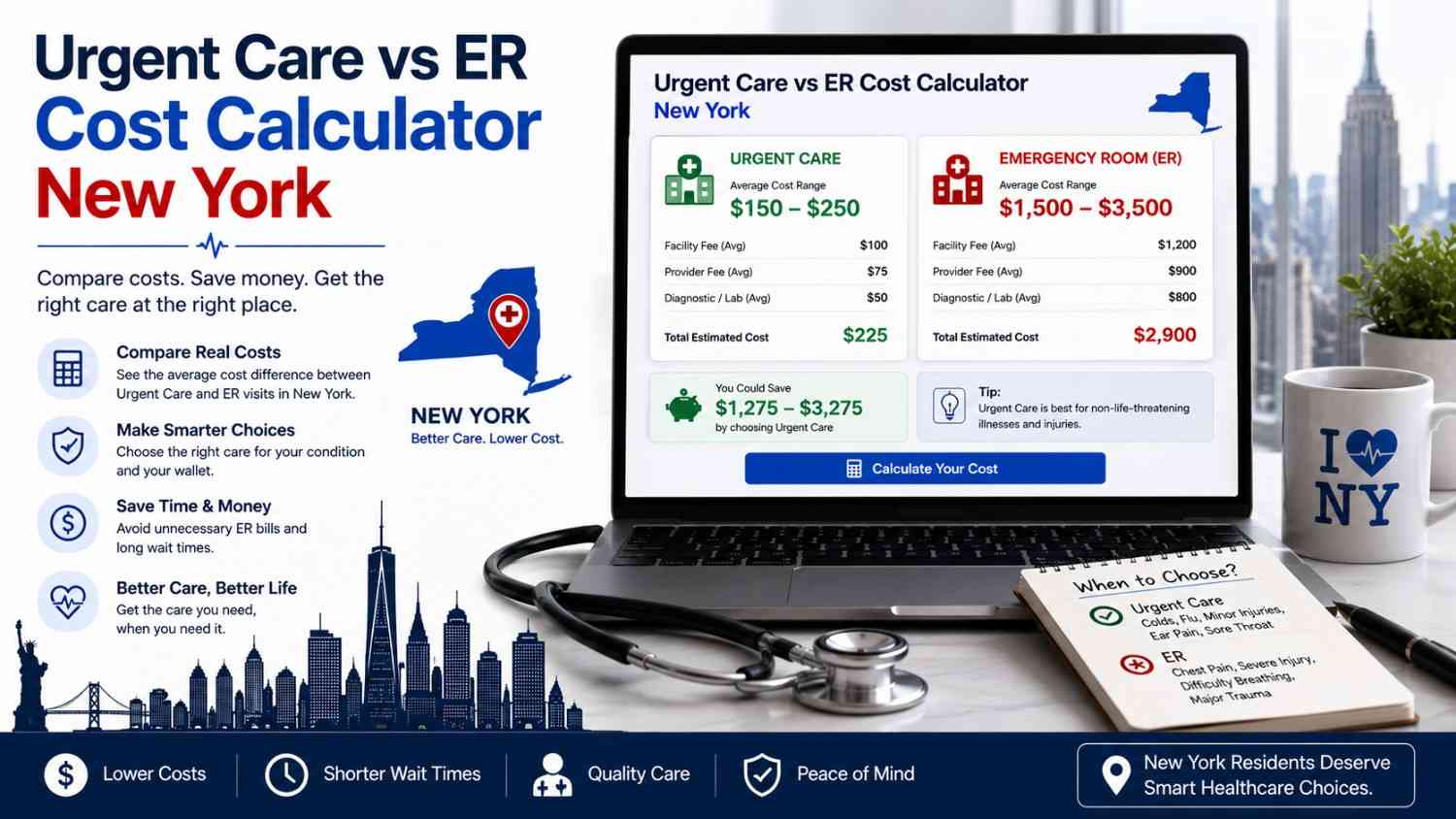
A medical bill can be difficult to predict, even when you have health insurance. In New York, the amount you pay for an urgent care visit may be very different from the amount you pay at a hospital emergency room (ER). Your final cost can depend on your insurance plan, remaining deductible, copay, coinsurance, the facility you visit, and whether additional tests are needed.
The Urgent Care vs ER Cost Calculator New York helps you estimate and compare your potential out-of-pocket costs before choosing where to receive care, when it is medically appropriate to compare options. Enter your estimated charges and insurance details to see how the two settings may affect your budget.
This calculator provides an estimate, not a guaranteed medical bill. It does not determine whether your symptoms are an emergency, and it should never delay emergency treatment.
Urgent Care vs ER: Which Usually Costs Less in New York?
Urgent care is generally a less expensive option for minor illnesses and injuries that need prompt attention but are not life-threatening. An emergency room is designed to evaluate and treat serious or potentially life-threatening conditions, including situations that require hospital-level resources.
However, the cheapest option on paper is not necessarily the right place for every medical problem. Your symptoms, the services you need, insurance coverage, and the facility’s billing practices all matter.
The New York State Attorney General explains that urgent care centers commonly charge a basic visit fee, with additional charges possible for services such as X-rays, blood draws, stitches, and outside laboratory testing. Hospital-based urgent care locations may also charge a facility fee. These additional costs can make two seemingly similar visits produce different bills.
Official source: New York Attorney General — Urgent Care Centers.
Quick comparison
| Factor | Urgent care | Emergency room |
|---|---|---|
| Typical role | Prompt treatment for non-life-threatening conditions | Evaluation and treatment of emergencies |
| Common examples | Minor cuts, sprains, mild infections, and some routine diagnostic tests | Severe breathing problems, suspected heart attack, major injuries, or stroke symptoms |
| Billing structure | Visit charge plus any applicable tests, procedures, and facility fees | Hospital facility charges, professional services, tests, procedures, and other applicable charges |
| Insurance considerations | Urgent care copay, deductible, coinsurance, and network status | ER copay or other plan-specific cost sharing, deductible, coinsurance, and applicable emergency billing protections |
| Main cost uncertainty | Additional tests, procedures, and facility fees | The complexity of treatment, hospital charges, testing, and whether admission is necessary |
These are general distinctions, not universal prices or coverage rules. The actual services and costs vary by provider and insurance plan.
Use the Urgent Care vs ER Cost Calculator
Use the calculator below to compare your estimated costs. You can enter separate estimates for urgent care and the emergency room, including covered charges, extra fees, and your insurance details.
Urgent Care vs ER Cost Calculator New York
Compare estimated out-of-pocket medical costs using your own charges and insurance details.
Choose self-pay if you are not submitting an insurance claim for this visit.
Your insurance assumptions
Enter the amount still remaining for covered services subject to your deductible.
Your percentage of covered charges after the applicable deductible.
Enter the remaining limit for covered costs that count toward your plan’s maximum.
Enter estimated charges for each option
Use allowed amounts for covered services when insured. For self-pay, use estimated prices you have received from each provider. Do not enter the same charge twice.
Urgent Care
Examples: allowed charges for covered tests or procedures, excluding the visit charge.
Enter the fixed visit copay from your plan. Ignored in self-pay mode.
Charges not included in covered allowed amounts. Verify whether they are actually your responsibility.
Emergency Room (ER)
Examples: allowed charges for covered physician services, tests or imaging, excluding the visit charge.
Enter the applicable fixed copay. Your plan may use different rules.
Enter only estimated amounts you may personally owe outside covered cost-sharing.
Your Cost Comparison
Estimates based on your entries and the calculation assumptions shown below.
Estimated Urgent Care Cost
Estimated ER Cost
Estimated cost breakdown
Important assumptions
- The insured calculation treats the visit copay as a fixed covered visit cost-sharing amount and applies the remaining deductible and coinsurance to additional covered charges.
- The remaining out-of-pocket limit caps modeled covered cost-sharing only. Extra charges are not automatically treated as covered or eligible for the limit.
- This simplified model does not reproduce every insurance plan’s benefit rules, claim processing, multiple deductibles, service-specific copays, or network exceptions.
- Self-pay estimates equal the visit charge plus additional charges and extra fees entered by the user.
- Real bills can differ. Confirm the charges, coverage, and billing rules with the facility and insurer.
Disclaimer: This calculator is for educational cost estimation only. It does not provide medical advice, diagnose symptoms, verify insurance benefits, or guarantee a provider’s bill. It does not determine whether urgent care or an emergency room is medically appropriate. Never delay emergency treatment to use this tool.
The results are based on the numbers you enter. If you do not know a charge or insurance benefit, check your insurance company's member portal, your Summary of Benefits and Coverage, or the facility's billing department before relying on the estimate.
How Much Does Urgent Care Cost in New York?
There is no single urgent care price that applies to every New York facility. A visit to an independent urgent care center may be billed differently from a hospital-affiliated location, even when both treat similar conditions.
The New York Attorney General's urgent care guidance describes a basic visit fee of around $100, while noting that some facilities may charge higher hospital-based rates. The same guidance says that facility fees may range from $25 to several hundred dollars and that additional charges may apply for tests and procedures.
These figures are useful as general context, not as a verified statewide average for October 2026. They should not be treated as a quote for a particular location or insurance plan.
What can increase an urgent care bill?
1. The initial visit charge
This is the basic charge for evaluating your condition. It may be different for a straightforward visit and a more complex evaluation.
2. Diagnostic testing
Blood tests, rapid tests, urine tests, and other diagnostics may be billed separately or included in a particular service's price, depending on the facility and billing arrangement.
3. X-rays and other imaging
An injury that requires imaging can cost more than a visit that involves only an examination. Ask whether the imaging charge is included in the estimate.
4. Procedures
Wound closure, stitches, splinting, and similar procedures may add to the bill.
5. Facility fees
Some hospital-affiliated outpatient locations charge a separate facility fee. Ask whether one applies and whether it is included in the quoted amount.
6. Laboratory billing
If a specimen is sent to an outside laboratory, a separate organization may bill you. The urgent care center's initial estimate might not include that charge.
Before a non-emergency visit, ask for an itemized estimate that identifies the visit, expected tests, procedures, facility fee, and any separate laboratory charges.
How Much Does an ER Visit Cost in New York?
Emergency room costs vary considerably because an ER evaluates patients with different symptoms and levels of medical need. A visit involving a brief examination is not financially comparable to one involving advanced imaging, multiple laboratory tests, emergency procedures, or hospital admission.
An ER bill may include several components:
- Hospital facility charge: The hospital's charge for emergency department services.
- Emergency physician charge: The professional service provided by the physician or other clinician.
- Laboratory testing: Blood work and other diagnostic tests.
- Imaging: X-rays, CT scans, or other imaging when medically indicated.
- Procedures and medications: Treatment provided during the visit.
- Additional hospital care: Charges may change substantially if the patient is admitted.
Not every bill contains every component, and some services may be bundled. The billing arrangement depends on the hospital, clinicians, services provided, and applicable insurance rules.
A useful comparison therefore needs more than a single average ER price. It should account for the services you expect, the allowed amount under your insurance plan, and the cost-sharing rules that apply to your visit.
Why a published ER price may not equal your final bill
Hospitals publish price information under federal hospital price transparency requirements. However, a published cash price, a negotiated insurance rate, a hospital's gross charge, and the amount an insured patient owes are not necessarily the same figure.
For insured care, your plan's allowed amount and benefit rules are especially important. For uninsured or self-pay care, the expected charges for the specific services are more useful than a broad national average.
You can learn more from the Centers for Medicare & Medicaid Services hospital price transparency consumer resource.
How Insurance Changes Your Urgent Care vs ER Cost
Two people receiving similar care at the same facility can owe different amounts because they have different insurance benefits. Understanding four common terms can help you make sense of your estimate.
1. Copay
A copay is a fixed amount you pay for a covered service under your plan. Your plan might have one copay for urgent care and a different ER copay.
Do not assume that an ER copay is always the full amount you will owe. Your plan may apply other cost-sharing rules, and additional services may be billed separately.
2. Deductible
Your deductible is the amount you pay for covered services subject to the deductible before your insurance begins paying according to the applicable benefit rules.
For example, suppose you have $600 remaining on a deductible. If a covered service has a $450 allowed amount and the full amount is subject to that deductible, you may be responsible for the entire $450.
If the allowed amount is $900 and the remaining deductible is $600, the deductible may account for the first $600, with the remaining $300 handled according to your plan's coinsurance or other benefit rules.
This is an illustration, not a prediction for every plan. Some services have different cost-sharing rules, and a fixed copay may apply instead of the deductible in certain circumstances.
3. Coinsurance
Coinsurance is the percentage of the covered service's allowed cost you pay under your plan, usually after the applicable deductible has been satisfied.
Suppose a covered service has a $200 allowed amount and your applicable coinsurance is 20%. If the deductible has already been met, your coinsurance share would be $40, assuming no other benefit rules change the calculation.
If the deductible has not been met, your responsibility may be higher.
4. Out-of-pocket maximum
Your out-of-pocket maximum is the limit on what you pay for covered services that count toward that limit during the plan year. Once you reach the applicable limit, the plan generally pays 100% of covered in-network benefits for the rest of that plan year.
Premiums, noncovered services, and certain out-of-network expenses generally do not count toward this limit. The rules and exclusions in your plan matter.
For 2026, HealthCare.gov lists maximum annual out-of-pocket limits of $10,600 for an individual and $21,200 for a family for applicable Marketplace plans. These are federal limits for those plans, not a prediction of what every New York resident will pay.
Official references:
- HealthCare.gov — Deductible
- HealthCare.gov — Coinsurance
- HealthCare.gov — Copayment
- HealthCare.gov — Out-of-pocket maximum
Example: Comparing Two Hypothetical Medical Visits
Consider a hypothetical New York resident comparing an urgent care visit with an ER visit for a condition that has already been determined to be appropriate for either setting.
Assume the person has insurance and receives the following estimates:
| Cost component | Urgent care | Emergency room |
|---|---|---|
| Estimated covered allowed charges | $180 | $1,200 |
| Assumed patient cost-sharing | $40 | $300 |
| Extra noncovered charges | $0 | $0 |
| Illustrative patient cost | $40 | $300 |
Under these assumptions, the difference is $260.
These are invented example figures, not current New York price averages, quoted provider prices, or an estimate of what your insurance company will actually charge. The example assumes that the listed cost-sharing amounts already reflect the applicable benefit rules.
A different insurance plan, facility, diagnosis, or set of tests could produce a very different result. The purpose of the calculator is to make your assumptions visible so you can replace them with better information.
Is Urgent Care Always Cheaper Than the ER?
No. Urgent care is often less expensive for an appropriate minor illness or injury, but the total cost depends on what the facility can treat and what services are needed.
A few situations can change the comparison:
- The urgent care center does not provide the service you need and refers you to a hospital.
- A visit requires imaging, lab work, a procedure, or additional treatment.
- The urgent care facility charges a separate facility fee.
- Your insurance plan has different benefits or network arrangements for the two settings.
- The condition requires emergency treatment, making the ER the medically appropriate choice.
If an urgent care visit cannot adequately treat the problem, choosing it solely because its initial fee is lower may not save money overall. More importantly, it should not delay the right care.
New York Insurance Protections and Surprise Medical Bills
New York has consumer protections that can limit certain unexpected out-of-network bills. However, the details depend on the type of insurance coverage, where the care is provided, and the circumstances of the visit.
Emergency services
New York's Department of Financial Services explains that people with coverage subject to New York law generally have protections against certain out-of-network emergency service bills and are limited to applicable in-network cost-sharing for protected services.
Federal No Surprises Act protections also apply to many covered emergency services. These rules are important because emergency care may involve hospital and physician services from different billing organizations.
Fully insured and self-funded plans
A health insurance card or plan document may identify whether coverage is fully insured or self-funded. This distinction can affect which state rules apply. Many self-funded employer plans are governed by federal protections, but the exact situation should be confirmed with the plan administrator.
Urgent care and out-of-network billing
Do not assume that every urgent care visit receives the same protections as emergency care. Before a planned visit, verify whether the facility participates in your specific plan's network and whether it is classified as an urgent care center or a hospital-based facility.
For an emergency, do not delay care while attempting to verify network status.
What to do if you receive a bill you do not understand
- Request an itemized bill from the provider.
- Compare it with your insurance company's Explanation of Benefits (EOB).
- Ask the insurer to explain the allowed amount, deductible, copay, coinsurance, and any denied service.
- If the bill appears to violate applicable protections, contact your insurer or the New York Department of Financial Services.
- Keep copies of the bill, EOB, notices, and any correspondence.
Read the official guidance: New York DFS — Surprise Medical Bills.
What If You Do Not Have Health Insurance?
If you are uninsured or choose not to submit a claim to your insurance plan, you need a different type of comparison.
Instead of relying on a copay or coinsurance percentage, begin with the provider's estimated self-pay charges. Ask whether the estimate includes the clinician's fee, facility fee, laboratory services, imaging, and any expected procedures.
For scheduled non-emergency services, federal rules generally require providers to give uninsured or self-pay patients a Good Faith Estimate when applicable. Under the rules described by New York DFS, patients can request an estimate before receiving care.
A Good Faith Estimate is not a guarantee of the final bill, and the requirements have specific conditions. Emergency treatment also cannot always be priced in advance because the services needed may not be known until the patient is evaluated.
You can start with the New York DFS consumer guidance on surprise medical bills and Good Faith Estimates.
When comparing self-pay options, request written prices from the actual facilities you are considering. A statewide estimate or an online average cannot replace a facility-specific quote.
How to Get a More Accurate Cost Estimate
The calculator becomes more useful when you enter figures from your own insurance plan and the facility you plan to visit.
Step 1: Check your insurance benefits
Look for urgent care and emergency department benefits in your Summary of Benefits and Coverage or member portal. Note the copay, deductible rules, coinsurance, network requirements, and applicable out-of-pocket maximum.
Step 2: Check how much of your deductible remains
Your remaining deductible can be different from your annual deductible. Use the current figure from your insurer rather than assuming you have not paid anything toward it.
Step 3: Ask the provider for a detailed estimate
For a planned, non-emergency visit, ask for the expected visit charge and whether tests, imaging, facility fees, or outside laboratory services may be billed separately.
Step 4: Confirm the insurance network
Check the specific location and your exact plan. A provider may accept some plans from an insurer without participating in every plan that insurer offers.
Step 5: Enter the figures into the calculator
Use the same basis for both options wherever possible. If one estimate includes lab work and the other does not, the comparison will not be like-for-like.
Step 6: Review the assumptions
A calculator can perform arithmetic correctly and still produce a poor estimate if the inputs are inaccurate or if your insurance applies different rules. Review the assumptions and confirm complicated billing questions with your insurer.
When You Should Not Choose Care Based on Price
A cost comparison is useful only after considering medical safety. It cannot determine whether a particular symptom is harmless or whether urgent care has the equipment and staff needed to treat it.
Call 911 for a suspected life-threatening emergency. Examples include severe difficulty breathing, signs of a heart attack, sudden stroke symptoms, severe uncontrolled bleeding, or loss of consciousness.
If you believe you may be experiencing a serious emergency, seek emergency care immediately. Do not wait to calculate a price, call several facilities, or look for a cheaper alternative.
Urgent care is intended for problems that need prompt evaluation but are not life-threatening. If you are uncertain about the seriousness of a symptom, seek appropriate medical advice rather than relying on a cost comparison.
Frequently Asked Questions
Is urgent care cheaper than the ER in New York?
Urgent care is often less expensive for minor conditions that the facility can appropriately treat. However, the actual amount depends on the provider's charges, insurance benefits, diagnostic tests, procedures, and facility fees. There is no single price difference that applies to every visit.
How much does urgent care cost without insurance in New York?
There is no uniform statewide self-pay price. The New York Attorney General describes a basic urgent care visit fee of around $100, while noting that hospital-based rates and additional service charges can be higher. Contact the specific facility for a current self-pay estimate.
Why is my ER copay not the same as my final bill?
Your plan may apply different cost-sharing rules to the emergency facility, physician, tests, and other covered services. The final amount can also depend on the allowed charges, deductible status, network rules, and how the claim is processed. Review your Explanation of Benefits and contact your insurer if the bill is unclear.
Does my deductible apply to urgent care?
It depends on your insurance plan. Some plans charge a fixed urgent care copay, while others may apply the deductible or use different rules for certain services. Check the benefits for your specific plan.
Does the ER copay include lab tests and imaging?
Not necessarily. Whether a copay covers other services depends on your plan's benefits and billing arrangement. Lab work, imaging, physician services, and facility charges may be handled differently. Confirm the details with your insurer.
Can an urgent care center charge a facility fee?
Yes. Some urgent care centers, especially hospital-based locations, may charge a separate facility fee. Ask whether a facility fee applies and whether the quoted amount includes it.
Can I use the calculator without insurance?
Yes. Use the uninsured or self-pay option and enter the estimated charges for each setting. For the most useful comparison, request actual prices from the facilities, including anticipated additional services. The result remains an estimate.
Does New York protect patients from surprise ER bills?
New York and federal law protect many insured patients from certain surprise out-of-network bills for emergency services. The protections and processes depend on the insurance plan and circumstances. Read the New York DFS guidance or contact your insurer for help with a specific bill.
Will this calculator tell me which facility I should visit?
No. It estimates potential costs; it does not diagnose a condition, evaluate symptoms, or recommend a medical treatment. Choose care based on your medical needs, and never delay emergency treatment to compare prices.
How can I check hospital prices in New York City?
You can use the NYC Health Care Price Comparison Tool to investigate available price information. Confirm that the displayed service, facility, payment type, and insurance assumptions match your situation before using a figure in a cost comparison.
Final Thoughts
Comparing urgent care and ER costs in New York involves more than looking at two advertised visit prices. The amount you pay can depend on your insurance plan, remaining deductible, coinsurance, network status, facility fees, and the tests or procedures needed during the visit.
Use the calculator to organize your estimates, then verify the most important figures with your insurer and the facility. For uninsured or self-pay care, request a written estimate whenever the rules and circumstances allow.
The goal is to make medical costs easier to understand before a planned visit—not to replace medical advice or delay emergency care.
Author: Junaidul Islam
Junaidul Islam writes practical cost guides and calculator resources for NewYorkCalculator.com. His focus is helping readers understand everyday expenses, compare estimates, and find reliable sources for financial decisions. This article is educational and is not a substitute for medical advice, an insurance coverage determination, or a provider's written estimate.
Editorial note: Costs and insurance benefits vary by provider and plan. Official resources linked in this article should be checked for the latest applicable guidance. The calculator's results are estimates based on user-provided information and should not be treated as guaranteed charges or benefits.