
Written by Junaidul Islam Finding an apartment in New York City is not simply a matter of asking, “What is the monthly rent?” The more useful question is: What rent can I realistically afford while still qualifying for the apartment and having enough money left for everyday life?
That distinction matters in New York.
A renter may technically qualify for a $3,000 apartment under the common NYC 40× income screening standard, while the same apartment may feel very expensive after taxes, transportation, groceries, debt payments, utilities and savings goals.
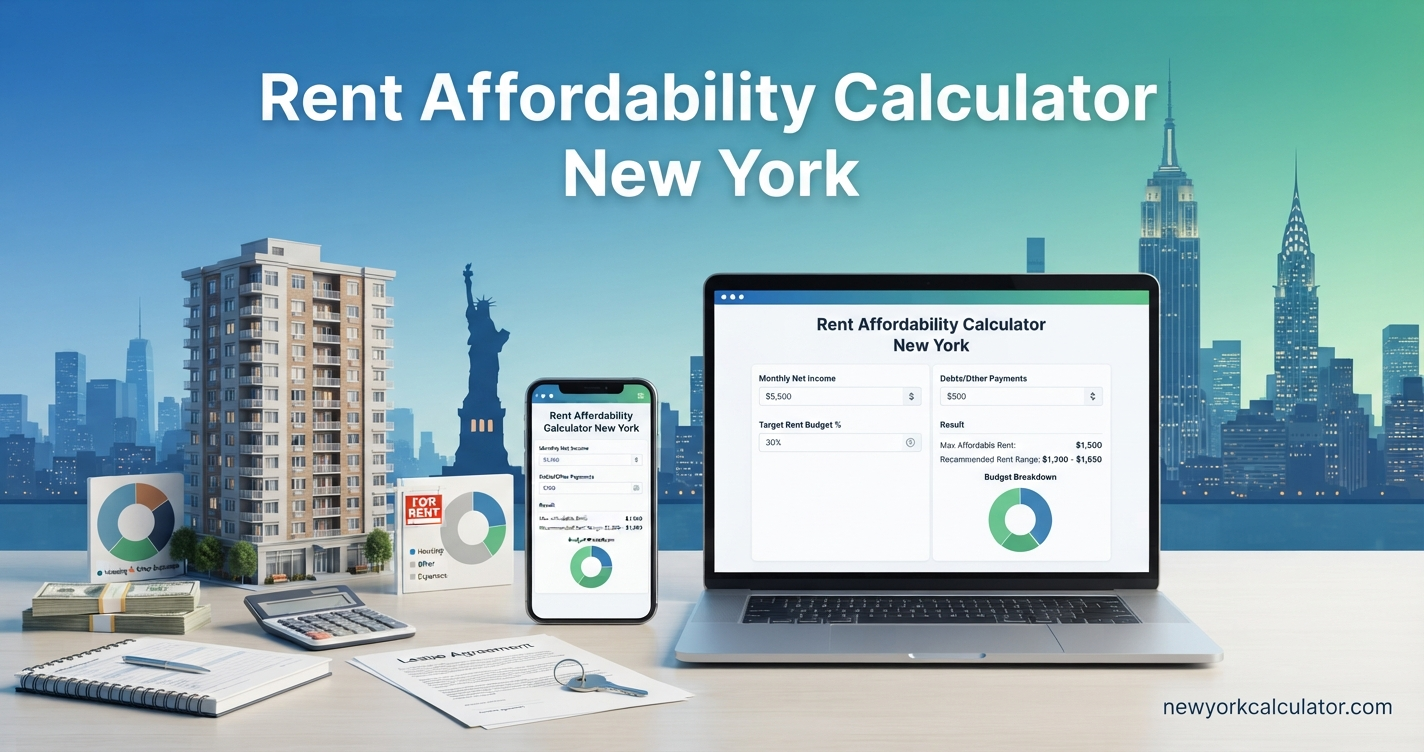
New York Rent Affordability Calculator
Estimate your affordable NYC rent, 40× landlord qualification, debt-adjusted budget and estimated move-in cash.
| Benchmark | Monthly Amount |
|---|---|
| 30% of gross income | $0 |
| 40× landlord income screen | $0 |
| Debt-adjusted estimate | $0 |
| Recommended maximum | $0 |
That is why this New York Rent Affordability Calculator looks at more than one number. It compares the common NYC landlord income requirement with a personal budgeting approach and lets you consider debt, other monthly expenses, roommates, savings, move-in costs and a target rent.
The goal is simple: help you answer three practical questions before you apply for an apartment:
How much rent can I afford?
What rent am I likely to qualify for?
How much cash should I have available before I move?
Important: The calculator is designed primarily for New York City rental planning. Landlord screening policies vary by building, owner and management company. The 40× rule is a common market practice, not a New York City law.
New York Rent Affordability Calculator
Use the calculator below to estimate your affordable rent, compare it with NYC's common 40× income screening convention, check a target apartment, and estimate some of the cash you may need when moving.
[INSERT CALCULATOR HERE]
How Much Rent Can I Afford in New York?
There is no single rent number that is right for every New Yorker.
Your affordable rent depends on:
- Gross annual income
- Monthly take-home income
- Existing debt payments
- Utilities and other housing costs
- Transportation and essential expenses
- Savings goals
- Number of people sharing the apartment
- Available savings for move-in costs
- The landlord's income requirements
- Whether a guarantor is available
For a quick starting point, two numbers are especially useful in NYC: the 30% affordability guideline and the 40× landlord income convention.
They are closely related mathematically, but they answer different questions.
The 30% Rule: A Personal Affordability Benchmark
A commonly used housing affordability benchmark is that housing should consume no more than about 30% of gross income.
For example, suppose you earn $90,000 per year.
Your gross monthly income is:
$90,000 ÷ 12 = $7,500
Thirty percent of that is:
$7,500 × 30% = $2,250
So $2,250 would be a starting point for a 30%-of-gross-income rent budget.
However, this should not automatically be interpreted as “you can comfortably spend $2,250.”
Taxes, health insurance, retirement contributions, transportation, food, debt and other expenses can substantially change your actual monthly cash flow.
NYC's own housing information uses the concept of rent burden, and the city's Comptroller has described households paying more than 30% of income toward gross rent as rent-burdened.
The NYC 40× Rule
The 40× rule is different.
Many NYC landlords and property managers commonly look for annual gross income equal to at least 40 times the monthly rent.
The basic formula is:
Maximum qualifying rent = Gross annual income ÷ 40
For example:
$120,000 ÷ 40 = $3,000
A person earning $120,000 per year may therefore meet the common income screen for a $3,000 monthly apartment.
The reverse calculation is equally useful:
Required annual income = Monthly rent × 40
So a $2,500 apartment would require:
$2,500 × 40 = $100,000
And a $4,000 apartment would require:
$4,000 × 40 = $160,000
The important point is that the 40× rule is a landlord screening convention, not a legal guarantee that a landlord must approve you. Some buildings may use different standards or consider additional factors.
30% Rule vs. 40× Rule: Why Both Matter
At first, these rules can look like two different systems.
They are actually very close mathematically.
If your annual income is $120,000:
- Annual income: $120,000
- Monthly gross income: $10,000
- 30% of gross monthly income: $3,000
- Annual income ÷ 40: $3,000
So the two methods produce the same basic number.
But the purpose is different.
The 30% benchmark is useful for personal budgeting.
The 40× calculation is useful for understanding whether your income may satisfy a common NYC landlord screening standard.
That is why the calculator displays them separately instead of pretending they are the same question.
Your Landlord May Approve a Rent That Your Budget Cannot Comfortably Handle
This is one of the most important points for renters.
Imagine you earn $120,000 annually and are considering a $3,000 apartment.
The 40× calculation works:
$120,000 ÷ 40 = $3,000
You may therefore satisfy the common income screen.
But your actual financial situation could be different.
Suppose you have:
- $700 monthly student loan payments
- $600 transportation and commuting costs
- $700 groceries and household spending
- $300 insurance and subscriptions
- $500 monthly savings target
- $200 utilities and other housing costs
The apartment does not exist in isolation.
Your rent is only one part of your monthly financial picture.
This is why our calculator includes debt and additional expenses rather than presenting the 40× number as a universal definition of affordability.
Gross Income Is Not the Same as Take-Home Pay
A major mistake renters make is calculating everything from salary without considering how much actually reaches their bank account.
If you earn $100,000, you do not receive $100,000 in spendable cash during the year.
Federal taxes, New York State taxes, NYC income tax for NYC residents, Social Security, Medicare, health insurance, retirement contributions and other payroll deductions can reduce your actual take-home pay.
That is why a good rent budget should look at both:
Gross income — useful for landlord qualification.
Take-home income — useful for personal cash-flow planning.
Some newer affordability tools have started separating gross income from after-tax income because the difference can materially change a renter's practical budget.
For that reason, if you know your actual monthly take-home pay, entering it into the calculator can give you a more useful personal-budget perspective.
What If I Have Student Loans, Car Payments or Credit Card Debt?
Debt can change the answer significantly.
Two people earning the same salary can have very different affordable rents if one has substantial recurring debt.
Common examples include:
- Student loan payments
- Car loans
- Credit card minimum payments
- Personal loans
- Child-related financial obligations
- Other recurring debt
Suppose your gross monthly income is $8,000.
The simple 30% calculation gives:
$8,000 × 30% = $2,400
But if you have $1,000 in recurring debt payments every month, a $2,400 rent may leave considerably less cash available for everything else.
Our calculator therefore shows a debt-adjusted perspective in addition to the standard 30% and 40× calculations.
This does not represent a legal landlord formula. It is a budgeting tool intended to help you make a more conservative decision.
How Much Income Do I Need for Different NYC Rents?
Here is the basic 40× calculation:
| Monthly Rent | Annual Income at 40× |
|---|---|
| $1,500 | $60,000 |
| $2,000 | $80,000 |
| $2,500 | $100,000 |
| $3,000 | $120,000 |
| $3,500 | $140,000 |
| $4,000 | $160,000 |
| $4,500 | $180,000 |
| $5,000 | $200,000 |
| $6,000 | $240,000 |
These figures are income-screening calculations, not guarantees of approval.
Your credit profile, employment history, assets, landlord requirements and other factors may also matter.
What If I Do Not Meet the 40× Rule?
Not meeting the common income multiple does not necessarily mean you cannot rent an apartment.
Depending on the property, a landlord may accept:
- A qualified guarantor
- A larger household income
- Significant liquid assets
- A guarantor service
- A different income multiplier
- Another form of financial qualification
One common NYC convention is an 80× guarantor income requirement.
For example, if rent is $3,000:
$3,000 × 80 = $240,000
That means a guarantor may be asked to demonstrate $240,000 in annual income under an 80× screening convention.
However, this is not universal. Always ask the landlord or management company for its exact qualification criteria before applying.
Renting With a Roommate Changes the Calculation
Roommates can dramatically change the economics of NYC renting.
Suppose a two-bedroom apartment costs $4,000 per month.
Split equally between two roommates:
$4,000 ÷ 2 = $2,000 per person
That does not automatically mean both renters will qualify. The landlord may assess the combined household income, each applicant separately, or apply its own screening policy.
Our calculator allows you to consider the number of people sharing the rent so you can see the difference between:
Total apartment rent
and
Your estimated share of the rent.
This is especially useful when comparing a studio alone with a one-bedroom or two-bedroom shared with another person.
Do Not Forget Utilities
Rent is not always your complete monthly housing cost.
Depending on the apartment and lease, you may also pay for:
- Electricity
- Gas
- Heating
- Water
- Internet
- Renters insurance
- Parking
- Other building or service charges
Some rental affordability calculations treat housing costs as more than simply the advertised base rent.
That matters because an apartment advertised at $2,800 is not necessarily an $2,800-per-month lifestyle cost.
Before signing a lease, ask exactly which utilities and recurring charges are included.
How Much Money Do You Need to Move Into an NYC Apartment?
Monthly affordability is only half of the equation.
You also need to think about cash required before or around move-in.
Potential upfront expenses can include:
- First month's rent
- Security deposit
- Application or screening charges where permitted
- Tenant-selected broker services
- Moving expenses
- Utility setup
- Renter's insurance
- Furniture and household essentials
- Overlap with your previous lease
New York City law limits security deposits for most residential rentals to one month's rent. Application fees are also subject to legal limits. You should always verify the current rule and the exact charges shown in your lease documents.
A calculator can estimate your expected cash requirement, but it should not be treated as a substitute for reviewing the actual lease and fee disclosures.
NYC Broker Fees Changed Under the FARE Act
This is particularly important for anyone using an older NYC rental guide.
The Fairness in Apartment Rental Expenses (FARE) Act took effect June 11, 2025.
Under the law, a broker representing a landlord generally cannot charge that broker's fee to the prospective tenant. Landlords and their agents must also disclose tenant-paid fees before the rental agreement is signed.
This does not mean every possible broker expense disappears.
A renter can still choose to hire their own broker and pay that broker for the renter's services, subject to the applicable rules.
That distinction is important when estimating move-in cash.
If a website still tells NYC renters that they automatically need to budget a traditional landlord-paid broker fee simply because a landlord listed the apartment through an agent, that information may be outdated.
Always check the current fee disclosure and current NYC rules.
Security Deposit and Application Fees
For most NYC residential rentals, the security deposit is generally capped at one month's rent under New York law.
For example:
$3,000 monthly rent → up to about $3,000 security deposit
That means a simple move-in calculation could start with:
First month's rent + one-month security deposit
For a $3,000 apartment:
$3,000 + $3,000 = $6,000
Then you may have other legitimate costs depending on the property and your situation.
The NYC rental market also has specific restrictions around application fees and other charges, so renters should not assume that every fee presented by a listing is automatically legitimate. Current NYC guidance should be checked before paying unusual charges.
Renters Insurance Should Be Part of Your Budget
Renters insurance is another recurring cost that can easily be forgotten.
A policy can help cover certain personal-property losses and liability risks, depending on the policy terms.
Some landlords may require renters insurance.
It is therefore useful to include a small monthly estimate in your personal housing budget even though it is not part of the 40× income formula.
What About New York City's Area Median Income?
Rent affordability is also connected to the city's affordable-housing system.
NYC HPD uses Area Median Income (AMI) to determine eligibility and affordability levels for many city-financed affordable housing programs.
For 2026, the NYC region's AMI for a three-person family at 100% AMI is listed by HPD as $152,700. HPD also publishes income bands and affordable-rent information by household size and AMI percentage.
This is important because:
Market-rate apartment affordability
and
Affordable-housing program eligibility
are not the same calculation.
Someone who cannot comfortably afford a market-rate apartment may qualify for an affordable-housing opportunity, while eligibility for a particular program depends on the program's income, household and other requirements.
Do not use the 40× calculator to determine whether you qualify for an NYC affordable-housing program.
Manhattan Is Not the Same as Queens, Brooklyn, the Bronx or Staten Island
A citywide affordability number can hide enormous differences between neighborhoods.
Your income may be insufficient for a typical apartment in one part of Manhattan but workable for an apartment in Queens or the Bronx.
Similarly, sharing an apartment in Brooklyn may create a completely different budget than renting a studio alone.
That is why renters should compare their affordability number with actual apartment prices in the neighborhoods they are considering.
Current rental-market data changes over time, so a neighborhood that fits your budget today may become more or less accessible later.
StreetEasy's 2026 reporting, for example, has documented continued rental-market pressure in NYC and significant differences in market conditions across neighborhoods and boroughs.
A Simple Example: Can Someone Earning $100,000 Afford a $2,500 Apartment?
Let's use a realistic example.
Annual gross income:
$100,000
Monthly gross income:
$8,333
Thirty percent:
$2,500
40× calculation:
$100,000 ÷ 40 = $2,500
So the apartment passes both basic benchmarks.
But now suppose the renter has:
- $500 student loan payment
- $400 transportation
- $600 groceries and household spending
- $300 insurance and subscriptions
- $500 savings target
- $200 utilities and other housing costs
The renter may still qualify for the apartment, but the real question becomes whether $2,500 leaves enough cash for the person's priorities.
That is the difference between qualification and comfort.
A Better Way to Think About Rent Affordability
Instead of asking only:
“What is the maximum rent I can qualify for?”
Ask these four questions:
1. What rent meets the landlord's income screen?
Use the 40× calculation.
2. What rent fits my personal budget?
Use the 30% benchmark and your actual expenses.
3. What happens after debt and other essential costs?
Calculate your remaining monthly cash flow.
4. Can I afford the move itself?
Calculate first month's rent, security deposit, applicable fees and moving costs.
A good apartment budget should pass all four tests—not just one.
What Is a Safe Rent Percentage?
There is no universal percentage that works for every New Yorker.
As a planning framework, you might compare:
25% of income — conservative
30% — common affordability benchmark
35% — higher housing burden
40% or more — potentially difficult for many households
Your own situation matters.
A person with no debt, substantial savings and a stable high income may tolerate a higher rent ratio than someone with student loans, dependents and a small emergency fund.
The calculator therefore should be treated as a decision-support tool, not a financial commandment.
Why Savings Matter Before Signing a Lease
A renter can have enough income and still be financially unprepared to move.
Consider a $3,500 apartment.
Even before furniture, movers and other expenses, you may need money for:
- First month's rent: $3,500
- Security deposit: potentially $3,500
- Other legitimate move-in expenses
- Moving costs
- Utility setup
- Insurance
- Emergency reserve
That can quickly become several thousand dollars.
This is why having sufficient savings is just as important as having sufficient annual income.
What Should I Enter Into the New York Rent Affordability Calculator?
For the most useful result, enter:
- Gross annual income
- Monthly take-home income, if you know it
- Monthly debt payments
- Other essential monthly expenses
- Target monthly rent
- Number of people sharing the apartment
- Current savings
- Estimated utilities
- Renters insurance or other recurring housing costs
- Broker situation, if applicable
You do not need perfect numbers.
A reasonable estimate is better than ignoring the expenses completely.
What the Calculator Result Means
After you calculate, pay attention to several different numbers instead of focusing only on the largest one.
Maximum Rent by 30% Rule
This shows the traditional gross-income affordability benchmark.
Maximum Rent by 40× Rule
This shows the approximate maximum monthly rent based on the common NYC income-screening convention.
Debt-Adjusted Budget
This gives you a more conservative view when recurring debt payments reduce your available cash.
Required Income
Enter a specific apartment's rent and the calculator can estimate the annual gross income corresponding to a 40× screening standard.
Guarantor Income
If an 80× guarantor convention is applicable, the calculator can show the corresponding income target.
Rent-to-Income Ratio
This shows how much of your gross income the selected rent represents.
Estimated Move-In Cash
This helps you think beyond the monthly payment and consider the money needed to actually start the lease.
New York Rent Affordability Calculator: Final Takeaway
The biggest mistake a renter can make is treating apartment affordability as one simple equation.
In New York City, there are really two different questions:
Can I qualify for this apartment?
and
Can I comfortably live in this apartment?
The common 40× rule helps answer the first question.
The 30% affordability benchmark helps with the second.
But even those two numbers do not tell the entire story.
Debt, take-home income, utilities, transportation, savings, roommates, guarantors, move-in costs and current rental rules can all change the practical answer.
The New York Rent Affordability Calculator on NewYorkCalculator.com is designed to bring those factors together so you can compare a target rent with both landlord-style qualification and personal financial reality.
Before signing a lease, verify the landlord's exact income requirements, read every fee disclosure, review the lease carefully and confirm current NYC and New York State rules. Rental laws and market conditions can change, and an online calculator should be used as an educational planning tool—not as legal, tax, financial or real-estate advice.
Frequently Asked Questions
How much rent can I afford on a $60,000 salary in NYC?
Using the basic 30% benchmark, $60,000 annual gross income equals $5,000 gross monthly income, and 30% is about $1,500 per month. The common 40× calculation also produces $1,500. Your actual comfortable budget may be lower after taxes, debt and other expenses.
How much income do I need for $2,000 rent in NYC?
Using the common 40× screening convention:
$2,000 × 40 = $80,000 annual gross income.
A landlord may use a different standard, so confirm the property's requirements.
How much income do I need for $3,000 rent?
At 40×:
$3,000 × 40 = $120,000 annual gross income.
That is a screening calculation, not a guarantee of approval.
What is the NYC 40× rule?
The 40× rule is a common NYC rental-market screening convention where a renter's annual gross income is expected to be around 40 times the monthly rent. It is not a citywide law requiring every landlord to use exactly 40×.
Is the 30% rule a law in New York?
No. The 30% figure is commonly used as a housing affordability benchmark and in housing-cost-burden analysis. It is not a law saying every renter must spend no more than 30% of income on rent.
What if I do not earn 40 times the rent?
Depending on the landlord, you may have options such as a guarantor, additional qualifying household income, assets or a guarantor service. Requirements vary by property.
How much does a guarantor need to earn in NYC?
A common market convention is 80× the monthly rent. For a $3,000 apartment, that would be $240,000 annual income. However, individual landlords and guarantor services can use different standards.
Does having a roommate make rent more affordable?
Usually, sharing an apartment can reduce each person's rent share. But whether you qualify depends on the landlord's rules and how the lease is structured.
Do I need to budget for a broker fee in NYC?
The FARE Act changed NYC broker-fee rules effective June 11, 2025. A landlord's broker generally cannot charge the tenant a fee for representing the landlord, although a renter can choose to hire their own broker. Review the current fee disclosures before paying.
How much security deposit can a NYC landlord charge?
For most residential rentals, New York law generally limits the security deposit to one month's rent. Always verify the current law and whether a special housing situation applies.
Is the 40× rule the same as affordability?
No. A person can meet a landlord's income screen and still find the rent difficult after taxes, debt, transportation, food, savings and other expenses.
Should I calculate rent using gross or take-home income?
Use gross income when checking the common 40× landlord convention. Use take-home income when thinking about your actual monthly spending ability.
Is this calculator for all of New York State?
The calculator is designed primarily around New York City rental affordability and NYC-specific practices. Rental screening practices can differ throughout New York State.
Methodology and Sources
This calculator and article use common rental affordability concepts rather than presenting any single formula as a guaranteed approval standard.
Key references include NYC Department of Consumer and Worker Protection information about the FARE Act, NYC HPD information about Area Median Income, NYC housing affordability information, and current NYC rental-market reporting. The 40× rule is treated as a market convention rather than a legal requirement.
Last reviewed: October 2026
Author: Junaidul Islam
Disclaimer: This article is for general educational and planning purposes. It is not legal, tax, financial or real-estate advice. Landlord requirements, rental prices, fees and laws may change. Always verify current requirements with the landlord, property manager or the appropriate government agency before making a rental decision.